White bar with a feathered mica top
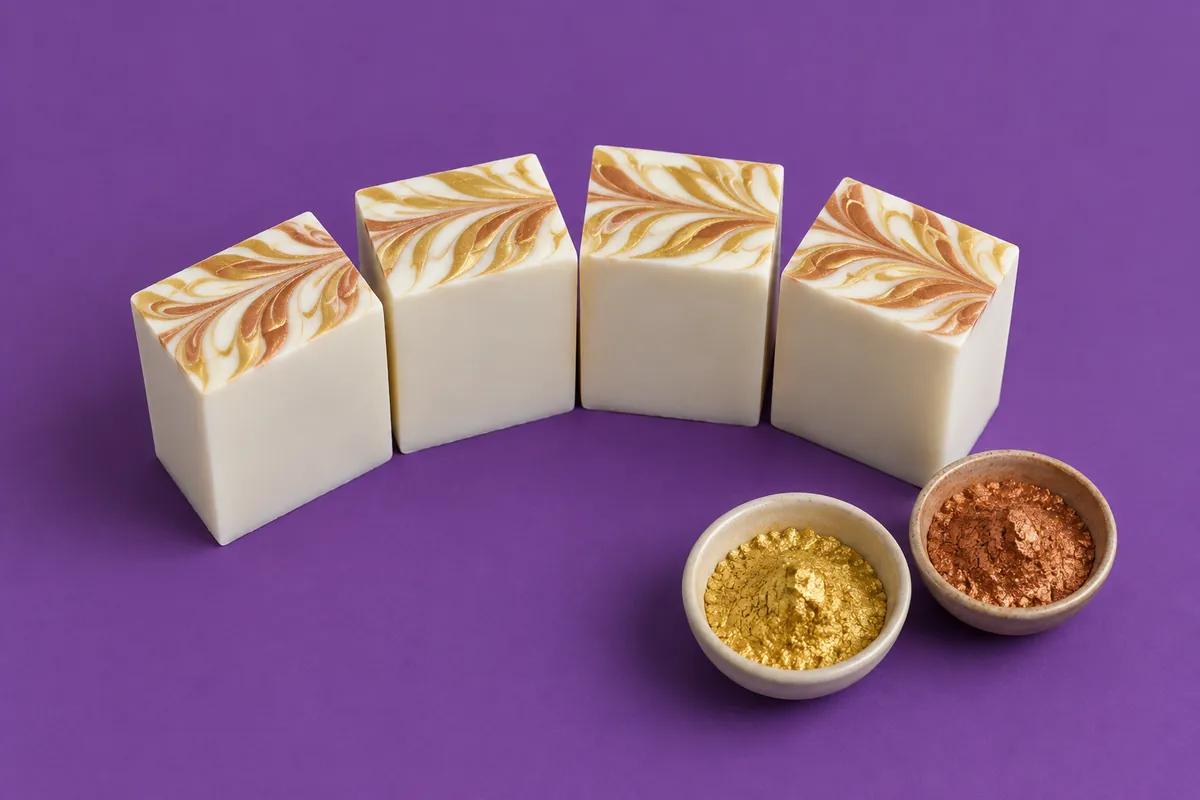
A plain white loaf finished with lines of gold and copper mica drawn into feathers across the top, like the pattern on a latte. Any loaf can take it; this lard, olive and coconut bar sets white, so the mica shows.
- Skill
- Intermediate
- Method
- Cold process
- Batch
- 900 g of oils about 1325 g of batter
- Hands-on
- 1 h 15 min
- Cure
- 5 weeks
- Gel phase
- Yes insulate the mould
What you need
For 900 g of oils, which fills a 25 × 9 cm loaf mould filled 6 cm deep (about 1.4 litres). Weigh everything, liquids included.
| Lard · 35.0 % | 315 g | 11.11 oz |
| Olive Oil · 35.0 % | 315 g | 11.11 oz |
| Coconut Oil · 25.0 % | 225 g | 7.94 oz |
| Castor Oil · 5.0 % | 45 g | 1.59 oz |
| Sodium hydroxide (NaOH) · the lye, 100 % pure | 127.2 g | 4.49 oz |
| Distilled water · for a 33 % lye solution | 258.3 g | 9.11 oz |
| Titanium dioxide · 2.5 tsp, whole loaf, dispersed in 34 g of the recipe's olive oil | 11.7 g | 0.41 oz |
| Gold mica · 0.25 tsp, stirred into 1 tsp (4.5 g) of the recipe's olive oil, for the top | 0.4 g | 0.01 oz |
| Copper mica · 0.25 tsp, stirred into 1 tsp (4.5 g) of the recipe's olive oil, for the top | 0.4 g | 0.01 oz |
| Isopropyl alcohol, 91 % or stronger, in a spray bottle · a light mist over the finished top against soda ash, well away from any flame | 30 ml | |
| Lavandin oil · 2.0 % of the oils, at trace | 18 g | 0.63 oz |
| Atlas cedarwood oil · 1.0 % of the oils, at trace | 9 g | 0.32 oz |
- Superfat
- 5 %
- Temperatures
- Oils and lye solution at 38 to 41 °C (100 to 105 °F), warm enough to keep the lard melted
Method
-
Get ready
Put on goggles, gloves and long sleeves and open a window. Line the mould and set it level where it can stay for a day, with a spatula, a bamboo skewer and two teaspoons or droppers in reach. -
Disperse the white and the micas
Weigh the olive oil and take 43 g of it. Stir the titanium dioxide into 34 g in a jug until smooth; in two small cups, stir the gold mica into 1 teaspoon of the rest and the copper mica into the last teaspoon, thin enough to drip. -
Make the lye solution
Where the air moves, pour the 127.2 g of sodium hydroxide slowly into the 258.3 g of water, never the reverse, and stir until clear. Leave it labelled and out of reach to cool to 38 to 41 °C (100 to 105 °F). -
Melt and scent the fats
Melt the lard and coconut oil, add the rest of the olive oil and the castor oil, and let them cool to 38 to 41 °C (100 to 105 °F) while they stay clear. Stir in the lavandin and cedarwood oils. -
Blend and whiten
Pour the lye solution in down the blender shaft and blend in short pulses to light trace. Stir the white into about 2 cups (500 ml) of the batter first, then pour that back into the pot and stir it through for an even white. -
Pour the loaf
Pulse to light-medium trace, pour it all into the mould, tap it on the worktop and smooth the top flat with the spatula. -
Lay the mica lines
While the surface still moves under a skewer, drip five thin lines of mica oil along the length, about 1.5 cm apart: gold, copper, gold, copper, gold. A little goes a long way. -
Feather the lines
Draw the skewer across the width through only the top 3 to 5 mm, every 2 cm along the loaf, alternating direction each time, so the lines pull into chevrons. For feathers, finish with one wavy pass down the middle. -
Mist and cover
Once the pattern is drawn, mist the top lightly with isopropyl alcohol against soda ash, away from any flame. Cover with a board that does not touch the top and wrap in a towel for a day, so the loaf gels. -
Unmould
Unmould with gloves on after 24 to 48 hours, once firm. -
Cut on its side
Lay the loaf on its side, top facing you, and cut bars about 2.5 cm (1 in) thick. Cutting down through the top would drag mica across the white faces. -
Cure
Stand the bars on edge with air between them, out of direct sun, for 5 weeks, turning them every few days.
Tips
- Timing is the whole trick. Too thin, and the mica sinks; too thick, and the lines break instead of feathering. A test line drawn with the skewer should move without tearing the surface.
- If the batter is too thick to feather, lift the top into peaks with the back of a spoon and dust dry mica over it through a tea strainer, blowing gently to spread it. Don't mist dry mica with alcohol: it turns soggy.
- Choose micas sold as stable in cold process. A mica is only as stable as the colour it is coated with.
The oils
| Oil | Share |
|---|---|
| Lard (pure rendered pork fat) | 35.0 % |
| Olive Oil (virgin / refined / olive oil) | 35.0 % |
| Coconut Oil | 25.0 % |
| Castor Oil | 5.0 % |
How it is made
| Process | Cold process |
| Alkali | NaOH |
| Superfat | 5 % |
| Water | lye water at 33 % |
| Iodine value | 57 |
| INS | 152 |
Why make it
A plain, dependable bar dressed up with a technique worth learning. Lard, olive and coconut oil make a hard, creamy soap, hardness 41 and cleansing 18 on our scale, that suits everyday washing and sets white enough for gold and copper mica to show against it. The mica is there for shimmer only: it sits on the top and washes away. It is worth knowing where it comes from. A 2018 report by Terre des Hommes and SOMO found children working in mica mining in several countries, India and Madagascar among them, so many makers now buy synthetic mica, or natural mica from a supplier who can trace it to the mine. The lard also means this is not a vegan soap; the calculator can swap it for a palm-free butter blend.
Sources
- Global mica mining and the impact on children's rights · Terre des Hommes Netherlands and SOMO, 2018
What tradition, makers' experience and research say about soaps like this, each labelled for what it is. It is not medical advice, and no soap treats a skin condition: if you have one, ask a doctor or pharmacist.
What the numbers say
- Lauric acid 12.3 %
- Myristic acid 5.3 %
- Palmitic acid 15.9 %
- Stearic acid 7.1 %
- Ricinoleic acid 4.4 %
- Oleic acid 42.0 %
- Linoleic acid 7.8 %
- Other 6.7 %
Saturated : unsaturated 44 : 56
Computed from the fatty acids of the fats above. The bands are what the craft has settled on, not chemistry — a bar outside one is not wrong.
From the guides
All guides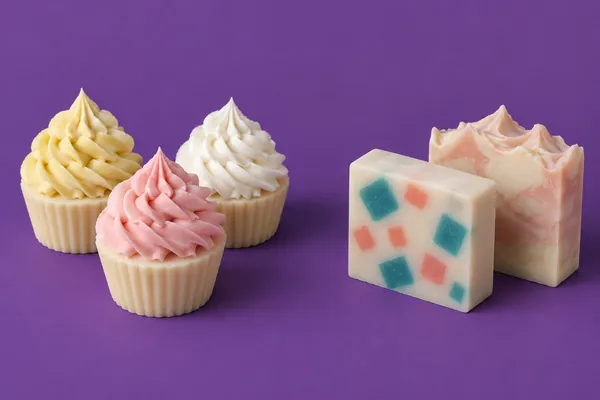
Embeds, textured tops and piping
Soap embeds that stay put and don't bleed, textured and botanical tops, piped frosting and soap cupcakes, and how to keep soda ash off the top.
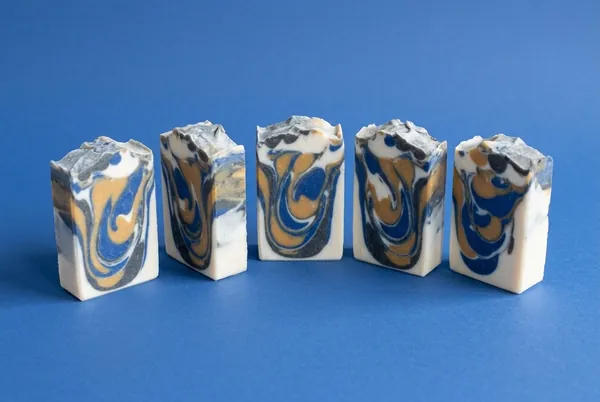
Swirl techniques: in the pot, drop, hanger, spoon and Taiwan
Seven cold-process swirls step by step, with the batter, recipe and temperatures that keep soap fluid, and why swirls turn muddy or lumpy.
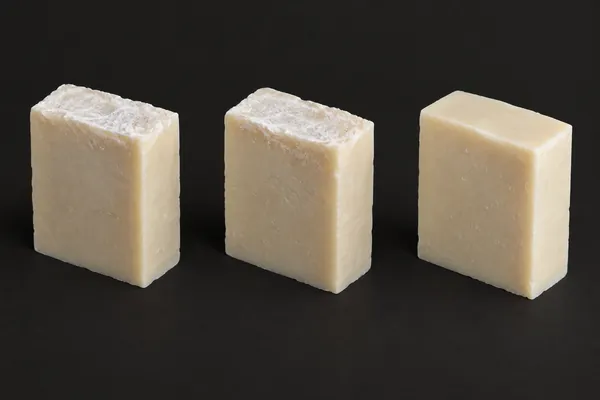
Soda ash: why it forms and how to stop it
Soda ash is sodium carbonate, made where lye still at the surface of fresh soap meets carbon dioxide in the air. Why it forms, how to prevent it and how to remove it.
Where these proportions come from
Our own plain lard, olive and coconut bar, chosen because lard sets white and the mica shows against it; the top follows Anne-Marie Faiola's surface-only work, a skewer drawn through just the top few millimetres, with the mica stirred into oil so it drags into feathers.
Formulation adapted from Soap Crafting by Anne-Marie Faiola (Storey Publishing, 2013). The method and notes are ours.