In short
- Soda ash is sodium carbonate: lye that is still unreacted at the surface of fresh soap, meeting carbon dioxide in the air.
- It forms in the first day or two, and only on faces the air can reach.
- Covering the mould does the most. Keeping the loaf warm enough to gel and using a little less water help too.
- It is harmless and dissolves in water: steam it, rinse it or plane it off.
- White specks inside a bar are not ash. Gritty or damp crystals that sting may be lye.
On this page
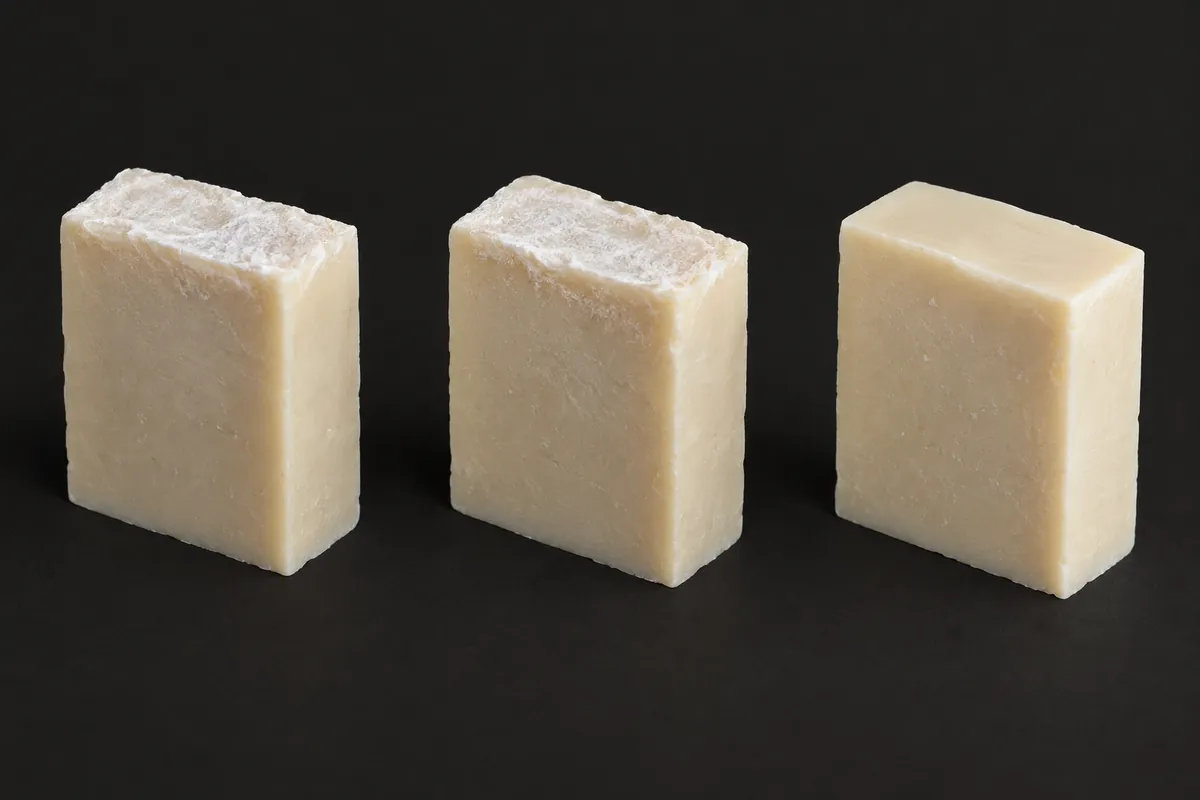
Soda ash is the dull white film that turns up on top of a loaf of cold process soap a day or two after it was poured. It is one of the commonest complaints in the craft and one of the least serious: the soap underneath is fine, and the film washes off. The useful questions are why one batch ashes when the next does not, and which of the many tips for stopping it have a reason behind them.
What soda ash is
Cold process soap is still saponifying when it goes into the mould. Most of the lye is used up within the first day, and until then a little sodium hydroxide sits in the batter that has not yet met any fat. Wherever that lye is at a surface open to the air, it reacts with carbon dioxide and becomes sodium carbonate, the chemical sold as washing soda. Those crystals are the ash.
Kevin Dunn, the chemist behind much of the published testing on handmade soap, gives two ways to recognise it. Sodium carbonate dissolves in water, so it rinses off, and it covers the whole of the surface that was open to the air rather than sitting in patches. Most ash is a thin coat on top, but it can run deeper: Soap Queen, the Bramble Berry blog, shows bars where it went down into the soap and left it crumbly. Factories knew carbonate’s effect inside soap. They added a little on purpose to stiffen cheap soap, and Simmons and Appleton’s 1908 handbook warned that too much made the soap brittle and made it bloom white on the surface.
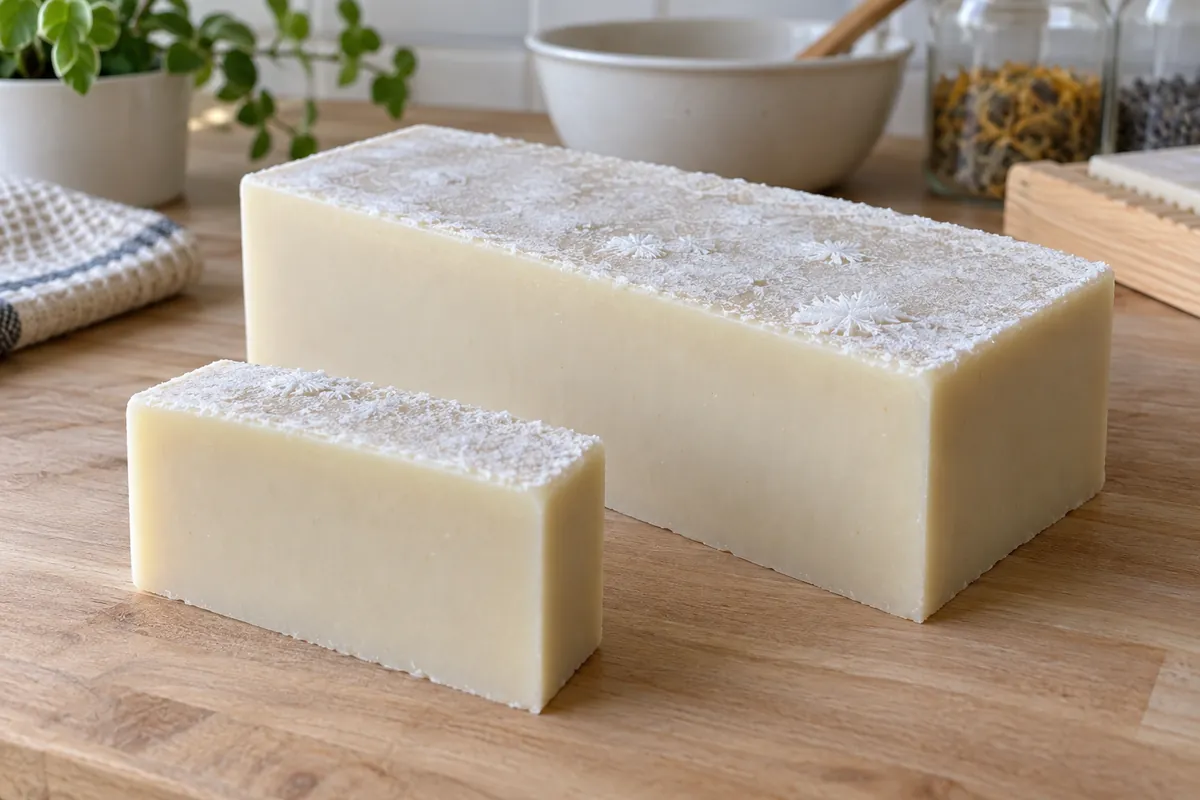 Ash forms only where the air reached the soap: across the top of the loaf, not on the sides that were against the mould.
There is a second, rarer white coat. DeeAnna Rouse of Classic Bells describes a smooth, slightly waxy, ivory layer that looks like a coat of paint and usually sits only on the top of the bar. It is made of large crystals of soap itself, not carbonate. It is just as harmless, but steam won’t shift it and washing leaves the bar looking used; a plane takes it off cleanly.
Why some batches ash and others don’t
Ash needs free lye at the surface and air to meet it. Anything that shortens the time the lye lingers at the surface, or keeps the air off while it does, means less ash, and most of the familiar causes turn out to be one or the other.
| What happened | Why it gives more ash | How well it is established |
|---|---|---|
| The top was left open | Carbon dioxide could reach the lye | Direct: covering prevents it |
| The loaf stayed cool and never gelled | Cooler soap saponifies more slowly, so lye stays at the surface longer | Consistent reports with a chemical reason: makers see ash most when lye and oils are below about 38 °C (100 °F) |
| A lot of water, a weak lye solution | Most likely slower saponification | Widely reported; the reason is untested |
| Poured at thin trace | The batter was less far along when it met the air | Maker experience |
| Unmoulded early | The sides met the air while lye remained | Plausible and widely advised |
| Small cavity moulds, thin slabs | Small pieces lose heat and rarely gel | Follows from how gel works |
For most of these, consistent reports with a chemical reason are as far as the evidence goes: we know of no controlled test of ash against temperature or water.
Heat matters because it speeds the reaction: a loaf that heats itself into gel uses up its lye sooner. Dunn’s lecture on time and temperature shows what decides that heat. A big loaf holds it while a cavity mould loses it, and a warmer start raises the peak. Hot process soap rarely ashes for the same reason: the cook uses up the lye before the soap ever reaches the mould. Melt and pour has no free lye to begin with.
How to prevent it
Pick the measures that suit the batch. A milk or honey soap can’t be pushed into a hot gel without scorching, for example, but it can always be covered.
- Cover the top. Lay plastic wrap on the surface or fit a lid, and leave it until the soap has cooled to room temperature. Let the wrap settle onto the batter by itself: Alicia Grosso finds that pressing it down leaves lumps and bumps in the top. Classic Bells leaves covers on for up to two or three days. This measure has the plainest reason behind it: no air, no carbon dioxide.
- Keep the loaf warm. Soap Queen soaps with the lye and oils at 38 °C (100 °F) or more, usually 46–49 °C (115–120 °F), then covers the mould with cardboard and a towel so it gels. In a cold room a heating pad on medium for 30 to 60 minutes, then switched off, helps. The gel phase guide covers when you would rather not gel.
- Use less water. Classic Bells suggests a lye concentration of 33 to 40 %; Soap Queen a water discount of 5 to 10 %. The water guide explains the three ways of stating it.
- Pour a little thicker. Medium trace rather than thin, when the design allows it.
- Leave it in the mould. David Fisher waits 36 to 48 hours before unmoulding, so the sides stay covered while lye remains.
- Mist the top with alcohol, lightly. Soap Queen sprays 99 % isopropyl alcohol over the top straight after pouring and again 10 to 15 minutes later; Anne-Marie Faiola uses 91 % up to three times in the first 90 minutes. Keep it to a fine mist. A drenched top dries hard over hot soap, which is one way to get a crack.
Check your water. The usual three oils with water at 38 % of the oils make a 27.5 % lye solution: 380 g of water for 1000 g of oils. At a 33 % solution the same bar takes 292.6 g.
Open it in the calculatorThat bar is our everyday recipe, which is written at a 33 % solution. It makes good soap either way; at 33 % it is less prone to ash, by most makers’ experience. Our classic olive, coconut and palm bar builds three of the measures above into its method: a 33 % solution, a lid on the mould and a towel so the loaf gels.
Which tips have a reason behind them
| Tip | What we know |
|---|---|
| Cover the surface | Sound. It keeps carbon dioxide away from the lye, and Dunn recommends it. |
| Soap warmer and let it gel | Sound in principle: warmer soap uses up its lye sooner. |
| Use less water | Widely reported to help. Faster saponification is the likely reason, but nobody has measured ash against water. |
| Spray alcohol | Widely used and widely reported to help. How it works is unknown; Classic Bells suspects it stops the soap-crystal kind better than true soda ash. |
| Stir in 0.5 % melted beeswax at trace | Soap Queen’s suggestion, as a barrier on the surface. It means soaping at about 71 °C (160 °F) and it speeds trace, so it is not a beginner’s fix. |
| Lower the superfat | Also suggested, but there is no evidence for it, and the chemistry points the other way: with less spare fat in the pot, the last of the lye takes longer to find something to react with. |
How to remove it
- Steam it. A hand-held clothes steamer held 2.5 to 13 cm (1 to 5 in) above each bar for 20 to 30 seconds clears a light coat. The carbonate dissolves and dries back as a film too thin to see.
- Rinse it. With gloves on, run the bar under cold water, rub the white areas gently with a paper towel, rinse off any lather and let it dry. Classic Bells prefers distilled water for this, on the grounds that the minerals in tap water can help set off orange spots later.
- Plane or peel it. A soap planer or a vegetable peeler takes off a thin layer. This is the one method that also removes soap-crystal ash, at the cost of a little soap.
- Leave it. It washes off the first time the bar is used.
When the white stuff isn’t soda ash
| What you see | What it probably is | Safe to use? |
|---|---|---|
| A dull white film over the whole top and any exposed sides, slightly rough, that rinses off | Soda ash | Yes |
| A smooth ivory layer like paint, on top only, that does not rinse off | Soap crystals | Yes |
| White flecks inside the bar, soft and waxy, with no sting | Stearic spots: stearic- and palmitic-rich fat that set in cool batter before it mixed in | Yes, once lye is ruled out |
| Fine crystals growing on the surface over weeks, on a bar made with a lot of citric acid or sodium citrate | Sodium citrate coming out of the soap | Yes |
| A thick, sparkly crust on the surface rather than a thin powder | A lye-heavy batch, in Grosso’s experience | No: test it |
| Hard, gritty white grains or damp pockets inside the bar, or anything that stings | Undissolved or unreacted lye | No: test it |
Dunn’s rule of thumb: ash covers every surface the air touched, and white dots or streaks below the surface are usually something else.
Recipes to try
All recipesSources
- Caustic Soda Handbook . Occidental Chemical Corporation (OxyChem) , 2026. Analytical methods: samples are handled quickly to avoid picking up carbon dioxide and moisture from the air.
- Sodium carbonate (CID 10340) . PubChem, US National Library of Medicine . Solubility 30.7 g per 100 g of water at 25 °C; insoluble in ethanol.
- Time and Temperature in Soapmaking . Kevin M. Dunn, lecture to the Handcrafted Soapmakers Guild , 2009.
- The Secret Life of Soap: Kevin Dunn at the 2011 HSMG Conference . Amanda Aaron, Lovin Soap , 2011. A report of Dunn's talk: ash is sodium carbonate, rinses off and covers the whole air-exposed surface; cover soap while it saponifies.
- Ash on bar soap . DeeAnna Rouse, Classic Bells . Soda ash and soap-crystal ash; 33 to 40 % lye concentration; covers left on for up to 2 to 3 days.
- Explaining and Preventing Soda Ash . Soap Queen (Bramble Berry) , 2018.
- Soap Crafting . Anne-Marie Faiola, Storey Publishing , 2013.
- The Complete Photo Guide to Soap Making . David Fisher, Creative Publishing International , 2018.
- The Everything Soapmaking Book, 3rd edition . Alicia Grosso, Adams Media , 2013. A thin white powder is harmless ash, a thick sparkly crust a lye-heavy batch; plastic wrap left to cling rather than pressed on.
- The Handbook of Soap Manufacture . W. H. Simmons and H. A. Appleton, Scott, Greenwood & Son (Project Gutenberg edition) , 1908. Soda ash added to stiffen soap, too much giving brittleness and efflorescence; free caustic measured in alcohol, which leaves carbonate on the filter.