Nut-free bar
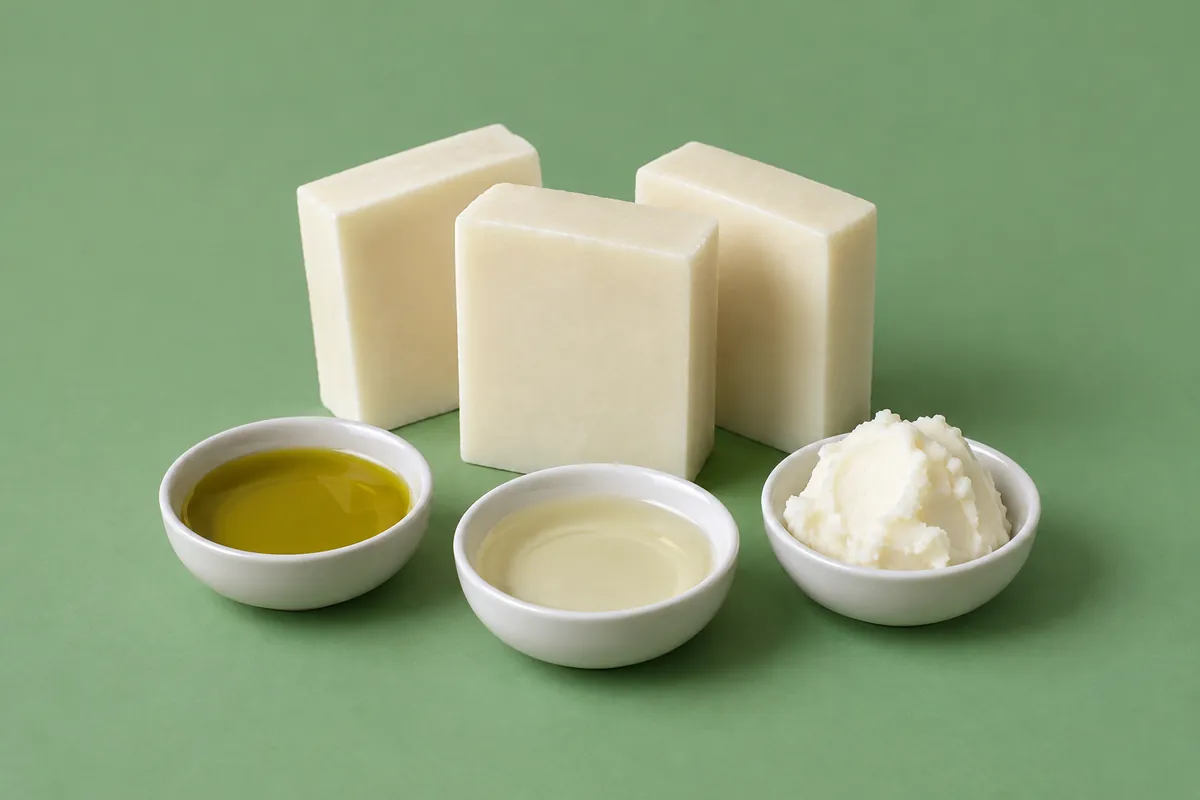
A mild, creamy everyday bar made without any tree nut or peanut oil: olive oil, beef tallow, castor oil and a fifth coconut oil. It is unscented and has nothing added, so there are fewer ingredients for an allergic household to check.
- Skill
- Beginner
- Method
- Cold process
- Batch
- 1000 g of oils about 1414 g of batter
- Hands-on
- 1 hour
- Cure
- 6 weeks
- Gel phase
- Either way gel or not, both work
What you need
For 1000 g of oils, which fills a 1.5 litre loaf mould. Weigh everything, liquids included.
| Olive Oil · 45.0 % | 450 g | 15.87 oz |
| Coconut Oil · 20.0 % | 200 g | 7.05 oz |
| Edible Tallow · 25.0 % | 250 g | 8.82 oz |
| Castor Oil · 10.0 % | 100 g | 3.53 oz |
| Sodium hydroxide (NaOH) · the lye, 100 % pure | 136.5 g | 4.81 oz |
| Distilled water · for a 33 % lye solution | 277.1 g | 9.78 oz |
- Superfat
- 6 %
- Temperatures
- Oils and lye solution each at 38 to 43 °C (100 to 110 °F)
Method
-
Check the labels
Buy single, named oils: olive oil, coconut oil, castor oil and beef tallow, not a vegetable oil blend or a ready-mixed soaping oil. If allergy is the reason for this bar, choose suppliers who say what else they pack on the same line. -
Clean your equipment
If the pot, stick blender, jugs or mould have been used for soap with almond oil, shea butter or other nut oils, wash them thoroughly in hot soapy water first. -
Get ready
Put on splash goggles, nitrile gloves and long sleeves, open a window or turn on the extractor fan, and keep children and pets out of the room. Line the loaf mould and set it on a level surface where it can stay for two days. -
Weigh the oils
Weigh 250 g beef tallow and 200 g coconut oil into the soaping pot, and 450 g olive oil and 100 g castor oil into a jug. -
Make the lye solution
Weigh 277.1 g distilled water into a heat-safe jug and 136.5 g sodium hydroxide into a dry container. At the open window or under the fan, pour the lye slowly into the water, never the water onto the lye, and stir until clear; leave it to cool, labelled and out of reach. -
Melt and combine the oils
Melt the tallow and coconut oil together on low heat until completely clear, then pour in the olive and castor oils. -
Check the temperatures
Carry on when the oils and the lye solution are both between 38 and 43 °C (100 and 110 °F). Tallow starts to cloud as it cools; if the oils turn hazy, warm them again until clear. -
Blend to light trace
Pour the lye solution into the oils down the shaft of the stick blender and pulse for a few seconds at a time, stirring between bursts. Stop when a drizzle leaves a faint line on the surface. -
Pour and cover
Pour into the mould, tap it on the worktop to raise air bubbles, and cover it with a board and a folded towel for a day. Wipe the pot and tools into the bin with paper towels, then wash them. -
Unmould and cut
After 24 to 48 hours, when the loaf is firm, unmould it with gloves on and cut it into bars about 2.5 cm (1 in) thick. If it still dents under a finger, give it another day. -
Label the bars
Write every ingredient on the label, by its common name and its INCI name, so anyone checking for allergens can read it; our labelling guide shows how. Keep these bars apart from any soap made with nut oils. -
Cure
Stand the bars on edge in a dry, airy room for six weeks, turning them now and then.
Tips
- If you change the recipe, check each new ingredient. Nut-derived oils and butters in soap include shea (Butyrospermum Parkii), sweet almond, macadamia, hazelnut, walnut, Brazil nut, pistachio, cashew, argan and kukui nut, and peanut oil appears as arachis oil; apricot kernel oil is a close relative of almond. Additives to watch are almond meal, almond milk, walnut shell and apricot seed powder, and some fragrance oils use a nut oil as their carrier, so ask the supplier.
- Coconut is separate from tree nuts in allergy terms: Allergy UK says people with a tree nut allergy need not avoid it, the US FDA took it off its tree nut labelling list in 2025, and the EU has never listed it. For a bar with no coconut, see our coconut-free oat and chamomile bar, but note that it contains shea butter.
- Tallow makes this bar unsuitable for vegans. Cocoa butter, which comes from a seed and not a nut, is the simplest swap; the two take different amounts of lye, so run the change through the calculator.
- An allergy question belongs to the person with the allergy and their clinician. This is a formulation with nothing nut-derived in it, not medical advice.
The oils
| Oil | Share |
|---|---|
| Olive Oil (virgin / refined / olive oil) | 45.0 % |
| Coconut Oil | 20.0 % |
| Edible Tallow (beef/mutton dripping) | 25.0 % |
| Castor Oil | 10.0 % |
How it is made
| Process | Cold process |
| Alkali | NaOH |
| Superfat | 6 % |
| Water | lye water at 33 % |
| Iodine value | 60 |
| INS | 144 |
Why make it
A bar for households where someone has a nut allergy: none of its oils comes from a tree nut or a peanut. Olive oil, beef tallow and castor oil give a mild, creamy, conditioning bar, cleansing 15 and conditioning 59 on our scale, and the castor keeps the lather full. Coconut is the one question, and current guidance agrees on it: Allergy UK says people with a tree nut allergy need not avoid coconut, and in 2025 the US FDA dropped coconut from its list of tree nuts for food labelling. Shea butter is left out even though it is refined to almost no protein and a 2011 study found no IgE-binding proteins in it, simply because it comes from a nut and is easy to do without. A person allergic to coconut itself should not use this bar, and anyone unsure should ask their allergist first.
Sources
- Tree Nut Allergy · Allergy UK, 2021
- Questions and Answers Regarding Food Allergens, Including the Food Allergen Labeling Requirements of the Federal Food, Drug, and Cosmetic Act (Edition 5): Guidance for Industry; Availability · US Food and Drug Administration, Federal Register, 2025
- Shea butter contains no IgE-binding soluble proteins · Journal of Allergy and Clinical Immunology 127(3):680-682 (Chawla, Bencharitiwong, Ayuso, Grishina and Nowak-Węgrzyn), 2011
What tradition, makers' experience and research say about soaps like this, each labelled for what it is. It is not medical advice, and no soap treats a skin condition: if you have one, ask a doctor or pharmacist.
What the numbers say
- Lauric acid 9.8 %
- Myristic acid 4.8 %
- Palmitic acid 14.4 %
- Stearic acid 7.7 %
- Ricinoleic acid 8.9 %
- Oleic acid 42.3 %
- Linoleic acid 7.2 %
- Other 5.2 %
Saturated : unsaturated 40 : 60
Computed from the fatty acids of the fats above. The bands are what the craft has settled on, not chemistry — a bar outside one is not wrong.
Try it differently
11 variationsThe same soap with one thing moved. Each opens in the calculator ready to change again.
- Lard (pure rendered pork fat) instead of Edible Tallow (beef/mutton dripping)
- Palm Oil instead of Edible Tallow (beef/mutton dripping)
- Rice Bran Oil instead of Edible Tallow (beef/mutton dripping)
- 5 % superfat
- 8 % superfat
- Lard (pure rendered pork fat) instead of Edible Tallow (beef/mutton dripping) and 5 % superfat
- Lard (pure rendered pork fat) instead of Edible Tallow (beef/mutton dripping) and 8 % superfat
- Palm Oil instead of Edible Tallow (beef/mutton dripping) and 5 % superfat
- Palm Oil instead of Edible Tallow (beef/mutton dripping) and 8 % superfat
- Rice Bran Oil instead of Edible Tallow (beef/mutton dripping) and 5 % superfat
- Rice Bran Oil instead of Edible Tallow (beef/mutton dripping) and 8 % superfat
From the guides
All guides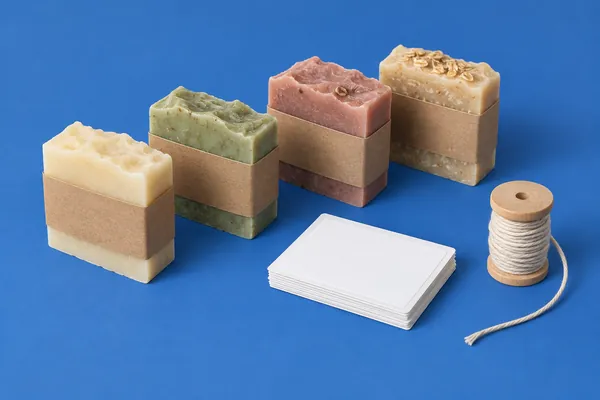
Labelling soap: US, EU, UK and Canada
What a soap label must say in the US, EU, UK and Canada: true soap or cosmetic, net weight, INCI list, allergens, and the claims that make soap a drug.
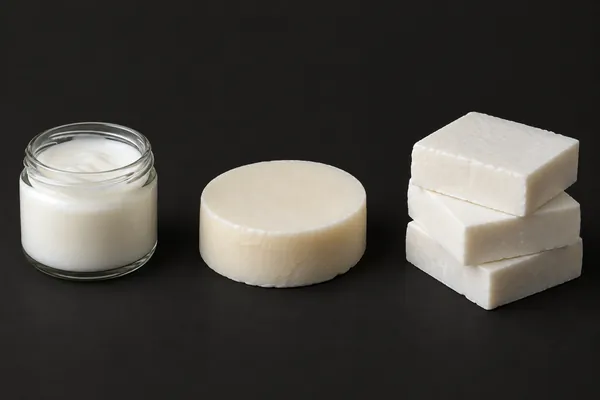
Lard and tallow: soaping with animal fats
Why lard and tallow make hard, mild, creamy soap, how to render and store them at home, how beef, mutton and pork fat differ, and classic recipes.
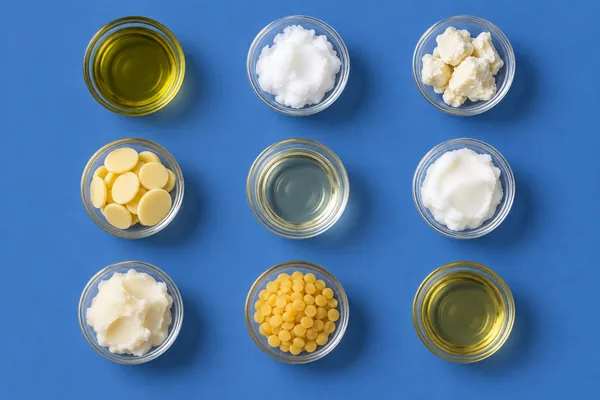
The soaping oils: what each one brings to a bar
Twenty-five soaping oils, butters and waxes: what each does in a bar and why, the share makers give it, and what to watch for, with figures from our records.
Where these proportions come from
Our own construction for households managing a nut allergy: olive oil for mildness, beef tallow for hardness, castor oil for lather and a fifth coconut oil, with shea, argan, almond and every other nut butter or oil left out. Coconut is botanically a drupe; Allergy UK does not ask people with a tree nut allergy to avoid it and US food labelling stopped listing it as a tree nut in 2025, but it stays a separate allergen. Superfat 6 %, in a 33 % lye solution.