Rice bran and avocado bar
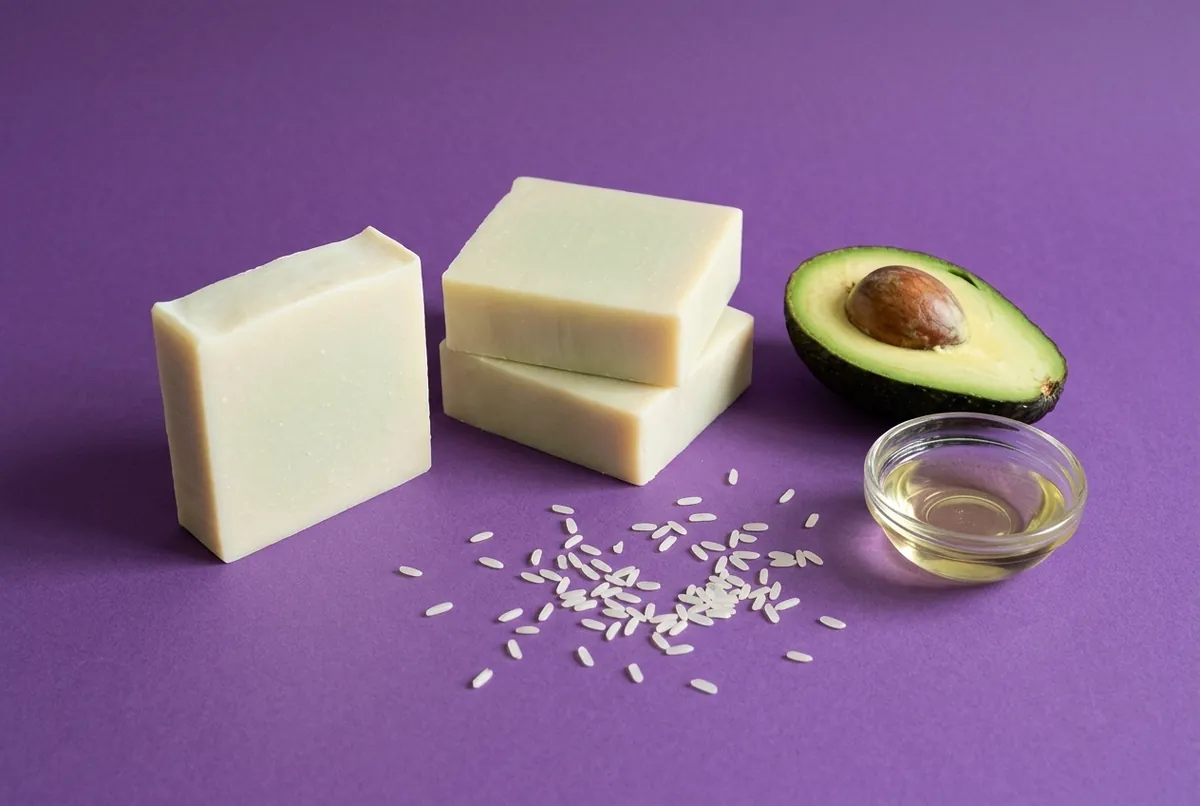
A palm-free conditioning bar built on rice bran and avocado oils, with cocoa butter for firmness and a modest 20 % coconut oil, so the lather is gentle and creamy. Unscented, with a 6 % superfat.
- Skill
- Beginner
- Method
- Cold process
- Batch
- 1000 g of oils about 1411 g of batter
- Hands-on
- 1 hour
- Cure
- 6 weeks
- Gel phase
- Either way gel or not, both work
What you need
For 1000 g of oils, which fills a 1.5 litre loaf mould. Weigh everything, liquids included.
| Rice Bran Oil · 30.0 % | 300 g | 10.58 oz |
| Avocado Oil · 25.0 % | 250 g | 8.82 oz |
| Cocoa Butter · 20.0 % | 200 g | 7.05 oz |
| Coconut Oil · 20.0 % | 200 g | 7.05 oz |
| Castor Oil · 5.0 % | 50 g | 1.76 oz |
| Sodium hydroxide (NaOH) · the lye, 100 % pure | 135.5 g | 4.78 oz |
| Distilled water · for a 33 % lye solution | 275.1 g | 9.70 oz |
- Superfat
- 6 %
- Temperatures
- Oils and lye solution each between 38 and 43 °C (100 and 110 °F)
Method
-
Get ready
Put on splash goggles, nitrile gloves and long sleeves, open a window or turn on the extractor fan, and keep children and pets out of the room. Set the mould out level where it can stay for two days. -
Weigh the oils
Weigh 200 g cocoa butter and 200 g coconut oil into the pot, and 300 g rice bran oil, 250 g avocado oil and 50 g castor oil into a jug. -
Make the lye solution
Weigh 275.1 g distilled water into a heat-safe jug and 135.5 g sodium hydroxide into a dry container. In a well-ventilated spot, pour the lye slowly into the water, never the water onto the lye, stir until clear and leave it to cool, labelled and out of reach. -
Melt the cocoa butter and coconut oil
Melt them together on the lowest heat until clear, then pour in the rice bran, avocado and castor oils. -
Check the temperatures
Carry on when both the oils and the lye solution are between 38 and 43 °C (100 and 110 °F). Cocoa butter sets quickly below that and thickens the batter before it has traced. -
Combine
Pour the lye solution into the oils down the shaft of the stick blender, tap the blender to let trapped air out, and keep the blade under the surface while it runs. -
Blend to light trace
Pulse for a few seconds, stir with the blender off, and repeat until the batter is opaque and a drizzle leaves a faint line on the surface. -
Pour and cover
Pour into the mould, tap it on the worktop to raise air bubbles, and cover it with a lid or board and a folded towel for a day. -
Clean up
With your gloves still on, wipe the batter off the pot and tools with paper towels into the bin, then wash them in hot soapy water. -
Unmould and cut
After 24 to 48 hours, when the loaf is firm, unmould it with gloves on and cut it into bars about 2.5 cm (1 in) thick. -
Cure
Stand the bars on edge in a dry, airy room for six weeks, turning them every few days.
Tips
- Rice bran oil is sold for frying in many supermarkets and Asian grocers, and any refined rice bran oil will do.
- Unrefined avocado oil is deep green and tints the fresh bar a pale green-cream; refined avocado oil gives a paler bar. Our calculator treats them as the same oil, so the lye does not change.
- Use fresh oils and store the bars somewhere cool and dry. Rice bran oil carries more linoleic acid than olive oil, and old or warm-stored oils are the likeliest to turn a bar spotty.
- For a scent, 30 g of lavender essential oil suits it, stirred in by hand at light trace; the lye stays the same.
The oils
| Oil | Share |
|---|---|
| Rice Bran Oil | 30.0 % |
| Avocado Oil | 25.0 % |
| Cocoa Butter (Theobroma Oil) | 20.0 % |
| Coconut Oil | 20.0 % |
| Castor Oil | 5.0 % |
How it is made
| Process | Cold process |
| Alkali | NaOH |
| Superfat | 6 % |
| Water | lye water at 33 % |
| Iodine value | 65 |
| INS | 137 |
Why make it
Rice bran and avocado oils make up more than half of this bar, and it comes out gentle: cleansing 14 and conditioning 57 on our scale, with cocoa butter keeping it firm without palm oil. That suits dry skin and frequent hand-washing, and with nothing added for scent it fits the advice dermatologists give for dry, sensitive skin: a gentle, fragrance-free cleanser (American Academy of Dermatology). Rice bran has a long history as a cleanser of its own. In Edo-period Japan people washed their faces and bodies with rice bran in a small cloth bag, the nukabukuro (POLA Research Institute). In soap the bran's oil is saponified like any other, so the bar's mildness comes from the formula, not from that tradition. Keep it cool and dry: rice bran oil is richer in linoleic acid than olive oil, and old bars can spot.
Sources
- Dermatologists' top tips for relieving dry skin · American Academy of Dermatology
- It is not garbage! · POLA Research Institute of Beauty & Culture, 2020
What tradition, makers' experience and research say about soaps like this, each labelled for what it is. It is not medical advice, and no soap treats a skin condition: if you have one, ask a doctor or pharmacist.
What the numbers say
- Lauric acid 9.9 %
- Myristic acid 3.9 %
- Palmitic acid 16.5 %
- Stearic acid 9.0 %
- Ricinoleic acid 4.4 %
- Oleic acid 37.0 %
- Linoleic acid 13.9 %
- α-Linolenic acid 1.4 %
- Other 5.3 %
Saturated : unsaturated 42 : 58
Computed from the fatty acids of the fats above. The bands are what the craft has settled on, not chemistry — a bar outside one is not wrong.
From the guides
All guides
Palm-free soap: what takes palm oil's place
What palm oil does in a bar of soap, why makers drop it, and how lard, tallow, shea, cocoa, kokum or stearic acid take its place, with worked palm-free recipes.
The soaping oils: what each one brings to a bar
Twenty-five soaping oils, butters and waxes: what each does in a bar and why, the share makers give it, and what to watch for, with figures from our records.
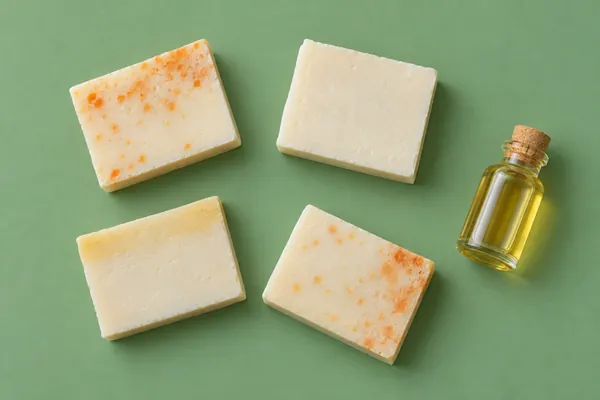
Dreaded orange spots (DOS) and rancid soap
What the orange spots on handmade soap are, why polyunsaturated oils, old fats and trace metals cause them, and which additives the tests show actually help.
Where these proportions come from
Our own formulation: rice bran and avocado oils make up more than half the oils for a conditioning bar, cocoa butter takes the place of palm for hardness, coconut is held at 20 % so the lather stays gentle, and a 6 % superfat leaves a margin for the natural variation in these oils.