Three-layer clay bar
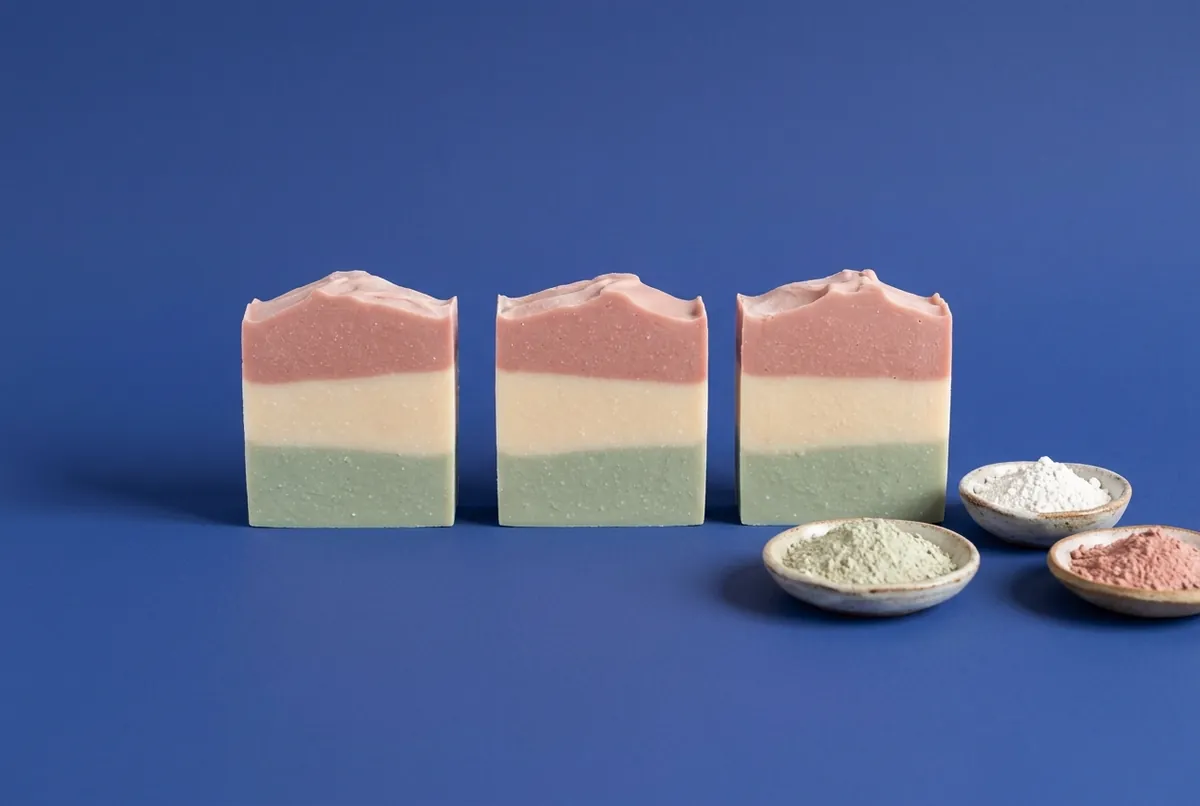
Three even layers of French green, kaolin cream and rose clay, each poured over a spatula at pudding thickness. Clays keep their colour through the cure, and tallow with coconut makes a hard, well-lathering bar.
- Skill
- Intermediate
- Method
- Cold process
- Batch
- 900 g of oils about 1332 g of batter
- Hands-on
- 1 h 30 min
- Cure
- 5 weeks
- Gel phase
- Yes insulate the mould
What you need
For 900 g of oils, which fills a 25 × 9 cm loaf mould filled 6 cm deep (about 1.4 litres). Weigh everything, liquids included.
| Edible Tallow · 30.0 % | 270 g | 9.52 oz |
| Olive Oil · 27.0 % | 243 g | 8.57 oz |
| Coconut Oil · 24.0 % | 216 g | 7.62 oz |
| Shea Butter · 14.0 % | 126 g | 4.44 oz |
| Castor Oil · 5.0 % | 45 g | 1.59 oz |
| Sodium hydroxide (NaOH) · the lye, 100 % pure | 125.7 g | 4.43 oz |
| Distilled water · 184 g for a 41 % lye solution, 71 g set aside | 255.2 g | 9.00 oz |
| French green clay · 1 tbsp, bottom layer, stirred into 37 g of the recipe's water | 12.5 g | 0.44 oz |
| Kaolin clay · middle layer, about 1¾ tsp, stirred into 15 g of the recipe's water | 5 g | 0.18 oz |
| Rose clay · 2 tsp, top layer, stirred into 19 g of the recipe's water | 6.3 g | 0.22 oz |
| Lavender oil · 2.0 % of the oils, at trace | 18 g | 0.63 oz |
| Geranium oil · 1.0 % of the oils, at trace | 9 g | 0.32 oz |
- Superfat
- 5 %
- Temperatures
- Oils and lye solution at 38 to 41 °C (100 to 105 °F), warm enough to keep the tallow melted
Method
-
Get ready
Put on goggles, gloves and long sleeves and open a window. Line the mould and set it on a surface you know is level, because layers poured in a tilted mould slope; have two jugs, three cups and a spatula in reach. -
Mix the clay slurries
Weigh the 255.2 g of water and take 71 g of it out. Stir the French green clay into 37 g of that, the kaolin into 15 g and the rose clay into the last 19 g, each in its own cup, until smooth. Mix them on the day: wet clay does not keep. -
Make the lye solution
Where the air moves, pour the 125.7 g of sodium hydroxide slowly into the rest of the water, never the reverse, and stir until clear. With over a quarter of the water set aside for the clays it runs stronger and hotter than usual, so stir gently with your face well back, then leave it labelled and out of reach to cool to 38 to 41 °C (100 to 105 °F). -
Melt and scent the fats
Melt the tallow, coconut oil and shea butter, add the olive and castor oils, and let them cool to 38 to 41 °C (100 to 105 °F) while they stay clear. Stir in the lavender and geranium oils. -
Blend to light trace
Pour the lye solution in down the blender shaft, tap out trapped air, and blend in short pulses with stirring between until light trace: thin custard that holds a faint line for a few seconds. -
Split into thirds
Weigh 410 g of batter into each of the two jugs and leave the rest, about 415 g, in the pot. Keep all three plain for now: clay thickens batter within a minute or two, so each portion is coloured only when its turn comes. -
Pour the green layer
Whisk the green clay into the first jug, pulse it with the blender until it reaches medium trace, like pudding, and pour it into the mould. Level it with the spatula and tap the mould on the worktop. -
Let it firm
Wait 3 to 5 minutes, until a light touch of the spatula leaves a mark that does not close. -
Pour the kaolin layer
Whisk the kaolin into the second jug and bring it to medium trace. Pour it slowly onto the back of a spatula held just above the green, moving from one end of the mould to the other, so it spreads instead of breaking through; tap gently. -
Pour the rose layer
Wait until the kaolin holds a mark, then whisk the rose clay into the pot, bring it to medium trace and pour it the same way. Smooth the top, or sweep it with the spatula like icing. -
Cover so it gels
Cover the mould with a board or lid and wrap it in a towel for a day, two towels in a room below about 24 °C (75 °F), so the whole loaf gels; a partial gel shows as a ring through every layer. -
Unmould and cut
Unmould with gloves on after 24 to 48 hours, once firm, and cut bars about 2.5 cm (1 in) thick so each shows all three layers. -
Cure
Stand the bars on edge with air between them, out of direct sun, for 5 weeks, turning them every few days.
Tips
- Leave the mould where it is from the first layer to the last. A mould nudged while the layers are soft gives lines that wave.
- Rose clay stirred into the warm lye solution comes out deeper, but that would colour all three layers; for layers it goes in at trace.
- Buy cosmetic-grade clays from a supplier who tests them for heavy metals, and disperse every clay fully: lumps can leave the bar crumbly or cracked.
The oils
| Oil | Share |
|---|---|
| Edible Tallow (beef/mutton dripping) | 30.0 % |
| Olive Oil (virgin / refined / olive oil) | 27.0 % |
| Coconut Oil | 24.0 % |
| Shea Butter | 14.0 % |
| Castor Oil | 5.0 % |
How it is made
| Process | Cold process |
| Alkali | NaOH |
| Superfat | 5 % |
| Water | lye water at 33 % |
| Iodine value | 50 |
| INS | 156 |
Why make it
Tallow, coconut and shea make a hard, long-lasting bar with a good lather, hardness 46 and cleansing 18 on our scale: an everyday bar for hands and body. It is made for the look, three layers coloured only with clay, and clays are the steadiest natural colours in soap because their colour comes from minerals rather than plant pigments that lye and light break down. Makers also value the slip clay gives a bar (Alicia Grosso). Clays have a long history in cosmetics and spa treatments (Carretero 2002), and kaolin is recognised in the United States as a skin protectant in leave-on products (21 CFR 347.10); in a bar the clay is rinsed off, so what it brings is colour and feel. Tallow makes it unsuitable for vegans.
Sources
- Alicia Grosso, The Everything Soapmaking Book, 3rd edition · Adams Media, 2013
- Clay minerals and their beneficial effects upon human health. A review · Applied Clay Science, 2002
- 21 CFR 347.10, Skin protectant active ingredients · U.S. Food and Drug Administration (eCFR)
What tradition, makers' experience and research say about soaps like this, each labelled for what it is. It is not medical advice, and no soap treats a skin condition: if you have one, ask a doctor or pharmacist.
What the numbers say
- Lauric acid 11.8 %
- Myristic acid 5.7 %
- Palmitic acid 13.9 %
- Stearic acid 14.2 %
- Ricinoleic acid 4.4 %
- Oleic acid 38.5 %
- Linoleic acid 5.9 %
- Other 5.6 %
Saturated : unsaturated 49 : 51
Computed from the fatty acids of the fats above. The bands are what the craft has settled on, not chemistry — a bar outside one is not wrong.
From the guides
All guides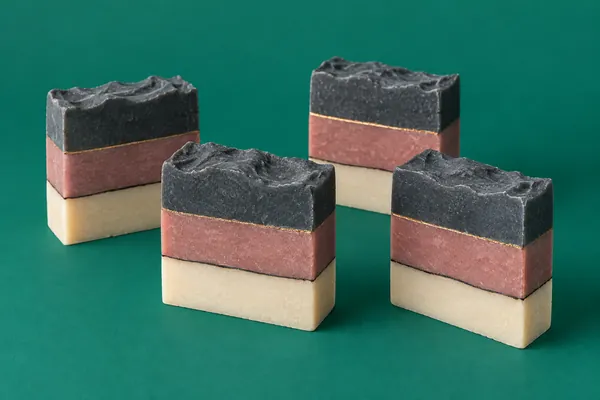
Layers, mica lines and pencil lines
Layered cold-process soap: batter thickness, pouring over a spatula, working out each layer from the mould, and pencil lines that don't split the bar.

Natural colourants: what herbs, clays and spices really do in soap
Clays, charcoal and plant colours in cold-process soap: doses per 500 g of oils, infused oil, powder or lye, and the colour each one actually turns.
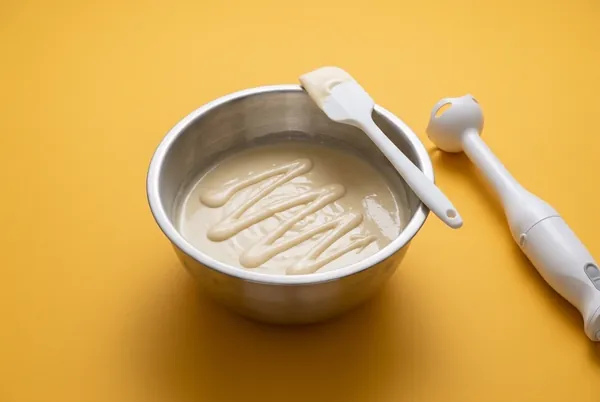
Trace: how to tell when soap batter is ready
What trace is, how to read emulsion, light, medium and thick trace, how to spot false trace, and what makes soap batter thicken faster or slower.
Where these proportions come from
Adapted from Kelly Cable's red, white and blue striped soap: her tallow, olive, coconut, shea and castor, with the castor cut from about 9 % to 5 % for a little more working time and the superfat set at 5 %; one batch is split and layered as Cable and Letcavage and Harden do it.
Formulation adapted from The Natural Soap Making Book for Beginners by Kelly Cable (Althea Press, 2017); Natural Soap Making by Elizabeth Letcavage and Melissa Harden (Stackpole Books, 2013). The method and notes are ours.