Bastile soap
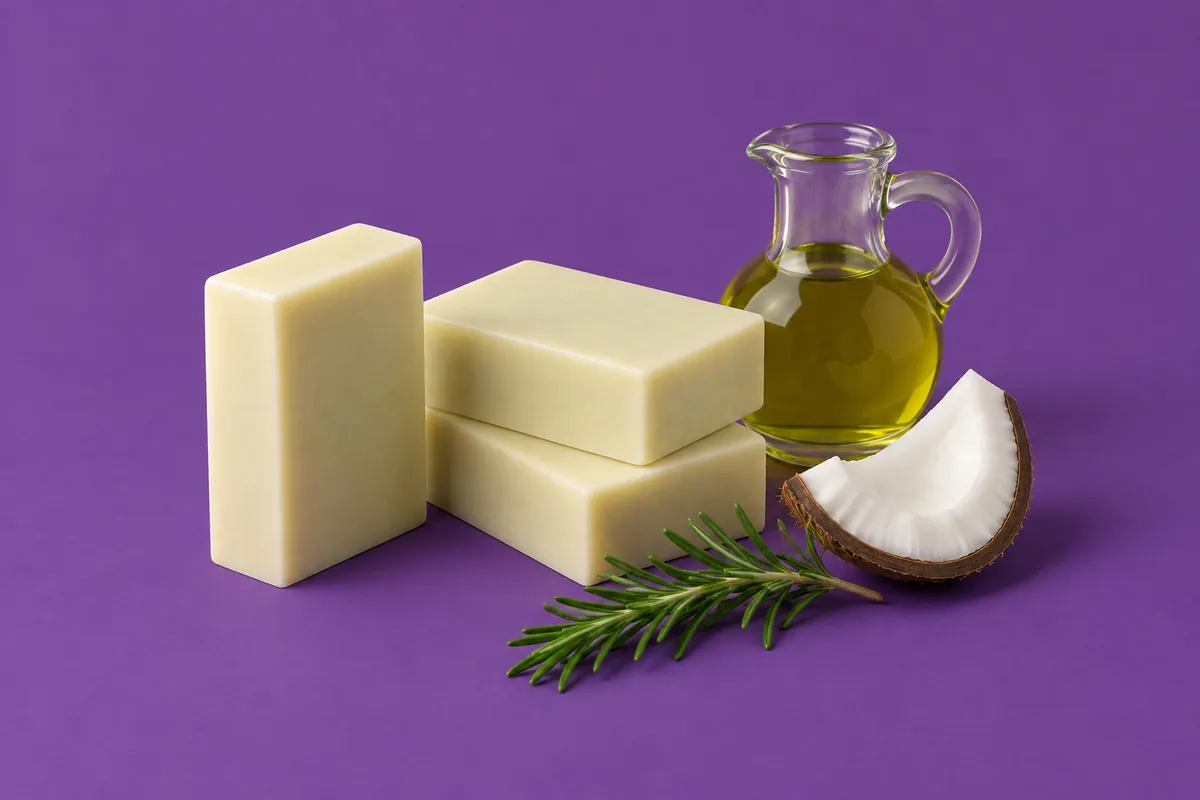
Four parts olive oil to one of coconut: the classic step from castile towards an everyday bar. The coconut brings a real lather and a firmer bar that is ready in eight weeks, while the olive keeps it mild. Lightly scented with lavender and rosemary, which you can leave out.
- Skill
- Beginner
- Method
- Cold process
- Batch
- 1000 g of oils about 1447 g of batter
- Hands-on
- 1 hour
- Cure
- 8 weeks
- Gel phase
- Yes insulate the mould
What you need
For 1000 g of oils, which fills a 1.5 litre loaf mould. Weigh everything, liquids included.
| Olive Oil · 80.0 % | 800 g | 28.22 oz |
| Coconut Oil · 20.0 % | 200 g | 7.05 oz |
| Sodium hydroxide (NaOH) · the lye, 100 % pure | 137.7 g | 4.86 oz |
| Distilled water · for a 33 % lye solution | 279.5 g | 9.86 oz |
| Lavender essential oil · 2.0 % of the oils, at trace | 20 g | 0.71 oz |
| Rosemary essential oil · 1.0 % of the oils, at trace | 10 g | 0.35 oz |
- Superfat
- 5 %
- Temperatures
- Oils and lye solution each between 35 and 40 °C (95 and 104 °F)
Method
-
Get ready
Put on splash goggles, nitrile gloves and long sleeves, open a window or turn on the extractor fan, and keep children and pets out of the room. Line a 1.5 litre loaf mould and have a towel and every tool out before you open the lye. -
Weigh the oils and the scent
Weigh 200 g coconut oil into the pot and 800 g olive oil into a jug. Weigh 20 g lavender and 10 g rosemary essential oil into a small glass or stainless steel cup. -
Make the lye solution
Weigh 279.5 g distilled water into a heat-safe jug and 137.7 g sodium hydroxide into a dry container. At the open window, pour the lye slowly into the water, never the water onto the lye, stir until clear and leave it to cool, labelled and out of reach. -
Melt the coconut oil
Melt the coconut oil on low heat until it is clear, then pour in the olive oil, which brings the blend down towards soaping temperature. -
Check the temperatures
Carry on when the oils and the lye solution are both between 35 and 40 °C (95 and 104 °F). If the oils go cloudy as they cool, warm them again for a moment until they clear. -
Combine
Pour the lye solution into the oils down the shaft of the stick blender, tap the blender on the bottom of the pot to let out trapped air, and keep the blade under the surface while it runs. -
Blend to light trace
Pulse for a few seconds, stir, and repeat. The coconut brings trace on sooner than in pure castile, usually within five minutes, but it is still a patient batter: stop when a drizzle leaves a faint line on the surface. -
Stir in the scent
Add the lavender and rosemary oils and stir them through by hand with the spatula, then give the batter one short pulse to even it out. -
Pour and insulate
Pour into the mould, tap it on the worktop to bring up air bubbles and cover it with a lid or board. Wrap it in a towel for a day so the loaf gels evenly and firms up sooner. -
Unmould and cut
After 24 to 48 hours, once the loaf is firm to a pressed finger, unmould it with gloves on and cut it into bars about 2.5 cm (1 in) thick. -
Clean up with your gloves on
Wipe the raw batter off the pot and tools with paper towels, put them in the bin, then wash everything in hot soapy water. -
Cure for eight weeks
Stand the bars on edge with air around them in a dry, airy room and turn them every week or so. They are ready at eight weeks, and like all olive-rich soaps they carry on getting harder and milder for months.
Tips
- The coconut is what turns castile into bastile: in the calculator, hardness goes from 17 to 29, cleansing from 0 to 14 and bubbly lather from 0 to 14, just inside the usual bands, while conditioning stays high at 67.
- For a gentler, unscented bar with castor oil for a creamier lather and a 6 % superfat, see our high-olive bastile bar. To make this one unscented, leave out the essential oils; nothing else changes.
- Use ordinary coconut oil, refined or virgin, the kind that is solid in a cool room and melts at about 24 °C (76 °F). Fractionated coconut oil is a different oil that takes a different amount of lye.
- Both essential oils soften over a cure. Cure the bars in an airy room, then keep them in a closed box to hold on to the scent that is left.
The oils
| Oil | Share |
|---|---|
| Olive Oil (virgin / refined / olive oil) | 80.0 % |
| Coconut Oil | 20.0 % |
How it is made
| Process | Cold process |
| Alkali | NaOH |
| Superfat | 5 % |
| Water | lye water at 33 % |
| Iodine value | 69 |
| INS | 134 |
Why make it
A fifth of coconut oil gives olive soap the lather it lacks: on our scale cleansing rises from castile's 0 to 14 and bubbly lather from 0 to 14, while conditioning stays high at 67. The result is a mild everyday bar that still foams in the shower, is harder than castile and is ready in about two months rather than six. Makers often choose it as the halfway point between pure castile and a coconut-rich bar, for hands and body. Bastile is a craft name rather than a tradition with a history, and its good name rests on makers' experience, not on trials. The coconut does add some cleansing, so very dry skin may get on better with castile, and like every true soap it is alkaline, around pH 9 to 10.
Sources
- Soap Crafting · Anne-Marie Faiola, Storey Publishing, 2013
- Evaluation of pH of Bathing Soaps and Shampoos for Skin and Hair Care · Tarun J. and others, Indian Journal of Dermatology 59(5):442-444, 2014
What tradition, makers' experience and research say about soaps like this, each labelled for what it is. It is not medical advice, and no soap treats a skin condition: if you have one, ask a doctor or pharmacist.
What the numbers say
- Lauric acid 9.8 %
- Myristic acid 3.8 %
- Palmitic acid 12.8 %
- Stearic acid 2.8 %
- Oleic acid 56.7 %
- Linoleic acid 10.2 %
- Other 5.0 %
Saturated : unsaturated 32 : 68
Computed from the fatty acids of the fats above. The bands are what the craft has settled on, not chemistry — a bar outside one is not wrong.
Try it differently
5 variationsThe same soap with one thing moved. Each opens in the calculator ready to change again.
From the guides
All guides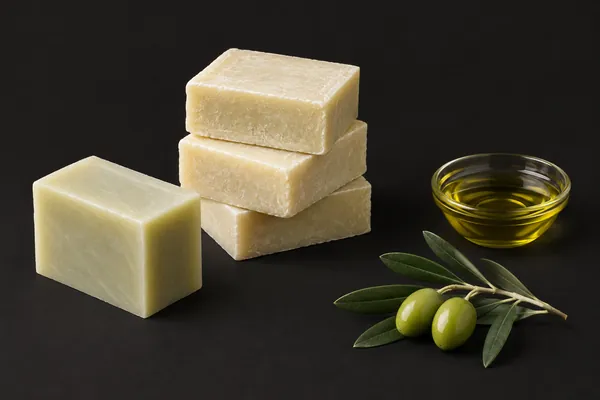
Castile soap: pure olive oil, and why it's worth the wait
What castile soap really is, why pure olive oil traces slowly and starts soft and slippery, how long to cure it, and a recipe with the calculator's numbers.
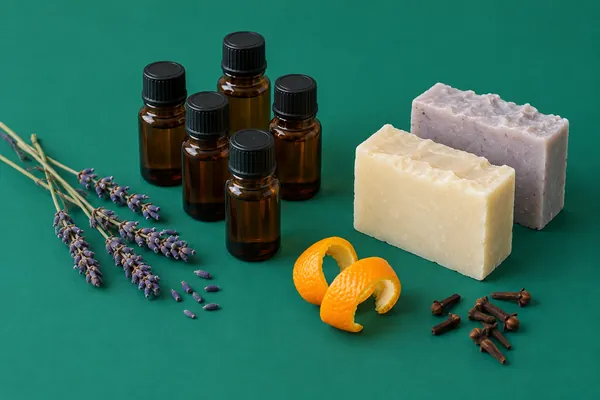
Scenting soap: essential oils and fragrance oils
How much essential or fragrance oil to use in soap, what ounces per pound mean in percent, the IFRA limits for common essential oils, and EU allergen labelling.
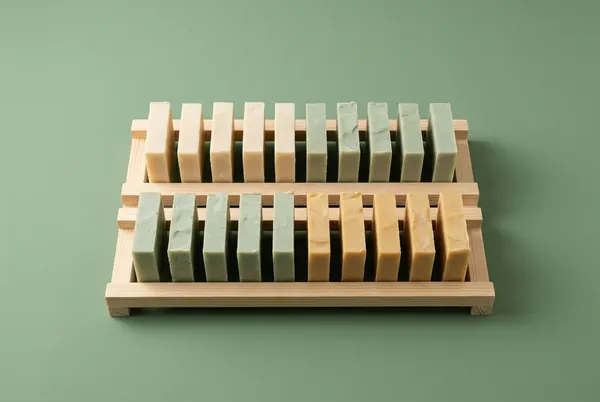
Curing and storing handmade soap
What curing does to cold process soap and what it doesn't, how long it takes, how to set bars up to cure, how to tell when they're done, and how to store them.
Where these proportions come from
Craft convention: bastile is the makers' name for a soap that is mostly olive oil with a lauric oil added for lather. Faiola's Soap Crafting (2013) gives the name to anything over 60 % olive oil, and many makers keep to 70 % or more. Ours is 80 % olive and 20 % coconut, at the same 33 % lye solution as our castile and for the same reason: Dunn (The Water Discount, 2008) found pure olive soap made at a 25 % solution, which is what water at 38 % of the oils gives, separated in the mould. The method and the scent are ours.