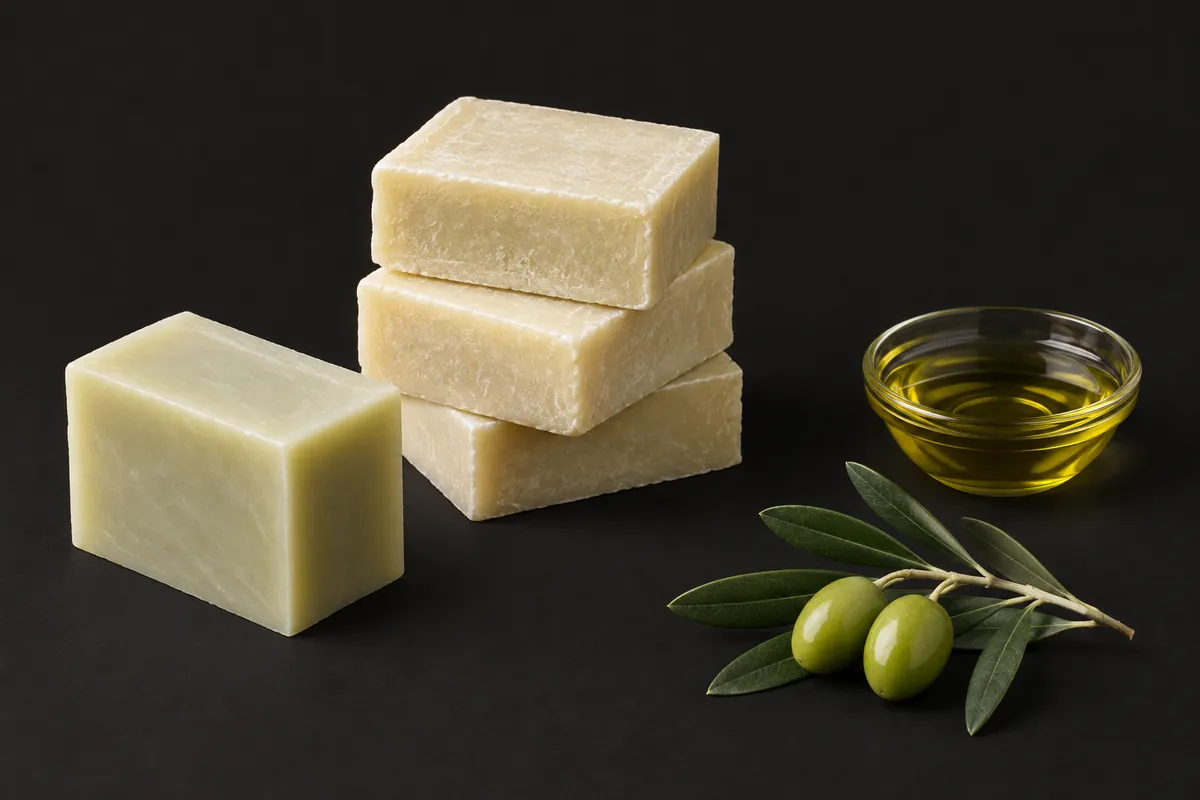
In short
- Castile means soap made from olive oil alone. Much of the liquid soap sold as castile today is a potassium soap of several oils.
- Olive oil is mostly oleic acid, with little of the saturated fat that thickens batter and firms a young bar, so castile traces slowly and starts soft.
- Its lather is low, creamy and slippery when the bar is young. Cure it for at least six months; it keeps improving after that.
- The quality numbers call it too soft because they count only saturated fatty acids as hardness, and they cannot see a cure.
- Less water, a little sodium lactate or salt, and patience before unmoulding all help.
- Any grade of olive oil makes castile. Pomace oil traces faster; its extra unsaponifiables are the usual explanation.
On this page
Castile is the plainest soap there is: olive oil, sodium hydroxide and water. It is also the one that most surprises new makers. It takes an age to trace, it is still soft when other soaps are ready to cut, a young bar feels slippery in the hand, and the calculator’s quality numbers look like a list of failures. None of that means anything has gone wrong. This guide explains why castile behaves as it does, what helps, and gives a recipe with the calculator’s numbers.
What “castile” means
Castile soap is soap made from olive oil alone, with sodium hydroxide, so it is a hard bar. The name is old: English had “castell sope”, soap from Castile in Spain, by the fifteenth century, and the name travelled. In 1911 the Encyclopaedia Britannica was still using “Castile soap” and “Marseilles soap” for the same thing, soap made from olive oil.
In shops the word now means something looser. Much of the liquid soap sold as castile is a potassium soap made from several vegetable oils. The best known of them lists water, coconut oil and potassium hydroxide first, then palm oil, with olive oil in fifth place. It is a different soap from the one this guide is about. On this site, as on our castile recipe, castile means olive oil and nothing else.
Bastile is the craft name for a soap that is mostly olive oil with something added for lather, usually coconut or castor oil. There is no fixed line: one well-known book draws it at 60 % olive oil, and many makers at 70 % or more. Our bastile is 80 % olive oil and 20 % coconut, and our high-olive bastile bar, 75 % olive with coconut and castor, is written out with a full method. Its traditional relatives, Aleppo, Nablus and Marseille soaps, have their own guide.
Why castile behaves the way it does
Everything unusual about castile comes from the make-up of olive oil. By the Codex standard, olive oil is 55 to 83 % oleic acid, a chain of 18 carbons with one bend in it, and only about 8 to 25 % saturated fatty acids (palmitic and stearic). It has almost none of the lauric and myristic acid that coconut oil brings.
It traces slowly. Trace is the batter thickening as soap forms. The saturated soaps of palmitic and stearic acid are the ones that set and stiffen a batter early, and olive oil has little of them, so a castile batter stays thin for a long time. Blend in short bursts and keep going: it takes noticeably longer than a recipe with coconut or palm oil in it, and a more powerful stick blender shortens the wait. Warmer oils and lye solution trace sooner too.
The usual mistake is to stop at emulsion, when the batter looks smooth and uniform but has not yet thickened, because the blending seems to be taking forever.
It comes out of the mould soft. Bars made from olive oil alone need at least 48 hours in the mould, and often longer, before they are firm enough to unmould and cut cleanly.
A young bar is slippery. Castile’s lather is low and creamy, with tiny bubbles and hardly any foam, and in a young bar it feels thick and almost slimy. It is the texture that gives castile its reputation, and it is at its worst in the first weeks.
It needs a long cure. A castile bar can take up to six months to harden fully, against four to six weeks for most soaps. High-oleic soaps keep improving long after the usual cure: the bar gets harder, lasts longer in the shower, and makers find the slippery feel fades. Weigh a bar now and then; while it is still losing weight, it is still curing. The curing guide explains how.
Why the numbers call it a bad soap
Put 100 % olive oil into the calculator and almost every quality figure falls outside its band.
| Figure | Castile | Usual band |
|---|---|---|
| Hardness | 17 | 29–54 |
| Cleansing | 0 | 12–22 |
| Conditioning | 82 | 44–69 |
| Bubbly lather | 0 | 14–46 |
| Creamy lather | 17 | 16–48 |
| Iodine value | 85 | 41–70 |
| INS | 106 | 136–165 |
100 % olive oil in our calculator. The bands are a community convention, not a measurement.
The reason is the way the figures are built. “Hardness” is the sum of four saturated acids (lauric, myristic, palmitic and stearic), so oleic acid, most of olive oil, counts for nothing. The figures describe a fresh soap by its fatty acids, and they cannot see cure time, water, or the way a bar’s structure changes as it dries. A six-month-old castile bar is hard in the hand, whatever the table says. That is a limit of the table, and the fatty acids guide explains it further. The historical soaps fare no better: see how Watt’s and Thomssen’s formulas score on today’s quality numbers.
The table is still useful for what it is. Make a fifth of the oil coconut instead, as in our bastile, and hardness comes up to 29, cleansing to 14 and bubbly lather to 14: just inside the bands, and a bar with a more familiar lather.
Helping it along
Less water. Less water shortens drying time and speeds trace, both of which castile needs, and it guards against castile’s one real failure. Kevin Dunn made pure olive oil soap at three strengths, mixed by shaking rather than with a stick blender. Only the 50 % solution traced; the weaker batches separated in the mould, a chalky, lye-heavy layer under a layer of free oil. With clove oil added to speed trace they set, but the weakest, at 25 %, still separated. A stick blender does far better than a shaken bottle, but the direction holds. Recipes differ in how much water they use, so the calculator shows the choice for 1000 g of olive oil at a 5 % superfat:
| Water setting | Lye solution | Water |
|---|---|---|
| 38 % of the oil weight, the old full-water habit | 25.3 % | 380.0 g |
| The calculator’s default, and our recipe page | 33 % | 261.2 g |
| A stronger solution | 38 % | 209.9 g |
Sodium hydroxide is 128.7 g in every row. The calculator notes solutions under 25 % as dilute and warns above 40 %, where trace comes fast and bars can turn crumbly.
Sodium lactate. One teaspoon per 454 g (1 lb) of oils, stirred into the lye solution once it has cooled, gives a firmer bar sooner and an easier unmoulding. For 1000 g of olive oil that is 14.5 g of the usual 60 % solution. More is not better: too much makes a brittle, crumbly bar.
Salt. Half a teaspoon per 454 g of oils, dissolved in the water before the lye goes in, also hardens the bar: 6.6 g for 1000 g of oil. Salt cuts lather, and castile has little to spare, so use one or the other at first.
Patience. Give the soap the full 48 hours or more in the mould. Silicone moulds are the slowest to let go of soft soap, and that is where sodium lactate and less water help most; the unmoulding guide has tricks for loaves that stick.
Which olive oil
Any grade makes castile. You do not need extra virgin oil, and freshness and a reliable supplier matter more than the grade. The Codex standard defines the grades.
| Grade | What it is | Free acidity, at most |
|---|---|---|
| Extra virgin olive oil | Pressed from the fruit, not refined | 0.8 % |
| Virgin olive oil | Pressed from the fruit, not refined | 2.0 % |
| Refined olive oil | Virgin oil, refined | 0.3 % |
| Olive oil | A blend of refined and virgin oils | 1.0 % |
| Olive-pomace oil | Extracted from the pressed pulp with solvent, refined, blended with virgin oil | 1.0 % |
From the Codex standard for olive oils and olive-pomace oils (CXS 33-1981). Free acidity is measured as oleic acid.
Extra virgin oil makes a greener soap and costs more. Lighter oils give a paler bar, though olive oil’s natural colour makes a pure white castile hard to get.
Pomace oil is the cheapest grade, and makers report that it traces faster. The usual explanation is its unsaponifiable matter, the part of an oil that lye cannot turn into soap: Codex allows up to 30 g/kg in olive-pomace oils against 15 g/kg in olive oils, and pomace oils carry more wax as well. Free fatty acids, which react with lye almost as soon as they meet it, are sometimes blamed too, but they cannot explain the pomace oil in the shops: Codex caps its free acidity at 1 %, lower than virgin olive oil’s 2 %. Why pomace traces faster is not settled. It makes perfectly good soap; use it when you want trace sooner, and virgin oil when you want time for a design.
Pomace oil needs slightly less lye than olive oil, so it has its own entry in the calculator: 1000 g at a 5 % superfat asks 127.0 g of sodium hydroxide, against 128.7 g for olive oil. Choose the oil you actually have.
A castile recipe
| Ingredient | 1000 g batch | 500 g batch |
|---|---|---|
| Olive oil | 1000 g | 500 g |
| Sodium hydroxide | 128.7 g | 64.3 g |
| Water | 261.2 g | 130.6 g |
| Sodium lactate, 60 % (optional) | 14.5 g | 7.2 g |
| Salt (optional) | 6.6 g | 3.3 g |
From the calculator: 5 % superfat, 33 % lye solution. If you enter the sodium lactate in the calculator, it counts the water the lactate carries and the water for the 1000 g batch drops to 255.4 g.
Make castile. 1000 g of olive oil at a 5 % superfat asks 128.7 g of sodium hydroxide and, at the default 33 % solution, 261.2 g of water.
Open it in the calculatorMake it as you would any cold process soap, with three differences. Expect the blending to take longer, and do not stop at emulsion. Leave the soap in the mould for at least 48 hours, and longer if it is still soft. And cure the bars for at least six months, somewhere cool and airy, turning them now and then. A batch made in spring is ready in the autumn.
Recipes to try
All recipesSources
- Castile soap . Merriam-Webster Dictionary . A fine hard bland soap made from olive oil and sodium hydroxide; from Middle English castell sope, from Castell, Castile; first known use in the 15th century.
- Soap . Encyclopaedia Britannica, 11th edition (via Wikisource) , 1911. In France olive oil 'occupies the chief place and the product is known as Marseilles or Castile soap'; soapmaking from olive oil established at Marseilles in the 13th century.
- Standard for Olive Oils and Olive Pomace Oils (CXS 33-1981) . Codex Alimentarius Commission (FAO/WHO) , 2015. Grade definitions; free acidity limits (0.8 % extra virgin, 2.0 % virgin, 0.3 % refined, 1 % olive oil and olive-pomace oil); unsaponifiable matter up to 15 g/kg for olive oils and 30 g/kg for olive-pomace oils; wax content higher in pomace oils.
- Peppermint Pure-Castile Liquid Soap . Dr. Bronner's . Ingredients: water, coconut oil, potassium hydroxide, palm oil, olive oil, mint oils, hemp seed oil, jojoba wax, citric acid, tocopherol.
- The Complete Photo Guide to Soap Making . David Fisher, Creative Publishing International , 2018. Castile has a low-bubble, thick, almost slimy lather and can take up to six months to harden fully; pomace oil can carry more unsaponifiables and speed trace; freshness matters more than grade.
- Soap Crafting . Anne-Marie Faiola, Storey Publishing , 2013. Soap over 60 % olive oil is informally called bastile; pomace can speed up trace; a water discount shortens drying and speeds trace; sodium lactate at 1 teaspoon per pound of oils in the lye water, which with a water discount eases unmoulding, especially from silicone moulds.
- Pure Soapmaking . Anne-Marie Faiola, Storey Publishing , 2016. Salt at half a teaspoon per pound of oils, dissolved in the water before the lye; salt decreases lather.
- Milk Soaps . Anne-Marie Faiola, Storey Publishing , 2019. Too much sodium lactate makes a brittle, crumbly bar.
- Smart Soapmaking . Anne L. Watson, Shepard Publications , 2013. Castile is notoriously hard to make; a more powerful stick blender shortens the blending; any grade of olive oil will do.
- The Natural Soap Chef . Heidi Corley Barto, Ulysses Press , 2012. Bars made with olive oil alone should stay in the mould for at least 48 hours.
- Curing soap . Classic Bells, Soapy Stuff . High-oleic soaps such as olive oil soap need a longer cure for best performance; weigh a bar to follow the water loss.
- The "Water Discount" . Kevin M. Dunn, The Handcrafted SoapMaker (Handcrafted Soapmakers Guild), issue 2008-2 , 2008. Olive oil soap at 50, 33.3 and 25 % lye: only the 50 % batch traced when shaken, the others separated in the mould; with clove oil to speed trace, the 25 % batch still separated. Less water traces faster and resists separation.