Coconut brine bar
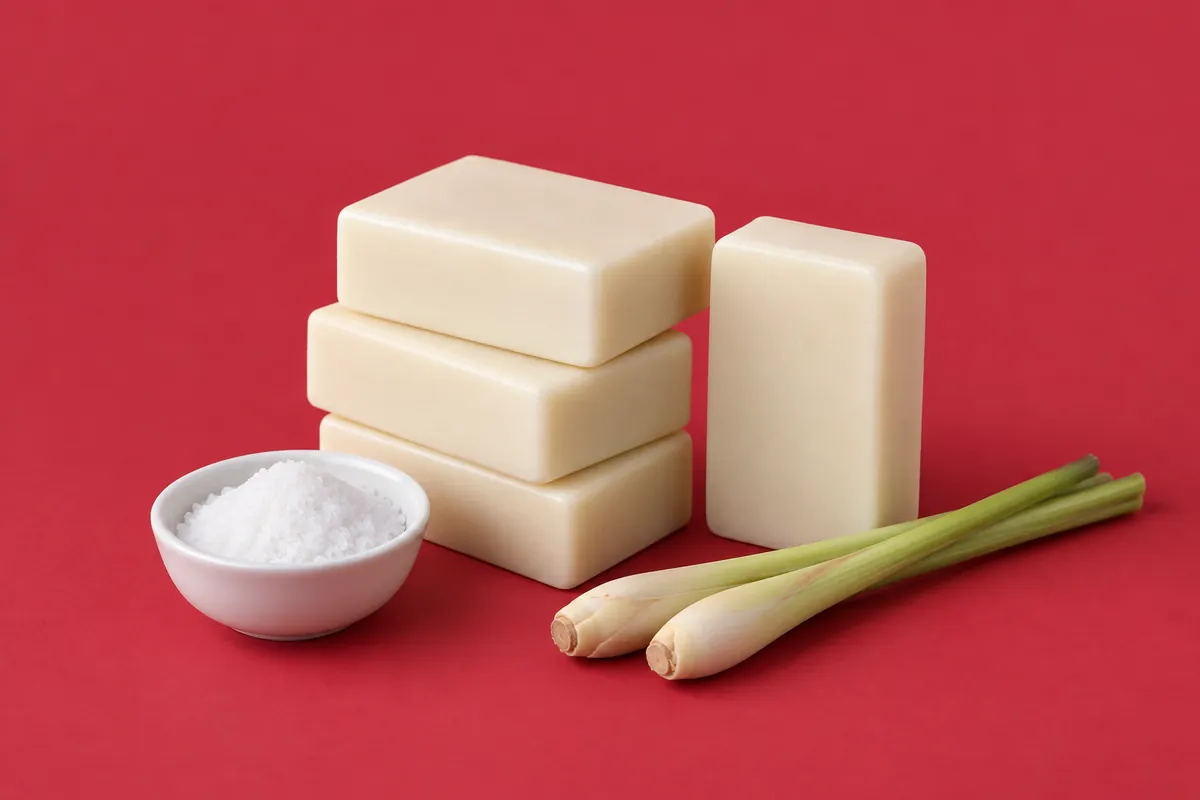
A smooth, hard brine bar: 60 % coconut oil at a 15 % superfat, with fine salt dissolved in generous water before the lye, poured into cavity moulds. Lemongrass and Virginian cedarwood scent it, and it lathers far more freely than a salt bar.
- Skill
- Beginner
- Method
- Cold process
- Batch
- 500 g of oils about 793 g of batter
- Hands-on
- 45 min
- Cure
- 6 weeks
- Gel phase
- Either way gel or not, both work
What you need
For 500 g of oils, which fills silicone cavity moulds holding about 800 ml in all, such as eight cavities of 100 ml. Weigh everything, liquids included.
| Coconut Oil · 60.0 % | 300 g | 10.58 oz |
| Olive Oil · 25.0 % | 125 g | 4.41 oz |
| Shea Butter · 10.0 % | 50 g | 1.76 oz |
| Castor Oil · 5.0 % | 25 g | 0.88 oz |
| Sodium hydroxide (NaOH) · the lye, 100 % pure | 69.3 g | 2.44 oz |
| Distilled water · for a 27 % lye solution | 190.0 g | 6.70 oz |
| Salt, fine (canning or table) · dissolved in the water before the lye goes in; close to all this lye solution keeps dissolved | 19 g | 0.67 oz |
| Virginian cedarwood essential oil · 2.0 % of the oils, at trace | 10 g | 0.35 oz |
| Lemongrass essential oil · 1.0 % of the oils, at trace | 5 g | 0.18 oz |
- Superfat
- 15 %
- Temperatures
- Oils and lye solution each at 35 to 40 °C (95 to 104 °F)
Method
-
Get ready
Put on splash goggles, gloves and long sleeves, open a window and keep children and pets out of the room. Stand the cavity moulds on a tray. -
Weigh everything
Weigh 300 g coconut oil and 50 g shea butter into the pot, and 125 g olive oil and 25 g castor oil into a jug. Weigh 190.0 g distilled water into a heatproof jug, 19 g fine salt into a cup, 69.3 g sodium hydroxide into a dry container, and 10 g Virginian cedarwood and 5 g lemongrass essential oil into a small glass. -
Make the brine
Stir the salt into the water until no grains are left at the bottom of the jug. -
Add the lye to the brine
At the open window, pour the sodium hydroxide slowly into the brine, never the brine onto the lye, and stir until it has all dissolved. If it turns faintly milky, a little salt has come back out; that is harmless, and all of it goes into the oils. Let it cool to 35 to 40 °C (95 to 104 °F). -
Melt the oils
Melt the coconut oil and shea butter until clear, then stir in the olive and castor oils and let them settle at 35 to 40 °C (95 to 104 °F). -
Blend to light trace
Pour the whole lye solution into the oils, any cloudy part included, and stick blend in short bursts, stirring between them, until a drizzle leaves a faint line on the surface. -
Add the scent
Stir in the essential oils with a spatula; lemongrass can thicken the batter a little, so move on promptly. -
Fill the moulds
Pour the batter into the cavities and tap the tray firmly on the worktop to release air, so the moulded faces come out crisp. -
Leave to set
Leave the moulds uncovered and uninsulated in a warm room. -
Unmould
With this much water the bars set more slowly than a salt bar, so press them out after 24 to 48 hours, once they are firm. If a detailed mould tears the corners, give them another day. -
Cure
Stand the bars on a rack with air around them for six weeks, turning them now and then.
Tips
- The salt stops at 19 g because the lye's own sodium pushes salt back out of solution. This batch's lye water keeps about 19.6 g dissolved; at an ordinary 33 % lye solution the same oils would hold only about 7 g, which is why the water here is raised to 38 % of the oils. Fisher, like many makers, dissolves a quarter of the water's weight in salt, which here would be 47.5 g, and most of that would come back out as white crystals.
- Use canning or pickling salt if you can. The anti-caking agents in some table salt leave the brine cloudy before the lye even goes in.
- The quality numbers read brisk, cleansing 41, because they cannot see the 15 % superfat. That spare oil is what keeps a 60 % coconut bar comfortable.
- This bar sits between two others: our sea salt bar, with salt at half the oil weight stirred in at trace, and our castile brine bar, pure olive oil with a brine.
The oils
| Oil | Share |
|---|---|
| Coconut Oil | 60.0 % |
| Olive Oil (virgin / refined / olive oil) | 25.0 % |
| Shea Butter | 10.0 % |
| Castor Oil | 5.0 % |
How it is made
| Process | Cold process |
| Alkali | NaOH |
| Superfat | 15 % |
| Water | 38 % of the oils |
| Iodine value | 36 |
| INS | 193 |
Why make it
A brine bar, soleseife in German, dissolves its salt in the water before the lye goes in, so the finished bar is smooth and dense rather than grainy. Fisher describes brine soap as rock hard, long-lasting and fine in texture, with a dense lather, and well suited to detailed moulds. This one is 60 % coconut oil for a brisk lather, cleansing 41 on our scale, at a 15 % superfat, a salt-bar figure that the quality numbers cannot show, to keep it kind to skin. The water is generous, 38 % of the oils, so that 19 g of salt stays dissolved despite the lye. That firms the bar, yet it is a small fraction of a salt bar's salt, so the lather stays lively. It suits anyone who wants a hard, long-lasting bar that lathers more freely than a salt bar. As with salt bars, there is no evidence that the salt does anything for skin.
Sources
- The Complete Photo Guide to Soap Making · David Fisher, Creative Publishing International, 2018
- Solubilities of Inorganic and Organic Compounds, 2nd edition · Atherton Seidell, D. Van Nostrand, 1919
What tradition, makers' experience and research say about soaps like this, each labelled for what it is. It is not medical advice, and no soap treats a skin condition: if you have one, ask a doctor or pharmacist.
What the numbers say
- Lauric acid 29.5 %
- Myristic acid 11.3 %
- Palmitic acid 9.2 %
- Stearic acid 6.8 %
- Ricinoleic acid 4.4 %
- Oleic acid 26.7 %
- Linoleic acid 5.0 %
- Other 9.4 %
Saturated : unsaturated 64 : 36
Computed from the fatty acids of the fats above. The bands are what the craft has settled on, not chemistry — a bar outside one is not wrong.
Try it differently
2 variationsThe same soap with one thing moved. Each opens in the calculator ready to change again.
From the guides
All guides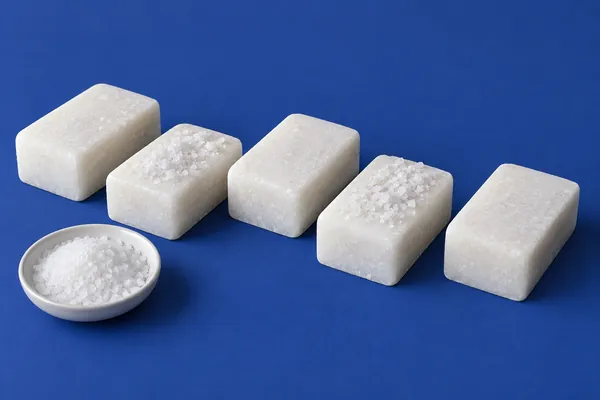
Salt bars: spa soap with sea salt
Why salt bars are mostly coconut oil at a 15 to 20 % superfat, how much salt to use and which to avoid, when to cut them, and how brine bars differ.
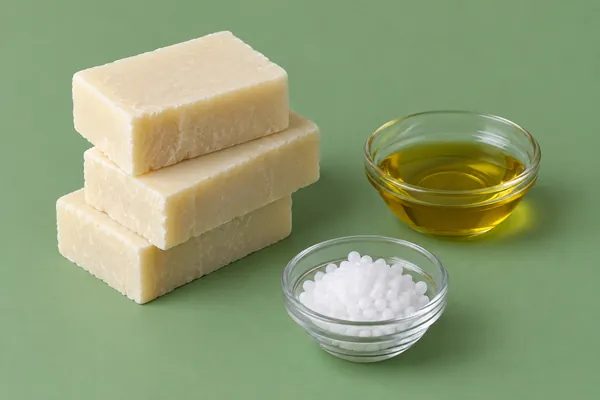
Superfat and lye discount: why recipes leave some oil unsaponified
What superfat and lye discount mean, how the calculator applies them, where makers set them for each soap, and why oil added at trace isn't the oil left over.

Soap moulds: choosing one and sizing a recipe to fit
Silicone, wood, slab, cavity, tube and improvised soap moulds; lining with freezer paper; and how to size a recipe to a mould, with a worked example.
Where these proportions come from
Craft convention: salt dissolved in the water before the lye rather than stirred in at trace, which cuts lather less and so allows more non-lauric oil than a salt bar: 60 % coconut oil at a 15 % superfat. The water is 38 % of the oils, a 26.7 % lye solution, because lye pushes salt out of solution: at that strength 19 g of salt stays dissolved by Winteler's measurements of salt in sodium hydroxide solutions, where a 33 % solution would hold about 7 g.