Charcoal pencil line bar
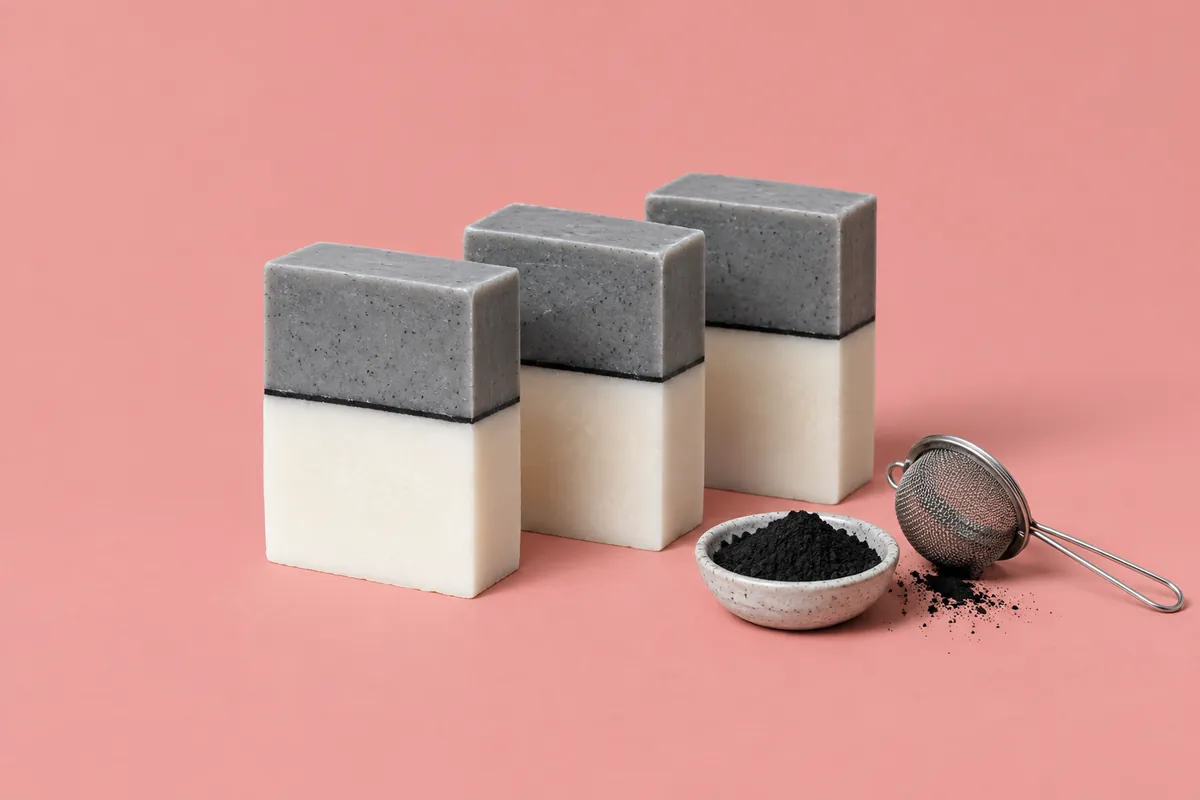
A white lower layer and a soft grey top, divided by one crisp charcoal line dusted through a tea strainer. The trick is a veil of powder, not a crust, so the bar never splits along its line.
- Skill
- Intermediate
- Method
- Cold process
- Batch
- 900 g of oils about 1317 g of batter
- Hands-on
- 1 h 15 min
- Cure
- 5 weeks
- Gel phase
- Yes insulate the mould
What you need
For 900 g of oils, which fills a 25 × 9 cm loaf mould filled 6 cm deep (about 1.4 litres). Weigh everything, liquids included.
| Olive Oil · 35.0 % | 315 g | 11.11 oz |
| Shea Butter · 30.0 % | 270 g | 9.52 oz |
| Coconut Oil · 30.0 % | 270 g | 9.52 oz |
| Castor Oil · 5.0 % | 45 g | 1.59 oz |
| Sodium hydroxide (NaOH) · the lye, 100 % pure | 126.4 g | 4.46 oz |
| Distilled water · for a 33 % lye solution | 256.5 g | 9.05 oz |
| Titanium dioxide · 1.5 tsp, white lower layer, dispersed in 27 g of the recipe's olive oil | 7 g | 0.25 oz |
| Activated charcoal, for the grey · 0.13 tsp, grey top layer, dispersed in 14 g of the recipe's olive oil | 0.3 g | 0.01 oz |
| Activated charcoal, for the line · 0.13 tsp, dusted dry through a tea strainer between the layers | 0.3 g | 0.01 oz |
| Lemon oil · 2.5 % of the oils, at trace | 23 g | 0.79 oz |
| Litsea oil · 0.5 % of the oils, at trace | 4.5 g | 0.16 oz |
- Superfat
- 5 %
- Temperatures
- Oils and lye solution at 35 to 40 °C (95 to 104 °F)
Method
-
Get ready
Put on goggles, gloves and long sleeves and open a window. Line the mould and set it on a level surface where it can stay for a day, with a 1 litre jug, a small cup, a spatula and a fine tea strainer in reach. -
Weigh the oils and mix the colours
Weigh 300 g shea butter and 300 g coconut oil into the pot. Weigh 350 g olive oil, pour 27 g of it into the jug and 14 g into the cup, and add 50 g castor oil to the rest. Stir 1½ teaspoons of titanium dioxide into the oil in the jug and the first ⅛ teaspoon of charcoal into the oil in the cup until smooth, and put the second ⅛ teaspoon of charcoal, dry, in the tea strainer. -
Make the lye solution
Where the air moves, pour the 126.4 g of sodium hydroxide slowly into the 256.5 g of water, never the reverse, and stir until clear. Leave it labelled and out of reach to cool to 35 to 40 °C (95 to 104 °F). -
Melt and scent the oils
Melt the shea butter and coconut oil gently, add the rest of the olive oil and the castor oil, and let them cool to 35 to 40 °C (95 to 104 °F) while they stay clear. Stir in 25 g lemon and 5 g litsea essential oil. -
Blend to light trace
Pour the lye solution in down the blender shaft, tap out trapped air, and blend in short pulses with stirring between until light trace: thin custard that holds a faint line for a few seconds. -
Split the batter
Weigh 755 g of batter into the white jug and whisk it in; that is the lower layer. Whisk the grey dispersion into the batter left in the pot, about 510 g, for the top. -
Pour the white layer
Pulse the white to medium trace, like pudding, pour it into the mould and level the top with the spatula so the line will run straight. Tap the mould, then leave it 3 to 5 minutes, until a light touch leaves a mark that does not close. -
Dust the line
Hold the strainer a few centimetres above the surface and tap it gently as you move from one end to the other. Step back, close your eyes and blow gently across the mould to even it out: you want a veil you can just see the white through, about 0.3 g over the whole layer. -
Pour the grey layer
Bring the grey to light-medium trace and pour it slowly onto the back of a spatula held just above the line, starting at one end, so it spreads without pushing the charcoal into drifts. Tap gently and smooth the top. -
Cover so it gels
Cover the mould with a board or lid and wrap it in a towel for a day, two towels in a room below about 24 °C (75 °F), so the whole loaf gels evenly. -
Unmould and cut
Unmould with gloves on after 24 to 48 hours, once firm, and cut bars about 2.5 cm (1 in) thick so the line runs straight across each face. Wipe the knife between cuts, or it smears charcoal down the white. -
Cure
Stand the bars on edge with air between them, out of direct sun, for 5 weeks, turning them every few days.
Tips
- Too much powder is why pencil lines split: loose charcoal keeps the two layers from growing together. If you overdo it, blow the excess off before you pour, rather than pouring over a drift.
- Pour the grey within about 10 minutes of the white. A lower layer left for hours has set too far for the next one to bond to it.
- For a shimmering line instead, dust ⅛ teaspoon of a dark mica the same way.
The oils
| Oil | Share |
|---|---|
| Olive Oil (virgin / refined / olive oil) | 35.0 % |
| Shea Butter | 30.0 % |
| Coconut Oil | 30.0 % |
| Castor Oil | 5.0 % |
How it is made
| Process | Cold process |
| Alkali | NaOH |
| Superfat | 5 % |
| Water | lye water at 33 % |
| Iodine value | 52 |
| INS | 155 |
Why make it
A good first design bar: two layers and one fine line teach timing, trace control and a steady pour, with little that can go badly wrong. The base is an everyday palm-free bar of olive oil, shea butter and coconut in near-equal parts with a little castor, balanced at cleansing 20 and conditioning 52 on our scale, hard and long-lasting. The charcoal and titanium dioxide are there for looks only; in these amounts they simply wash away with the bar. Lemon and litsea give a bright, sherbet-like scent that many people enjoy in a morning shower, and litsea is there because lemon alone fades over the cure. The caveat is the line itself: a heavy hand with the charcoal keeps the layers from bonding, and the bar splits along it.
What tradition, makers' experience and research say about soaps like this, each labelled for what it is. It is not medical advice, and no soap treats a skin condition: if you have one, ask a doctor or pharmacist.
What the numbers say
- Lauric acid 14.7 %
- Myristic acid 5.7 %
- Palmitic acid 8.6 %
- Stearic acid 14.5 %
- Ricinoleic acid 4.4 %
- Oleic acid 40.8 %
- Linoleic acid 6.9 %
- Other 5.5 %
Saturated : unsaturated 48 : 52
Computed from the fatty acids of the fats above. The bands are what the craft has settled on, not chemistry — a bar outside one is not wrong.
From the guides
All guides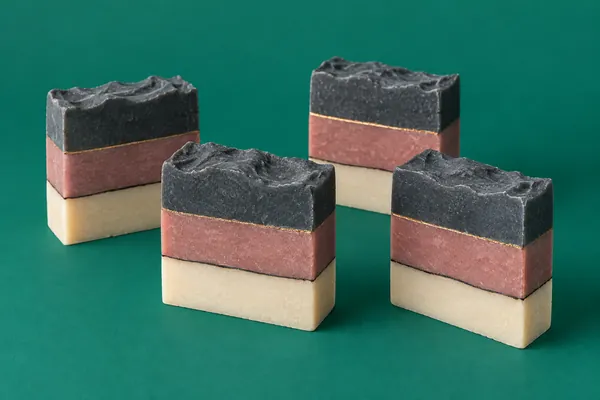
Layers, mica lines and pencil lines
Layered cold-process soap: batter thickness, pouring over a spatula, working out each layer from the mould, and pencil lines that don't split the bar.
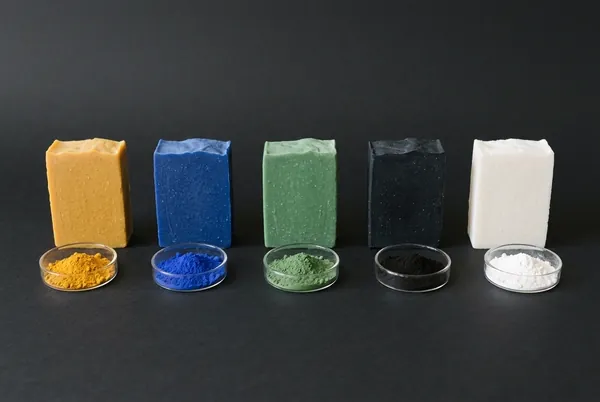
Colouring soap: micas, oxides, ultramarines and pigments
Which colourants survive cold-process soap, how much to use per 500 g of oils, how to disperse and split colour, and what the EU, UK and US rules ask.
Where these proportions come from
Adapted from David Fisher's The Basic, the recipe behind his coffee soap with a mica line, with shea butter in place of the palm oil; the dusted line follows Fisher's and Anne-Marie Faiola's tea-strainer method.
Formulation adapted from The Complete Photo Guide to Soap Making by David Fisher (Creative Publishing International, 2018); Soap Crafting by Anne-Marie Faiola (Storey Publishing, 2013). The method and notes are ours.