Lavender and calendula bar
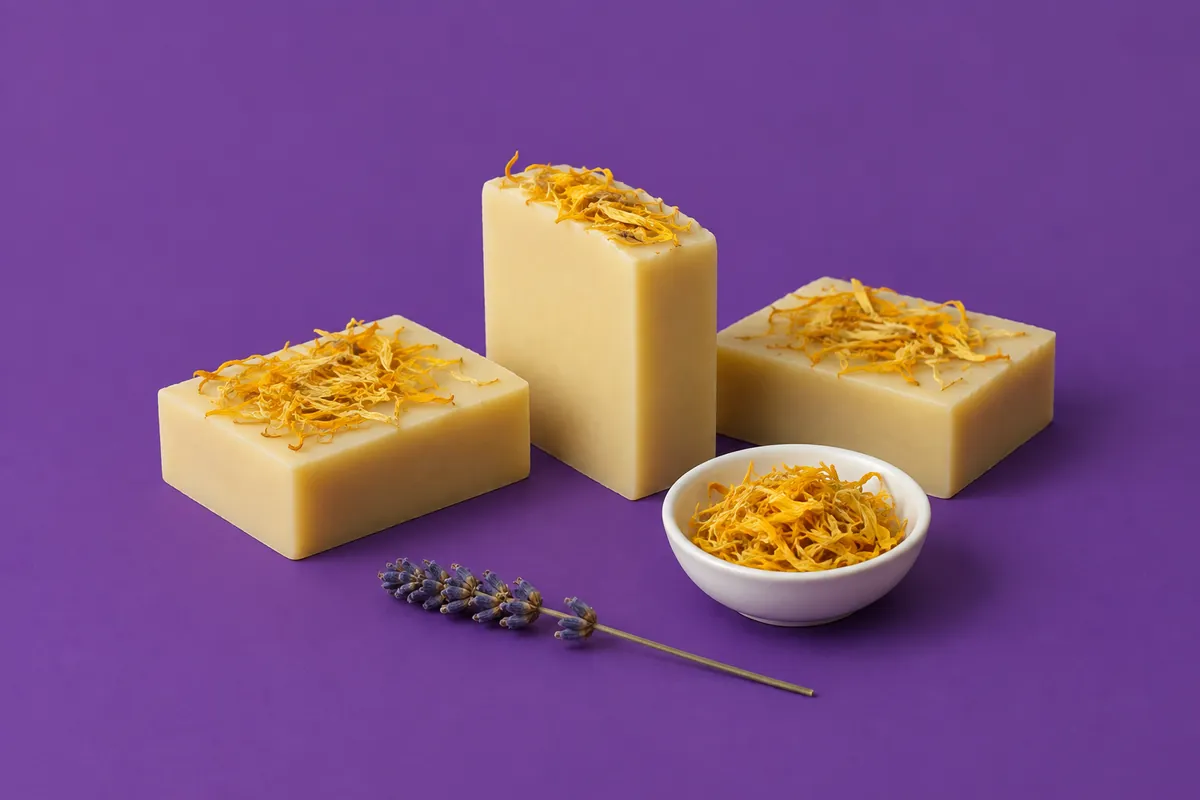
A gentle, palm-free bar made with calendula-infused olive oil, lightly scented with lavender and finished with calendula petals pressed into the top. Calendula is the one common flower that stays yellow in soap, so the petals keep their colour.
- Skill
- Beginner
- Method
- Cold process
- Batch
- 1000 g of oils about 1430 g of batter
- Hands-on
- 1 h 15 min
- Cure
- 6 weeks
- Gel phase
- Either way gel or not, both work
What you need
For 1000 g of oils, which fills a 1.5 litre loaf mould. Weigh everything, liquids included.
| Olive Oil · 50.0 % | 500 g | 17.64 oz |
| Shea Butter · 20.0 % | 200 g | 7.05 oz |
| Coconut Oil · 18.0 % | 180 g | 6.35 oz |
| Cocoa Butter · 7.0 % | 70 g | 2.47 oz |
| Castor Oil · 5.0 % | 50 g | 1.76 oz |
| Sodium hydroxide (NaOH) · the lye, 100 % pure | 134.2 g | 4.73 oz |
| Distilled water · for a 33 % lye solution | 272.4 g | 9.61 oz |
| Dried calendula petals, for the infused oil · infused in 280 g of olive oil and strained out | 8 g | 0.28 oz |
| Dried calendula petals, for the top · a loose handful, pressed onto the poured soap | 3 g | 0.11 oz |
| Olive oil, extra for the calendula infusion · 280 g is infused so that 250 g can be strained off for the recipe; the petals keep the rest | 30 g | 1.06 oz |
| Lavender essential oil · 2.0 % of the oils, at trace | 20 g | 0.71 oz |
- Superfat
- 6 %
- Temperatures
- Oils and lye solution each between 32 and 43 °C (90 and 110 °F)
Method
-
Infuse the calendula oil
A day or more ahead, put 8 g of dried calendula petals and 280 g of olive oil in a clean glass jar and stand it in a pan of hot water, keeping the oil at about 49 °C (120 °F) and below 54 °C (130 °F), for 2 to 4 hours; warm oil only this way, never over a flame, and don't leave it. Strain it through fine cloth and weigh out 250 g, topping it up with plain olive oil if the petals kept too much. -
Get ready
Open a window or turn on the extractor fan, send children and pets out, and put on splash goggles, nitrile gloves and long sleeves. Set out a 1.5 litre loaf mould, lined if it is not silicone. -
Weigh everything
Weigh 200 g shea butter, 180 g coconut oil and 70 g cocoa butter into the pot, and the 250 g of calendula oil, 250 g of plain olive oil and 50 g castor oil into a jug. Weigh 272.4 g of distilled water into the lye jug, 20 g of lavender essential oil into a small cup, and the 134.2 g of sodium hydroxide last, into a dry container. -
Make the lye solution
Where air moves, pour the sodium hydroxide slowly into the water, never the water onto the lye, and stir until it turns clear. Keep your face away from the vapour and leave it to cool, labelled and out of reach. -
Melt the butters
Melt the shea butter, cocoa butter and coconut oil on the lowest heat until just clear, then pour in the calendula oil, the plain olive oil and the castor oil. -
Check the temperatures
Go on when the oils are clear and both they and the lye solution are between 32 and 43 °C (90 and 110 °F). -
Blend to light trace
Pour the lye solution into the oils down the shaft of the stick blender and tap the blender to let trapped air out. Pulse and stir until the batter looks like thin custard and a drizzle leaves a faint line on the surface. -
Add the lavender
Stir in the lavender essential oil by hand, then give the batter two or three short pulses. -
Pour
Pour into the mould, scraping the pot clean, tap the mould firmly on the worktop to bring up air bubbles, and smooth the top. -
Press on the petals
After 10 to 15 minutes, when the top has thickened enough to hold them, scatter the 3 g of calendula petals over it and press them in lightly with a gloved hand so they stick. -
Cover and leave
Set an upturned box or tray over the mould so nothing touches the petals, and leave it for a day. It may gel or not; either is fine. -
Unmould and cut
After 24 to 48 hours, when the loaf is firm, unmould it with gloves on and lay it on its side to cut, so the knife doesn't drag petals down the bars. -
Cure
Stand the bars on edge in a dry, airy place out of the sun for six weeks, turning them every few days. Light fades the petals and the golden tint, so keep the finished bars in the dark too.
Tips
- Calendula is the petal to use on top: its colour is a carotenoid that survives lye, while lavender buds and most other petals turn brown. That is why the lavender here is the essential oil only.
- For the most sensitive skin, leave the lavender out. The bar is just as good unscented.
- Calendula belongs to the daisy family, so anyone allergic to daisies or ragweed should try the bar on a small patch of skin first.
- The infused oil is still olive oil to the calculator: the petals are strained out and change nothing in the lye.
The oils
| Oil | Share |
|---|---|
| Olive Oil (virgin / refined / olive oil) | 50.0 % |
| Shea Butter | 20.0 % |
| Coconut Oil | 18.0 % |
| Cocoa Butter (Theobroma Oil) | 7.0 % |
| Castor Oil | 5.0 % |
How it is made
| Process | Cold process |
| Alkali | NaOH |
| Superfat | 6 % |
| Water | lye water at 33 % |
| Iodine value | 61 |
| INS | 139 |
Why make it
A gentle, pretty bar for people who like a light floral scent. Half olive oil and only 18 % coconut keep the cleansing low, 12 on our scale, and shea and cocoa butter make the lather creamy. Calendula is here because it is the petal that keeps its golden colour in soap. In herbal medicine the European Medicines Agency's monograph accepts calendula creams and infusions as traditional remedies on the strength of long use alone, not trials; a soap is a different product, and the petals in it are for colour. Lavender is a classic soap scent that people choose simply because they like it. For very sensitive skin, make it unscented, as dermatologists advise fragrance-free cleansers, and remember that calendula belongs to the daisy family.
Sources
- European Union herbal monograph on Calendula officinalis L., flos · European Medicines Agency, 2018
- Dermatologists' top tips for relieving dry skin · American Academy of Dermatology
What tradition, makers' experience and research say about soaps like this, each labelled for what it is. It is not medical advice, and no soap treats a skin condition: if you have one, ask a doctor or pharmacist.
What the numbers say
- Lauric acid 8.8 %
- Myristic acid 3.4 %
- Palmitic acid 11.1 %
- Stearic acid 12.8 %
- Ricinoleic acid 4.4 %
- Oleic acid 47.9 %
- Linoleic acid 8.1 %
- Other 4.2 %
Saturated : unsaturated 39 : 61
Computed from the fatty acids of the fats above. The bands are what the craft has settled on, not chemistry — a bar outside one is not wrong.
From the guides
All guides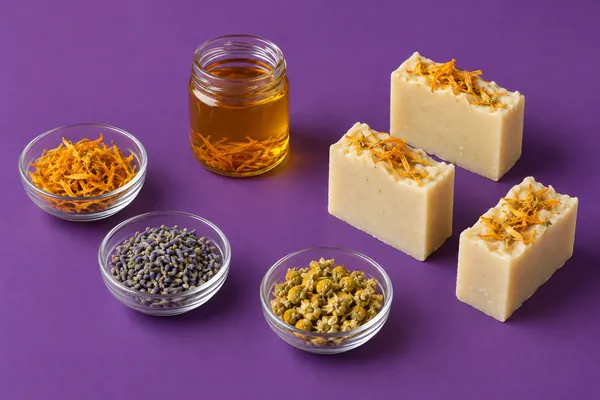
Herbs, flowers and infusions in soap
What dried herbs, petals, infused oils and herbal teas really do in soap: which survive lye, how to infuse an oil, and which claims a herbal soap can make.

Scenting soap: essential oils and fragrance oils
How much essential or fragrance oil to use in soap, what ounces per pound mean in percent, the IFRA limits for common essential oils, and EU allergen labelling.
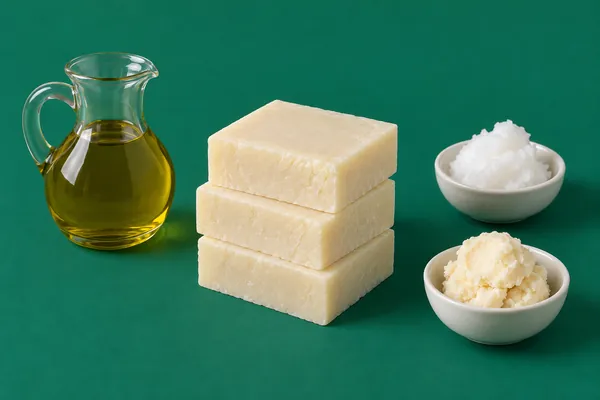
Your first cold process soap, step by step
A complete first batch of cold process soap: one simple recipe with exact lye and water for 500 g and 1 kg of oils, and every step from goggles to cure.
Guides with this recipe
Where these proportions come from
Our own formulation: a gentle palm-free bar, half olive oil with only 18 % coconut oil, at a 6 % superfat. The calendula follows Anne-Marie Faiola's calendula bar, with petals infused in part of the oil and more pressed onto the top.
Formulation adapted from Soap Crafting by Anne-Marie Faiola (Storey Publishing, 2013). The method and notes are ours.