Butter bar
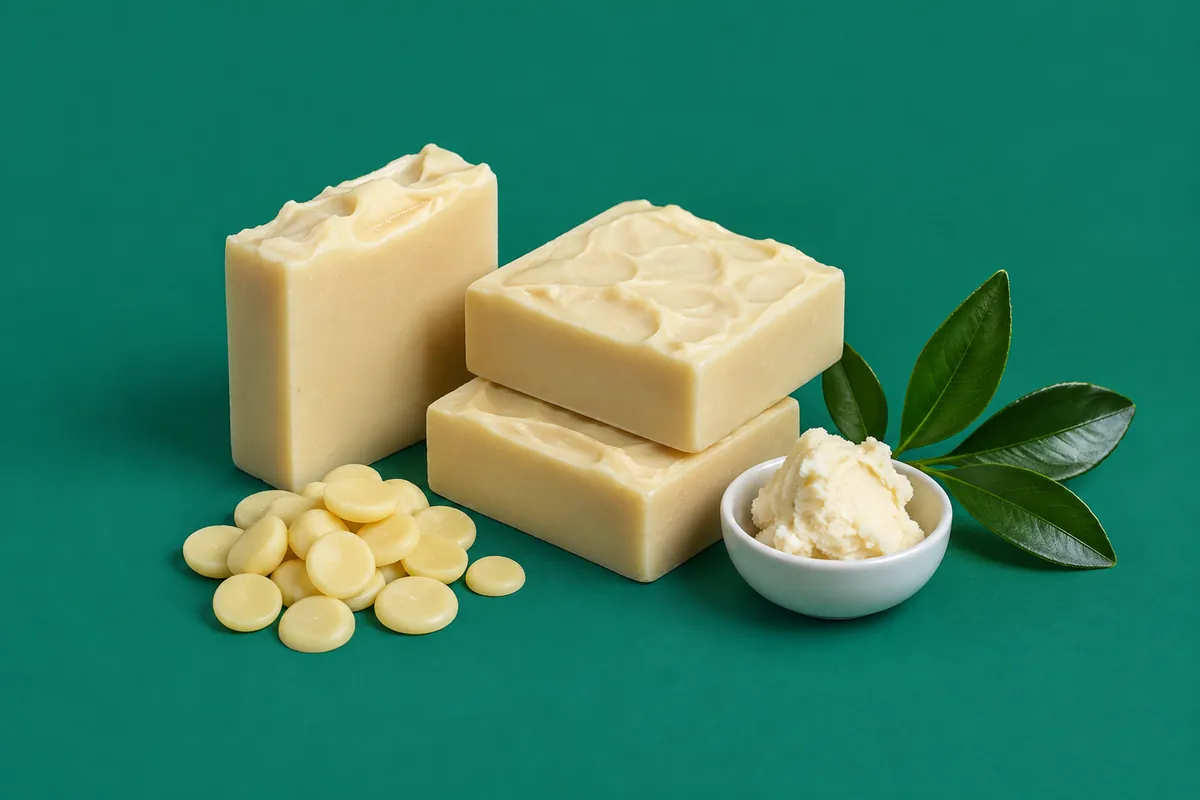
Forty per cent shea and cocoa butter make a hard, dense bar with a creamy, lotion-like lather, and an 8 % superfat leaves a little more oil in it than an everyday bar. Lightly scented with petitgrain; leave it out and nothing else changes.
- Skill
- Beginner
- Method
- Cold process
- Batch
- 1000 g of oils about 1425 g of batter
- Hands-on
- 1 hour
- Cure
- 6 weeks
- Gel phase
- Either way gel or not, both work
What you need
For 1000 g of oils, which fills a 1.5 litre loaf mould. Weigh everything, liquids included.
| Olive Oil · 35.0 % | 350 g | 12.35 oz |
| Shea Butter · 25.0 % | 250 g | 8.82 oz |
| Cocoa Butter · 15.0 % | 150 g | 5.29 oz |
| Coconut Oil · 20.0 % | 200 g | 7.05 oz |
| Castor Oil · 5.0 % | 50 g | 1.76 oz |
| Sodium hydroxide (NaOH) · the lye, 100 % pure | 132.1 g | 4.66 oz |
| Distilled water · for a 33 % lye solution | 268.2 g | 9.46 oz |
| Petitgrain essential oil · 2.5 % of the oils, at trace | 25 g | 0.88 oz |
- Superfat
- 8 %
- Temperatures
- Oils and lye solution each at 38 to 43 °C (100 to 110 °F), so the butters stay liquid
Method
-
Get ready
Put on splash goggles, nitrile gloves and long sleeves, open a window or turn on the extractor fan, and keep children and pets out of the room. Line a 1.5 litre loaf mould. -
Weigh the oils and scent
Weigh 250 g shea butter, 150 g cocoa butter and 200 g coconut oil into the soaping pot, 350 g olive oil and 50 g castor oil into a jug, and 25 g petitgrain essential oil into a small glass cup. -
Make the lye solution
Weigh 268.2 g distilled water into a heat-safe jug and 132.1 g sodium hydroxide into a dry container. At the open window or under the fan, pour the lye slowly into the water, never the water onto the lye, stir until clear and leave it to cool, labelled and out of reach. -
Melt the butters
Melt the shea butter, cocoa butter and coconut oil together on the lowest heat until completely clear, with no cloudy flecks of cocoa butter left, then pour in the olive and castor oils. -
Check the temperatures
Carry on when the oils and the lye solution are each between 38 and 43 °C (100 and 110 °F). Cooler than that, the butters begin to set and thicken the batter before it has really traced. -
Combine
Pour the lye solution into the oils down the shaft of the stick blender, tap the blender on the bottom of the pot to let trapped air out, and keep the blade under the surface while it runs. -
Blend to light trace
Pulse for a few seconds at a time, stirring between bursts. Butters bring trace on quickly, so check often and stop when a drizzle leaves a faint line on the surface. -
Add the scent
Pour in the petitgrain and stir it through by hand with a spatula for 20 to 30 seconds. -
Pour and cover
Pour into the mould, tap it on the worktop to raise air bubbles, and smooth the top or texture it with the back of a spoon. Cover it with a lid or board, adding a towel only if the room is cold: a butter-rich loaf that gets too hot can crack on top. -
Clean up
With your gloves still on, wipe the batter off the pot and tools with paper towels into the bin, then wash them in hot soapy water. -
Unmould and cut
After 24 to 36 hours, when the loaf is firm but still cuts cleanly, unmould it with gloves on and cut it into bars about 2.5 cm (1 in) thick. -
Cure
Stand the bars on edge in a dry, airy room for six weeks, turning them every few days.
Tips
- Cut early. Cocoa butter sets a loaf hard within a couple of days, and a butter bar left too long in the mould tends to crumble or chip at the edges under the knife.
- If the batter turns thick and grainy the moment the lye goes in, the butters are setting, not tracing. Stand the pot in hot water for a minute, stir, and blend again.
- Unrefined cocoa butter smells faintly of chocolate and tints the bar a warm cream; deodorised cocoa butter keeps it paler and lets the petitgrain through. For dry or sensitive skin, leave the scent out.
- The shea and cocoa butter luxury bar is a close cousin with rose geranium and optional silk, and the goat milk, oat and honey bar puts goat milk into a similar base.
The oils
| Oil | Share |
|---|---|
| Olive Oil (virgin / refined / olive oil) | 35.0 % |
| Shea Butter | 25.0 % |
| Cocoa Butter (Theobroma Oil) | 15.0 % |
| Coconut Oil | 20.0 % |
| Castor Oil | 5.0 % |
How it is made
| Process | Cold process |
| Alkali | NaOH |
| Superfat | 8 % |
| Water | lye water at 33 % |
| Iodine value | 54 |
| INS | 147 |
Why make it
Forty per cent butters put this bar at 42 for hardness and 33 for creaminess on our scale, so it lasts well in a wet soap dish and lathers in a dense, lotion-like way rather than in big bubbles. The 20 % coconut oil keeps it cleaning properly, at 14 on our scale, the gentle end of normal, and the 8 % superfat leaves a little more free oil than an everyday bar. Makers reach for it for dry hands in winter. Shea butter has long been rubbed into skin across sub-Saharan Africa, but in soap almost all of it turns into soap like any other fat; what stays is its share of the superfat and its unsaponifiable matter, 2 to 12 % of the butter, which lye cannot turn into soap. Past about 40 % butters a bar starts to feel waxy and lathers less, which is why this one stops there.
Sources
- A review of ethnomedicinal uses of shea butter for dermatoses in Sub-Saharan Africa · Dermatologic Therapy (Ugwu-Dike and Nambudiri), 2022
- Triterpene alcohol and fatty acid composition of shea nuts from seven African countries · Journal of Oleo Science (Akihisa et al.), 2010
What tradition, makers' experience and research say about soaps like this, each labelled for what it is. It is not medical advice, and no soap treats a skin condition: if you have one, ask a doctor or pharmacist.
What the numbers say
- Lauric acid 9.8 %
- Myristic acid 3.8 %
- Palmitic acid 11.5 %
- Stearic acid 17.2 %
- Ricinoleic acid 4.4 %
- Oleic acid 42.9 %
- Linoleic acid 6.9 %
- Other 4.2 %
Saturated : unsaturated 45 : 55
Computed from the fatty acids of the fats above. The bands are what the craft has settled on, not chemistry — a bar outside one is not wrong.
Try it differently
20 variationsThe same soap with one thing moved. Each opens in the calculator ready to change again.
- Mango Butter instead of Cocoa Butter (Theobroma Oil)
- Kokum Butter instead of Cocoa Butter (Theobroma Oil)
- Illipe Butter instead of Cocoa Butter (Theobroma Oil)
- Sal Butter instead of Cocoa Butter (Theobroma Oil)
- Cupuaçu Butter instead of Cocoa Butter (Theobroma Oil)
- Murumuru Butter instead of Cocoa Butter (Theobroma Oil)
- 5 % superfat
- 12 % superfat
- Mango Butter instead of Cocoa Butter (Theobroma Oil) and 5 % superfat
- Mango Butter instead of Cocoa Butter (Theobroma Oil) and 12 % superfat
- Kokum Butter instead of Cocoa Butter (Theobroma Oil) and 5 % superfat
- Kokum Butter instead of Cocoa Butter (Theobroma Oil) and 12 % superfat
- Illipe Butter instead of Cocoa Butter (Theobroma Oil) and 5 % superfat
- Illipe Butter instead of Cocoa Butter (Theobroma Oil) and 12 % superfat
- Sal Butter instead of Cocoa Butter (Theobroma Oil) and 5 % superfat
- Sal Butter instead of Cocoa Butter (Theobroma Oil) and 12 % superfat
- Cupuaçu Butter instead of Cocoa Butter (Theobroma Oil) and 5 % superfat
- Cupuaçu Butter instead of Cocoa Butter (Theobroma Oil) and 12 % superfat
- Murumuru Butter instead of Cocoa Butter (Theobroma Oil) and 5 % superfat
- Murumuru Butter instead of Cocoa Butter (Theobroma Oil) and 12 % superfat
From the guides
All guides
Superfat and lye discount: why recipes leave some oil unsaponified
What superfat and lye discount mean, how the calculator applies them, where makers set them for each soap, and why oil added at trace isn't the oil left over.
The soaping oils: what each one brings to a bar
Twenty-five soaping oils, butters and waxes: what each does in a bar and why, the share makers give it, and what to watch for, with figures from our records.
Seizing, ricing and acceleration
Why soap batter suddenly thickens, sets solid or turns lumpy, which fragrances and conditions cause it, what to do mid-batch, and how to test a new scent small.
Where these proportions come from
Our own formulation: 40 % shea and cocoa butter, which is about where a bar stops feeling like soap and starts feeling waxy, with olive oil, 20 % coconut oil for a proper lather and a little castor oil, at an 8 % superfat.