In short
- Acceleration is batter thickening faster than planned. Seizing is its extreme, a solid lump in seconds. Ricing is hard lumps in batter that is still fluid.
- Fragrance is the usual trigger. Eugenol, the main aroma chemical of clove and cinnamon leaf oils, is the best-measured culprit, and many floral and spice fragrance oils behave the same way.
- Heat, less water, hard fats and stick blending make any fragrance faster.
- Mid-batch, stop blending, stir by hand and get the batter into the mould. If it sets in the pot, cook it as hot process.
- Seized or riced soap is usually fine once it has set, but test it first: a batch that set unevenly can hide lye.
On this page
Most batches of cold process soap thicken at a pace you can plan around: a minute or two of stick blending to emulsion, then time to colour, swirl and pour. Now and then a batch moves far faster, and a planned swirl turns into a race to get the batter into the mould before it sets in the jug. This guide covers the three ways that happens, what causes each, what to do with the batch in front of you, and how to find out whether a fragrance will do it before you trust it with a full loaf.
Three ways batter runs away
- Acceleration. The batter thickens much faster than planned, from thin to pudding in a minute or two, but it can still be poured or spooned.
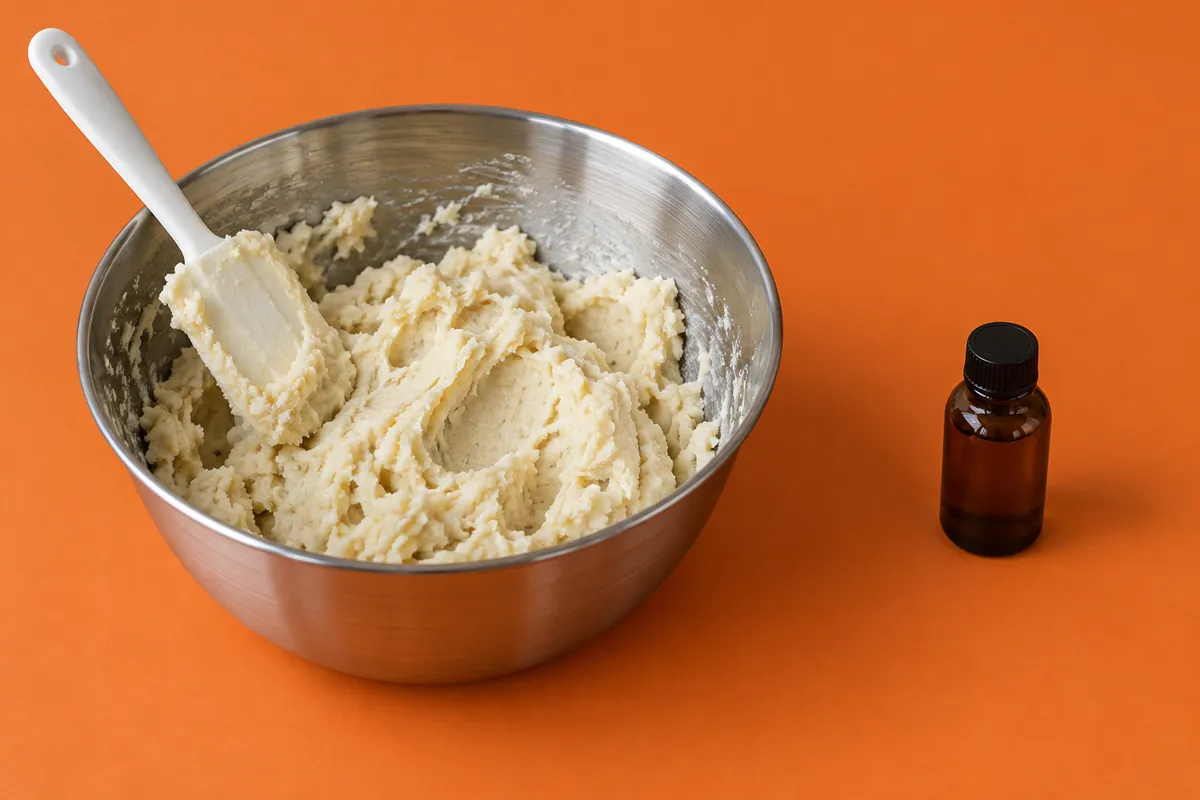
- Seizing. The extreme case. Within seconds, often just after the fragrance goes in, the batter stiffens into a clumpy, clay-like mass that will not pour. Seized batter usually runs hot in the mould afterwards; Soap Queen notes that seizing and heat go together. Streaks can be the warning: Susan Miller Cavitch found synthetic fragrance oils “more prone to begin streaking and then suddenly seize” the batch.
- Ricing. Small, hard lumps like grains of rice or tapioca appear in batter that is otherwise still fluid, sometimes with a slick of oil around them.
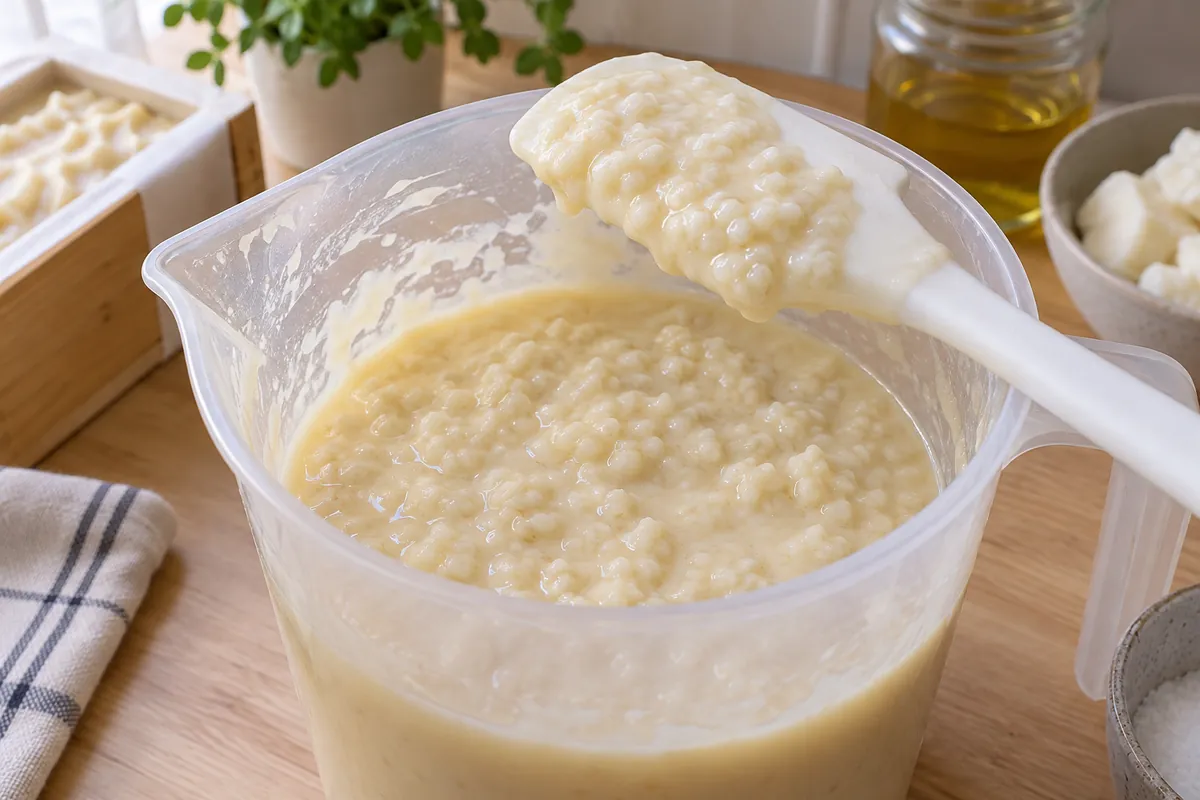 Ricing: the batter is still liquid, but the fragrance has turned part of it into firm little lumps.
Two other problems can look similar at first glance, and it matters which you have.
| When it starts | What it looks like | Can you still pour it? | |
|---|---|---|---|
| Acceleration | Any time, often just after the fragrance | Smooth but thickening fast | Yes, quickly |
| Seizing | Seconds after the fragrance goes in | Stiff, clumpy, sets in the pot | No: press it into the mould |
| Ricing | After the fragrance | Hard lumps in fluid batter | Yes, once blended smooth |
| False trace | Within a minute of adding the lye, before any fragrance | Grainy or curdled, from hard fats setting in cool batter | Keep blending until it is smooth first |
| Separation | Any time | Oil pooling on the surface | No: see separation |
False trace is covered in the trace guide; separation is the one of these that can leave caustic pockets in the bar.
What is going on in the pot
Trace is the batter thickening as soap forms and holds the oil and lye in a stable emulsion. Anything that speeds up saponification, or makes the young soap set sooner, shortens the time you have to work.
Part of this has been measured. Kevin Dunn recorded the thickness of soap batter minute by minute and found it rose faster at a higher temperature, with less water, and with more eugenol, the main aroma chemical in clove oil. On his graphs, the same batter reached the top of his thickness scale in about five minutes at 60 °C and took more than twenty at 40 °C. In an earlier study he added clove oil on purpose, to force trace in olive soaps that would not trace on their own. His lectures also note that saturated fats saponify faster than unsaturated oils, and that fragrances and additives can raise both the speed of the reaction and the peak temperature of the loaf.
Eugenol can make up most of an oil. IFRA’s table of typical levels, which our fragrance data use, puts it at about 82 % of clove bud oil, 85 % of clove leaf oil, 74 % of cinnamon leaf oil and 51 % of West Indian bay oil. Two similar names are quite different: cinnamon bark oil carries about 2 % and bay laurel oil about 1 %. Low eugenol does not make an oil safe to soap with, though. Cavitch names cassia alongside clove as an oil that makes batter overreact, and cassia is mostly cinnamic aldehyde: 70 to 85 % aldehydes in the grades Simmons and Appleton describe.
Why eugenol and a good many floral and spice fragrances do this has not, as far as we can find, been worked out in print. What makers have instead is a track record: some fragrances accelerate every time, and suppliers who test in cold process soap say so in their notes.
One related case is well understood. A free fatty acid such as stearic acid reacts with lye in seconds, where an oil takes hours, because it is simply an acid meeting a base. That is why stearic acid melted into the oils can make batter set almost at once, and why Catherine Failor, in her book on transparent soap, adds it separately after trace. Old fats that have begun to break down carry more free fatty acids, which react just as quickly. Simmons and Appleton traced many faults of factory cold-process soap to such oils in 1908: the free acid turns to soap so fast that grains form, and strong lye throws them out of solution, leaving the batch “thick and gritty”.
Ricing has no measured explanation either. Soap Queen describes it as an ingredient in the fragrance binding with the harder fats in the recipe to form small lumps. That comes from experience rather than a laboratory, but it fits what makers see: ricing is commoner in recipes rich in hard fats and butters, and rarer in soft-oil recipes.
What makes a batch move too fast
| Cause | Why | What to change |
|---|---|---|
| A fragrance not proven in cold process | Eugenol-rich oils (clove, cinnamon leaf, West Indian bay, allspice) and many floral and spice fragrance oils speed trace; Modern Soapmaking adds “ozone” notes to the list | Read the supplier’s cold process notes, test in a small batch, and stir it in by hand, last |
| Hot batter | Heat speeds saponification | Modern Soapmaking keeps below about 43 °C (110 °F) for working time; Soap Queen soaps at about 49 °C (120 °F) and warns that hotter batter accelerates. With a known accelerator, soap at room temperature |
| Little water | A stronger lye solution traces faster and runs hotter | Use the full water: Modern Soapmaking suggests a 25 to 33 % lye solution for the most time |
| A lot of saturated fat | Saturated fats saponify faster; Modern Soapmaking expects fast trace once they pass about half the fatty acids, and Faiola finds palm kernel oil accelerates above 15 % | Swap some hard fat for olive or high-oleic sunflower oil |
| Pomace olive oil | Cavitch and Faiola both find it traces fast, and Cavitch that it exaggerates what a fragrance does | Use refined olive oil instead, and run the recipe through the calculator again |
| Cold milk added at trace | It chills the hard fats, a false trace that looks like acceleration | Warm it a little first: Faiola adds her milk at about 29 °C (85 °F) |
| Stearic acid, or old fats | Free fatty acids react in seconds | Add stearic acid melted, after trace, or leave it out; use fresh oils |
| Honey, sugars, alcoholic liquids | They add heat | Stir honey in at thin trace; for beer, wine and juices see liquids in soap |
| Clays and some pigments | They thicken the batter | Disperse clay in a little water before it goes in |
| Stick blending | Every second of it moves trace on | Short bursts: DeeAnna Rouse uses three or four of 2 to 3 seconds with hand stirring between. Don’t stick blend a fragrance in |
Temperatures and water figures are makers’ working ranges from the sources named, not measured limits.
When it happens mid-batch
The batter is accelerating
Put the stick blender down and stir by hand with a spatula. Drop the ambitious design: a simple pour or a textured top will still work, a fine swirl will not. Get the batter into the mould now, tap the mould on the worktop to settle it, and expect extra heat, so leave off the towel and watch the loaf for cracks. The overheating guide covers what to do if it starts to dome.
It has seized
Work fast. Scoop the batter into the mould with a spatula, press it into the corners to push out air, and bang the mould down a few times. It will be rustic, and it will get hot, so skip the insulation.
If it has set too far to mould, cook it. Scrape it into a stainless steel pot no more than a third full, heat it on medium-low, and stir often until it turns into a gelatinous mass like mashed potato. Anne-Marie Faiola’s rescue takes 15 to 60 minutes of this; Soap Queen finds it works on a batch up to about 24 hours old. Then press the soap into moulds. What you have made is hot process soap, and the hot process guide explains the rest.
It has riced
Stick blend in short bursts to smooth the lumps out. Soap Queen finds they usually blend back in, but the batter will thicken as they do, so have the mould ready. Lumps left in show later: Faiola finds riced soap can leave pock marks and oil pockets in the cured bar. If the lumps will not go, or oil starts to pool around them, the batch is separating: cook it as above rather than pouring it, and read the separation section of the soft soap guide.
Testing a new fragrance
A fragrance that behaves in one recipe can race in another, so test it in the recipe you mean to use, at the temperatures and water you really use. Soap Queen tests fragrances in 1 lb (454 g) batches; Faiola advises a pound or less.
- Make a small batch of the real recipe. Scale your recipe down to about 500 g of oils, keeping the same water, superfat and lye concentration.
- Match your usual conditions. Same soaping temperature, same stick blender, same room. A test run hotter or cooler than usual tells you little.
- Weigh the fragrance at the rate you plan to use. Check it against the supplier’s maximum for soap; the scenting guide covers usage rates and limits.
- Blend to emulsion, then stir the fragrance in by hand. Time how long the batter takes to reach thin, medium and thick trace, and watch for lumps, oil slicks or sudden heat.
- Pour it and keep watching. Check the mould after an hour or two for heat and cracking, and look at the bars again over the next week: vanilla-type fragrances turn soap brown as it cures.
- Write it down. Fragrance, supplier, batch, rate, temperatures and times. Those notes are what make the full-size batch predictable.
A 500 g test batch. The usual three oils at 500 g take 72.1 g of sodium hydroxide and 146.3 g of water at a 33 % lye solution; fragrance at 3 % of the oils is 15 g.
Open it in the calculatorWorking with a fragrance you know accelerates
You don’t have to give up a scent that accelerates. You have to give it less to work with.
- Put it in after the reaction. In hot process soap the fragrance goes in after the cook, when the lye is used up, so it has nothing to accelerate. Failor makes the same point about transparent soap: by the time the fragrance goes in, the oils and lye have finished reacting. Rebatching works the same way.
- Soap cool, with full water. Room-temperature oils and lye, and a lye solution at the weak end of your usual range. Anne Watson keeps the most water in her calculator’s range for fragrances known to accelerate.
- Dilute it and add it late. Soap Queen mixes the fragrance with an equal weight of the recipe’s liquid oil before adding it. Watson passes on the advice to keep the scent cool and add it when the batter has just begun to thicken, though she avoids such scents herself or saves them for rebatching. Either way, stir it in by hand.
- Stir it in briefly. Cavitch drizzles essential oil in at light trace and stirs “for twenty to thirty seconds, or as little time as needed”, because “too much stirring causes streaking and seizing”.
- Keep the design simple and the mould ready. A one-colour loaf or a textured top, with everything in reach before the fragrance goes in.
Recipes to try
All recipesSources
- Trace Analysis . Kevin M. Dunn, lecture to the Handcrafted Soapmakers Guild , 2010. Batter viscosity measured over time at different temperatures, water contents and eugenol levels.
- The 'Water Discount' . Kevin M. Dunn, The Handcrafted Soapmaker 2008-2 , 2008. Low-water soap traces faster; clove oil added to force trace in olive soaps.
- Time and Temperature in Soapmaking . Kevin M. Dunn, lecture to the Handcrafted Soapmakers Guild , 2009.
- Transparency and Meltability in Hot-Process Soap . Kevin M. Dunn, lecture to the Handcrafted Soapmakers Guild , 2012. Soap from oil takes 1 to 4 hours; soap from a fatty acid forms in seconds.
- IFRA Standards, 51st Amendment: Annex on contributions from other sources . International Fragrance Association , 2023. Typical eugenol levels in natural oils, as held in our fragrance data.
- Making Transparent Soap . Catherine Failor, Storey Publishing , 2000.
- Smart Soapmaking . Anne L. Watson, Shepard Publications , 2013.
- Soap Crafting . Anne-Marie Faiola, Storey Publishing , 2013.
- Pure Soapmaking . Anne-Marie Faiola, Storey Publishing , 2016. Pomace olive oil speeding trace; palm kernel oil accelerating above 15 %; milk warmed before it goes in at trace, since cold milk chills the solid oils; riced soap leaving pock marks and oil pockets.
- The Natural Soap Book . Susan Miller Cavitch, Storey Publishing , 1995. Fragrance oils that streak and then seize; clove and cassia making batter overreact; pomace exaggerating it; scent stirred in for only 20 to 30 seconds.
- The Handbook of Soap Manufacture . W. H. Simmons and H. A. Appleton, Scott, Greenwood & Son (Project Gutenberg edition) , 1908. Free acidity in the oils making cold-process soap thick and gritty; cassia oil graded by its cinnamic aldehyde content.
- Soap Behaving Badly . Soap Queen (Bramble Berry) , 2014.
- Controlling Trace in Cold Process Soapmaking . Kenna Cote, Modern Soapmaking .
- Trace and stick blender basics . DeeAnna Rouse, Classic Bells .