Green cube embed bar
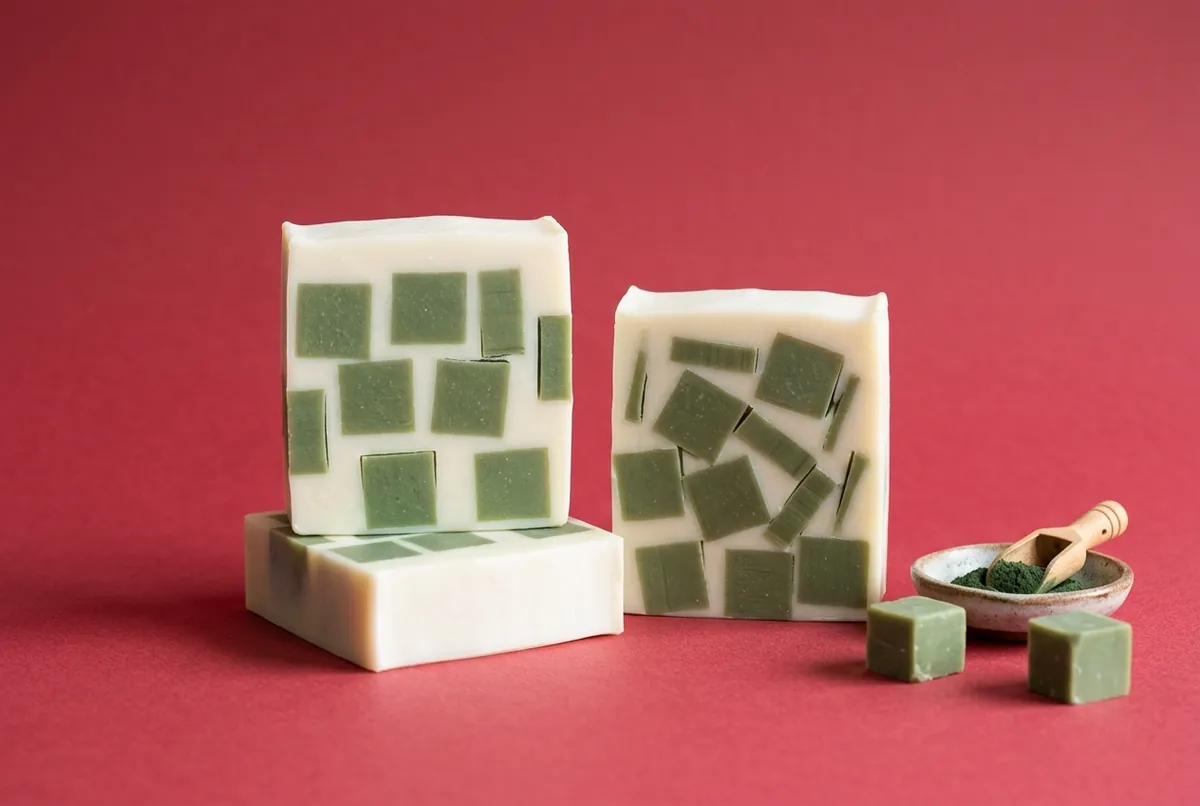
Sage green cubes set in a white bar, made as two batches of one recipe: a quarter for the cubes, cut a day or two later, and three quarters for the base. The base is planned by weight, so the loaf comes out full.
- Skill
- Intermediate
- Method
- Cold process
- Batch
- 1000 g of oils about 1463 g of batter
- Hands-on
- 2 hours
- Cure
- 5 weeks
- Gel phase
- Yes insulate the mould
What you need
For 1000 g of oils, which fills a 25 × 9 cm loaf mould at least 7 cm deep (about 1.5 litres), and a 15 × 10 cm tub for the cubes. Weigh everything, liquids included.
| Olive Oil · 40.0 % | 400 g | 14.11 oz |
| Coconut Oil · 25.0 % | 250 g | 8.82 oz |
| Shea Butter · 20.0 % | 200 g | 7.05 oz |
| Sunflowerseed Oil - High Oleic Acid · 10.0 % | 100 g | 3.53 oz |
| Castor Oil · 5.0 % | 50 g | 1.76 oz |
| Sodium hydroxide (NaOH) · the lye, 100 % pure | 138.5 g | 4.88 oz |
| Distilled water · for a 33 % lye solution | 281.2 g | 9.92 oz |
| Chromium oxide green · 0.75 tsp, cube batch only, dispersed in 14 g of its olive oil | 3.7 g | 0.13 oz |
| Titanium dioxide · 2 tsp, base batch only, dispersed in 27 g of its olive oil | 9.4 g | 0.33 oz |
| Lemongrass oil · 1.5 % of the oils, at trace | 15 g | 0.53 oz |
| Atlas cedarwood oil · 1.5 % of the oils, at trace | 15 g | 0.53 oz |
- Superfat
- 5 %
- Temperatures
- Oils and lye solution at 35 to 40 °C (95 to 104 °F) for both batches
Method
-
Plan it by weight
The weighing list covers two batches: a quarter of every amount makes the green cubes, and three quarters, made a day or two later, makes the white base. The loaf holds about 1,425 g, which is about 330 g of cubes plus the 1,095 g of base, the finished weight less the embeds. -
Weigh the cube batch
Put on goggles, gloves and long sleeves. Weigh 100 g olive oil, 62.5 g coconut oil, 50 g shea butter, 25 g sunflower oil and 12.5 g castor oil, and a quarter of the 138.5 g of sodium hydroxide (34.6 g) and of the 281.2 g of water (70.3 g). Take 14 g of the olive oil and stir the chromium green into it until smooth. -
Make the cube batch
Where the air moves, pour the lye slowly into its water, never the reverse, stir until clear and let it cool to 35 to 40 °C (95 to 104 °F). Melt the fats, add the liquid oils, blend the two to light trace, then whisk in the green and 3.75 g each of lemongrass and cedarwood oil. -
Pour the slab
Blend to medium trace, like pudding, and pour into a lined tub about 15 × 10 cm so it stands about 2.4 cm deep. Cover it and wrap it in a towel for a day. -
Cut the cubes
After 24 to 48 hours, when firm, unmould it with gloves on, trim the rough edges and cut 2.4 cm cubes, about 24 of them, some 330 g in all. Use them within a few days, while they are fresh enough to bond with the base. -
Weigh the base batch
Weigh the other three quarters: 300 g olive oil, 187.5 g coconut oil, 150 g shea butter, 75 g sunflower oil and 37.5 g castor oil, and the other three quarters of the sodium hydroxide (103.9 g) and of the water (210.9 g). Take 27 g of the olive oil and stir the titanium dioxide into it. -
Make the base
Make the lye solution and melt the oils as before, blend them to light trace at 35 to 40 °C (95 to 104 °F), and whisk in the white and 11.25 g each of lemongrass and cedarwood oil. Blend on to a thin pudding: thick enough to hold a cube where you put it, fluid enough to fill every gap. -
Lay the first cubes
Pour about 340 g of base into the lined loaf mould and tap it level. Press 12 cubes gently into it in two rows of six, about 1.5 cm apart and clear of the walls. -
Lay the second cubes
Pour about 340 g more slowly around and over them, filling the gaps first, and tap the mould. Press in the other 12 cubes, staggered against the rows below. -
Top it off
Pour the rest of the base over them, tap the mould firmly to bring up trapped air, and smooth the top. Tent any cube corner that still shows with folded card. -
Cover so it gels
Cover the mould with a board or lid and wrap it in a towel for a day, two towels in a room below about 24 °C (75 °F), so the whole base gels evenly around the cubes. -
Unmould and cut
Unmould with gloves on after 24 to 48 hours and cut bars about 2.5 cm (1 in) thick. Each cube should sit tight and flush in the cut face; a gap or a rim you can catch with a fingernail means the base was too thick when poured. -
Cure
Stand the bars on edge with air between them, out of direct sun, for 5 weeks, turning them every few days.
Tips
- Fresh cubes bond. Soap a day to a few days old is firm enough to handle and still soft enough to knit with the base; old, cured pieces tend to loosen and fall out as the bar wears.
- Colour embeds with oxides, ultramarines or micas. A dye bleeds out of the cube into the base and blurs its edges.
- The weighing list's lye and water are the totals for both batches. The steps split them into a quarter and three quarters; write the four figures on the containers before you start.
The oils
| Oil | Share |
|---|---|
| Olive Oil (virgin / refined / olive oil) | 40.0 % |
| Coconut Oil | 25.0 % |
| Shea Butter | 20.0 % |
| Sunflowerseed Oil - High Oleic Acid | 10.0 % |
| Castor Oil | 5.0 % |
How it is made
| Process | Cold process |
| Alkali | NaOH |
| Superfat | 5 % |
| Water | lye water at 33 % |
| Iodine value | 59 |
| INS | 145 |
Why make it
Under the cubes this is a palm-free everyday bar, cleansing 17 and conditioning 60 on our scale, so it washes like any good household bar and suits most skin. People make it for the look and for the skill: planning the base by weight and setting fresh cubes so they bond is a real step up from a plain loaf, and the result makes a striking gift. The green is chromium oxide, a mineral pigment permitted in cosmetics in the United States (21 CFR 73.2327) and chosen by makers because it keeps its colour through lye and light, where plant greens fade. Lemongrass and cedarwood give a fresh, woody scent. The cubes wear down with the base as long as they were fresh when set; old, cured pieces can loosen.
Sources
- 21 CFR 73.2327, Chromium oxide greens · U.S. Food and Drug Administration (eCFR)
What tradition, makers' experience and research say about soaps like this, each labelled for what it is. It is not medical advice, and no soap treats a skin condition: if you have one, ask a doctor or pharmacist.
What the numbers say
- Lauric acid 12.3 %
- Myristic acid 4.7 %
- Palmitic acid 8.9 %
- Stearic acid 10.8 %
- Ricinoleic acid 4.4 %
- Oleic acid 47.4 %
- Linoleic acid 7.8 %
- Other 5.1 %
Saturated : unsaturated 40 : 60
Computed from the fatty acids of the fats above. The bands are what the craft has settled on, not chemistry — a bar outside one is not wrong.
From the guides
All guides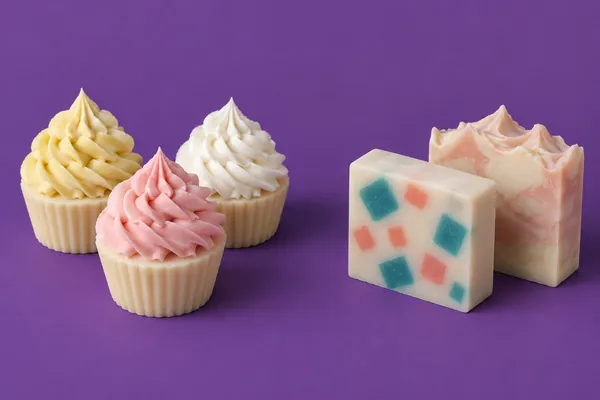
Embeds, textured tops and piping
Soap embeds that stay put and don't bleed, textured and botanical tops, piped frosting and soap cupcakes, and how to keep soda ash off the top.
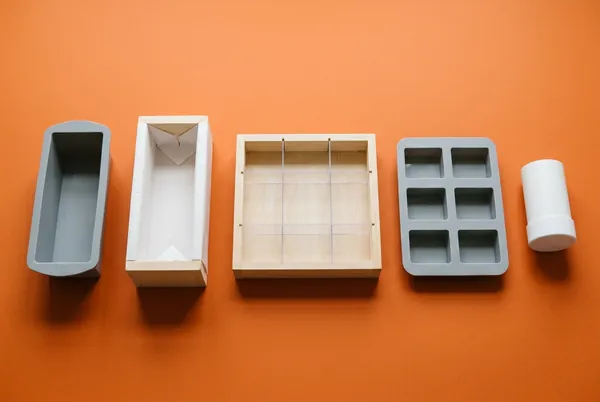
Soap moulds: choosing one and sizing a recipe to fit
Silicone, wood, slab, cavity, tube and improvised soap moulds; lining with freezer paper; and how to size a recipe to a mould, with a worked example.
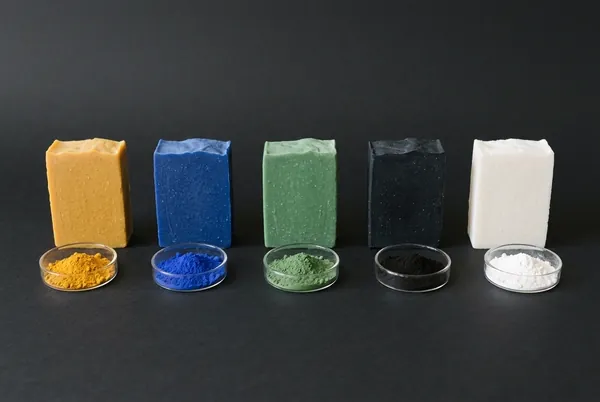
Colouring soap: micas, oxides, ultramarines and pigments
Which colourants survive cold-process soap, how much to use per 500 g of oils, how to disperse and split colour, and what the EU, UK and US rules ask.
Where these proportions come from
The oils of our palm-free classic, made as two batches of one recipe the way Heidi Corley Barto makes her mosaic soaps, with the base sized by David Fisher's rule for embeds: the finished weight minus the weight of the pieces.
Formulation adapted from The Natural Soap Chef by Heidi Corley Barto (Ulysses Press, 2012); The Complete Photo Guide to Soap Making by David Fisher (Creative Publishing International, 2018). The method and notes are ours.