Soap scrap confetti bar
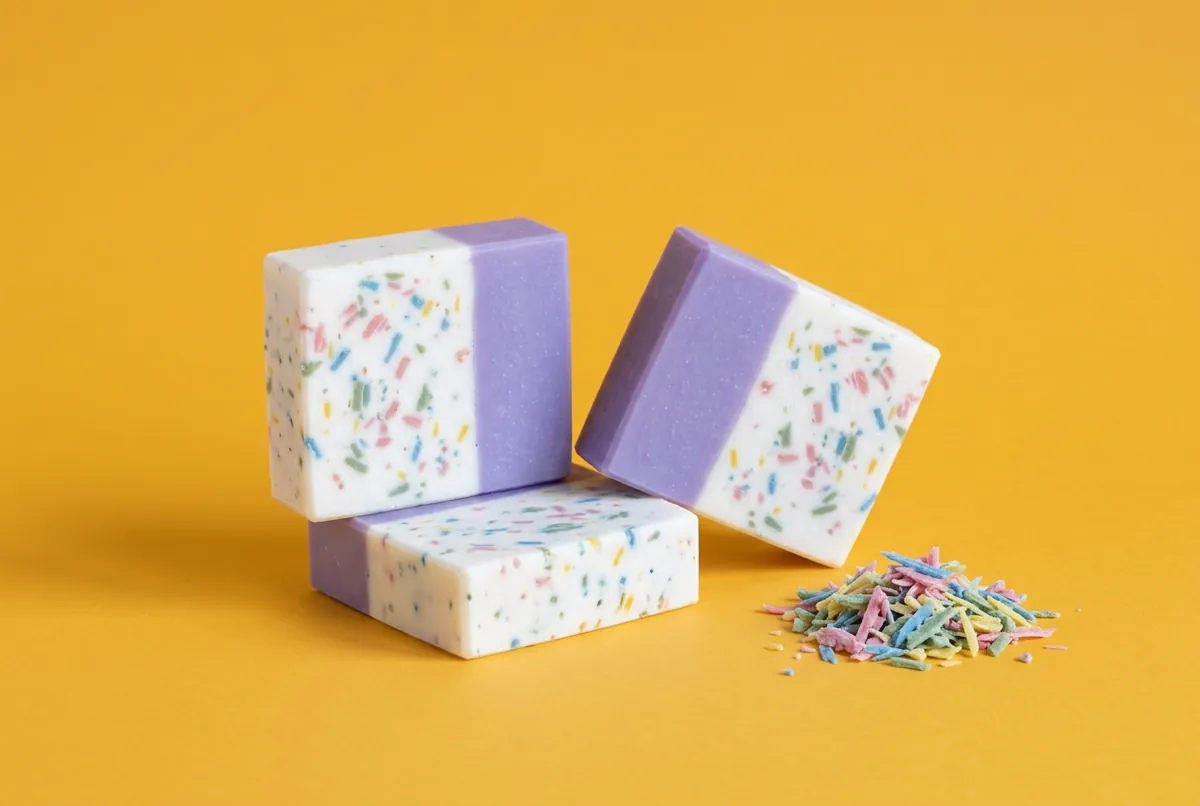
Grated offcuts from earlier batches folded into white batter beside a plain violet stripe, so every bar is flecked with confetti. Soaped cool and chilled so the pieces keep their edges: a good home for bevel trimmings and loaf ends.
- Skill
- Intermediate
- Method
- Cold process
- Batch
- 900 g of oils about 1512 g of batter
- Hands-on
- 1 h 15 min
- Cure
- 6 weeks
- Gel phase
- No keep it cool
What you need
For 900 g of oils, which fills a 25 × 9 cm loaf mould filled 6.7 cm deep (about 1.5 litres), with one card divider. Weigh everything, liquids included.
| Olive Oil · 30.0 % | 270 g | 9.52 oz |
| Coconut Oil · 25.0 % | 225 g | 7.94 oz |
| Rice Bran Oil · 23.0 % | 207 g | 7.30 oz |
| Shea Butter · 20.0 % | 180 g | 6.35 oz |
| Castor Oil · 2.0 % | 18 g | 0.63 oz |
| Sodium hydroxide (NaOH) · the lye, 100 % pure | 124.9 g | 4.41 oz |
| Distilled water · for a 33 % lye solution | 253.6 g | 8.94 oz |
| Soap shreds, grated from offcuts · firm cold-process offcuts in several bright colours, grated on the coarse side of a box grater; white portion only | 200 g | 7.05 oz |
| Ultramarine violet · 1.5 tsp, violet portion only, dispersed in 15 g of the recipe's rice bran oil | 6.3 g | 0.22 oz |
| Titanium dioxide · 1 tsp, white portion only, dispersed in 24 g of the recipe's rice bran oil | 4.7 g | 0.17 oz |
| Rubbing alcohol (isopropyl, 91 % or stronger), in a fine spray bottle · misted over the top of the poured loaf against soda ash; it evaporates. Flammable: keep it away from flames | 1 tbsp | |
| Frankincense oil · 1.5 % of the oils, at trace | 13.5 g | 0.48 oz |
| Rosemary oil · 1.0 % of the oils, at trace | 9 g | 0.32 oz |
- Superfat
- 5 %
- Temperatures
- Lye solution cooled to room temperature, 21 to 27 °C (70 to 80 °F); oils at 27 to 32 °C (80 to 90 °F)
Method
-
Grate the shreds
Grate 200 g of firm soap offcuts on the coarse side of a box grater, a few colours if you have them, and toss them together. Any cold-process soap works, as long as it is firm enough to grate cleanly. -
Line the mould and set the divider
Line the mould and set it level. Cut a strip of stiff card as long as the inside of the mould and 2 cm taller, wrap it in packing tape, and stand it along the mould 3 cm from one long side, so it splits the mould into a narrow third and a wide two thirds; tape a tab from each end to the rim. -
Make the lye solution ahead
An hour or two before, put on goggles, gloves and long sleeves and, where the air moves, pour the 124.9 g of sodium hydroxide slowly into the 253.6 g of water, never the reverse. Stir until clear and leave it labelled and out of reach to cool to room temperature, 21 to 27 °C (70 to 80 °F). -
Disperse the colours
Weigh the rice bran oil and take 39 g of it. Stir the ultramarine violet into 15 g in one spouted jug and the titanium dioxide into the other 24 g in a second, until a smear on a white plate shows no grains. -
Melt and scent the oils
Melt the coconut oil and shea butter gently, add the olive oil, the castor oil and the rest of the rice bran oil, and let them cool to 27 to 32 °C (80 to 90 °F) while they stay clear. Stir in the frankincense and rosemary oils. -
Blend to light trace
Pour the lye solution in down the blender shaft, tap out trapped air, and blend in short pulses until the batter is smooth and just thickening, thin custard that holds a faint line for a few seconds. -
Colour both portions
Pour 480 g of batter into the violet jug and whisk it evenly violet. Whisk the white into the batter left in the pot, about 780 g. -
Fold in the confetti
Fold the shreds into the white batter with a spatula until every piece is coated. It should be thick enough to hold them where they are and still pour. -
Pour both sides at once
Pour the violet into the narrow side and the confetti batter into the wide side at the same time, a jug in each hand or with a helper, keeping the two levels within about 1 cm of each other so the divider does not lean. -
Lift the divider
Tap the mould firmly on the worktop, untape the tabs and pull the divider straight up and out. Tap again and smooth the top. -
Freeze it
Mist the top lightly with rubbing alcohol, away from any flame, cover the mould, seal it in a large bag or box and put it in the freezer, away from food, for 8 to 12 hours. Kept that cold, the loaf never gels, so the white stays bright and the shreds keep their edges. -
Let it come back
Take it out and leave it at room temperature for a day, until any damp on the surface has dried and the loaf is firm. -
Unmould and cut
Unmould with gloves on and cut bars about 2.5 cm (1 in) thick across the loaf, so every face shows the violet stripe beside the confetti. -
Cure
Stand the bars on edge with air between them, out of direct sun, for 6 weeks, turning them every few days.
Tips
- The shreds are finished soap, so they go in on top of the recipe: the calculator leaves them out and the lye does not change.
- Bright shreds show best. Pale or tan offcuts vanish into the white, so save the strongest colours, the bevelled edges and the ends of other loaves, for this bar.
- Grate soap that has had at least a few days to firm up; very fresh soap smears on the grater instead of shredding.
The oils
| Oil | Share |
|---|---|
| Olive Oil (virgin / refined / olive oil) | 30.0 % |
| Coconut Oil | 25.0 % |
| Rice Bran Oil | 23.0 % |
| Shea Butter | 20.0 % |
| Castor Oil | 2.0 % |
How it is made
| Process | Cold process |
| Alkali | NaOH |
| Superfat | 5 % |
| Water | lye water at 33 % |
| Iodine value | 63 |
| INS | 142 |
Why make it
A thrifty bar that turns bevel shavings and loaf ends into confetti, so nothing from earlier batches goes to waste. The base is a mild, palm-free everyday blend, cleansing 17 and conditioning 57 on our scale, and the shreds are finished soap, so the whole bar washes like a good ordinary bar on most skin. Saving soap ends for new bars is an old household habit, never more so than in Britain after soap went on the ration in 1942 (Hansard). Frankincense and rosemary give a warm, resinous scent over whatever the shreds carry. People love it because no two bars look alike. Use offcuts from soaps you know, since every shred ends up on your skin.
Sources
- Soap Rationing, House of Commons debate, 18 February 1942 · UK Parliament, Hansard, 1942
What tradition, makers' experience and research say about soaps like this, each labelled for what it is. It is not medical advice, and no soap treats a skin condition: if you have one, ask a doctor or pharmacist.
What the numbers say
- Lauric acid 12.3 %
- Myristic acid 4.8 %
- Palmitic acid 11.3 %
- Stearic acid 10.5 %
- Ricinoleic acid 1.8 %
- Oleic acid 42.0 %
- Linoleic acid 12.7 %
- Other 5.0 %
Saturated : unsaturated 43 : 57
Computed from the fatty acids of the fats above. The bands are what the craft has settled on, not chemistry — a bar outside one is not wrong.
From the guides
All guides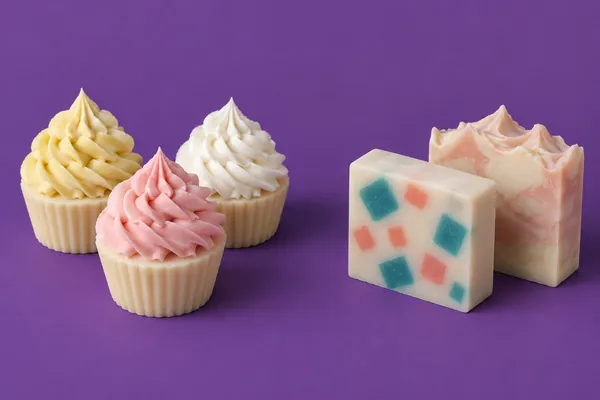
Embeds, textured tops and piping
Soap embeds that stay put and don't bleed, textured and botanical tops, piped frosting and soap cupcakes, and how to keep soda ash off the top.
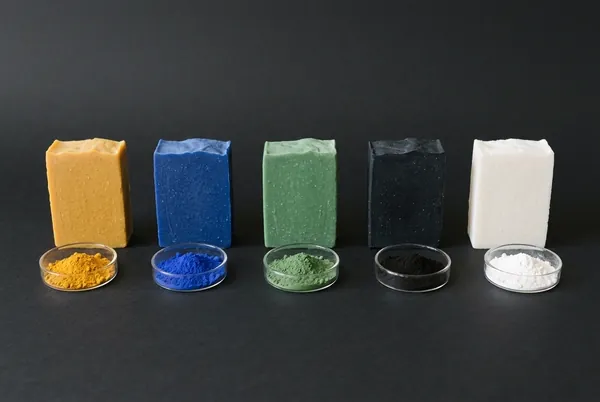
Colouring soap: micas, oxides, ultramarines and pigments
Which colourants survive cold-process soap, how much to use per 500 g of oils, how to disperse and split colour, and what the EU, UK and US rules ask.
Where these proportions come from
Adapted from Anne-Marie Faiola's almond milk confetti bars: her olive, rice bran, coconut and castor oils with shea butter in place of the palm oil, grated offcuts folded into a white two thirds beside a violet third, and the loaf soaped cool and frozen so it never gels. We use plain water, weigh the shreds, and swap her elemi, which our list lacks, for frankincense, a resin from the same plant family.
Formulation adapted from Pure Soapmaking by Anne-Marie Faiola (Storey Publishing, 2016). The method and notes are ours.