Taiwan swirl bar in charcoal and rose
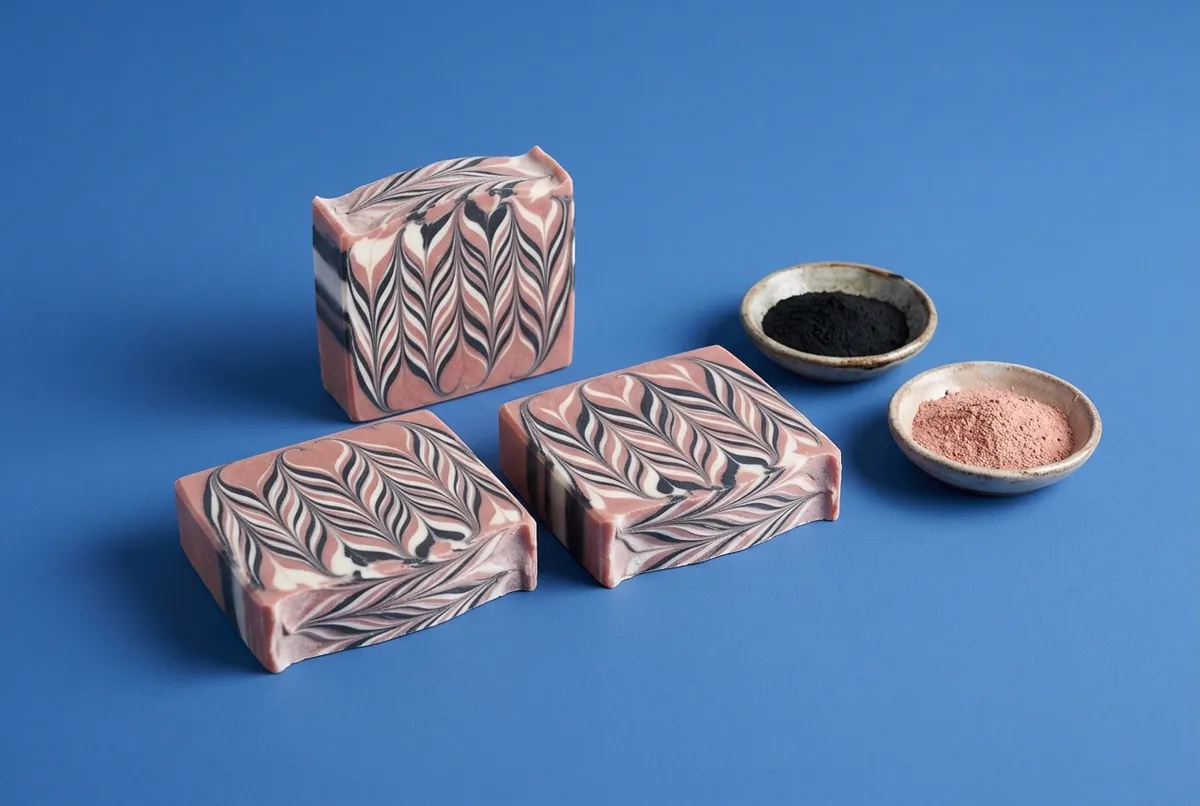
White, charcoal and rose clay poured side by side between card dividers, then dragged across and along into feathered chevrons. Cutting the loaf parallel to its top shows the whole pattern on the face of every bar.
- Skill
- Advanced
- Method
- Cold process
- Batch
- 900 g of oils about 1350 g of batter
- Hands-on
- 1 h 40 min
- Cure
- 6 weeks
- Gel phase
- Yes insulate the mould
What you need
For 900 g of oils, which fills a 25 × 9 cm loaf mould filled 6 cm deep (about 1.4 litres), with three card dividers. Weigh everything, liquids included.
| Olive Oil · 40.0 % | 360 g | 12.70 oz |
| Lard · 25.0 % | 225 g | 7.94 oz |
| Coconut Oil · 25.0 % | 225 g | 7.94 oz |
| Rice Bran Oil · 10.0 % | 90 g | 3.17 oz |
| Sodium hydroxide (NaOH) · the lye, 100 % pure | 127.1 g | 4.48 oz |
| Distilled water · 269 g for a 32 % lye solution, 14 g set aside | 282.8 g | 9.98 oz |
| Titanium dioxide · 1.5 tsp, for the two white channels, dispersed in 20 g of the recipe's olive oil | 7 g | 0.25 oz |
| Activated charcoal · 0.5 tsp, for the black channel, dispersed in 9 g of the recipe's olive oil | 1.1 g | 0.04 oz |
| Rose clay · 1.5 tsp, for the pink channel, stirred into 14 g of water held back from the recipe's water | 4.7 g | 0.17 oz |
| Lavender oil · 2.0 % of the oils, at trace | 18 g | 0.63 oz |
| Clary sage oil · 1.0 % of the oils, at trace | 9 g | 0.32 oz |
- Superfat
- 5 %
- Temperatures
- Oils and lye solution at 35 to 38 °C (95 to 100 °F), warm enough to keep the lard melted
Method
-
Make the dividers
Cut three strips of stiff card as long as the inside of the mould, 25 cm, and 2 cm taller than it, and wrap them in packing tape so they can't soak up water. Stand them lengthwise about 2.2 cm apart to make four equal channels, and tape a tab from each end to the rim. -
Get ready
Put on goggles, gloves and long sleeves, open a window and ask a helper to stand by. Set out four spouted jugs and a chopstick; the mould, dividers in, must sit level where it can stay for a day. -
Disperse the colours
Weigh the olive oil and take 38 g of it for the colours. Stir the titanium dioxide into 20 g of it, the charcoal into 9 g in the charcoal jug, and put the last 9 g, plain, in the rose jug. Weigh the 282.8 g of water, take 14 g out into a cup and stir the rose clay into it. -
Make the lye solution
Where the air moves, pour the 127.1 g of sodium hydroxide slowly into the rest of the water, never the reverse, and stir until clear. Leave it labelled and out of reach to cool to 35 to 38 °C (95 to 100 °F). -
Melt and scent the oils
Melt the lard and coconut oil gently, add the rest of the olive oil and the rice bran oil, and cool to 35 to 38 °C (95 to 100 °F) while the oils stay clear. Stir in the lavender and clary sage oils. -
Blend to light trace
Pour the lye solution in down the blender shaft, tap out trapped air, and blend in short pulses with stirring between until light trace: thin custard that holds a faint line for a few seconds. -
Fill the charcoal and rose jugs
Weigh 325 g of batter into the charcoal jug and whisk it black. Weigh 310 g into the rose jug and whisk in its plain oil, but leave the clay out for now: clay thickens batter, so it goes in last. -
Whiten the rest and colour the rose
Whisk the white into the batter left in the pot, about 650 g, and pour half of it into the fourth jug. Now whisk the rose clay into the rose jug. -
Pour the four channels together
With your helper steadying the dividers, pour a little from each jug into its channel in turn, white, charcoal, rose and white across the width, and go round until all four are full. Keep the levels within about 1 cm of each other, so no divider leans. -
Lift the dividers
Tap the mould gently, then pull the dividers straight up, slowly, one at a time. -
Swirl across
Push a chopstick to the bottom at one end and drag it side to side across the width in tight zigzags, about 1 cm apart, working along to the far end without lifting it out. -
Swirl along
Go back over it the other way: long zigzags along the length, working across the width from one side to the other. Stop there; a third pass starts to blur the chevrons. -
Cover so it gels
Cover the mould with a board or lid and wrap it in a towel, two if the room is below about 24 °C (75 °F), for a day. Gel deepens the black and the rose, and at a 31 % lye solution the white stays clear of glycerin rivers. -
Unmould
Unmould with gloves on after 2 days, once the loaf is firm. -
Cut it parallel to the top
Stand the loaf on one long side and cut it down the middle along its length, which halves it parallel to the top. Cut each half across into five bars about 5 cm wide; every bar shows the swirl on its face. -
Cure
Stand the bars on edge with air between them, out of direct sun, for 6 weeks, turning them every few days.
Tips
- Rehearse the pour with water in the divided mould first. Four channels need a helper or a steady rhythm, and a divider that leans lets neighbouring colours run together.
- If you would rather cut ordinary bars, slice across the loaf as usual: the cut faces show wavy stripes and the swirl shows on each bar's top.
- Half a teaspoon of charcoal in a quarter of the batter is plenty for black. More starts to grey the lather.
The oils
| Oil | Share |
|---|---|
| Olive Oil (virgin / refined / olive oil) | 40.0 % |
| Lard (pure rendered pork fat) | 25.0 % |
| Coconut Oil | 25.0 % |
| Rice Bran Oil | 10.0 % |
How it is made
| Process | Cold process |
| Alkali | NaOH |
| Superfat | 5 % |
| Water | lye water at 31 % |
| Iodine value | 61 |
| INS | 147 |
Why make it
Lard, olive and coconut oil make a firm, creamy bar with a steady lather, cleansing 18 and conditioning 56 on our scale, and lard has been a mainstay of household soap for generations. Its slow trace is also what gives time for four channels and two passes of the chopstick. This is a bar people make for the pattern: cut parallel to the top, every face shows the whole feathered chevron, and it is a satisfying technique to master. The black is activated charcoal and the pink is rose clay, both there for colour; charcoal soaps are often sold with bigger promises, but here it is simply the black, and at half a teaspoon it does not grey the lather. Lavender and clary sage give a soft herbal scent. Lard makes it unsuitable for vegans.
What tradition, makers' experience and research say about soaps like this, each labelled for what it is. It is not medical advice, and no soap treats a skin condition: if you have one, ask a doctor or pharmacist.
What the numbers say
- Lauric acid 12.3 %
- Myristic acid 5.2 %
- Palmitic acid 15.8 %
- Stearic acid 5.8 %
- Oleic acid 45.0 %
- Linoleic acid 10.5 %
- Other 6.4 %
Saturated : unsaturated 43 : 57
Computed from the fatty acids of the fats above. The bands are what the craft has settled on, not chemistry — a bar outside one is not wrong.
From the guides
All guides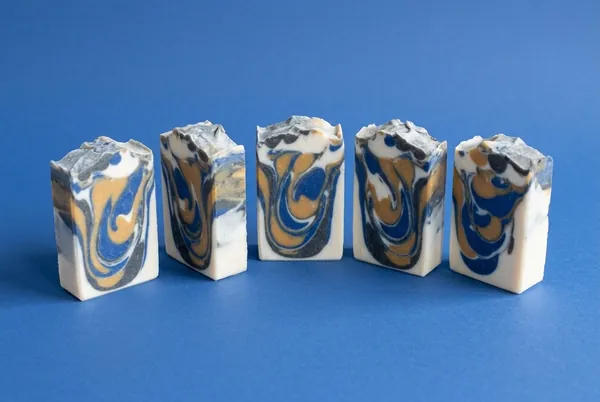
Swirl techniques: in the pot, drop, hanger, spoon and Taiwan
Seven cold-process swirls step by step, with the batter, recipe and temperatures that keep soap fluid, and why swirls turn muddy or lumpy.
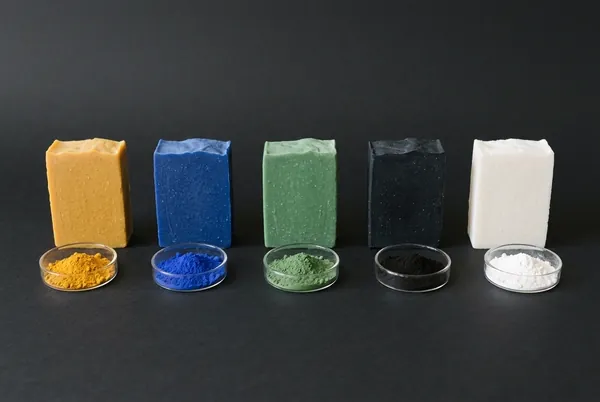
Colouring soap: micas, oxides, ultramarines and pigments
Which colourants survive cold-process soap, how much to use per 500 g of oils, how to disperse and split colour, and what the EU, UK and US rules ask.

Natural colourants: what herbs, clays and spices really do in soap
Clays, charcoal and plant colours in cold-process soap: doses per 500 g of oils, infused oil, powder or lye, and the colour each one actually turns.
Where these proportions come from
Our own slow blend, half liquid oils with lard and coconut for a firm, creamy bar, at a 31 % lye solution for working time; the divided pour and the cut parallel to the top follow the mantra swirls in Anne-Marie Faiola's and David Fisher's books.
Formulation adapted from Soap Crafting by Anne-Marie Faiola (Storey Publishing, 2013); The Complete Photo Guide to Soap Making by David Fisher (Creative Publishing International, 2018). The method and notes are ours.