African black soap homage
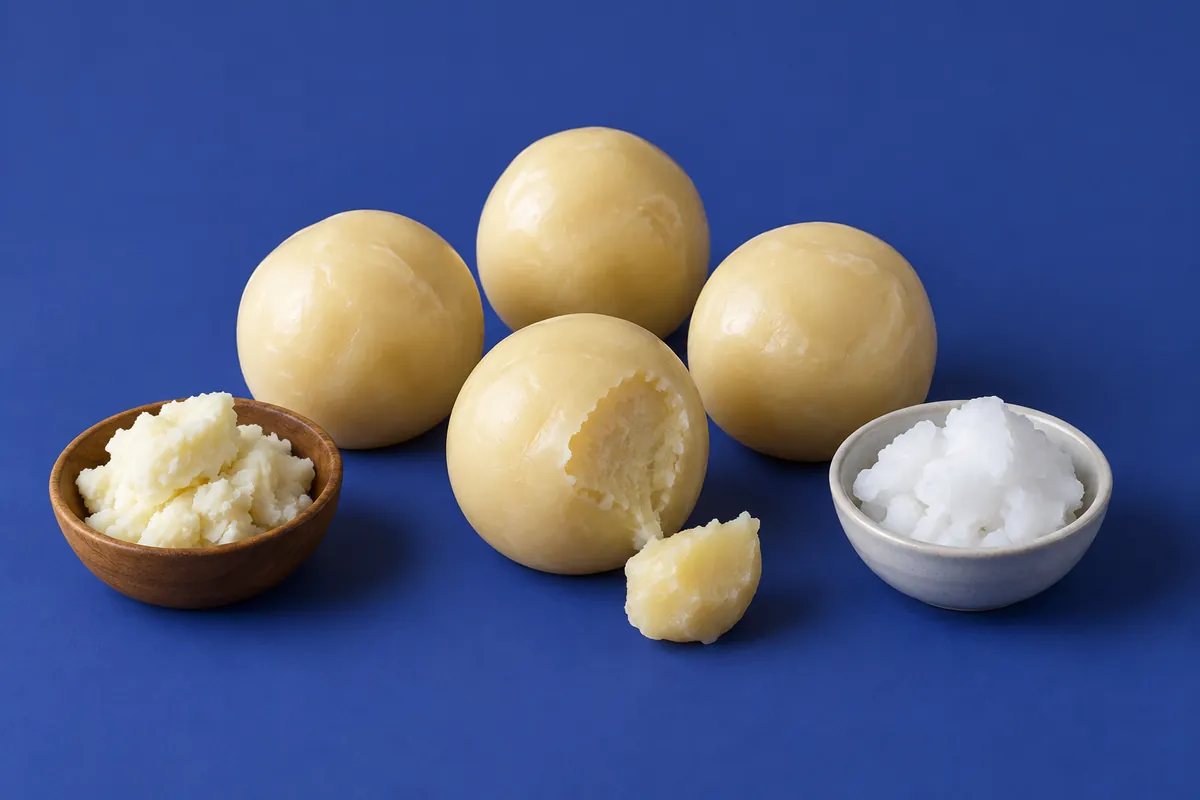
An honest homage to West African black soap: palm kernel oil, coconut oil and shea butter cooked with potassium hydroxide into a soft, pliable soap you pinch off and lather in your hands. The ash lye and dark colour of the original are not reproduced, so this one is pale and smooth, with a big, rich lather.
- Skill
- Advanced
- Method
- Hot process
- Batch
- 500 g of oils about 1070 g of batter
- Hands-on
- 1 h 30 min
- Cure
- 2 weeks
- Gel phase
- In the pot it gels as it cooks
What you need
For 500 g of oils, which fills a 1.2 litre tub lined with baking paper, or hand-rolled balls. Weigh everything, liquids included.
| Palm Kernel Oil · 45.0 % | 225 g | 7.94 oz |
| Coconut Oil · 25.0 % | 125 g | 4.41 oz |
| Shea Butter · 30.0 % | 150 g | 5.29 oz |
| Potassium hydroxide (KOH) · the lye, 90 % pure; if your label says otherwise, weigh 126.8 g at 85 % or 113.4 g at 95 % | 119.7 g | 4.22 oz |
| Distilled water · for a 21 % lye solution | 450.0 g | 15.87 oz |
- Superfat
- 6 %
- Temperatures
- Lye solution cooled below 82 °C (180 °F), fats at 65 to 71 °C (150 to 160 °F), cooked on low
Method
-
Get ready
Put on sealed goggles, nitrile gloves and long sleeves, and keep them on until the soap is cooked and cooled. Weigh 225 g palm kernel oil, 125 g coconut oil and 150 g shea butter into a slow cooker of 3.5 litres or more, 450 g distilled water into a heat-proof jug and 119.7 g potassium hydroxide flakes into a dry container, then close the flake tub at once: it pulls water from the air. -
Make the lye solution
At an open window, add the flakes to the water a little at a time, stirring, never the water to the flakes. It fizzes and gets hotter than sodium hydroxide does; let it cool below 82 °C (180 °F), and keep it away from aluminium, tin and zinc, which it attacks, giving off hydrogen. -
Melt the fats
Melt the palm kernel oil, coconut oil and shea butter in the slow cooker on low and bring them to 65 to 71 °C (150 to 160 °F). -
Blend to a paste
Pour the lye solution into the fats and stick blend in bursts of a minute or so, stirring between them. With this much water the batter is thin at first, then thickens quickly as the palm kernel and coconut oils react; keep going until it is an even, opaque paste like soft mashed potato. -
Cover and cook
Put the lid on and leave the cooker on low, and stay nearby for the first half hour: soap this rich in coconut and palm kernel oil can foam up the sides of the pot. Stir it down whenever it rises, then stir every 20 to 30 minutes. -
Cook until even
Over two to three hours the paste turns from chalky white to a glossy, slightly translucent cream or pale honey colour, with the feel of petroleum jelly. It never turns fully clear: the superfat and shea keep it cloudy. -
Test a spoonful
Stir a teaspoon of the soap into half a cup of boiling distilled water until it dissolves and let it cool. A cloudy liquid is what you want; a greasy film or droplets on top mean some oil has not reacted yet, so cook another half hour and test again. -
Cook off some water
Take the lid off and keep the cooker on low for 30 to 60 minutes, folding the soap over every few minutes, until it is a thick, sticky dough that pulls away from the sides. Driving off steam lets it firm up sooner; the recipe itself does not change. -
Shape it
Turn off the cooker. When the soap is cool enough to handle in gloves but still soft, press it into the lined tub, or roll it into balls of about 100 g; lightly dampened gloves stop it sticking. -
Clean up
Scrape the pot and tools with paper towels into the bin, then soak them in hot water, which dissolves potassium soap easily, and wash them. -
Let it firm up
Leave the soap uncovered on a rack for two to four weeks, turning the balls or the block now and then, until it holds its shape and no longer feels tacky. It stays softer and more pliable than a bar made with sodium hydroxide: that is the nature of potassium soap, and of black soap. -
Store and use it
Keep it wrapped or in a lidded tin, because potassium soap draws moisture from the air and turns sticky in a steamy bathroom. Pinch off a piece and work it into a lather between wet hands or on a cloth, and put the rest away dry.
Tips
- The ash is the whole difference. Traditional makers roast plantain skins, cocoa pods or palm leaves, leach the ash for its potash and cook it with the oils, and the roasting colours the soap brown to black and leaves the bits that make it rough and crumbly. Weighed potassium hydroxide gives a pale, smooth soap with a known superfat, so this is a homage and not a copy; cocoa powder or charcoal would darken it but would not make it black soap.
- The lye assumes potassium hydroxide flakes of 90 % purity, the usual label figure. If your label says otherwise, enter it in the calculator before you weigh: purer flakes make the soap lye-heavy.
- The calculator shows a warning that liquid soap is usually made at 0 to 3 % superfat. That is about clouding soap that is diluted into a liquid; this one is never diluted, and the 6 % superfat is chosen to soften a soap this high in coconut and palm kernel oil.
- Shea is botanically a tree nut. Refined shea butter carries almost no protein, but anyone with a nut allergy should read our nut-free bar first.
The oils
| Oil | Share |
|---|---|
| Palm Kernel Oil | 45.0 % |
| Coconut Oil | 25.0 % |
| Shea Butter | 30.0 % |
How it is made
| Process | Hot process |
| Alkali | KOH |
| Superfat | 6 % |
| Water | 90 % of the oils |
| Iodine value | 26 |
| INS | 204 |
Why make it
Black soap, ose dudu in Yoruba, is an everyday soap across much of West Africa, used for body, face and hair. The original takes its alkali from the ash of plantain skins, cocoa pods or palm leaves, whose main alkali is potassium carbonate, and a soap manual of 1908 already described Fante soap made from palm oil and plantain-skin ash. Makers value it for a quick, rich lather in any water. Here that comes from 70 % palm kernel and coconut oil, cleansing 47 on our scale, with shea for a softer feel. Most of the users surveyed at New York dermatology clinics in 2017 were pleased with black soap, but the authors found very little research on it. The strength is also the caveat: it can feel drying, so it suits oily skin and grubby hands better than dry skin, and many people follow it with a moisturiser.
Sources
- Evaluation of various agro-wastes for traditional black soap production · Bioresource Technology 79:95-97 (Taiwo and Osinowo), 2001
- The Handbook of Soap Manufacture · Scott, Greenwood & Son (W. H. Simmons and H. A. Appleton), 1908
- Discovering Black Soap: A Survey on the Attitudes and Practices of Black Soap Users · Journal of Clinical and Aesthetic Dermatology 10(7):18-22 (Lin, Nabatian and Halverstam), 2017
What tradition, makers' experience and research say about soaps like this, each labelled for what it is. It is not medical advice, and no soap treats a skin condition: if you have one, ask a doctor or pharmacist.
What the numbers say
- Lauric acid 34.8 %
- Myristic acid 11.9 %
- Palmitic acid 7.0 %
- Stearic acid 14.2 %
- Oleic acid 23.1 %
- Linoleic acid 3.3 %
- Other 7.9 %
Saturated : unsaturated 74 : 26
Computed from the fatty acids of the fats above. The bands are what the craft has settled on, not chemistry — a bar outside one is not wrong.
Try it differently
3 variationsThe same soap with one thing moved. Each opens in the calculator ready to change again.
From the guides
All guides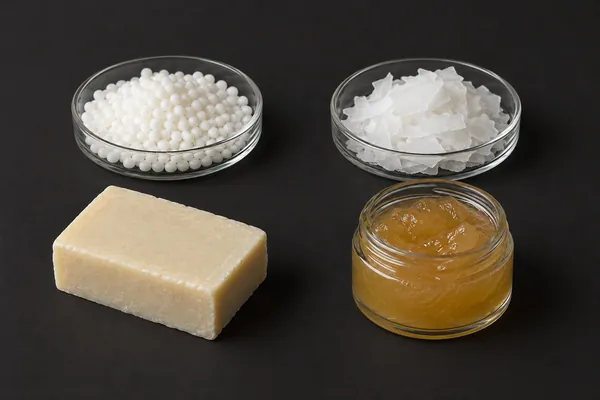
Sodium hydroxide, potassium hydroxide and dual lye explained
Why NaOH makes bars and KOH makes soft soap, converting between them, KOH purity, dual-lye recipes, and the calculator slip that turns a bar caustic.
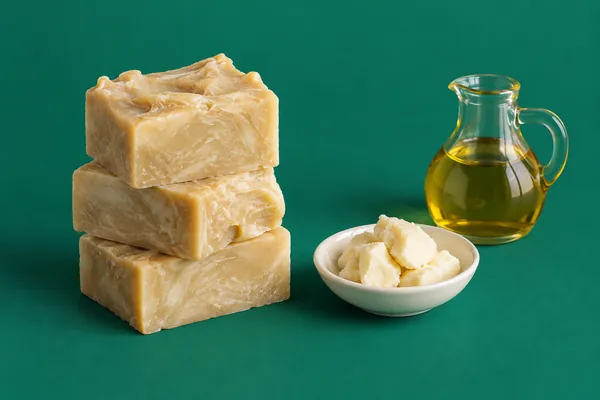
Hot process soap, step by step
Cook soap batter in a slow cooker until the lye is spent, then stir in the superfat oil, fragrance and colour. A full recipe with the calculator's numbers.
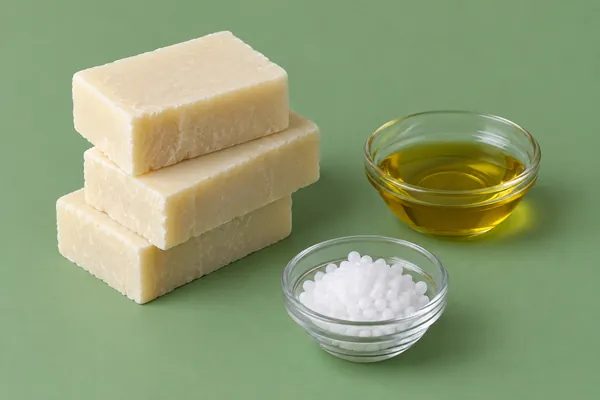
Superfat and lye discount: why recipes leave some oil unsaponified
What superfat and lye discount mean, how the calculator applies them, where makers set them for each soap, and why oil added at trace isn't the oil left over.
Guides with this recipe
Where these proportions come from
West African black soap is made with potash leached from the ash of plantain skins, cocoa pods or palm leaves, cooked with palm kernel oil and shea butter, often with coconut or palm oil, and judged by eye. This homage keeps fats of that kind, 45 % palm kernel oil, 25 % coconut oil and 30 % shea butter, and replaces the ash with weighed potassium hydroxide at a 6 % superfat, cooked as a soft soap. It does not reproduce the ash's dark colour or the original's rough, crumbly texture.