In short
- Hot process is the same reaction as cold process; heat finishes it in about an hour instead of a day or two.
- Cook on low until the whole pot has turned translucent, like petroleum jelly. You judge it by eye, not with your tongue.
- An oil held back until after the cook stays oil, so you choose the superfat. The calculator works out the lye on the other oils.
- Use more water than for cold process, about 2.5 times the lye, and yogurt or sodium lactate if you want it to spread in the mould.
- The bars are safe once set but still need four to six weeks on a rack to become hard, long-lasting soap.
On this page
Hot process soap starts exactly like cold process: weigh, make the lye solution, blend to trace. Then, instead of pouring the batter into a mould and waiting, you cook it. In a slow cooker on low, the reaction that takes a day or two in a cold process loaf is finished in about an hour. This guide gives a full recipe with the calculator’s numbers, the method, and how to tell by eye when the cook is done.
What changes from cold process
The chemistry does not change. The same lye meets the same oils, and heat only makes the reaction run faster. What we think of as old-fashioned soapmaking, a pot over a fire, was a form of hot process. Cooking the batter changes three practical things.
The soap is safe as soon as it has set. The lye is used up in the pot, not over the following day in the mould.
Anything added after the cook meets no lye. An oil stirred in then stays oil, so you choose which oil makes up the superfat. Fragrances that would seize a cold process batch, and additives the lye would scorch or discolour, go into finished soap instead.
The soap is thick and rustic. Cooked soap does not pour; it is spooned and pressed into the mould, and the bars have a textured, rustic look that poured cold process bars do not.
What it does not change is the danger. Until the cook is finished the batter is caustic, and in hot process it is also hot enough to scald.
What you need
Everything on the list for cold process, plus something to cook in.
A slow cooker with a low setting and a lid is the easiest, because you can watch the soap and stir it. Choose one big enough that the batter fills it no more than about halfway: soap can swell as it cooks. Grosso checks before she starts: she fills the crock with water to the volume of the oils, lye and water together, and wants at least 5 cm (2 in) clear above it. Like the rest of your soap equipment, it should never go back to cooking food. A stainless steel pot with a lid in an oven at 77 to 82 °C (170 to 180 °F) also works; it heats more evenly than most slow cookers but is harder to keep an eye on.
You will also want cling film, to lay over the pot under the lid so less water escapes, and a loaf or slab mould. Cooked soap is too thick to press neatly into small, detailed cavity moulds.
Water, and keeping it spreadable
Cooked soap loses water and stiffens as it cools, and the thicker it is, the harder it is to get into the mould without air pockets. So hot process uses more water than cold process: about 2.5 times the weight of the lye, against about 2 times for a typical cold process recipe. In the calculator, choose the water:lye ratio and set it to 2.5. Some makers hold back a fifth of that water and stir it in after the cook, which loosens the soap just when it is stiffest.
Four additions make cooked soap noticeably more fluid:
- Sodium lactate, 1 teaspoon per 454 g (1 lb) of oils, stirred in at the end of the cook, where Fisher finds it makes the soap much more fluid. It also makes the bars harder sooner. For 1000 g of oils, that is 14.5 g of the usual 60 % solution.
- Plain yogurt, 1 tablespoon per 454 g of oils, stirred in after the cook. For 1000 g of oils, 33.8 g.
- Glycerin, 1 tablespoon per 454 g of oils, stirred in after the cook, where Grosso finds it helps the soap flow into the mould. For 1000 g of oils, 41 g.
- Milk, as part of the liquid, or warmed and stirred in after the cook, as in our goat milk and shea hot process bar: added then, it never meets fresh lye and the bars stay pale.
Enter the sodium lactate and yogurt in the calculator and it counts the water they carry as part of the recipe’s water, taking it off the lye solution: with both, 323.2 g instead of 358.7 g. The total stays the same. Part of it simply arrives after the cook, when the soap is stiffest, which is the same idea as holding water back.
Warm anything you add after the cook, and warm your spoons and spatulas too. Cold additions make hot soap seize up around them.
The recipe
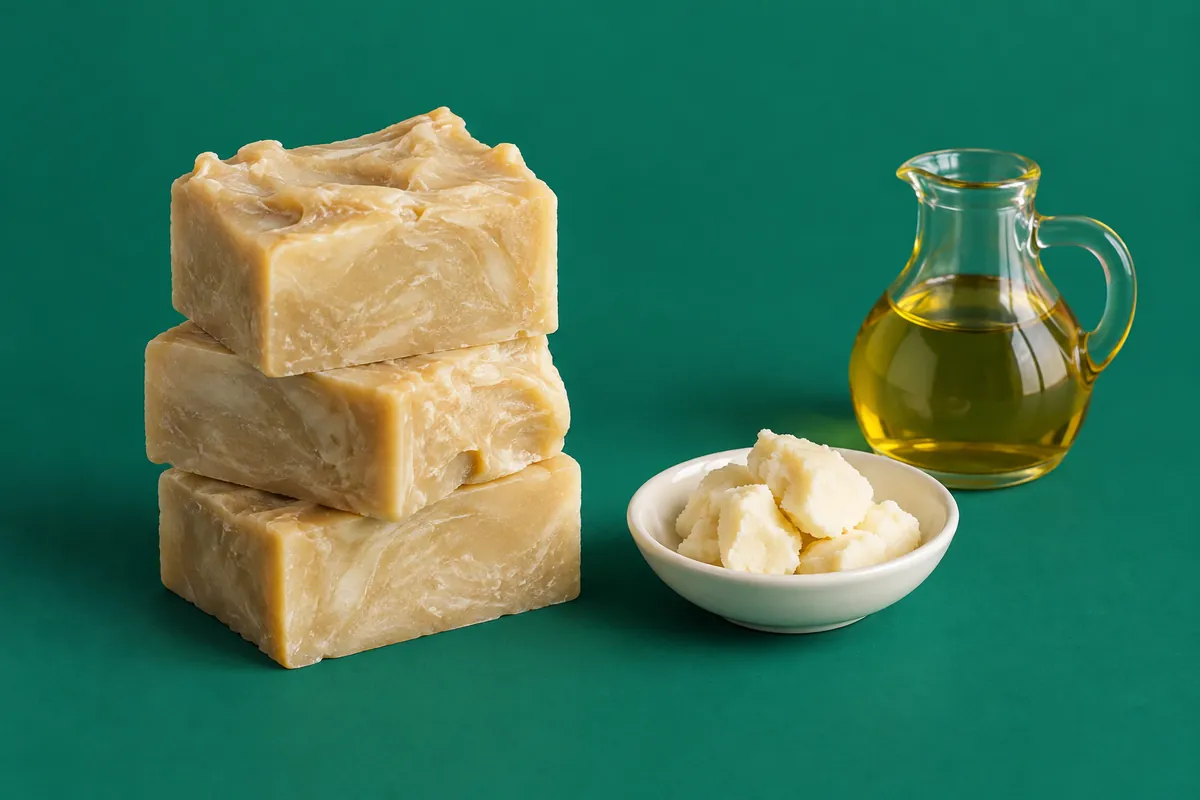
This is the everyday bar of olive, coconut and palm oil, with 5 % of its olive oil replaced by shea butter, which waits until after the cook. The lye is worked out on the three oils in the pot, with a 1 % lye discount, and the shea becomes the superfat.
| Ingredient | Weight | Share of oils | When |
|---|---|---|---|
| Olive oil | 350 g | 35 % | In the cook |
| Coconut oil | 300 g | 30 % | In the cook |
| Palm oil | 300 g | 30 % | In the cook |
| Shea butter | 50 g | 5 % | After the cook |
| Sodium hydroxide | 143.5 g | In the lye solution | |
| Water | 358.7 g | In the lye solution |
From the calculator: 1000 g of oils, hot process with the shea butter ticked for after the cook, a 1 % lye discount on the cook, and water at 2.5 times the lye (a 28.6 % solution). The batch weighs 1502.2 g before any fragrance or yogurt.
The calculator puts the superfat of the finished bar at 5.3 %. Its quality figures are hardness 47, cleansing 21, conditioning 49, bubbly lather 21 and creamy lather 26, with an iodine value of 50 and an INS of 162: a firm, all-round bar. If you would rather not use palm oil, the palm-free classic cooks the same way; tick whichever oil you want as the superfat.
Cook it yourself. With the shea butter set for after the cook, the calculator asks 143.5 g of sodium hydroxide and 358.7 g of water for 1000 g of oils.
Open it in the calculatorWhy cook at a 1 % discount rather than 0, when the shea is there as the superfat? Because oils vary. The calculator’s range check covers the oils in the cook, and it says that, depending on where your oils sit in their saponification ranges, the cook could be anything from 2.8 % lye-heavy to 4.5 % lye-light. Count the shea in, and the finished bar lands between 1.7 and 8.6 % superfat, never on the lye-heavy side. Cook at 0 % and the worst case drops to 0.7 %, which leaves little in hand. Either way, when the cook runs lye-heavy, the spare lye finds the shea and turns some of it into soap, which is one reason an oil added after the cook cannot be guaranteed to stay oil.
Reading the cook
Hot process soap tells you how far it has got by how it looks. The changes run from the outside in, because the soap against the hot pot cooks first. Makers name the stages after what they resemble (applesauce, mashed potato, petroleum jelly), but these are rough labels, and not every batch shows all of them.
The edges go first. Within the first 15 to 20 minutes, a band of soap around the edge turns glossy, translucent and slightly darker, while the middle is still opaque and creamy.
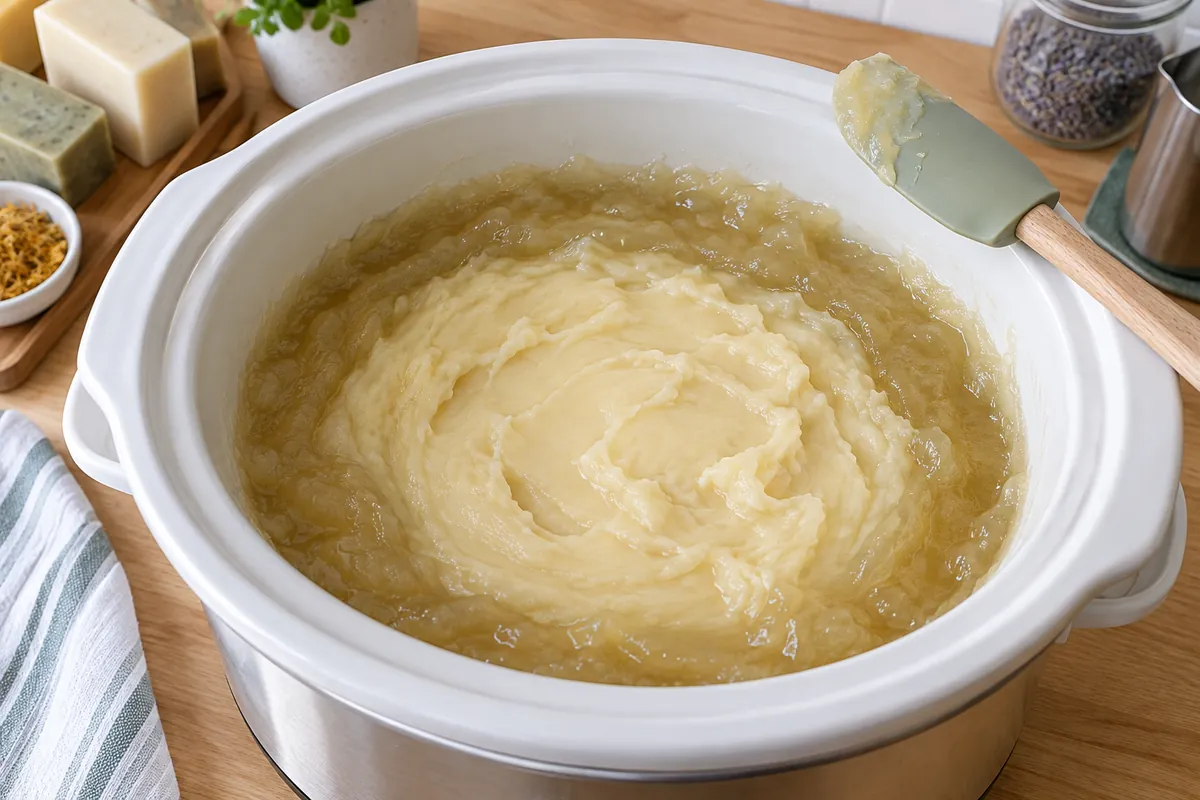 Partway through the cook: translucent at the edges, still opaque in the middle. Stir the edges into the centre and keep cooking.
It rises. The soap may puff up and froth. If it swells to more than about twice its starting volume, the heat is probably too high: stir it down and, if you can, turn the heat lower.
It goes stiff and lumpy. As the change spreads inwards, the whole mass thickens into something like mashed potato, with translucent and opaque patches side by side. Fold the edges into the centre each time you check, so the batch cooks evenly.
It turns clear and glossy. Finally the whole mass is translucent, glossy and a little stretchy, like petroleum jelly. That is the finished cook. With a slow cooker on low it usually takes about an hour, but slow cookers vary, and so does the time: Grosso’s recipes allow three hours on low, checked every 30 minutes.
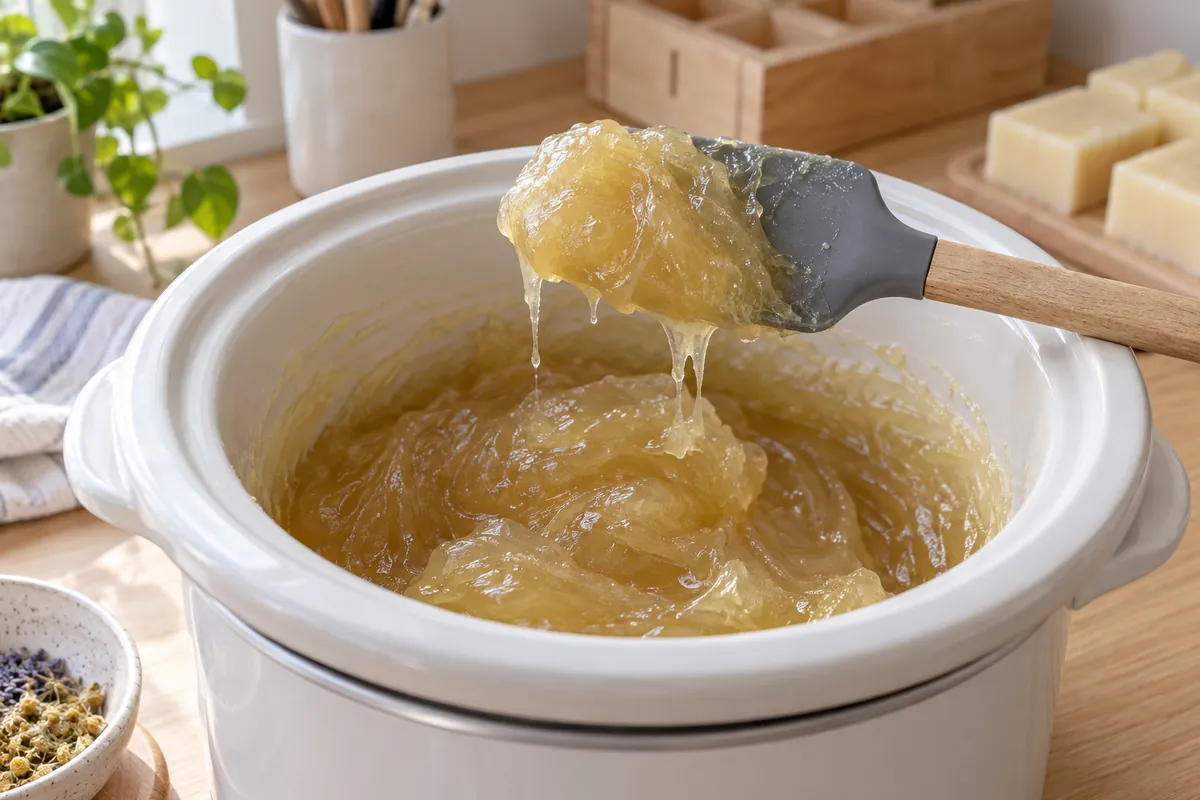 Done: translucent all the way through, with no opaque or creamy streaks when you fold it.
You can tell it is done without tasting it. Fold the soap over with the spatula and look at what comes up from the bottom and the middle: if you see opaque, creamy streaks, it needs longer. If oil pools on the surface or liquid weeps out, the batch has separated: stir it well and keep cooking. When in doubt, give it another 15 minutes. Cooking a finished batch a little longer only dries it out a little.
The method
- Get ready. Put on goggles, gloves and long sleeves. Weigh every ingredient, clear the kitchen of children and pets, and set the slow cooker to low so it warms up.
- Make the lye solution. Add the sodium hydroxide to the water, never the water to the lye, and stir until it dissolves. It gets very hot, and can pass 90 °C (194 °F). Let it cool for a few minutes; the temperature at which you combine it with the oils matters much less than in cold process, as long as both are below about 77 °C (170 °F).
- Melt the oils for the cook. Melt the olive, coconut and palm oils in the slow cooker. Keep the shea butter aside.
- Blend to trace. Pour the lye solution into the oils and stick blend until the batter reaches trace (the trace guide shows what to look for). A well-emulsified batter is less likely to separate as it heats.
- Cover and cook. Lay cling film over the pot, put the lid on, and cook on low. Check every 15 to 20 minutes, but do not lift the lid more than you need to: each time, heat and water escape.
- Stir the edges in. When you check, fold the translucent edges into the centre and stir down any foam.
- Cook until translucent. Keep going until the whole batch looks like petroleum jelly, as described above.
- Add the extras. Turn off the heat. Stir in the shea butter, which melts in the hot soap, and the yogurt and sodium lactate if you use them. Let the soap cool to below about 82 °C (180 °F), then stir in the fragrance and any colour.
- Pack the mould. Spoon the soap into the mould, pressing it into the corners, and bang the mould on the worktop to knock out air pockets. Texture the top with the back of a spoon.
- Unmould, cut and cure. Once it has cooled and firmed, often within a few hours and certainly by the next day, unmould it and cut it into bars. Cure them on a rack for four to six weeks.
After the cook: superfat, scent and colour
The superfat. Holding an oil back only works in hot process. In cold process, most of the lye is still unreacted at trace, so oil added then becomes soap along with the rest, and the superfat is a mix of everything in the pot. After a hot process cook, the added oil stays oil, at least for a while. Choose one that keeps: saturated and monounsaturated fats last longest, so shea, cocoa butter, olive, avocado and high-oleic sunflower are good choices and linoleic-rich oils such as hemp and grapeseed are not. The superfat guide explains the arithmetic.
Scent. Heat drives fragrance off, so let the soap cool below about 82 °C (180 °F) before it goes in, and stir it through quickly: the soap stiffens as it cools. Some books say to choose fragrances with a flash point above about 66 °C (150 °F) for hot process. Flash point is a fire-safety figure, the lowest temperature at which a liquid gives off enough vapour to ignite, and it does not tell you how fast a scent will evaporate from hot soap. Every fragrance loses more the hotter the soap is when it goes in, and citrus oils, the most volatile, fade first. The scenting guide covers amounts and limits.
Colour. Mix colourants with a little warm oil or water first, so they spread through the thick soap without streaks. For a swirl, split the cooked soap into warmed containers and colour each one; it has to be done quickly, before the soap stiffens. Grosso treats each colour as its own small batch, set up while the soap cooks. She colours a small portion and works it back into its share, then spoons the colours into the mould in blocks or stripes and pulls a chopstick through them to the bottom. She puts the odds that a colourant which fails in cold process will survive hot process at about even, and finds it needs less colourant.
Moulding and curing
Hot process bars have a rustic, textured look, and it is best to design for it rather than against it: a swooped top, a spoon texture, a sprinkle of dried botanicals. If you want smoother bars, add the yogurt or sodium lactate, keep the water at 2.5 times the lye, and work quickly while the soap is hot.
Unmould when the soap has cooled and firmed. The bars are safe to use then, because the cook used up the lye, but they are not yet at their best. Hot process soap is usually made with more water than cold process, to keep it fluid, and it takes at least as long to dry. Cure the bars on a rack with air all round for four to six weeks, nearer six with this recipe’s extra water, and weigh one now and then: when its weight stops falling, it is ready. The curing guide has more.
When it goes wrong
Lumps and paler bits through the bars. The edges cooked faster than the middle. Next time, fold the edges into the centre each time you check.
Too stiff to get into the mould. Too little water, or too much cooked off. Use water at 2.5 times the lye, keep the cling film under the lid, add yogurt or sodium lactate, and warm everything you add.
It separated in the pot. A mixing problem, easily fixed: stir it back together and keep cooking.
It climbed out of the pot. The heat was too high or the pot too full. Stir it down at once and turn the heat lower.
The scent is faint. The soap was too hot when the fragrance went in. Let it cool further next time.
Recipes to try
All recipesSources
- The Complete Photo Guide to Soap Making . David Fisher, Creative Publishing International , 2018. The slow cooker and oven method: water at 2.5 times the lye; cling film under the lid; checks every 20 minutes; done when it looks like petroleum jelly and applesauce; keep it at 66 to 77 °C; sodium lactate 1 teaspoon per 454 g of oils, added at the end of the cook for fluidity, and yogurt 1 tablespoon; troubleshooting.
- The Everything Soapmaking Book, 3rd edition . Alicia Grosso, Adams Media , 2013. Sizing the slow cooker with the batch's volume of water and 2 inches of headroom; three hours on low, checked every 30 minutes; glycerin at 1 tablespoon per pound of oils for flow; colouring cooked soap in portions, glopping and swirling; even odds for colours that fail in cold process.
- A Hot Process Soap Tutorial: How to Hot Process Soap in a Crockpot . Modern Soapmaking . Cook on low until the batch is fully gelled; cool below 82 °C (180 °F) before adding fragrance, and flash point does not decide that; add superfat and other additions after the cook; never leave it cooking unattended.
- Curing soap . Classic Bells, Soapy Stuff . Hot process soap saponifies within hours, but it is usually made with more water, so it takes longer to dry, not less; some makers cure it at least six weeks, against four for cold process.
- Superfat . Classic Bells, Soapy Stuff . At trace most of the lye is still unreacted, so oil added then becomes soap like the rest; oil added after a hot process cook stays as oil for a while, longest for saturated and monounsaturated fats.
- 29 CFR 1910.106(a)(14), Flammable liquids: definitions . US Occupational Safety and Health Administration . Flashpoint: the minimum temperature at which a liquid gives off enough vapour to form an ignitable mixture with air near its surface.