Banana and oat bar
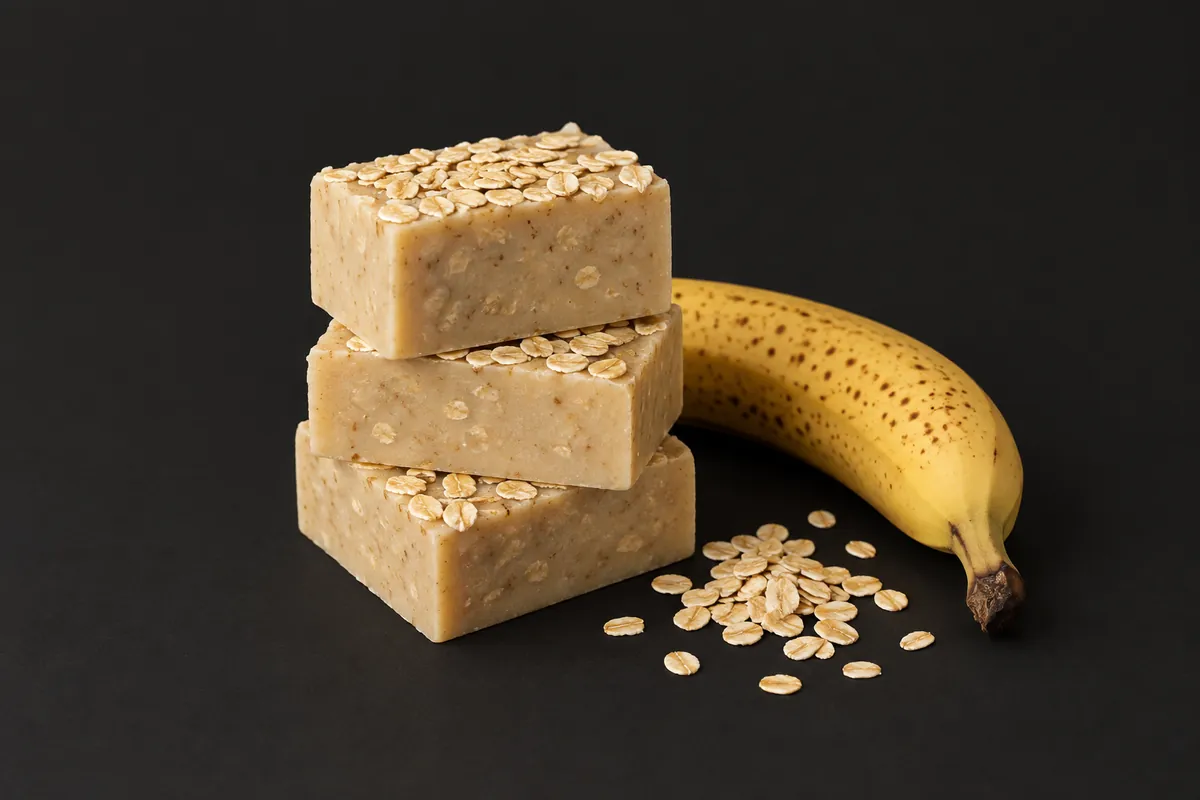
A gentle, olive-rich bar with ripe banana blended into the oils and finely ground oats for a light scrub, topped with whole oats. Kept cool so the banana's sugar doesn't overheat it, it cures a warm beige; unscented.
- Skill
- Intermediate
- Method
- Cold process
- Batch
- 1000 g of oils about 1489 g of batter
- Hands-on
- 1 hour
- Cure
- 6 weeks
- Gel phase
- No keep it cool
What you need
For 1000 g of oils, which fills a 1.5 litre loaf mould. Weigh everything, liquids included.
| Olive Oil · 40.0 % | 400 g | 14.11 oz |
| Coconut Oil · 20.0 % | 200 g | 7.05 oz |
| Shea Butter · 20.0 % | 200 g | 7.05 oz |
| Sunflowerseed Oil - High Oleic Acid · 10.0 % | 100 g | 3.53 oz |
| Cocoa Butter · 5.0 % | 50 g | 1.76 oz |
| Castor Oil · 5.0 % | 50 g | 1.76 oz |
| Sodium hydroxide (NaOH) · the lye, 100 % pure | 134.9 g | 4.76 oz |
| Distilled water · for a 35 % lye solution | 248.8 g | 8.78 oz |
| Very ripe banana, mashed · blended into the melted oils until completely smooth | 88 g | 3.10 oz |
| Rolled oats, finely ground · 2 tbsp, ground to a flour in a spice grinder | 11.5 g | 0.41 oz |
| Rolled oats, whole, for the top · 1 tbsp, scattered over the poured soap | 5.8 g | 0.20 oz |
- Superfat
- 6 %
- Temperatures
- Lye solution and banana oils both at about 32 °C (90 °F)
Method
-
Grind the oats
Grind a handful of rolled oats to a fine flour in a spice grinder and measure out 2 tablespoons. Keep a tablespoon of whole oats for the top. -
Get ready
Put on goggles, gloves and long sleeves, open a window or run the extractor, weigh every ingredient, line the mould, and clear a shelf in the fridge. -
Make the lye solution
Sprinkle the lye into 248.8 g of cold distilled water, never the water onto the lye, and stir until clear. Leave it to cool to about 32 °C (90 °F) where no one will knock it. -
Melt the oils
Melt the shea butter, cocoa butter and coconut oil gently, then stir in the olive, sunflower and castor oils. -
Blend in the banana
Add 88 g of very ripe banana to the warm oils and stick blend until there is not a string or lump left. Let the banana oils cool to about 32 °C (90 °F), no cooler, or the butters start to set. -
Combine
Pour the lye solution into the banana oils down the blender shaft and blend in short bursts to light trace. The banana's sugar speeds trace, so check the batter often. -
Add the ground oats
Blend a few seconds more, to medium trace, like pudding, then stir in the ground oats by hand so they stay spread through the bar instead of sinking. -
Pour and top
Pour into the mould, tap it on the bench to release air, smooth the top, and scatter the whole oats over it, pressing them in lightly. -
Chill it
Put the mould uncovered in the fridge for the first night. Banana is 12 % sugar and heats the loaf, and a loaf that gels turns darker and speckled. -
Unmould and cut
Let the loaf come back to room temperature, then unmould and cut it once it is firm, usually after 48 hours. -
Cure
Cure the bars on a rack with air around them for six weeks, turning them now and then.
Tips
- Expect a warm beige to light tan: banana browns in soap, and gets darker with brown speckles if the loaf gels.
- Use a banana that is soft and freckled, and blend it completely: strings and lumps of fruit can spoil in the bar.
- For a smooth bar with no scrub, use 2 tablespoons of colloidal oatmeal instead of the ground oats, stirred first into a spoonful of the oils.
The oils
| Oil | Share |
|---|---|
| Olive Oil (virgin / refined / olive oil) | 40.0 % |
| Coconut Oil | 20.0 % |
| Shea Butter | 20.0 % |
| Sunflowerseed Oil - High Oleic Acid | 10.0 % |
| Cocoa Butter (Theobroma Oil) | 5.0 % |
| Castor Oil | 5.0 % |
How it is made
| Process | Cold process |
| Alkali | NaOH |
| Superfat | 6 % |
| Water | lye water at 30 % |
| Iodine value | 61 |
| INS | 141 |
Why make it
A mild, olive-rich bar for dry hands and bodies: cleansing 14 and conditioning 61 on our scale, with a fine oat scrub and a whole-oat top. Banana goes in for its sugar, which soapmakers find gives a slightly fuller lather, and for the fun of a fruit soap; beyond that there is no evidence that banana does anything for skin once it has been through lye and rinsed off. The oats have a better pedigree, since colloidal oatmeal is a recognised skin protectant in leave-on products, though ground oats in a rinse-off bar are there mainly for texture. With no fragrance, it suits people who avoid scent, as dermatologists advise for dry, sensitive skin. Expect beige to tan rather than yellow, because banana browns in soap.
Sources
- The Complete Photo Guide to Soap Making · Creative Publishing International, 2018
- 21 CFR 347.10, Skin protectant active ingredients · US Food and Drug Administration, Code of Federal Regulations
- Dermatologists' top tips for relieving dry skin · American Academy of Dermatology, 2026
What tradition, makers' experience and research say about soaps like this, each labelled for what it is. It is not medical advice, and no soap treats a skin condition: if you have one, ask a doctor or pharmacist.
What the numbers say
- Lauric acid 9.8 %
- Myristic acid 3.8 %
- Palmitic acid 9.8 %
- Stearic acid 12.3 %
- Ricinoleic acid 4.4 %
- Oleic acid 48.8 %
- Linoleic acid 7.8 %
- Other 4.4 %
Saturated : unsaturated 39 : 61
Computed from the fatty acids of the fats above. The bands are what the craft has settled on, not chemistry — a bar outside one is not wrong.
From the guides
All guides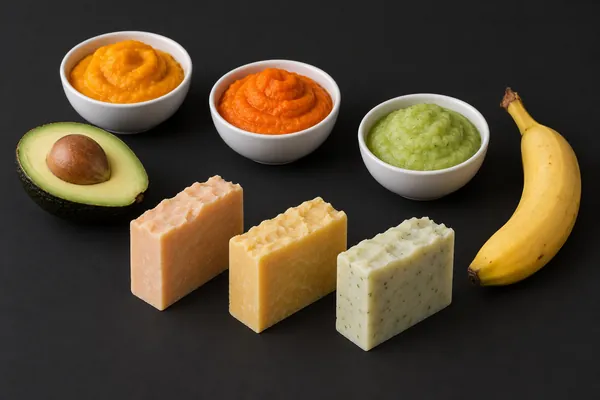
Fruit and vegetable purées in soap
How much pumpkin, carrot, cucumber, avocado or banana to put in soap, when to add it, why purées overheat and spoil, what each really adds, and a recipe.

Soap additives: salt, sugar, sodium lactate, clays, oats, silk and more
What common soap additives do, how much to use and when they go in: sourced doses for sodium lactate, salt, sugar, honey, citric acid, clays, oats and silk.
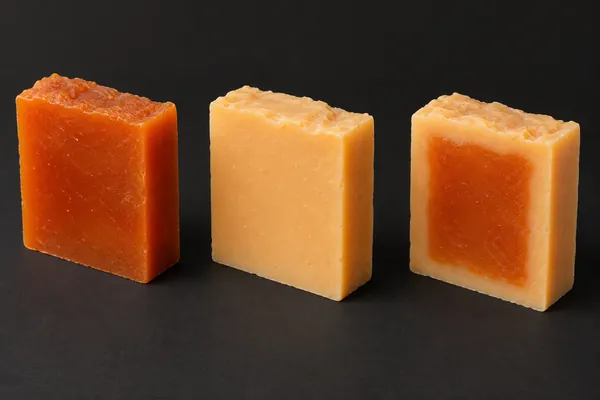
Gel phase: to insulate or keep it cool
What gel phase is, why a loaf turns dark and translucent, how gelled and ungelled bars differ, why partial gel is cosmetic, and how to cause or prevent it.
Where these proportions come from
Our own formulation: an olive-rich moisturising bar with a fifth coconut oil and a quarter shea and cocoa butter, at a 6 % superfat. The water is set at a 30 % lye solution because the banana goes into the oils and takes its water out of the lye's share, leaving the lye you mix near 35 %.