In short
- Most sources use about 1 oz of purée per pound of oils, a little over 6 % of the oils, blended smooth and added with the oils or at light trace.
- A purée is mostly water. The calculator counts that water as part of the recipe's water, so the plain water goes down.
- Sugars heat the batch and lumps spoil. Blend until smooth, soap cool and skip the insulation.
- Avocado brings real fat, which the calculator adds to the superfat. Vitamins and fruit acids don't survive lye in any useful form.
- What a purée reliably gives is a soft colour and a story for the label.
On this page
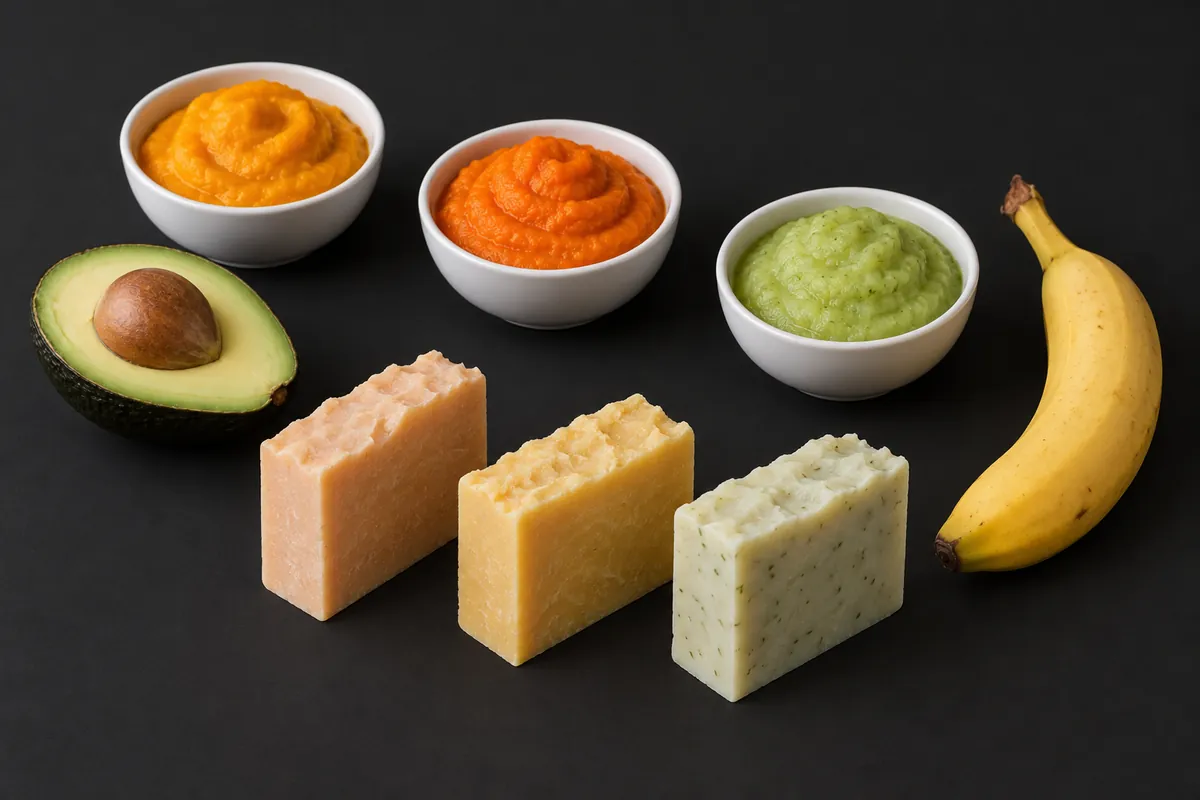
Pumpkin, carrot, cucumber, avocado and banana all turn up in handmade soap, usually blended to a purée and stirred in by the spoonful. They are easy to use well, and just as easy to overdo: a purée is mostly water with some sugar in it, and too much of it, or lumps of it, can overheat a loaf or leave spots that spoil. This guide gives the rates the sources use, where the purée goes in, what the calculator does with it, and a worked recipe. The claims come last, because most of them don’t survive the lye.
How much purée
Most sources settle on about an ounce of purée per pound of oils, a little over 6 % of the oils. Lovely Greens uses 1 oz (28 g) per pound (454 g) of oils. Faiola stirs 3 oz (85 g) of pumpkin into a batch of 50 oz (1.4 kg) of oils, about the same. Cable puts 4 oz (113 g) into a 3 lb (1.4 kg) batch of soap. Fisher’s ceiling is 5–6 % of the finished soap, about an ounce per pound of soap. Faiola’s cucumber soap in Pure Soapmaking uses 1 oz (28 g) of purée for 22 oz (624 g) of oils, about 4.5 %, with a tablespoon of puréed peel for colour.
| Purée | Water | Sugars | Fat | Usual dose | Grams for 1000 g of oils |
|---|---|---|---|---|---|
| Pumpkin, canned | 90.0 % | 3.3 % | 0.3 % | 1 oz per lb of oils (Lovely Greens) | 62.5 g |
| Carrot, strained | 92.3 % | 3.6 % | 0.1 % | 50 g per lb of oils (Lovely Greens) | 110 g |
| Banana, mashed | 74.9 % | 12.2 % | 0.3 % | 1 oz per lb of soap (Tweak and Tinker) | 95 g |
| Avocado, mashed | 73.2 % | 0.7 % | 14.7 % | up to a third of the water’s weight (The Nerdy Farm Wife) | up to 94 g |
| Cucumber, with peel | 95.2 % | 1.7 % | 0.1 % | half the water (Fisher) | 147.6 g |
| Sweet potato, boiled | 80.1 % | 5.7 % | 0.1 % | not in the calculator |
Composition from USDA FoodData Central. Grams are for 1000 g of oils at a 33 % lye solution; a single figure is the dose the calculator fills in.
More purée does not make a better bar. It makes a wetter, softer one that is likelier to overheat or spoil. Soap Queen warns that too much purée can grow mould and bacteria, and a 2024 study that put apple or carrot pomace, the pulp left from juicing, into soap at 5–15 % found every one of those bars far softer than the plain control (Łusiak et al.).
The calculator counts the water
Nerius put it simply in 1999: a purée “must be calculated as a liquid”. The calculator does exactly that. It takes the water each purée carries, from USDA food data, off the plain water, so the recipe’s total water stays where you set it. The 62 g of pumpkin in the recipe below carries 55.8 g of water, and the plain water drops by the same amount.
That has a consequence worth knowing. If the purée goes in at trace, the lye dissolves in less water than the recipe’s figure, so the solution you mix is stronger. At the usual 33 % lye solution, 62 g of pumpkin at trace makes the lye you mix 38.1 %; 110 g of carrot purée makes it 43.5 %, and the calculator warns you. The fix is to set a little more water before you start: at a 30 % setting, the same pumpkin leaves the lye at 34.1 %, which is what the recipe below does.
For a purée the calculator doesn’t list, take its water off yourself by weighing that much less plain water than the calculator shows: 60 g of boiled sweet potato brings 48 g of water with it.
Blend it smooth
Lumps are what spoil. Lovely Greens found that little pieces of carrot could cause spoilage, The Nerdy Farm Wife that large chunks of avocado can spoil in soap, and Fisher that any chunk can turn rancid or mouldy; Faiola adds that pieces leave a discoloured halo in the bar around them. Stick-blend the purée until there is nothing left to see, with a spoonful of the recipe’s water if it is stiff.
Use plain canned pumpkin, not pie filling, which is spiced and sweetened (Corley Barto). Strained baby-food carrots are a ready-made purée (Corley Barto); Fisher cooks baby carrots in water until soft and blends them. Seed an ordinary cucumber before blending it; the peel of an English cucumber blends in as small green flecks (Corley Barto). Some makers find cucumber speeds trace (Faiola), so have the mould ready. A fresh purée spoils like the food it is, so keep it cold and use it the day you make it.
When the purée goes in
With the oils, before trace. Blended into the warm oils before the lye goes in, as The Nerdy Farm Wife does with avocado and our banana oat bar with banana, or straight after the lye and oils are combined, as Faiola does with pumpkin, a purée spreads evenly with little risk of lumps.
At light trace. Soap Queen prefers to add purée at thin trace, and Faiola goes no later than thin trace, so that the batter around the fruit is still alkaline enough to stop mould and bacteria. Cable stirs hers in at light trace along with the essential oils, as the avocado and cucumber bar and the green tea and cucumber facial bar do.
In the lye liquid. Corley Barto blends the purée into the recipe’s milk or water, chills it, and adds the lye to that in an ice bath, never letting it pass 60 °C (140 °F). For her pumpkin soap she dissolves the lye in 65 g of plain water first, so she can see it has fully dissolved, then stirs that into 150 g of pumpkin standing in ice. It is a good method, but it uses far more purée than other sources, about a quarter of the weight of the oils, and the calculator will tell you the amount is above the usual range. See liquids in soap for adding lye to anything but water.
Heat, gel and colour
Sugar speeds saponification and the heat that comes with it. Canned pumpkin is 3.3 % sugar, but banana is 12.2 % (USDA), and a loaf full of sugar in a warm, insulated mould can crack or overflow. Soap purée batches cool and don’t insulate them. Corley Barto makes her purée soaps at 32–43 °C (90–110 °F), pours them into chilled moulds and puts them in the fridge. Faiola freezes her avocado soap for 12 hours after pouring, because the heat of gel turns fresh avocado brown. The gel phase guide covers how to keep a loaf out of gel.
Expect muted colours, never the colour in the bowl. Pumpkin, carrot and sweet potato owe their orange to carotenes, which stand up to alkali well: food chemists leave samples overnight in 10 % potassium hydroxide in methanol without losing them (Rodriguez-Amaya et al., 1988). Even so, a purée gives only a soft yellow to apricot in the bar, and like most natural colours it fades in light over the months (Lovin Soap). Faiola finds carrot and pumpkin keep their colour longest and greens fade first; she stores purée soaps in the dark and gives them a shelf life of about a year, even when the colour goes sooner. Cucumber gives a cream bar with flecks of green peel. Avocado does not stay green (The Nerdy Farm Wife). Banana browns, with dark speckles if it gels (Tweak and Tinker). Red berries lose their colour altogether: it comes from anthocyanins, which break down above pH 7 (Enaru et al., 2021), and Cavitch found cherry and blueberry juice made “a dull, gray mess”. For a stronger colour, see natural colourants.
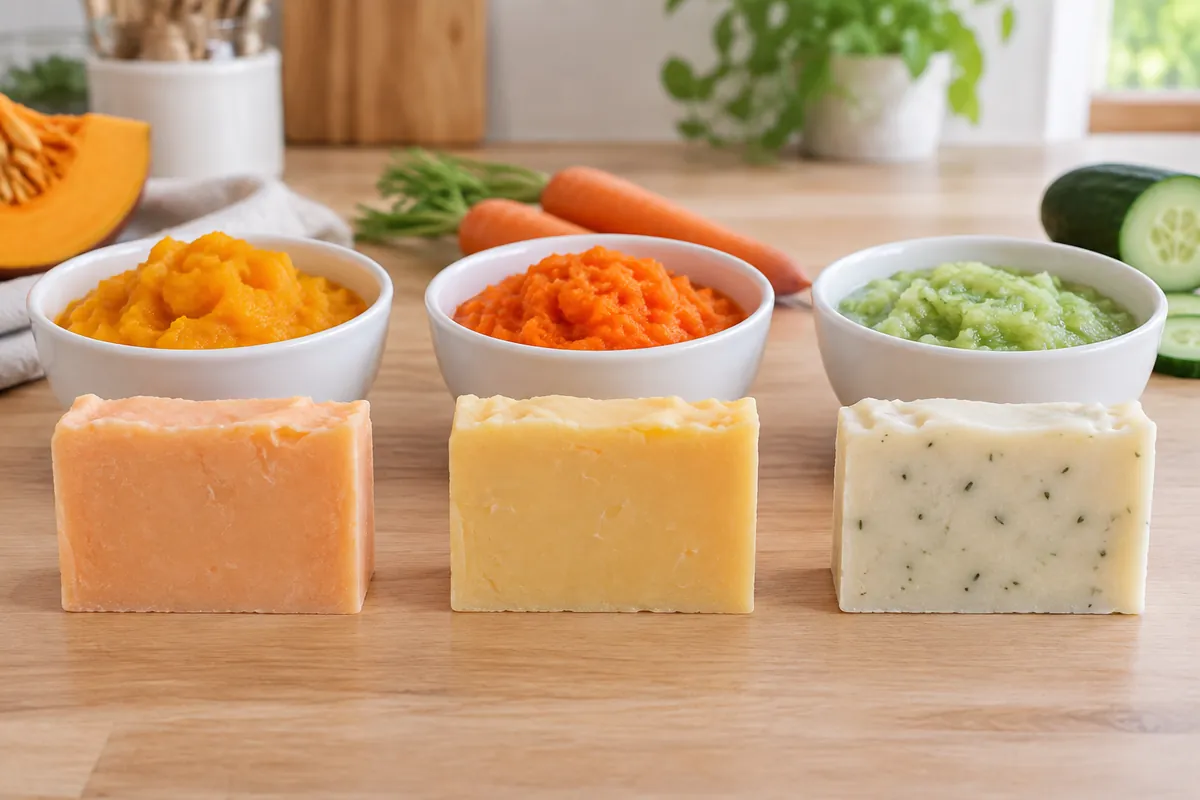 A purée tints a bar; it doesn’t dye it. Pumpkin, carrot and cucumber soaps beside their purées.
What each purée adds, and what it doesn’t
| Purée | What it really adds | What the label story says | What happens in a bar |
|---|---|---|---|
| Pumpkin, carrot, sweet potato | Colour, a little sugar for lather | Vitamin A for the skin | Some carotene survives, but in a bar rinsed off in seconds; there is no evidence it does anything for skin |
| Cucumber | Water and green flecks | Cooling, soothing, tightens pores | It is 95 % water, and nothing in it survives the lye to cool or tighten anything |
| Avocado | Real fat, 14.7 % of it | Vitamins and rich oils | The fat raises the superfat; vitamin E breaks down in alkali (Czauderna and Kowalczyk, 2007) |
| Banana | Sugar, 12.2 % | Nourishing | Sugar means more lather and more heat |
| Citrus and other acid fruit | Fruit acids | Natural fruit acids that exfoliate | The lye neutralises them into salts, using up a little lye as it does |
Composition from USDA FoodData Central.
Vitamin C oxidises quickly in solution, and alkali speeds that up (PubChem), so none of the fruit’s vitamin C is left to speak of. The avocado’s fat is the one change the calculator has to account for, and it does: a third of the water’s weight in avocado, 93.6 g for 1000 g of oils, brings 13.7 g of fat and takes a 5 % superfat to 6.3 %.
The honest pitch for a purée soap is the one a customer can see: made with real pumpkin, and the colour to prove it. The additives guide covers what turns a soap label’s claim into a cosmetic or a drug claim.
A pumpkin soap, worked through
This is the palm-free everyday bar with an ounce of pumpkin per pound of oils, added at light trace. Our pumpkin spice bar uses the same 62 g in a lard and coconut base, with a full method and photographs. The water is set a little higher than usual, at a 30 % lye solution, so the lye you mix stays at 34.1 % once the pumpkin’s water is taken off.
| Ingredient | Weight | Note |
|---|---|---|
| Olive oil | 400 g (14.1 oz) | 40 % of the oils |
| Coconut oil | 250 g (8.8 oz) | 25 % |
| Shea butter | 200 g (7.1 oz) | 20 % |
| High-oleic sunflower oil | 100 g (3.5 oz) | 10 % |
| Castor oil | 50 g (1.8 oz) | 5 % |
| Sodium hydroxide | 138.5 g (4.88 oz) | 5 % superfat |
| Water | 267.3 g (9.43 oz) | 30 % lye solution with the pumpkin’s water |
| Pumpkin purée, canned | 62 g (2.2 oz) | about 1 oz per lb of oils |
| Batch | 1467.8 g (51.8 oz) | about 13 bars of 110 g |
Worked by the calculator. Hardness 37, cleansing 17, conditioning 60; these quality numbers are a convention for comparing recipes, explained in the fatty acids guide.
- Blend the pumpkin. Stick-blend 62 g of plain canned pumpkin until completely smooth, and keep it in the fridge until you need it.
- Make the lye solution. With goggles and gloves on, stir 138.5 g of sodium hydroxide into 267.3 g of cold distilled water in a heat-safe jug, and leave it to cool where no one will knock it.
- Melt the oils. Melt the coconut oil and shea butter, stir in the olive, sunflower and castor oils, and let them cool.
- Soap it cool. When the oils and the lye are both at about 32 °C (90 °F), pour the lye into the oils.
- Blend to light trace. Stick-blend in short bursts until the batter is like thin custard.
- Add the pumpkin. Pulse it in until the colour is even, with no streaks.
- Pour, and don’t insulate. Pour into the mould and leave it uncovered in a cool room, or in the fridge for the first few hours in a warm kitchen.
- Cut and cure. Unmould after one to two days, cut, and cure for four to six weeks.
Open the pumpkin soap. 62 g of pumpkin at light trace takes the plain water to 267.3 g and leaves the lye at 138.5 g.
Open it in the calculatorExpect a pale apricot to soft orange bar that mellows over the cure. If you want it more orange, a little annatto-infused oil in place of some of the olive oil does it: see botanicals.
Recipes to try
All recipesSources
- The Natural Soap Chef . Heidi Corley Barto, Ulysses Press , 2012. Purées blended into the recipe's liquid, iced and held under 60 °C (140 °F) as the lye goes in; purée soaps made at 32–43 °C (90–110 °F) in chilled moulds.
- The Natural Soap Making Book for Beginners . Kelly Cable, Althea Press , 2017. 4 oz of pumpkin purée at trace in a 3 lb batch, with the water reduced by the purée's weight.
- Soap Crafting . Anne-Marie Faiola, Storey , 2013. 3 oz of pumpkin purée in a 50 oz batch of oils; avocado soap frozen for 12 hours to stop it browning.
- The Complete Photo Guide to Soap Making . David Fisher, Creative Publishing International , 2018. Purées at no more than 5–6 % of the soap, blended with no chunks.
- Pure Soapmaking . Anne-Marie Faiola, Storey Publishing , 2016. 1 oz of cucumber purée for 22 oz of oils; purées finely ground and added no later than thin trace; chunks mould or leave halos; cucumber speeding trace; carrot and pumpkin keeping their colour longest; a shelf life of about a year.
- The Natural Soap Book . Susan Miller Cavitch, Storey Publishing , 1995. Cherry and blueberry juices turning soap grey.
- Soapmaking for Fun & Profit . Maria Nerius, Prima Publishing , 1999. A fruit or vegetable purée must be counted as a liquid.
- USDA FoodData Central: canned pumpkin (168450), strained carrots (173506), banana (173944), avocado (171705), cucumber with peel (168409), boiled sweet potato (168484) . US Department of Agriculture .
- Assessment of provitamin A determination by open column chromatography/visible absorption spectrophotometry . D. B. Rodriguez-Amaya, M. Kimura, H. T. Godoy and H. K. Arima, Journal of Chromatographic Science 26(12) , 1988. Overnight saponification in 10 % potassium hydroxide does not degrade the provitamin A carotenoids.
- Alkaline saponification results in decomposition of tocopherols in milk and ovine blood plasma . M. Czauderna and J. Kowalczyk, Journal of Chromatography B 858 , 2007.
- Ascorbic acid: stability . PubChem (Hazardous Substances Data Bank) .
- Anthocyanins: Factors Affecting Their Stability and Degradation . B. Enaru et al., Antioxidants 10(12) , 2021.
- Evaluation of physical parameters and spectral characterization of the quality of soaps containing by-products from the food industry . P. Łusiak et al., Scientific Reports 14 , 2024. Apple and carrot pomace at 5–15 %: every bar far softer than the control.
- Sodium hydroxide solution: reactivity profile . NOAA CAMEO Chemicals .
- Coloring soap quick-start guide . Lovin Soap .
- Complete guide to natural soap additives; Natural carrot soap . Lovely Greens .
- How to add purées to cold process soap . Soap Queen .
- Avocado soap tips and recipe . The Nerdy Farm Wife .
- Using bananas in soap . Tweak and Tinker .