Coconut-free oat and chamomile bar
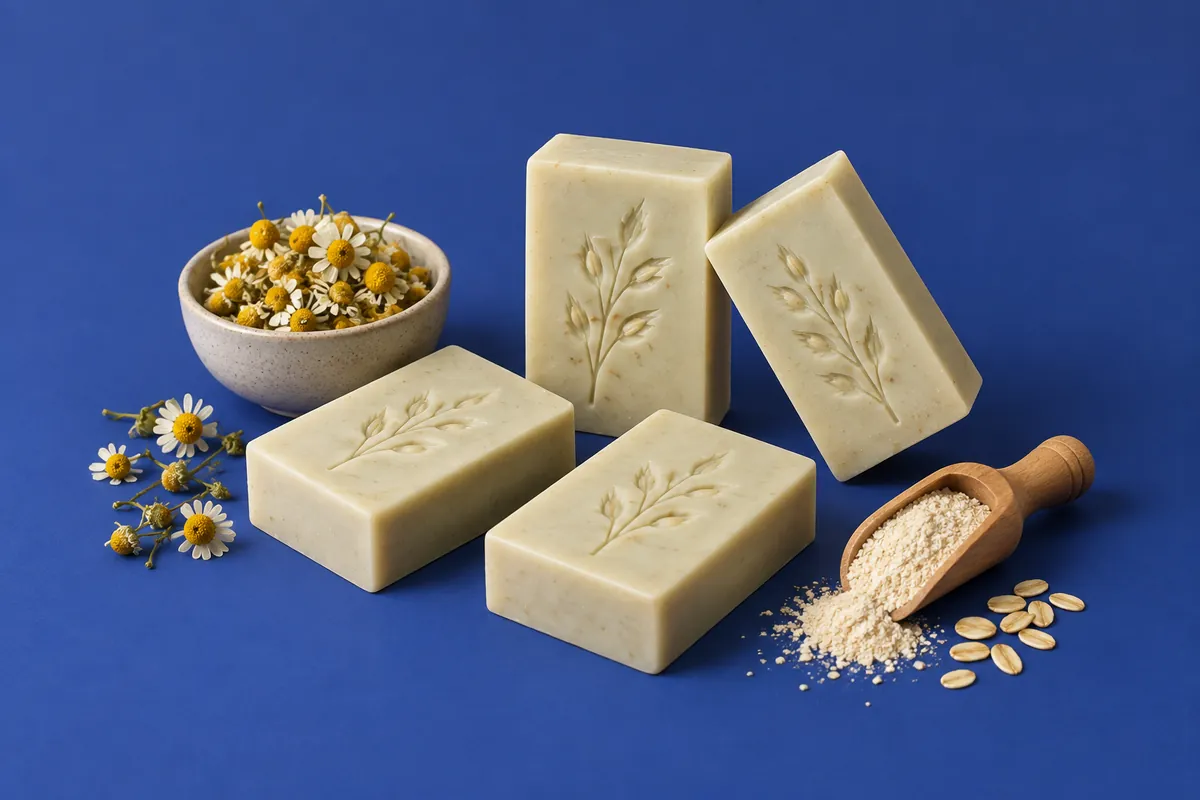
A mild, unscented bar with no coconut, palm or palm kernel oil: olive pomace oil infused with chamomile, a little shea butter and castor oil, and colloidal oatmeal and bentonite clay blended in at trace. Made for anyone who avoids coconut, or simply wants a very gentle soap.
- Skill
- Beginner
- Method
- Cold process
- Batch
- 1000 g of oils about 1428 g of batter
- Hands-on
- 1 h 15 min
- Cure
- 8 weeks
- Gel phase
- Either way gel or not, both work
What you need
For 1000 g of oils, which fills a 1.5 litre loaf mould. Weigh everything, liquids included.
| Olive-Pomace Oil · 92.0 % | 920 g | 32.45 oz |
| Shea Butter · 5.0 % | 50 g | 1.76 oz |
| Castor Oil · 3.0 % | 30 g | 1.06 oz |
| Sodium hydroxide (NaOH) · the lye, 100 % pure | 126.7 g | 4.47 oz |
| Distilled water · 207 g for a 38 % lye solution, 45 g set aside | 251.9 g | 8.89 oz |
| Dried chamomile flowers · infused in 970 g of the olive pomace oil a day or more ahead, then strained out | 7 g | 0.25 oz |
| Sodium lactate (60 % solution) · 2 tsp, stirred into the lye solution once it has cooled a little; helps this soft soap leave the mould | 13.1 g | 0.46 oz |
| Bentonite clay · 1 tbsp, mixed to a paste with 45 g of the recipe's water, held back from the lye | 11.7 g | 0.41 oz |
| Colloidal oatmeal · 4 tbsp, whisked into about 30 g of the recipe's oils first | 24 g | 0.86 oz |
- Superfat
- 5 %
- Temperatures
- Oils and lye solution each at 35 to 43 °C (95 to 110 °F), never above 49 °C (120 °F)
Method
-
Infuse the oil
A day or more ahead, put 7 g of dried chamomile flowers and 970 g of olive pomace oil in a heatproof bowl over a pan of barely simmering water. Keep the oil at about 50 °C (122 °F) for two hours, stirring now and then and lifting the bowl off whenever it runs hotter; above about 55 °C (131 °F) the flowers scorch and the oil turns brown. -
Strain it
Strain the oil through a sieve lined with muslin, pressing the flowers, and weigh out 920 g, topping it up with plain pomace oil if you are short. Keep it covered in the fridge until the day. -
Get ready
Put on splash goggles, nitrile gloves and long sleeves, open a window or turn on the extractor fan, and keep children and pets out of the room. Line the loaf mould and set it on a level surface where it can stay for four days. -
Weigh everything
Weigh the 920 g of infused oil into the soaping pot and 50 g shea butter and 30 g castor oil into a small pan. Weigh 251.9 g distilled water into a heat-safe jug and pour 45 g of it into a cup for the clay, then weigh 126.7 g sodium hydroxide into a dry container. -
Mix the clay
Stir 1 tbsp (11.7 g) bentonite clay into the cup of held-back water a little at a time until smooth, and leave it to swell into a soft paste while you work. -
Make the lye solution
At the open window or under the fan, pour the sodium hydroxide slowly into the rest of the water, never the reverse, and stir until clear. With some water set aside it runs a little stronger and hotter than usual; after a few minutes stir in 2 tsp (13.1 g) sodium lactate, then leave it to cool, labelled and out of reach. -
Melt and combine the oils
Melt the shea butter with the castor oil on the lowest heat and pour it into the infused oil. Spoon about 30 g of the oils into a small cup and whisk 4 tbsp (24.3 g) colloidal oatmeal into it. -
Blend to thin trace
When the oils and the lye solution are each between 35 and 43 °C (95 and 110 °F), pour the lye solution into the oils down the shaft of the stick blender. Pulse and stir until the batter looks like thin custard; with this much olive oil it can take several minutes. -
Add the oats and clay
Add the oatmeal in its oil and all of the clay paste, and blend in short bursts until no lumps or streaks remain. The oats thicken the batter a little, which helps a soap this soft. -
Pour and cover
Pour into the mould, tap it on the worktop to release air, smooth the top, and lay baking paper and a light towel over it for a day. -
Unmould and cut
After three or four days, when the loaf is firm and has pulled away from the sides, unmould it with gloves on and cut it into bars about 2.5 cm (1 in) thick. If it still dents under a finger, give it another day. -
Stamp, if you like
Within a day of cutting, while the soap is still soft, press a soap stamp into the top of each bar with a firm tap of a rubber mallet, about 1 mm (1/16 in) deep. -
Cure for eight weeks
Stand the bars on edge in a dry, airy room and turn them every few days. They are soft and slippery at first; at eight weeks they are firmer and last longer, and like any olive-rich soap they keep improving for months.
Tips
- With no coconut or palm kernel oil there is nothing to make big, fast bubbles, so the lather is low and creamy and the calculator puts cleansing at 0. That is where the mildness comes from.
- Chamomile tints the bar a warm cream rather than scenting it. It belongs to the daisy family, so anyone allergic to daisies or ragweed should try the bar on a small patch of skin first; the same goes for anyone who reacts to oats.
- Pomace oil traces faster than other olive oils, which helps a batter this soft. With virgin or refined olive oil instead, choose Olive Oil in the calculator: it asks a little more lye, 128.2 g where pomace takes 126.7 g.
- Bentonite swells as it takes up water. Stir it in slowly and let it stand for a few minutes; a lumpy slurry leaves hard specks in the bar.
The oils
| Oil | Share |
|---|---|
| Olive-Pomace Oil (refined / blended) | 92.0 % |
| Shea Butter | 5.0 % |
| Castor Oil | 3.0 % |
How it is made
| Process | Cold process |
| Alkali | NaOH |
| Superfat | 5 % |
| Water | lye water at 33 % |
| Iodine value | 82 |
| INS | 105 |
Why make it
For anyone who avoids coconut oil, or wants the mildest bar they can make. With no coconut, palm or palm kernel oil, cleansing is 0 and conditioning 80 on our scale, so it washes very gently with a low, creamy lather, much like castile. It is unscented, following dermatologists' advice to use gentle, fragrance-free cleansers on dry, sensitive skin. The colloidal oatmeal has the best case of any addition here: the US FDA recognises it as a skin protectant in leave-on products, though a soap is rinsed off within a minute. The chamomile adds a traditional touch and a cream colour, and its reputation rests on herbal tradition. The caveats: the bar is soft and slippery for weeks and best after eight, and chamomile belongs to the daisy family, so anyone allergic to ragweed or daisies should try a small piece first.
Sources
- Dermatologists' top tips for relieving dry skin · American Academy of Dermatology, 2026
- 21 CFR 347.10, Skin protectant active ingredients · US Food and Drug Administration, Code of Federal Regulations
- European Union herbal monograph on Matricaria recutita L., flos · European Medicines Agency, Committee on Herbal Medicinal Products, 2015
What tradition, makers' experience and research say about soaps like this, each labelled for what it is. It is not medical advice, and no soap treats a skin condition: if you have one, ask a doctor or pharmacist.
What the numbers say
- Palmitic acid 12.9 %
- Stearic acid 4.7 %
- Ricinoleic acid 2.7 %
- Oleic acid 66.0 %
- Linoleic acid 11.7 %
- Other 2.5 %
Saturated : unsaturated 18 : 82
Computed from the fatty acids of the fats above. The bands are what the craft has settled on, not chemistry — a bar outside one is not wrong.
From the guides
All guides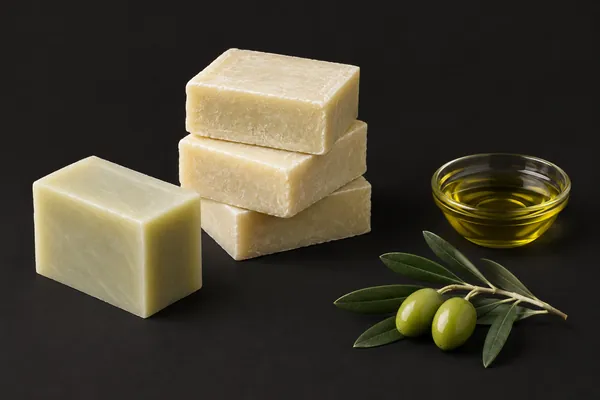
Castile soap: pure olive oil, and why it's worth the wait
What castile soap really is, why pure olive oil traces slowly and starts soft and slippery, how long to cure it, and a recipe with the calculator's numbers.
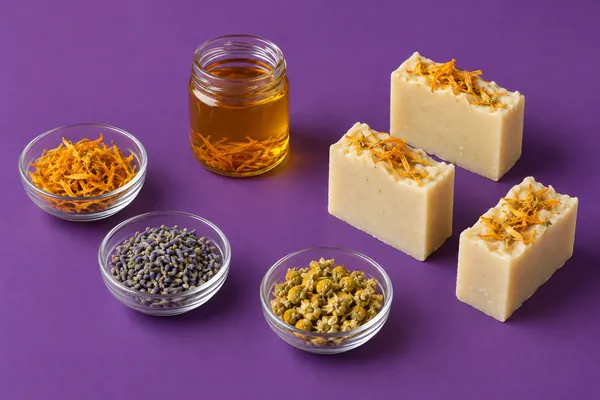
Herbs, flowers and infusions in soap
What dried herbs, petals, infused oils and herbal teas really do in soap: which survive lye, how to infuse an oil, and which claims a herbal soap can make.

Soap additives: salt, sugar, sodium lactate, clays, oats, silk and more
What common soap additives do, how much to use and when they go in: sourced doses for sodium lactate, salt, sugar, honey, citric acid, clays, oats and silk.
Where these proportions come from
Adapted from Anne-Marie Faiola's unscented oatmeal soap, keeping her oils and her 5 % superfat: 92 % olive pomace oil infused with chamomile, 5 % shea butter and 3 % castor oil, with colloidal oatmeal and bentonite clay at trace and sodium lactate in the lye. The clay is mixed with water held back from the recipe instead of extra water, the lye solution is 33 %, and the soap is cast in a loaf rather than cups.
Formulation adapted from Pure Soapmaking by Anne-Marie Faiola (Storey Publishing, 2016). The method and notes are ours.