Solid dish and kitchen bar
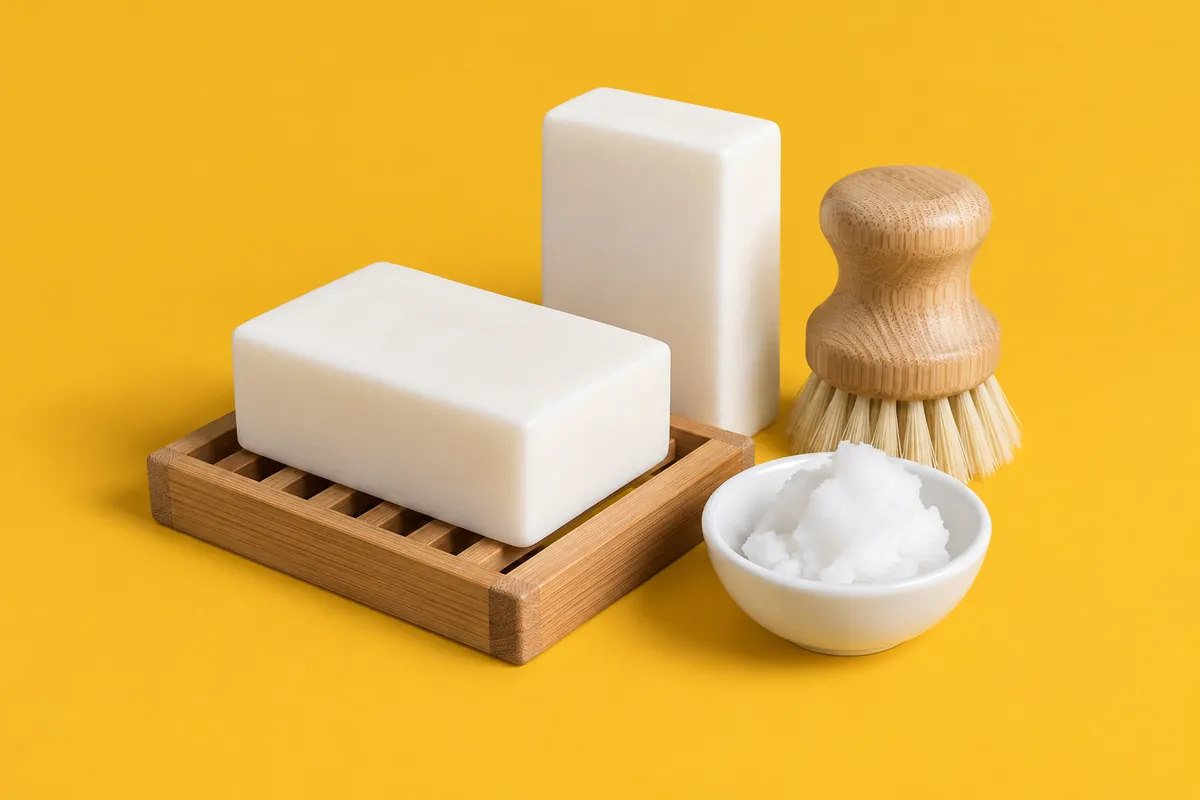
A hard, unscented bar for dishes, pans and worktops: 80 % coconut oil to cut grease, castor oil for a quick lather and a little cocoa butter to help it last by the sink. Rub a wet brush over it and wash up as usual.
- Skill
- Beginner
- Method
- Cold process
- Batch
- 1000 g of oils about 1484 g of batter
- Hands-on
- 45 min
- Cure
- 4 weeks
- Gel phase
- Either way gel or not, both work
What you need
For 1000 g of oils, which fills a 1.5 litre loaf mould. Weigh everything, liquids included.
| Coconut Oil · 80.0 % | 800 g | 28.22 oz |
| Castor Oil · 10.0 % | 100 g | 3.53 oz |
| Cocoa Butter · 10.0 % | 100 g | 3.53 oz |
| Sodium hydroxide (NaOH) · the lye, 100 % pure | 169.3 g | 5.97 oz |
| Distilled water · for a 35 % lye solution | 314.5 g | 11.09 oz |
- Superfat
- 2 %
- Temperatures
- Oils and lye solution at 32 to 38 °C (90 to 100 °F), left uncovered
Method
-
Get ready
Put on goggles, gloves and long sleeves, open a window and line a 1.5 litre loaf mould. Weigh 800 g coconut oil and 100 g refined cocoa butter into the pot, 100 g castor oil into a jug, 314.5 g distilled water into the lye jug and 169.3 g sodium hydroxide into a small dry container. -
Make the lye solution
Pour the sodium hydroxide into the water, never the water onto the lye, and stir until it runs clear, keeping your face away from the vapour. Let it cool to 32 to 38 °C (90 to 100 °F). -
Melt the oils
Melt the coconut oil and cocoa butter until just clear, stir in the castor oil and let the oils cool to the same 32 to 38 °C (90 to 100 °F). -
Blend to light trace
Pour the lye solution into the oils and stick blend in short pulses. This much coconut oil traces fast, so stop at light trace, when a drizzle leaves a faint line on the surface. -
Pour and leave it uncovered
Pour into the mould and tap it on the worktop to let air out. Leave it uncovered in a cool room with no towel over it: a batch this high in coconut oil makes plenty of heat of its own and can crack if it is kept warm. -
Cut it the same day
It sets hard quickly. With your gloves on, unmould and cut it as soon as it holds a clean edge, often 4 to 12 hours after pouring; left too long, it cuts with chips and cracks. -
Cure for four to six weeks
Stand the bars on a rack with air around them for four to six weeks. The drier the bar, the longer it lasts at the sink. -
Wash up with it
Rub a wet brush or cloth over the bar, then wash dishes, pans and worktops as usual and rinse. For a greasy pan, work the bar straight onto the brush. -
Keep it on a draining dish
Stand the bar on a slatted or draining soap dish between uses, never in a puddle: a bar that sits in water goes soft and wastes away.
Tips
- This is a cleaning bar, not a hand soap. So much coconut oil at a 2 % superfat makes a very cleansing soap, and across coconut oil's published saponification range it could even carry a trace of free lye, so if your skin is sensitive, wear gloves for the washing up.
- Use refined, deodorised cocoa butter. Unrefined cocoa butter smells of chocolate, and a bar for the kitchen sink is best left unscented.
The oils
| Oil | Share |
|---|---|
| Coconut Oil | 80.0 % |
| Castor Oil | 10.0 % |
| Cocoa Butter (Theobroma Oil) | 10.0 % |
How it is made
| Process | Cold process |
| Alkali | NaOH |
| Superfat | 2 % |
| Water | lye water at 35 % |
| Iodine value | 19 |
| INS | 223 |
Why make it
A bar for the sink, not for skin. Coconut oil makes the most cleansing soap there is, 54 on our scale where our bath bars sit between 10 and 20, and its soap dissolves even in salt water, which is why marine soap for use at sea was made from it (Simmons and Appleton, 1908). Makers choose a solid dish bar to cut down on plastic bottles and to know exactly what goes into their washing-up. The honest limits: in hard water part of any soap turns to scum (USGS), so glasses may want a hot rinse, and a 2 % superfat is far too stripping for regular hand washing. If your hands are dry, wear gloves for the dishes, as dermatologists advise.
Sources
- The Handbook of Soap Manufacture · Scott, Greenwood & Son, 1908
- Hardness of water · U.S. Geological Survey
- Dermatologists' top tips for relieving dry skin · American Academy of Dermatology
What tradition, makers' experience and research say about soaps like this, each labelled for what it is. It is not medical advice, and no soap treats a skin condition: if you have one, ask a doctor or pharmacist.
What the numbers say
- Lauric acid 39.3 %
- Myristic acid 15.1 %
- Palmitic acid 9.9 %
- Stearic acid 6.1 %
- Ricinoleic acid 8.9 %
- Oleic acid 9.9 %
- Linoleic acid 2.2 %
- Other 11.7 %
Saturated : unsaturated 79 : 21
Computed from the fatty acids of the fats above. The bands are what the craft has settled on, not chemistry — a bar outside one is not wrong.
From the guides
All guides
Laundry soap bars and household soap
Why laundry and kitchen bars are high in coconut and made with almost no superfat, how to grate one into laundry powder, and what washing soda and borax do.
Soap in hard water: scum, chelators and rinse
Why soap turns to scum in hard water, how much soap each litre wastes, what a chelator in the bar can and cannot do, and why coconut soap copes best.
Superfat and lye discount: why recipes leave some oil unsaponified
What superfat and lye discount mean, how the calculator applies them, where makers set them for each soap, and why oil added at trace isn't the oil left over.
Guides with this recipe
Where these proportions come from
Our own formulation: 80 % coconut oil, the most cleansing soap there is and the one that copes best with hard water, 10 % castor oil for a quick lather and 10 % cocoa butter for a harder bar that lasts at a wet sink, at the 2 % superfat our laundry soap guide gives a kitchen bar, so that it rinses clean.