In short
- Laundry and kitchen bars are high in coconut oil, often with tallow, and made at 0 to 2 % superfat, because free oil is what a wash should not leave behind.
- At 0 % the calculator's uncertainty band shows the bar may carry a little free alkali. That is acceptable for laundry, not for skin: handle fresh bars with gloves.
- Washing soda (sodium carbonate) softens the water by turning calcium into chalk, and makes the wash strongly alkaline. It causes serious eye irritation.
- Borax adds a milder alkali. The EU classifies it as toxic for reproduction and restricts its sale to the public, and our powder leaves it out.
- Soap forms scum in hard water, and high-efficiency machines are built for low-sudsing HE detergent. Know both limits before you replace your detergent.
On this page
Laundry soap is the easiest soap to design. There is no skin to please and no fragrance to fit, just oils that clean and as little leftover oil as possible. This guide gives three bars with the calculator’s numbers, shows how to turn one into laundry powder, and explains what washing soda and borax actually do, including why we leave borax out.
Why laundry soap has almost no superfat
In a bar for skin, the superfat is a margin of safety and a little oil left in for feel, usually 3 to 8 %. A laundry bar has no skin to condition, and oil left in it goes into the wash along with the grease the soap is supposed to carry away. So laundry soap is made at 0 to 1 %, and a kitchen bar that people also handle at about 2 %. Our laundry bar is made at 0 %.
The oils are chosen for cleaning. Coconut oil, rich in lauric and myristic acids, makes one of the most cleansing soaps by the usual measure: 100 % coconut soap scores 68 for cleansing, against a usual band of 12 to 22 for skin soaps. Its soap also stays dissolved where others do not. Coconut “marine” soaps were made for washing in sea water, because salt water that makes other soaps separate out leaves coconut soap in solution, still able to lather. Tallow gives a hard, long-lasting bar, and with the superfat taken out it makes a good laundry bar on its own.
Leaving the superfat at zero also removes the safety margin, and the calculator shows what that means. SAP values are ranges, and a recipe at 0 % is only exactly balanced if your oils sit where the calculator’s figures do. For our laundry bar, the calculator’s uncertainty band runs from a 3.1 % superfat, if your oils need more lye than the typical figures, to 3.3 % lye-heavy, if they need less. At 1 %, the worst case narrows to 2.3 % lye-heavy. In a wash that washing soda has already made strongly alkaline, that trace of free alkali adds little. On skin it matters, which is why a laundry bar should not double as a hand soap.
Three bars
| Bar | Oils | Superfat | Sodium hydroxide | Water |
|---|---|---|---|---|
| Laundry bar | 500 g tallow, 500 g coconut oil | 0 % | 161.3 g | 299.5 g |
| Kitchen bar | 700 g coconut oil, 200 g olive oil, 100 g castor oil | 2 % | 164.5 g | 305.5 g |
| Coconut laundry bar | 1000 g coconut oil | 0 % | 182.9 g | 339.6 g |
From the calculator: 1000 g of oils and a 35 % lye solution in each case.
The laundry bar is hard and long-lasting: hardness 66, cleansing 36, with an iodine value of 27. The kitchen bar is our bar for dishes, pans and sinks: 70 % coconut oil for grease, castor oil for a quicker lather, a little olive oil to soften the edge, and a 2 % superfat so it leaves little oil behind. The coconut laundry bar suits anyone who avoids animal fats; it is the most cleansing of the three and the hardest on hands, and its recipe page has the full method.
Make the laundry bar. 500 g of tallow and 500 g of coconut oil at a 0 % superfat ask 161.3 g of sodium hydroxide and, at a 35 % solution, 299.5 g of water.
Open it in the calculatorMake them as you would any cold process soap. Recipes this high in coconut oil and tallow trace quickly and set hard, so have the mould ready. Cure the bars for the usual four to six weeks: a dry bar lasts longer and grates to a finer powder.
Making laundry powder
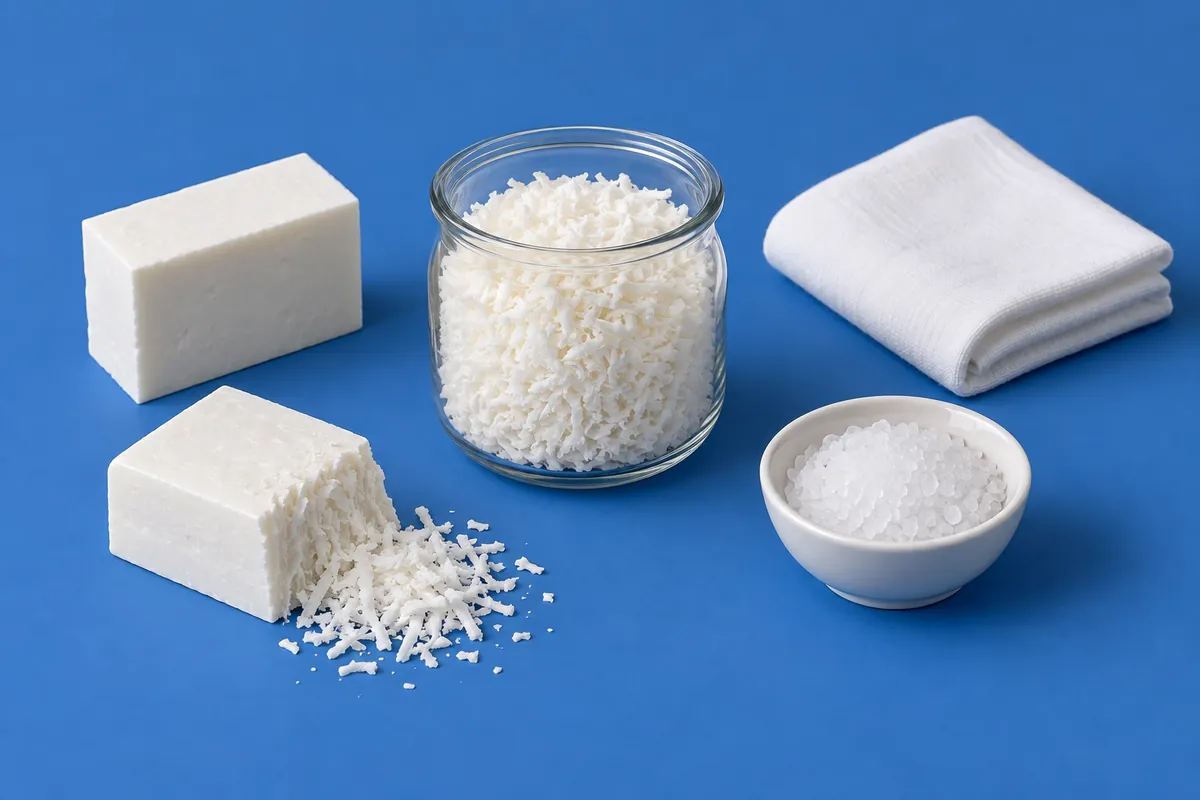
A widely printed recipe grates one cured bar on the finest holes of a grater and mixes it with 1 cup of washing soda and 1 cup of borax. Letcavage and Harden’s Natural Soap Making doses it at half a cup per load in a top-loading machine and 2 tablespoons in a front-loader, and suggests dissolving the powder in a cup or two of hot water first if it does not dissolve in the wash. Those measures are by volume, and they are one starting point rather than a standard: how much you need depends on your water, your machine and how dirty the load is.
Our version leaves the borax out, for the reasons below, and keeps the grated soap and the washing soda. Two cautions go with it:
- Know which soda you have. Washing soda sold in the US, such as Arm & Hammer’s, is sodium carbonate itself; its safety data sheet lists it at 60 to 100 %. Soda crystals, as sold in the UK, are usually the hydrated form, sodium carbonate decahydrate, and only 37 % of their weight is sodium carbonate; the rest is water. Weight for weight, you need about 2.7 times as much of the crystals for the same effect, so a recipe written for one does not transfer to the other.
- Protect your eyes and hands. Washing soda is classified as causing serious eye irritation, and its maker advises gloves and eye protection. Grate and mix where the dust will not blow about, label the jar, and keep it out of reach of children.
What washing soda does
Washing soda is sodium carbonate, and it earns its place in the powder by dealing with hard water. In hard water, soap reacts with calcium to form soap scum, and every gram of soap that ends up as scum is a gram that is not cleaning. Carbonate takes calcium out of the water as insoluble calcium carbonate (chalk), which leaves more of the soap free to work. Detergent makers call this a precipitating builder. It is not a complete cure: a detergent patent from Lever Brothers notes that carbonate alone seldom brings calcium down far enough for good cleaning in hard water.
It also makes the wash strongly alkaline: its safety data sheet gives pH 11.4. That strength is why it irritates eyes and skin, and why it is no friend to wool and silk. The wool industry’s own advice is to wash wool in a mild, neutral detergent and avoid heavy-duty ones, and a soap and soda powder is neither mild nor neutral.
The chalk it makes has to go somewhere, and the same patent notes that precipitating calcium with carbonate can deposit calcium carbonate on the washed fabric.
Washing soda is not baking soda. Baking soda is sodium bicarbonate, a much weaker alkali (pH 8.3 in a 1 % solution), and it does not do the same job.
What borax does, and why we leave it out
Borax is sodium tetraborate decahydrate. On its own in water it is a milder alkali than washing soda, about pH 9.2, and a buffer: it resists changes in pH. Its manufacturer lists detergents among its uses, as a pH regulator and complexing agent. In a soap and soda powder, though, it adds a second, milder alkali to a mix that the washing soda has already made strongly alkaline.
Its hazards are why the rules about it differ from country to country:
- In the EU, borax has a harmonised classification as toxic for reproduction, category 1B: “may damage fertility; may damage the unborn child”, and its maker’s safety data sheet also classifies it as causing serious eye irritation. It was identified as a substance of very high concern in 2010, and REACH lists it among the substances that may not be sold to the general public, on their own or in mixtures above set concentrations. The manufacturer’s European safety data sheet lists consumer uses as advised against and the product as restricted to professional users.
- In Canada, Health Canada advised in 2016 against using boric acid and borax in homemade crafts such as slime, and in homemade pesticides, because overexposure has the potential to cause developmental and reproductive effects, with particular concern for children and pregnant women. For cleaning products, its advice is to follow the label and store them out of children’s reach.
- Elsewhere, including the United States, borax is sold as a laundry booster. The manufacturer’s data sheet notes that it is poorly absorbed through intact skin. If you use it, use it as its label directs.
Soap and washing soda do the cleaning and the softening. Borax only adds a milder alkali to a mix that is already alkaline, and we would rather not keep a substance with that classification in a jar beside the washing machine.
Where soap falls short in a machine
Hard water. Soap forms scum with the calcium and magnesium in hard water, so the harder your water, the more soap you need and the more residue you risk. Washing soda helps, and adds a little chalk of its own. It is worth knowing your water: the US Geological Survey calls water up to 60 mg/L of hardness (as calcium carbonate) soft, 61 to 120 moderately hard, 121 to 180 hard, and anything above that very hard. Your water supplier publishes the figure. The hard water guide explains the chemistry.
Cold washes. Grated soap dissolves slowly in cold water and can leave flecks in the load. Dissolving the powder in hot water before it goes into the machine solves it.
High-efficiency machines. HE washers use little water and are built for low-sudsing detergent. Whirlpool, for one, tells owners to use only HE detergent in them, warns that too much detergent means oversudsing and poor rinsing, and that older powdered detergents do not dissolve well. Some books call homemade soap powder safe for HE machines, but the instructions that count are the ones for your machine. A homemade powder has no HE rating, so if you use one, use a small dose, dissolve it first, and read your machine’s manual.
Wool and silk. Wash them in a mild, neutral detergent, as the wool industry advises, not in soap and soda.
Stain bars and ox gall
The simplest use of a laundry bar is as a stain bar: wet the stain, rub the bar into it, leave it for a while and then wash as usual.
In German-speaking countries the traditional stain bar is gall soap, Gallseife, soap made with ox gall. The reasoning is sound as far as it goes: bile acids are the body’s own detergents for fat, and they break fat into fine droplets. We know of no independent test showing that gall soap removes stains better than a plain laundry bar used the same way, and we have no sourced amount of ox gall to give you, so we leave it at that.
Kitchen and household bars
The kitchen bar is a household soap for every day: a bar on a dish by the sink, rubbed onto a brush or cloth for pans, dishes and worktops. It lathers quickly and cuts grease, and the low superfat leaves little oil on the dishes. It is still a cleaning bar, high in coconut and low in superfat, so if your hands are sensitive, wear gloves for the washing up, or use a gentler bar at the sink: our citrus kitchen bar is lard, coconut and olive oil at an everyday 5 % superfat. Keep it on a draining dish between uses; a bar that sits in water goes soft and wastes away.
Recipes to try
All recipesSources
- Natural Soap Making . Elizabeth Letcavage and Melissa Harden, Stackpole Books , 2013. Laundry powder: one bar grated on the finest holes, 1 cup of washing soda and 1 cup of borax; half a cup per top-loader load or 2 tablespoons per front-loader; dissolve in hot water first if it does not dissolve.
- The Natural Soap Making Book for Beginners . Kelly Cable, Althea Press , 2017. Take the superfat out and tallow makes a good laundry bar; the book's laundry bar is made at a 1 % lye discount.
- Soap . Encyclopaedia Britannica, 11th edition (via Wikisource) , 1911. Coconut ('marine') soaps are not insoluble in strong salt solution, so they lather in sea water; calcium and magnesium salts affect soap and form insoluble compounds.
- Hardness of Water . US Geological Survey, Water Science School . In hard water soap reacts with calcium to form soap scum and more soap is needed; bands of 0-60, 61-120, 121-180 and over 180 mg/L as calcium carbonate.
- Arm & Hammer Super Washing Soda, Safety Data Sheet . Church & Dwight Co. , 2015. Disodium carbonate 60-100 %; Eye Irrit. 2A, H319, causes serious eye irritation; pH 11.4; repeated or prolonged skin contact likely to irritate; wear gloves and eye protection.
- Sodium carbonate (CID 10340) and sodium carbonate decahydrate (CID 151402) . PubChem, US National Library of Medicine . Molar masses 105.99 and 286.14 g/mol: the crystals are 37 % sodium carbonate by weight.
- Sodium bicarbonate, Safety Data Sheet . Arm & Hammer Performance Products , 2025. pH 8.3 at 1 %.
- Borax Decahydrate, Technical: Safety Data Sheet (EU), version 1.11 . Borax Europe Ltd (Rio Tinto) , 2026. Classified Eye Irrit. 2 (H319) and Repr. 1B (H360FD, may damage fertility, may damage the unborn child); consumer uses advised against and restricted to professional users under REACH Annex XVII; pH 9.2 in 1 % solution; poorly absorbed through intact skin.
- Support document for identification of disodium tetraborate, anhydrous, as a substance of very high concern . European Chemicals Agency, Member State Committee , 2010. Covers the decahydrate (borax, CAS 1303-96-4); toxic for reproduction, Repr. 1B, H360FD; adopted 9 June 2010.
- Regulation (EC) No 1907/2006 (REACH), Annex XVII, entry 30 and Appendix 6 . European Union . Substances in Appendix 6, which lists disodium tetraborate decahydrate, may not be placed on the market for supply to the general public, alone or in mixtures above the set concentration limits.
- Health Canada advises Canadians to avoid homemade craft and pesticide recipes using boric acid . Health Canada , 2016. Covers borax; overexposure has the potential to cause developmental and reproductive effects, with particular concern for children and pregnant women; follow the directions on cleaning products and store them out of children's reach.
- Fabric washing process and detergent composition for use therein (US 4,530,774) . Lever Brothers Co. , 1985. Sodium carbonate alone is not usually capable of reducing calcium in hard water far enough for good detergency, and precipitating calcium hardness with carbonate can deposit calcium carbonate on the washed fabrics.
- HE Detergent use in a Washer . Whirlpool Product Help . Use only HE detergent in a high-efficiency machine; too much detergent causes oversudsing and poor rinsing; older powdered detergents do not dissolve well.
- Best detergent to use when washing wool . The Woolmark Company . Use a neutral, mild detergent for wool; avoid heavy-duty detergents.
- Physiology, Bile Acids . Isaac Chen and Sebastiano Cassaro, StatPearls (NCBI Bookshelf) , 2023. Bile acids help digest fat through their surfactant properties, emulsifying fats into micelles (PMID 31747172).