Honey and beeswax bar
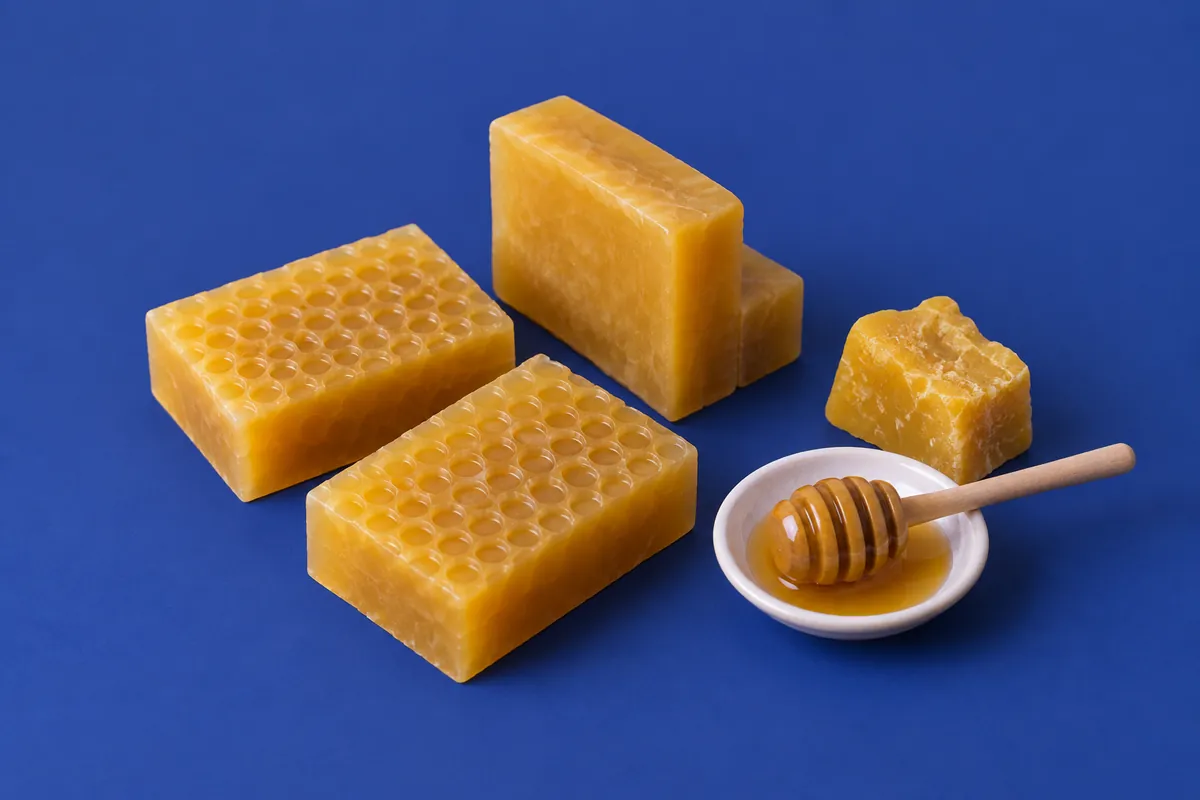
An everyday bar with a little beeswax for hardness, a spoonful of honey for lather and a scent of orange and cedarwood, poured onto bubble wrap so every bar carries a honeycomb pattern. Warm soaping and a full gel turn it golden.
- Skill
- Intermediate
- Method
- Cold process
- Batch
- 1000 g of oils about 1473 g of batter
- Hands-on
- 1 hour
- Cure
- 4 weeks
- Gel phase
- Yes insulate the mould
What you need
For 1000 g of oils, which fills a 20 cm (8 in) square slab mould about 4 cm deep. Weigh everything, liquids included.
| Olive Oil · 40.0 % | 400 g | 14.11 oz |
| Coconut Oil · 30.0 % | 300 g | 10.58 oz |
| Sunflowerseed Oil - High Oleic Acid · 13.0 % | 130 g | 4.59 oz |
| Cocoa Butter · 10.0 % | 100 g | 3.53 oz |
| Castor Oil · 5.0 % | 50 g | 1.76 oz |
| Beeswax · 2.0 % | 20 g | 0.71 oz |
| Sodium hydroxide (NaOH) · the lye, 100 % pure | 140.6 g | 4.96 oz |
| Distilled water · 252 g for a 36 % lye solution, 30 g set aside | 281.8 g | 9.94 oz |
| Honey · 1 tbsp, dissolved in 30 g of the recipe's water, warmed | 21 g | 0.74 oz |
| Sweet orange essential oil · 2.0 % of the oils, at trace | 20 g | 0.71 oz |
| Atlas cedarwood essential oil · 1.0 % of the oils, at trace | 10 g | 0.35 oz |
- Superfat
- 5 %
- Temperatures
- Beeswax melted at about 65 °C (149 °F), oils kept at 50 to 55 °C (122 to 131 °F) and the lye solution at 45 to 50 °C (113 to 122 °F)
Method
-
Line the mould with bubble wrap
Cut two pieces of small-bubble wrap to fit the slab mould and lay one in the bottom, bubbles facing up. -
Get ready
Put on goggles, gloves and long sleeves and weigh everything, setting 30 g of the distilled water aside in a cup for the honey. -
Make the lye solution
Where the air moves, sprinkle the sodium hydroxide into the rest of the water, never the water onto the lye, stir until it clears, and let it cool to 45 to 50 °C (113 to 122 °F). -
Melt the beeswax
Melt the beeswax on its own in a small heat-safe jug standing in a pan of simmering water; it needs about 65 °C (149 °F). -
Melt the oils
Melt the coconut oil and cocoa butter, add the olive, sunflower and castor oils, warm them to 50 to 55 °C (122 to 131 °F), and stir in the melted beeswax until the oils are clear. -
Loosen the honey
Warm the 30 g of reserved water and stir the honey into it until it dissolves. -
Blend to light trace
Pour the lye solution into the oils and stick blend in short bursts. At this temperature it thickens fast, so stop at light trace; if flecks of wax appear, stand the pot in hot water and blend again. -
Add the honey and scent
Stir in the honey water and the orange and cedarwood essential oils, then blend for a few seconds. -
Pour
Pour the batter over the bubble wrap, tap the mould so it settles between the bubbles, and level the top. -
Press the top
Lay the second piece of bubble wrap bubbles-down on the surface and smooth it gently with your fingertips so it touches the soap everywhere. -
Insulate and watch
Cover with a board and a towel so the slab gels, but look after 30 minutes: honey adds heat, and if the top cracks or bulges, take the towel off. -
Unmould and cut
The next day, unmould the slab, peel off the bubble wrap, and cut it into 12 bars. -
Cure
Stand the bars on a rack with air around them for four weeks, turning them now and then.
Tips
- Keep the beeswax at 2 %. Fisher finds that more than about 3 % dampens the lather and makes the bar feel sticky.
- Bubble wrap keeps the air off the soap, so the honeycomb faces come out without the white bloom of soda ash.
- Honey darkens a gelled bar more than a cool one: expect golden amber rather than cream. Wash second-hand bubble wrap before it goes near the soap.
The oils
| Oil | Share |
|---|---|
| Olive Oil (virgin / refined / olive oil) | 40.0 % |
| Coconut Oil | 30.0 % |
| Sunflowerseed Oil - High Oleic Acid | 13.0 % |
| Cocoa Butter (Theobroma Oil) | 10.0 % |
| Castor Oil | 5.0 % |
| Beeswax (yellow / white) | 2.0 % |
How it is made
| Process | Cold process |
| Alkali | NaOH |
| Superfat | 5 % |
| Water | lye water at 33 % |
| Iodine value | 56 |
| INS | 153 |
Why make it
A cheerful everyday bar and a good one to give: the honeycomb pattern from bubble wrap costs nothing and always gets noticed. David Fisher uses honey for exactly what it does in soap, more lather and a golden colour in a gelled bar, and beeswax at 2 % adds a little hardness and helps keep soda ash off. On our scale the bar is balanced, cleansing 20 and conditioning 56, with a lively lather, and the orange and cedarwood scent is warm rather than sweet. Honey's reputation for skin comes from tradition and from products that stay on the skin; in soap it is rinsed away within seconds, so its value here is lather and colour. With honey and beeswax in it, it is not a vegan bar.
Sources
- The Complete Photo Guide to Soap Making · Creative Publishing International, 2018
What tradition, makers' experience and research say about soaps like this, each labelled for what it is. It is not medical advice, and no soap treats a skin condition: if you have one, ask a doctor or pharmacist.
What the numbers say
- Lauric acid 14.7 %
- Myristic acid 5.7 %
- Palmitic acid 11.4 %
- Stearic acid 6.1 %
- Ricinoleic acid 4.4 %
- Oleic acid 44.3 %
- Linoleic acid 7.2 %
- Other 5.7 %
Saturated : unsaturated 43 : 57
Computed from the fatty acids of the fats above. The bands are what the craft has settled on, not chemistry — a bar outside one is not wrong.
From the guides
All guides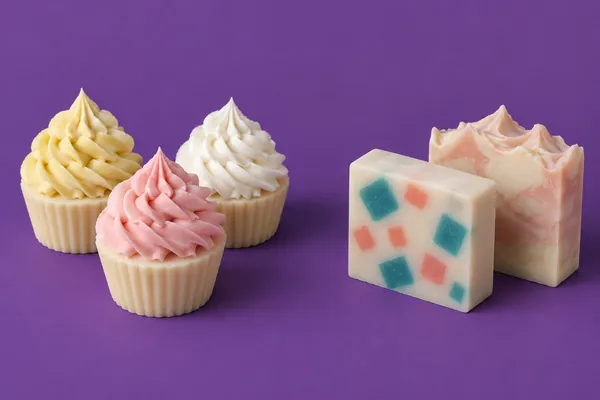
Embeds, textured tops and piping
Soap embeds that stay put and don't bleed, textured and botanical tops, piped frosting and soap cupcakes, and how to keep soda ash off the top.

Soap additives: salt, sugar, sodium lactate, clays, oats, silk and more
What common soap additives do, how much to use and when they go in: sourced doses for sodium lactate, salt, sugar, honey, citric acid, clays, oats and silk.
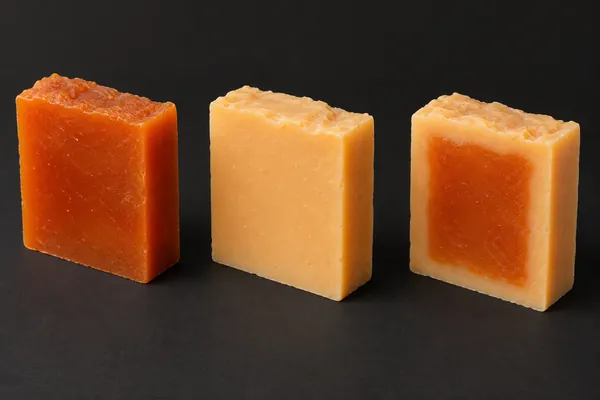
Gel phase: to insulate or keep it cool
What gel phase is, why a loaf turns dark and translucent, how gelled and ungelled bars differ, why partial gel is cosmetic, and how to cause or prevent it.
Guides with this recipe
Where these proportions come from
Adapted from Fisher's beeswax and honey soap: his proportions of olive, coconut, sunflower, cocoa butter, castor and 2 % beeswax, at 5 % superfat. We use high-oleic sunflower oil, which keeps longer, loosen the honey in some of the water before it goes in at trace, and press bubble wrap into both faces for the honeycomb.
Formulation adapted from The Complete Photo Guide to Soap Making by David Fisher (Creative Publishing International, 2018). The method and notes are ours.