Indigo in-the-pot swirl bar
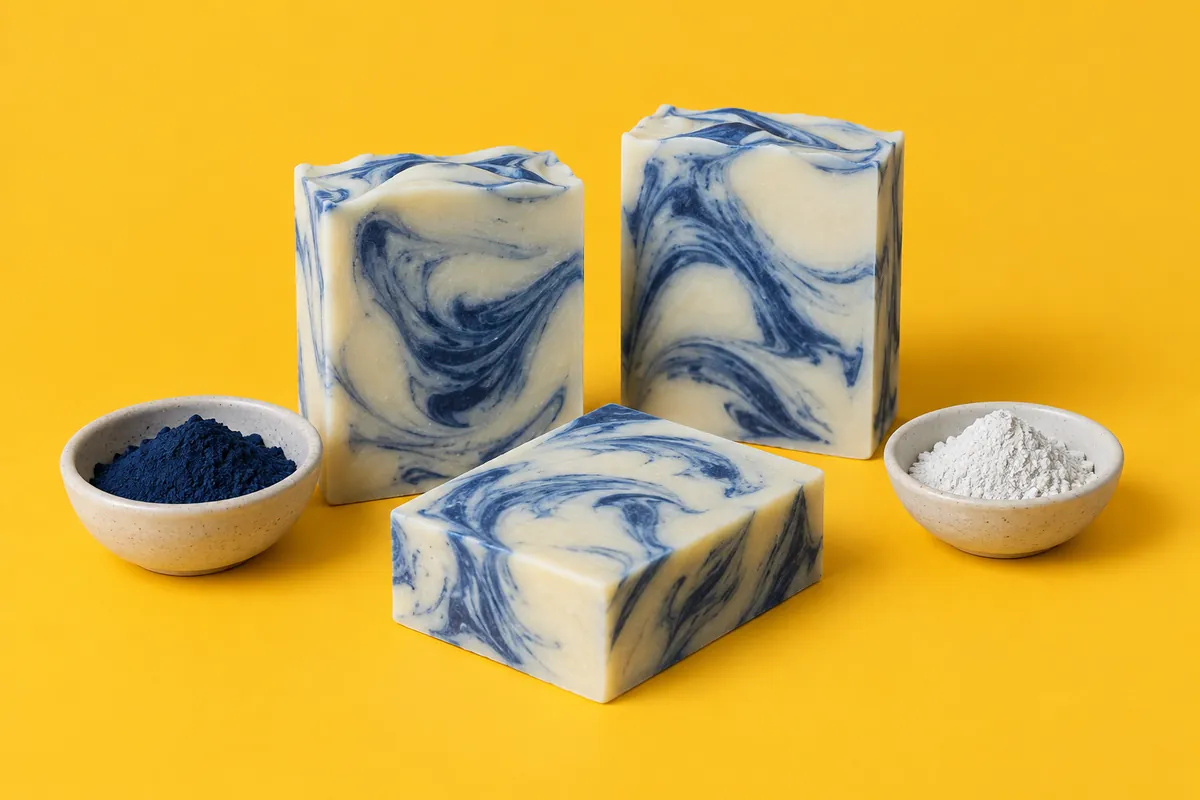
A pale, kaolin-whitened bar with ribbons of natural indigo blue, swirled in the pot and poured. The recipe is slow on purpose, mostly olive and rice bran oils at a 30 % lye solution, so the swirl has time to form.
- Skill
- Intermediate
- Method
- Cold process
- Batch
- 900 g of oils about 1352 g of batter
- Hands-on
- 1 h 15 min
- Cure
- 6 weeks
- Gel phase
- No keep it cool
What you need
For 900 g of oils, which fills a 25 × 9 cm loaf mould filled 6 cm deep (about 1.4 litres). Weigh everything, liquids included.
| Olive Oil · 45.0 % | 405 g | 14.29 oz |
| Coconut Oil · 25.0 % | 225 g | 7.94 oz |
| Rice Bran Oil · 15.0 % | 135 g | 4.76 oz |
| Shea Butter · 15.0 % | 135 g | 4.76 oz |
| Sodium hydroxide (NaOH) · the lye, 100 % pure | 125.3 g | 4.42 oz |
| Distilled water · 277 g for a 31 % lye solution, 15 g set aside | 292.3 g | 10.31 oz |
| Indigo powder · 1.25 tsp, for the blue third only, dispersed in 14 g of the recipe's olive oil | 2.1 g | 0.07 oz |
| Kaolin clay · about 1¾ tsp, stirred into 15 g of the recipe's water, for the pale base | 5 g | 0.18 oz |
| Lavender oil · 2.0 % of the oils, at trace | 18 g | 0.63 oz |
| Atlas cedarwood oil · 1.0 % of the oils, at trace | 9 g | 0.32 oz |
- Superfat
- 5 %
- Temperatures
- Oils and lye solution at 32 to 35 °C (90 to 95 °F)
Method
-
Set everything out first
Put on goggles, gloves and long sleeves and open a window. Line the mould and set it on a level surface, with a 1 litre jug, a small cup, a spatula and a chopstick in reach: once the lye meets the oils, the batter is on a clock. -
Disperse the indigo and the kaolin
Weigh the olive oil, take 14 g of it into the jug and stir the 1¼ teaspoons of indigo into it until a smear on a white plate shows no grains. Weigh the 292.3 g of water and take 15 g out of it into the cup; stir the 5 g of kaolin into that to a smooth slurry. -
Make the lye solution
Where the air moves, pour the 125.3 g of sodium hydroxide slowly into the rest of the water, never the water onto the lye, and stir until clear. Leave it labelled and out of reach to cool to 32 to 35 °C (90 to 95 °F). -
Melt and scent the oils
Melt the coconut oil and shea butter gently, add the rest of the olive oil and the rice bran oil, and let the blend cool to 32 to 35 °C (90 to 95 °F) while it stays clear. Stir in the lavender and cedarwood oils, two that behave well in cold process. -
Blend only to light trace
Pour the lye solution in down the blender shaft, tap out trapped air, and blend in short pulses with stirring between. Stop at light trace, thin custard that holds a faint line for a few seconds; this batter moves slowly, so take your time and don't overshoot. -
Colour a third of the batter blue
Pour 430 g of batter into the indigo jug and whisk until it is evenly blue. Whisk the kaolin slurry into the batter left in the pot, about 885 g, for the pale base. -
Start the mould
Pour about 60 g of the blue into the bottom of the empty mould in a loose zigzag, so the bottom of each bar carries colour too. -
Pour the blue back into the pot
Pour the rest of the blue into the pot in four places: two from about 30 cm (12 in) up, so it plunges to the bottom, and two from just above the surface, so it stays near the top. -
Swirl the pot once
Draw the spatula round the inside of the pot in one full circle, then once straight across the middle. Stop there: pouring into the mould carries the swirl further, and more stirring only blurs it. -
Pour into the mould
Pour steadily from a low height, moving from one end of the mould to the other and back, until the pot is empty. Tap the mould firmly on the worktop to bring up air. -
Finish the top
Draw a chopstick through the top 1 cm in loose loops down the length, or smooth the top with the spatula. -
Keep it out of gel
Leave the mould uncovered for 30 minutes, then cover it and chill it overnight in a fridge kept apart from food. Staying out of gel keeps the base pale and, at this 30 % lye solution, keeps glycerin rivers from forming. -
Unmould and cut
Let the loaf come back to room temperature and unmould it with gloves on after 2 to 3 days, once it is firm: olive-rich soap set cool needs longer than most. Cut it into bars about 2.5 cm (1 in) thick. -
Cure
Stand the bars on edge with air between them, out of direct sun, for 6 weeks, turning them every few days.
Tips
- If the batter reaches medium trace before the blue goes back into the pot, it will sit in ropes instead of sinking: spoon both colours into the mould in alternate dollops and drag a chopstick through them instead.
- Indigo varies between suppliers, and some powder sold as indigo comes from a different plant. Try a new one in a 50 g cup of batter before you colour a loaf with it.
- If you sell the soap, tell your safety assessor about the indigo: the EU's scientific committee could not rule out a weak potential for skin sensitisation.
The oils
| Oil | Share |
|---|---|
| Olive Oil (virgin / refined / olive oil) | 45.0 % |
| Coconut Oil | 25.0 % |
| Rice Bran Oil | 15.0 % |
| Shea Butter | 15.0 % |
How it is made
| Process | Cold process |
| Alkali | NaOH |
| Superfat | 5 % |
| Water | lye water at 30 % |
| Iodine value | 63 |
| INS | 142 |
Why make it
A good first swirl with a natural colour. The batter is slow on purpose, mostly olive and rice bran oils, so ribbons of blue have time to form in the pot, and the soap is an easy everyday bar, cleansing 17 and conditioning 59 on our scale, lightly scented with lavender and cedarwood. Indigo is one of the oldest dyes known, found on 6,000-year-old cotton from Peru (Splitstoser and colleagues), and makers like it for a muted, denim blue that mineral pigments do not quite match; kaolin keeps the rest of the bar pale. The colour is decoration and nothing more. Suppliers vary, so try a new indigo in a cup of batter first, and if you sell the soap, note that the EU's scientific committee could not rule out a weak potential for skin sensitisation.
Sources
- Early pre-Hispanic use of indigo blue in Peru · Science Advances, 2016
- Opinion on hair dye Indigofera tinctoria (C170) · European Commission, Scientific Committee on Consumer Safety, 2020
What tradition, makers' experience and research say about soaps like this, each labelled for what it is. It is not medical advice, and no soap treats a skin condition: if you have one, ask a doctor or pharmacist.
What the numbers say
- Lauric acid 12.3 %
- Myristic acid 4.8 %
- Palmitic acid 11.7 %
- Stearic acid 8.6 %
- Oleic acid 46.5 %
- Linoleic acid 11.6 %
- Other 5.2 %
Saturated : unsaturated 41 : 59
Computed from the fatty acids of the fats above. The bands are what the craft has settled on, not chemistry — a bar outside one is not wrong.
From the guides
All guides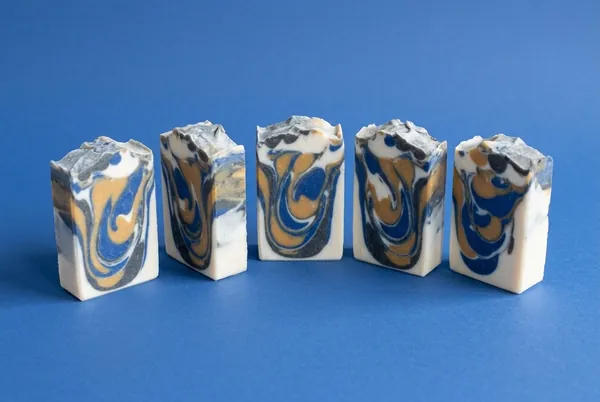
Swirl techniques: in the pot, drop, hanger, spoon and Taiwan
Seven cold-process swirls step by step, with the batter, recipe and temperatures that keep soap fluid, and why swirls turn muddy or lumpy.

Natural colourants: what herbs, clays and spices really do in soap
Clays, charcoal and plant colours in cold-process soap: doses per 500 g of oils, infused oil, powder or lye, and the colour each one actually turns.
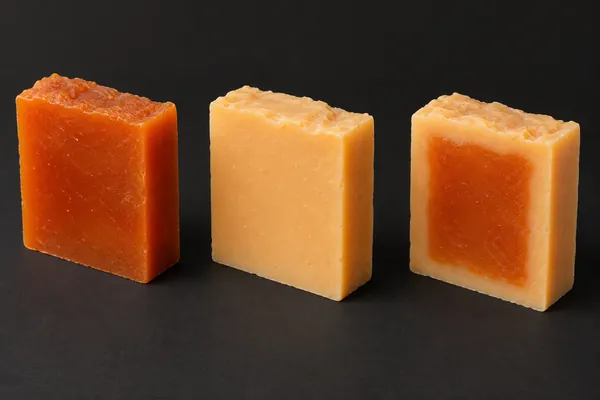
Gel phase: to insulate or keep it cool
What gel phase is, why a loaf turns dark and translucent, how gelled and ungelled bars differ, why partial gel is cosmetic, and how to cause or prevent it.
Where these proportions come from
Our own slow palm-free blend: olive and rice bran oils for working time, as in Anne-Marie Faiola's shoebox in-the-pot swirl, with coconut oil and shea butter added for a firmer, better-lathering bar; the in-the-pot method and the indigo dose follow Faiola and David Fisher.
Formulation adapted from Soap Crafting by Anne-Marie Faiola (Storey Publishing, 2013); The Complete Photo Guide to Soap Making by David Fisher (Creative Publishing International, 2018). The method and notes are ours.