Goat milk soap base
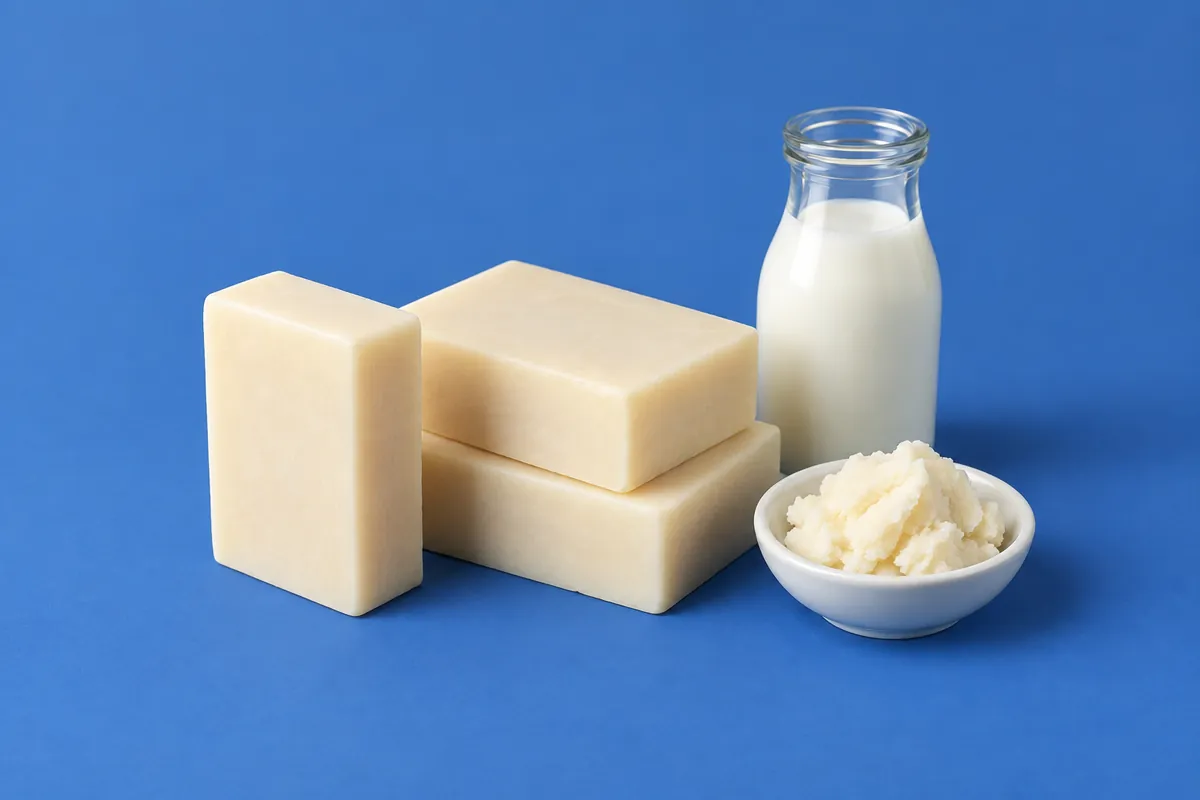
Our plain milk soap: olive, coconut, palm and shea with frozen goat milk as all of the liquid, the lye added slowly and the loaf kept cold so it stays cream rather than tan. Unscented, and a base to build your own milk soaps on.
- Skill
- Intermediate
- Method
- Cold process
- Batch
- 1000 g of oils about 1437 g of batter
- Hands-on
- 1 hour
- Cure
- 6 weeks
- Gel phase
- No keep it cool
What you need
For 1000 g of oils, which fills a 1.5 litre loaf mould. Weigh everything, liquids included.
| Olive Oil · 40.0 % | 400 g | 14.11 oz |
| Coconut Oil · 25.0 % | 250 g | 8.82 oz |
| Palm Oil · 25.0 % | 250 g | 8.82 oz |
| Shea Butter · 10.0 % | 100 g | 3.53 oz |
| Sodium hydroxide (NaOH) · the lye, 100 % pure | 139.6 g | 4.92 oz |
| Goat milk, frozen in cubes · all of the liquid; the lye goes onto it | 298 g | 10.51 oz |
- Superfat
- 6 %
- Temperatures
- Keep the milk and lye below 30 °C (86 °F) and soap with the oils at 25 to 30 °C (77 to 86 °F)
Method
-
Freeze the milk
The day before, weigh 297.9 g goat milk into an ice-cube tray and freeze it solid. Cubes melt evenly as the lye goes in; a solid block does not. -
Get ready
Put on splash goggles, nitrile gloves and long sleeves and open a window. Set out a 1.5 litre loaf mould, clear a shelf in the fridge or freezer for it, and make an ice bath: a bowl of ice and water that a heat-safe polypropylene jug can stand in. -
Weigh the oils and lye
Melt the whole tub of palm oil and stir it well, then weigh 250 g of it with 250 g coconut oil and 100 g shea butter into the pot. Weigh 400 g olive oil into a jug and 139.6 g sodium hydroxide into a small, dry container. -
Melt the solid oils
Warm the pot gently until the coconut oil, palm oil and shea butter are just clear, stir in the olive oil, and let the oils cool to 25 to 30 °C (77 to 86 °F). -
Add the lye to the milk
Put the frozen milk cubes in the jug and stand it in the ice bath. Sprinkle in a spoonful of lye and stir until it has dissolved into the melting milk before adding the next, taking 10 to 15 minutes over it and keeping the mix below 30 °C (86 °F). It should end up pale yellow and smell faintly of ammonia. -
Strain and blend
Pour the milk and lye through a stainless steel sieve into the oils, which catches any curds and shows you no lye is left undissolved. Stick blend in short bursts, stirring between them, until the batter reaches light trace. -
Pour and chill
Pour into the mould, tap it on the worktop to release air, and put it uncovered in the fridge or the freezer for 24 hours, so the loaf never heats into gel and browns the milk. -
Clean up with your gloves on
Wipe the raw batter off the pot and tools with paper towels into the bin, then wash everything in hot soapy water. -
Unmould and cut
Let the loaf come back to room temperature before you unmould it, or moisture condenses on the cold soap. An ungelled loaf takes a while to firm up, so wait until it is firm, usually 24 to 48 hours after pouring, then unmould it with gloves on and cut it into bars. -
Cure
Stand the bars on a rack with air around them for four to six weeks, turning them now and then. The ammonia smell fades in the first week or two.
Tips
- Expect cream to pale yellow bars that drift a shade darker as they cure. Light tan all through means the milk warmed while the lye went in; a darker centre with a paler rim is partial gel, and only cosmetic.
- If the milk and lye thicken like custard, the mix is too cold: stir it, let it warm a few degrees and carry on.
- Other milks work the same way, but let the calculator weigh them: each carries its own share of water and fat, and cream or coconut milk bring enough fat to change the superfat a lot. Our milk soap guide compares them.
- To scent it, stir essential oils in at light trace, as our lavender goat milk bar does. For a palm-free milk soap, that bar and our goat milk, oat and honey bar are written out in full.
The oils
| Oil | Share |
|---|---|
| Olive Oil (virgin / refined / olive oil) | 40.0 % |
| Coconut Oil | 25.0 % |
| Palm Oil | 25.0 % |
| Shea Butter | 10.0 % |
How it is made
| Process | Cold process |
| Alkali | NaOH |
| Superfat | 6 % |
| Water | lye water at 35 % |
| Iodine value | 54 |
| INS | 154 |
Why make it
Milk soap is ordinary soap with milk in place of the water, and this is our plain base for it: goat milk as all the liquid, kept cold so the bar stays pale. The oils make a balanced bar, hardness 44, cleansing 17 and conditioning 53, and the milk's fat lifts the effective superfat to about 7 %. Makers often choose goat milk soap for dry or sensitive skin, but that reputation rests on experience rather than trials. The chemist Kevin Dunn found that milk's fat simply becomes soap, its sugar browns in the lye and its protein curdles, and we know of no controlled study showing that a milk soap is gentler than the same soap made with water. One caution belongs with it: two clinical reports describe people with eczema who became allergic to goat milk as a food after using goat milk skin products.
Sources
- Protein in Handcrafted Soap (lecture slides) · Kevin M. Dunn, Handcrafted Soap and Cosmetic Guild, 2014
- Goat's milk allergy in a family following household sensitization to goat's milk soap · Anantharajah A. and Randall K.L., Asia Pacific Allergy 11(2) e13, 2021
- Goat milk skin products may cause the development of goat milk allergy · De Luca J.F. et al., Clinical & Experimental Allergy, 2022
What tradition, makers' experience and research say about soaps like this, each labelled for what it is. It is not medical advice, and no soap treats a skin condition: if you have one, ask a doctor or pharmacist.
What the numbers say
- Lauric acid 12.4 %
- Myristic acid 5.0 %
- Palmitic acid 18.9 %
- Stearic acid 7.2 %
- Oleic acid 44.2 %
- Linoleic acid 8.6 %
- Other 5.0 %
Saturated : unsaturated 47 : 53
Computed from the fatty acids of the fats above. The bands are what the craft has settled on, not chemistry — a bar outside one is not wrong.
Try it differently
20 variationsThe same soap with one thing moved. Each opens in the calculator ready to change again.
- Edible Tallow (beef/mutton dripping) instead of Palm Oil
- Lard (pure rendered pork fat) instead of Palm Oil
- Shea Butter instead of Palm Oil
- Kokum Butter instead of Palm Oil
- Cocoa Butter (Theobroma Oil) instead of Palm Oil
- Mango Butter instead of Palm Oil
- 5 % superfat
- 8 % superfat
- Edible Tallow (beef/mutton dripping) instead of Palm Oil and 5 % superfat
- Edible Tallow (beef/mutton dripping) instead of Palm Oil and 8 % superfat
- Lard (pure rendered pork fat) instead of Palm Oil and 5 % superfat
- Lard (pure rendered pork fat) instead of Palm Oil and 8 % superfat
- Shea Butter instead of Palm Oil and 5 % superfat
- Shea Butter instead of Palm Oil and 8 % superfat
- Kokum Butter instead of Palm Oil and 5 % superfat
- Kokum Butter instead of Palm Oil and 8 % superfat
- Cocoa Butter (Theobroma Oil) instead of Palm Oil and 5 % superfat
- Cocoa Butter (Theobroma Oil) instead of Palm Oil and 8 % superfat
- Mango Butter instead of Palm Oil and 5 % superfat
- Mango Butter instead of Palm Oil and 8 % superfat
From the guides
All guides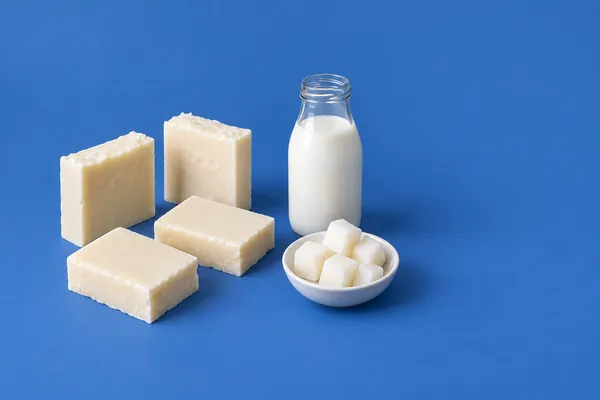
Milk soap: goat milk, freezing and keeping it pale
How to make goat milk soap without scorching it: frozen milk, lye added a spoonful at a time, a cool mould, and a full recipe worked through the calculator.
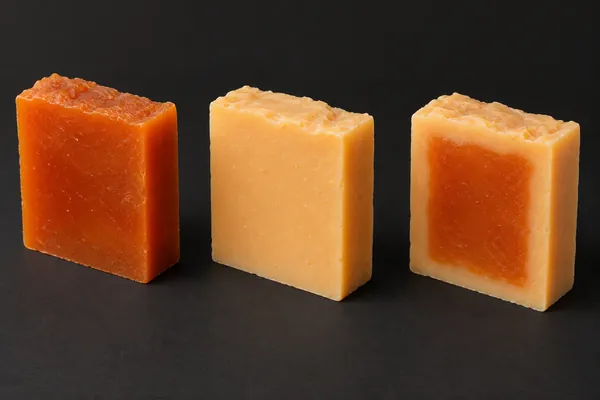
Gel phase: to insulate or keep it cool
What gel phase is, why a loaf turns dark and translucent, how gelled and ungelled bars differ, why partial gel is cosmetic, and how to cause or prevent it.
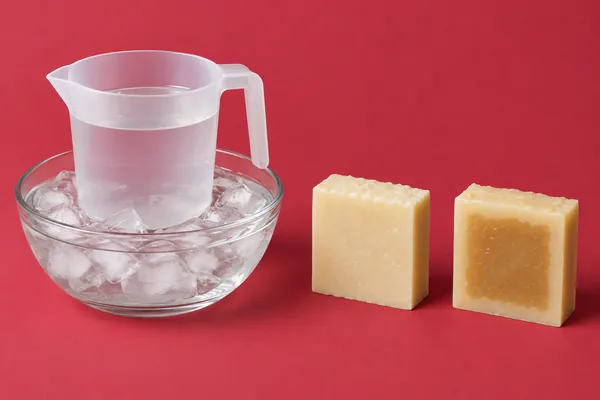
Heat in soapmaking: lye solution, soaping temperature and gel
How hot a lye solution gets and why; where a loaf's own heat comes from; what decides gel; and safe temperatures for milk, sugar and melt and pour.
Where these proportions come from
Our own formulation: olive, coconut, palm and shea at a 6 % superfat, with goat milk as the whole liquid. The milk is a process choice rather than an oil, so the oils define the recipe; the method is the one milk-soap makers have used since the 1990s: frozen milk, the lye added a spoonful at a time, and the batch kept cool so the milk sugars do not scorch.
Formulation adapted from Making Natural Milk Soap (excerpted from Milk-Based Soaps) by Casey Makela (Storey Publishing, 1999). The method and notes are ours.