In short
- Dissolving sodium hydroxide gives off 44.5 kJ per mole in a lot of water, but less in a strong solution: about 38 kJ per mole at 33 %.
- If no heat escaped, a 33 % lye solution made from water at 20 °C would reach about 108 °C. Real jugs lose heat as the lye dissolves, but a fresh solution can still pass 90 °C (194 °F): Failor measured about 93 °C.
- Saponification releases heat of its own, of the same order as the lye did, but over hours. Whether a loaf gels depends on how fast that heat arrives against how fast the mould loses it.
- Soap starts to turn into gel at about 60 °C; the less water in the batter, the hotter it must get to gel right through.
- Sugars, honey, milk and alcohol make a batch run hotter. Milk sugar browns in lye within minutes, and reducing sugars above 84 °C with alkali can give off carbon monoxide.
On this page
Temperature matters at every stage of cold process soap, from the jug of lye solution to the hours the loaf spends in the mould. This guide puts numbers on each stage, from primary data where they exist and from worked estimates where they do not, and says which is which.
How hot a lye solution gets
Dissolving sodium hydroxide in water gives off heat. The standard figure is for a large excess of water: 10,637 calories, or 44.5 kJ, for every mole dissolved at 25 °C, the “best” value in the US National Bureau of Standards’ critical review of these measurements (Parker, 1965). That is about 1.1 kJ for every gram of lye.
A soap’s lye solution is nowhere near that dilute, and in a strong solution each mole gives off less, because there is less water per mole for its ions to settle into. The same review tabulates the correction for every strength, as the relative apparent molal enthalpy. Here is the whole calculation for a 33 % solution.
- The composition. 100 g of solution is 33 g of NaOH and 67 g of water. At 39.997 g/mol that is 0.825 mol of NaOH in 0.067 kg of water, a molality of 12.3 mol/kg.
- The heat per mole at that strength. Parker’s table lists +1,513 cal/mol at 12.33 mol/kg, right next to ours. The heat of solution is −10,637 + 1,513 = −9,124 cal/mol, which at 4.184 J per calorie is −38.2 kJ/mol.
- The heat given off. 0.825 mol × 38.2 kJ/mol = 31.5 kJ.
- The heat the solution can hold. OxyChem’s handbook gives the specific heat of 32 to 34 % caustic soda as 0.84 to 0.86 Btu per pound per °F between 80 and 200 °F, about 3.6 J per gram per degree. 100 g of solution takes about 358 J to warm by 1 °C.
- The temperature rise. 31,500 J ÷ 358 J/°C = 88 °C. From water at 20 °C (68 °F), the solution would reach about 108 °C (227 °F).
That is an estimate, and an upper one, because it assumes every joule stays in the solution. In a real jug the lye takes a minute or two to dissolve, and heat leaks into the jug, the air and the steam coming off the surface all the while. Even so, a fresh solution can pass 90 °C (194 °F): Failor records one spiking to about 200 °F (93 °C), Cavitch and Faiola give the same figure, and Watson warns that it can get up to boiling. Faiola adds that liquids containing sugar get hotter still. The estimate still tells you two useful things: the solution goes far beyond the temperature that scalds, and it comes within about 10 °C of boiling, which for a 33 % solution is about 119 °C (246 °F) on OxyChem’s chart.
The method holds up against an independent check. OxyChem’s handbook works a dilution example on its enthalpy chart: 50 % caustic at 120 °F, diluted to 20 % with water at 80 °F, ends at about 143 °F. The same Parker data and specific heats, with a short extrapolation past the last line of Parker’s table, give 143 °F.
| Lye concentration | Water : lye | Heat per gram of lye | Rise if no heat escaped | From water at 20 °C |
|---|---|---|---|---|
| 25 % | 3 : 1 | 1.06 kJ | 72 °C | about 92 °C (198 °F) |
| 28.6 % | 2.5 : 1 | 1.02 kJ | 80 °C | about 100 °C (213 °F) |
| 33 % | 2.03 : 1 | 0.96 kJ | 88 °C | about 108 °C (227 °F) |
| 40 % | 1.5 : 1 | 0.82 kJ | 95 °C | about 115 °C (238 °F) |
Estimates from Parker’s heats of solution and OxyChem’s specific heats, worked the same way as above. Real readings are lower.
Two things stand out. A stronger solution gives off less heat per gram of lye, yet it gets hotter, because there is less water to take the heat up. A water discount makes the lye solution hotter as well as stronger.
In a whole recipe the numbers are larger than they feel. The 128.7 g of sodium hydroxide for 1000 g of olive oil at a 5 % superfat, dissolved in its 261.2 g of water at 33 %, gives off about 123 kJ: enough to warm a litre of water by nearly 30 °C.
The same arithmetic explains the rule about order. Pour water onto solid lye and the first few grams of water become a very strong, very hot solution in contact with the beads, which is how splashing and boiling over happen. Dow’s handbook for its own caustic soda puts it simply: add the caustic to the water, never the water to the caustic. The lye safety guide covers the rest.
The heat of saponification
The second source is the reaction itself. We could not find a measured value for the heat that saponifying a soaping oil gives off, so here is an estimate from small molecules whose heats are well known.
Saponifying an ester comes to the same thing, energetically, as two steps: splitting it with water, then neutralising the acid that comes out. For ethyl acetate, the textbook small ester, the NIST formation enthalpies make the first step take in a little heat, about 4 to 7 kJ per mole. The second gives out about 56 kJ per mole: Parker’s value for hydrogen and hydroxide ions combining is 13,345 cal, or 55.8 kJ, and a carboxylic acid adds little to it. The net is roughly 50 kJ per mole of ester bonds.
Olive oil has 3.39 mmol of ester bonds per gram (its SAP value, 190 mg KOH/g, divided by 56.1). The 1000 g recipe above saponifies 95 % of them with its 3.22 mol of lye, which on this estimate gives off something like 160 kJ: somewhat more than the 123 kJ the lye gave off as it dissolved. Treat that as an order of magnitude. Long-chain soap crystallises and forms liquid crystal in ways a small ester does not, and each of those changes has a heat of its own.
The difference that matters is time. The lye’s heat arrives in a minute and you can cool it in a sink. The reaction’s heat arrives over hours, in a mould, and it speeds the reaction that makes it: warm batter saponifies faster, which warms it further. Thomssen’s 1922 manual saw the result in a factory frame: “The heat produced by the further spontaneous saponification will cause the soap to rise in the middle of the frame.” Factory cold process ran on that heat. Simmons and Appleton’s 1908 handbook describes coconut oil combining with strong lye even when cool and “evolving sufficient heat to complete the saponification”; in a blend, the coconut starts the reaction and its heat carries the tallow, palm or olive oil along with it.
Gel: where the heat goes
Soap and water together change phase with temperature. Cool fresh soap is curd: crystals of soap in water, opaque. Warm enough, it turns into what old soap boilers called neat soap, a liquid crystal, translucent and glossy, which soapmakers call gel. The chemistry of saponification guide describes the structure.
Dunn’s phase chart for soap and water puts numbers on it. Read from the chart, so approximately: across the range it covers, about 11 to 27 % water, soap begins to turn to gel at about 60 °C (140 °F), and the temperature needed to gel it right through rises as the water falls. With about 27 % water, 60 °C is nearly enough. With 20 %, it takes about 75 °C (167 °F). With 11 %, it takes more than 100 °C.
| Lye concentration | Water in the fresh batch | Gel begins | Gels right through at about |
|---|---|---|---|
| 25 % | 25.5 % | about 60 °C | 60–65 °C |
| 33 % | 18.8 % | about 60 °C | 75–80 °C |
| 40 % | 14.6 % | about 60 °C | 90–95 °C |
Water in the batch for 1000 g of olive oil at a 5 % superfat, from the calculator; gel temperatures read from Dunn’s chart (2012).
Makers reached the same threshold by experience. In Pure Soapmaking Faiola writes that soap “typically gels when it reaches a temperature above 140°F (60°C) in the mold”, and that most recipes mixed at 49 °C (120 °F) or above gel on their own.
How hot does a loaf get? Faiola puts gel usually 40 to 60 °F, 22 to 33 °C, above the temperature the batter was poured at. A loaf poured at 38 to 43 °C (100 to 110 °F) therefore peaks somewhere around 60 to 76 °C: right across the threshold. That is why the same recipe gels one day and not the next, and why a batch with little water is the likelier to gel only in the middle, where it is hottest.
Size, shape and insulation
A loaf makes heat in proportion to its volume and loses it in proportion to its surface. A 25 × 8 × 7 cm loaf, 1.4 litres, has 862 cm² of surface: 0.62 cm² for every cubic centimetre. A single 7 × 5 × 2.5 cm cavity has 1.49 cm² per cubic centimetre, 2.4 times as much surface through which each gram can lose heat. Double every dimension of the loaf and the ratio halves. That is the arithmetic behind three pieces of craft advice:
- Cavity moulds rarely gel on their own. A maker who wants gel has to add heat; Faiola forces it with a heating pad set low for about 30 minutes when she wants brighter colours.
- Big moulds can run away. Watson warns that a very large batch poured into one mould can overheat, even to boiling, and advises moderate moulds with space between them.
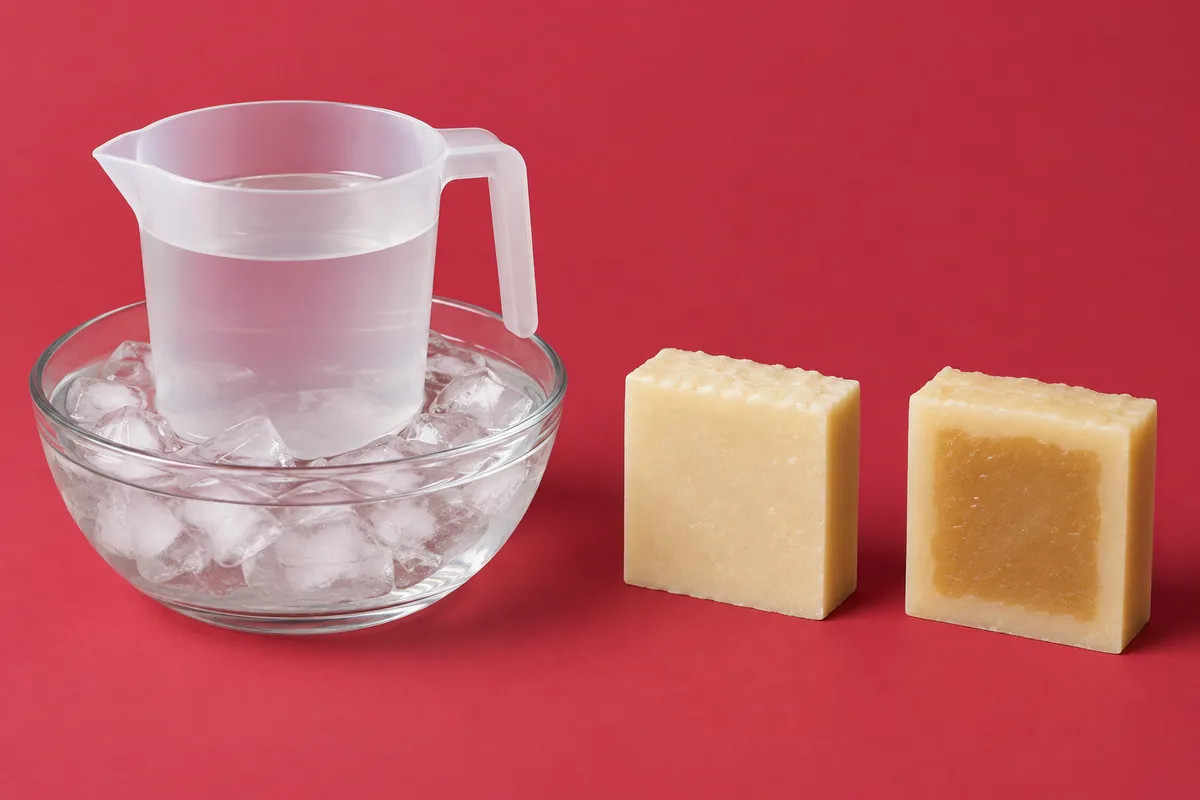
- Insulation and cold work on the same balance. Towels or a box slow the heat loss and push a loaf into gel; an uncovered mould in the fridge or freezer keeps it out. The gel phase guide covers when you want which.
Choosing a soaping temperature
The floor is set by the fats. If the batter cools until its harder fats begin to set, it thickens without saponifying, which Watson calls false trace. How cool a blend can go depends on the blend, since fats dissolve in one another, but the melting points of the hard ones give the scale. From the ranges on our oil pages, coconut oil melts at 23–26 °C, cocoa butter at 31–35 °C, shea butter at 33–40.5 °C and beeswax at 62–65 °C, which is why Faiola advises soaping with beeswax at 63 °C (145 °F) or above, to keep it from hardening.
Above the floor, the choice is a working habit rather than chemistry, and the sources spread widely.
| Source | Lye and oils combined at |
|---|---|
| Simmons and Appleton (1908) | “as low as is consistent with fluidity”: 24 °C (75 °F) for coconut oil alone, 38–49 °C (100–120 °F) with tallow |
| Cavitch, The Natural Soap Book | close to 27 °C (80 °F) for vegetable oil soaps; soaps half beef tallow take a wider range |
| Watson, Smart Soapmaking | 32–43 °C (90–110 °F); lye and oils need not match |
| Letcavage and Harden, Natural Soap Making | about 38 °C (100 °F), give or take 5.5 °C (10 °F) |
| Faiola, Soap Crafting | at or below 60 °C (140 °F), usually below 49 °C (120 °F), within about 5.5 °C (10 °F) of each other; palm-heavy recipes 54–60 °C (130–140 °F) |
| Faiola, Pure Soapmaking | below 60 °C (140 °F), most recipes 43–49 °C (110–120 °F); 49–54 °C (120–130 °F) for madder, alkanet and indigo, which need a hot gel; below 49 °C in silicone moulds, where overheated soap can come out pock-marked; some recipes pour lye at 54–57 °C (130–135 °F) into oils at 32–38 °C (90–100 °F) |
| Corley Barto, The Natural Soap Chef | 32–38 °C (90–100 °F) for recipes with castor oil, cooler than the rest of her book |
Soap forms anywhere in this range. What changes is the speed.
Warmer batter saponifies faster: it traces sooner, heats itself sooner and is more likely to gel. Cooler batter gives more time for swirls and layers and keeps milks and sugars paler. Corley Barto soaps her castor oil recipes cooler because, she says, castor oil heats up more; we know of no measurement behind that.
Watson turns the reaction’s heat into a gauge. She blends until the batter has warmed by about 1 °C (2 °F) from its starting temperature, the sign that saponification is under way, and never past a rise of 3 °C (5 °F), after which it may be too thick to pour.
Less water, hotter lye. At a 40 % lye concentration the 128.7 g of sodium hydroxide for 1000 g of olive oil goes into 193.0 g of water instead of 261.2 g.
Open it in the calculatorSugar, honey, milk and alcohol
Sugars and alcohols make a batch trace faster and run hotter. Dunn’s explanation is that they bridge the gap between soap and water molecules, so the oil emulsifies sooner and saponifies faster, which brings the temperature rise and gel forward. Our additive database marks sugar, honey and sorbitol as heating the batch, and when one is in a recipe the method the calculator writes out tells you not to insulate the mould. Our buttermilk and honey bar goes further and spends its first day in the fridge.
Honey and milk bring a hazard as well. NOAA’s chemical database warns that reducing sugars “heated (above 84°C.), evolve toxic levels of carbon monoxide in the presence of alkalis”. Honey’s glucose and fructose are reducing sugars, and so is milk’s lactose. That is one reason honey goes in at trace, never into hot lye. Faiola starts her honey soaps with both liquids below 38 °C (100 °F), adds the honey at trace and puts the poured soap straight into the fridge or freezer.
Milk has a second problem: colour. Dunn put lactose into lye and it turned brown within minutes, which he takes to be the source of the colour of goat milk soap. Keeping the milk cold while the lye goes in is the whole technique: our goat milk, oat and honey bar sprinkles the lye onto frozen milk standing in iced water. Published ceilings for the milk and lye mixture range from 49 °C (120 °F) in Letcavage and Harden to 60 °C (140 °F) in Corley Barto, and our milk soap guide aims below 30 °C (86 °F). Cavitch stayed there too, cooling her lye to 27 °C (80 °F) before drizzling it into milk warmed to the same temperature, and Faiola keeps her coconut-milk lye below 38 °C (100 °F). The lower the peak, the paler the bar.
Beer and wine carry both sugar and alcohol. Cable lets them go flat, then simmers them for 30 minutes before use to cut the risk of overheating, and never insulates the soap; the liquids guide covers the preparation.
When a loaf overheats
An overheating loaf rises in the middle, as Thomssen saw, then cracks along the top, and in the worst case pushes soap up and over the sides of the mould. Faiola adds sweating and heat tunnelling, large holes in the centre of the loaf, to what sugar’s extra heat can do. Heat also shows inside the bar as glycerin rivers and cracks. The fix is to take the heat away: uncover it and move it somewhere cold. Cable puts an overheating loaf in the refrigerator, warning that it may still overflow.
The worst case is the one Watson warns about: a loaf that reaches the boiling point of its own water. Fresh batter is about 15 to 25 % water, and a sugary recipe, soaped warm and poured into a big insulated mould, has every factor in this guide pushing it that way.
Hot process and melt and pour
In hot process the heat is added on purpose. Fisher cooks at 66–77 °C (150–170 °F), in a slow cooker on low or an oven, which takes the whole batch through gel while the reaction finishes. Fragrance goes in once the soap has cooled somewhat, below about 82 °C (180 °F) in the hot process method our calculator’s steps follow and in our goat milk and shea hot process bar, so that it does not evaporate.
Melt and pour base is finished soap, so it has no reaction heat of its own. Its limit is how much heat it can take. Fisher gives 54–60 °C (130–140 °F) as the most workable range and warns that above 71 °C (160 °F) a base begins to boil and burn. Overheating drives off water, and Failor notes that it leaves the soap brittle or smelling unpleasant. Melt it in short bursts or over water, and stir between them. The melt and pour calculator sizes the batch.
Recipes to try
All recipesSources
- Thermal Properties of Aqueous Uni-univalent Electrolytes (NSRDS-NBS 2) . V. B. Parker, US National Bureau of Standards , 1965. NaOH(c) heat of solution at infinite dilution, −10,637 cal/mol at 25 °C; Table XIV A, relative apparent molal enthalpy of NaOH solutions; heat of neutralisation, −13,345 cal/mol.
- Caustic Soda Handbook . OxyChem (Occidental Chemical Corporation) , 2026. Table 3, specific heats of caustic soda solutions; Graph 1, boiling points; Graph 6, the dilution example used to check the method.
- NIST Chemistry WebBook: ethyl acetate, acetic acid and ethanol, condensed phase thermochemistry . National Institute of Standards and Technology .
- Transparency and Meltability in Hot-Process Soap . Kevin M. Dunn, Handcrafted Soapmakers Guild conference , 2012. Phase chart of soap and water: curd, curd plus neat, and neat (gel) against temperature and moisture.
- Protein in Handcrafted Soap . Kevin M. Dunn, Handcrafted Soapmakers Guild conference , 2014. Lactose browns within minutes in lye.
- Alcohols, sugars and cold process soap . Kevin M. Dunn, for Wholesale Supplies Plus . Supplier-hosted article by a chemist; the only explanation we found of why sugars and alcohols speed saponification.
- Sodium hydroxide solution, chemical datasheet . NOAA CAMEO Chemicals . Reducing sugars heated above 84 °C with alkali evolve toxic levels of carbon monoxide.
- The Caustic Soda Solution Handbook, Form No. 102-00011 . The Dow Chemical Company , 2004. Add caustic soda solution to water, never water to the solution.
- Making Transparent Soap . Catherine Failor, Storey Publishing , 2000. A fresh lye solution spikes to about 200 °F; its steam carries lye; overheated melt-and-pour base.
- Soap Crafting . Anne-Marie Faiola, Storey Publishing , 2013. Soaping temperatures; gel usually 40–60 °F above the pour; a heating pad to force gel.
- Pure Soapmaking . Anne-Marie Faiola, Storey Publishing , 2016. Lye solution to 200 °F (93 °C), hotter with sugary liquids; gel above 140 °F (60 °C) in the mould, natural in most recipes mixed at 120 °F or above; recipe windows of 110–120 °F, 120–130 °F for madder, alkanet and indigo, below 120 °F in silicone, and lye at 130–135 °F into oils at 90–100 °F; beeswax at 145 °F or above; honey soaps below 100 °F and chilled after pouring; coconut-milk lye below 100 °F; sugar's heat causing sweating, cracking and heat tunnels.
- The Natural Soap Book . Susan Miller Cavitch, Storey Publishing , 1995. Vegetable oil soaps made close to 80 °F (27 °C), tallow-rich ones over a wider range; lye solution over 200 °F (93 °C); lye at 80 °F drizzled into goat milk at 80 °F, rising to no more than about 85 °F.
- Smart Soapmaking . Anne L. Watson, Shepard Publications , 2013. Working range 90–110 °F; the temperature rise at the point of no return; ice bath; large batches overheating.
- Natural Soap Making . Elizabeth Letcavage and Melissa Harden, Stackpole Books , 2013.
- The Natural Soap Chef . Heidi Corley Barto, Ulysses Press , 2012.
- The Natural Soap Making Book for Beginners . Kelly Cable, Althea Press , 2017.
- The Complete Photo Guide to Soap Making . David Fisher, Creative Publishing International , 2018. Hot process cook 150–170 °F; melt-and-pour base workable at 130–140 °F, boiling and burning above 160 °F.
- The Handbook of Soap Manufacture . W. H. Simmons and H. A. Appleton, Scott, Greenwood & Son (Project Gutenberg edition) , 1908. Cold-process temperatures; coconut oil combining with strong lye at a low temperature and evolving enough heat to complete the saponification, and carrying other fats with it in a blend.
- The Soap-Maker's Manual . E. G. Thomssen (Project Gutenberg edition) , 1922.