In short
- Freeze the milk and add the lye to it a spoonful at a time, in an ice bath, so the mix stays below about 30 °C (86 °F).
- Milk sugar browns in lye within minutes. Heat decides whether the bar ends up cream or tan, so keep the loaf out of gel too.
- The calculator counts the water the milk carries: 297.9 g of goat milk supplies all 259.2 g of water in our recipe.
- The milk's fat raises the superfat, and the milk itself uses a few per cent of the lye. Don't discount the lye any further for it.
- A faint ammonia smell is normal and fades during the cure, which is the usual four to six weeks.
On this page
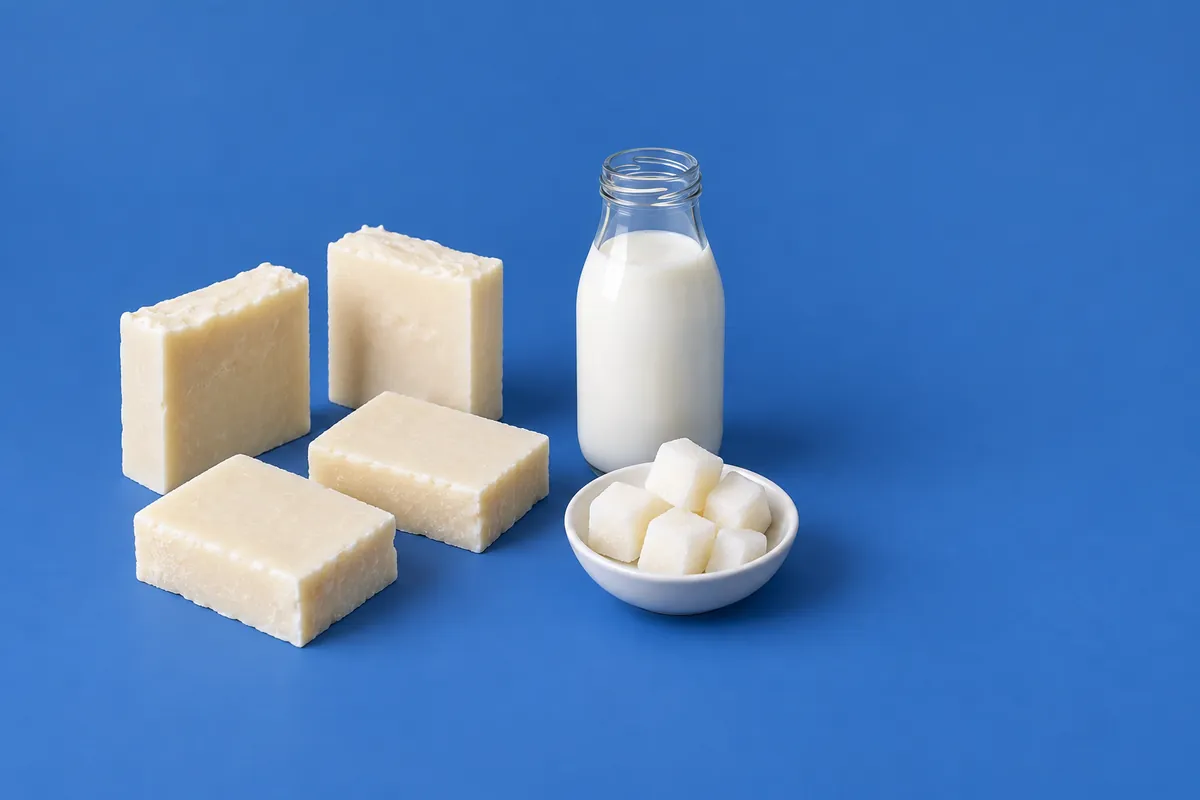
Milk is the liquid makers reach for most often after water, and goat milk above all. The soap is made exactly like any other cold process bar, with one change: the milk has to be kept cold while the lye goes into it. Warm milk browns and smells in lye, and past a certain temperature the mixture gives off carbon monoxide. This guide explains what the milk does, why it scorches, three ways to add it, and what the calculator does with its water and fat, and ends with a full recipe.
What milk brings to soap
Milk is mostly water. What sets it apart is the few per cent of fat, sugar and protein in it:
| In 100 g | Water | Fat | Sugars (lactose) | Protein |
|---|---|---|---|---|
| Goat milk | 87.0 g | 4.1 g | 4.5 g | 3.6 g |
| Whole cow’s milk | 88.1 g | 3.3 g | 5.1 g | 3.2 g |
USDA FoodData Central, foods 171278 and 171265. The calculator uses the water and fat figures.
Against a kilo of oils that is not much. The 297.9 g of goat milk in the recipe below carries about 12 g of fat, 13 g of lactose and 11 g of protein. The chemist Kevin Dunn separated goat milk into its fat, sugar and protein layers and put each into lye, which is the most direct evidence we have found for what happens to them. The fat saponified like any other fat and became soap. The lactose turned orange-brown within minutes, and so did pure laboratory lactose with no protein present, so the sugar browns on its own in lye; in milk, the Maillard reaction between sugar and protein may add to it. Either way, most of the colour of a milk soap comes from its sugar. The protein, mostly casein, curdled but did not break down into amino acids.
The sugar is also the part that shows in the lather. Makers add sugar to soap to boost lather, commonly a teaspoon per pound of oils, which is about 9 g for 1000 g of oils. A batch with goat milk as all its liquid carries about 13 g of lactose, somewhat more than that dose.
Beyond that the claims run ahead of the evidence. Dunn lists what he is not qualified to answer, among them whether milk soaps moisturise, treat eczema or reduce wrinkles, and we know of no controlled study showing that a milk soap is gentler on skin than the same soap made with water. People who make and buy it like it, which is a good enough reason to make it.
Why milk scorches, smells and darkens
A lye solution made with plain water can pass 90 °C (194 °F) as the lye dissolves. Milk cannot take that. Stir lye into milk at room temperature and the sugar scorches: the mix goes from cream through yellow to orange and brown, and smells burnt. The finished soap is still usable, but it cures beige to tan and the burnt smell takes a while to go.
There is a second smell even in a well-made batch: ammonia. Milk proteins carry amide groups, and strong alkali breaks them off as ammonia, faster the hotter it is. A faint ammonia smell as the lye goes in is normal. It fades as the soap cures, usually within the first week or two.
The loaf can brown the milk after it is poured, too. Saponification heats soap from the inside, and a loaf wrapped in towels climbs into gel, the hot translucent phase that darkens everything in it. Gel does no harm to the soap’s safety, but for a pale milk bar you want the lower curve:
That is why milk soap goes into the fridge or the freezer, uncovered, for its first day. Not every maker avoids gel: Grosso covers her half-and-half soap lightly so that it gels without getting too hot. The gel phase guide covers the reasons in full. Sugary milks and honey add heat of their own, and in a warm, insulated loaf they can crack the top or push soap out of the mould, which the guide on overheating and cracks deals with.
How cold is cold enough
Books disagree. Letcavage and Harden keep the milk and lye below 49 °C (120 °F); Corley Barto allows 60 °C (140 °F); Soap Queen finishes the mix at 10 to 18 °C (50 to 65 °F). Makela, writing in the 1990s, poured the lye into cold milk over at least 15 minutes in an ice bath, and held the mix at about 27 °C (80 °F) rather than colder. The pattern behind them is simple: the lower the peak temperature, the paler the bar. We aim to keep the milk and lye below 30 °C (86 °F) the whole time, and to soap at 25 to 30 °C (77 to 86 °F).
That floor was deliberate, because too cold has its own small problem: milk and lye held very cold, or left standing too long, can thicken to a custard. Stir it, let it warm a few degrees and carry on; Makela scooped custarded batches into the oils and blended them smooth.
Three ways to put milk in soap
Frozen milk as all the liquid
The standard method, and the one in the recipe below. Freeze the milk in cubes and add the lye to the frozen milk a spoonful at a time. The ice has to melt before the milk can warm, and melting soaks up a large share of the heat the lye gives off, so the mix stays cold while the lye dissolves. Corley Barto finds that frozen milk resists scorching better than milk that is only chilled. If the milk is raw, from your own animals, Makela pasteurises it first: 68 °C (155 °F) held for a minute, then cooled and frozen.
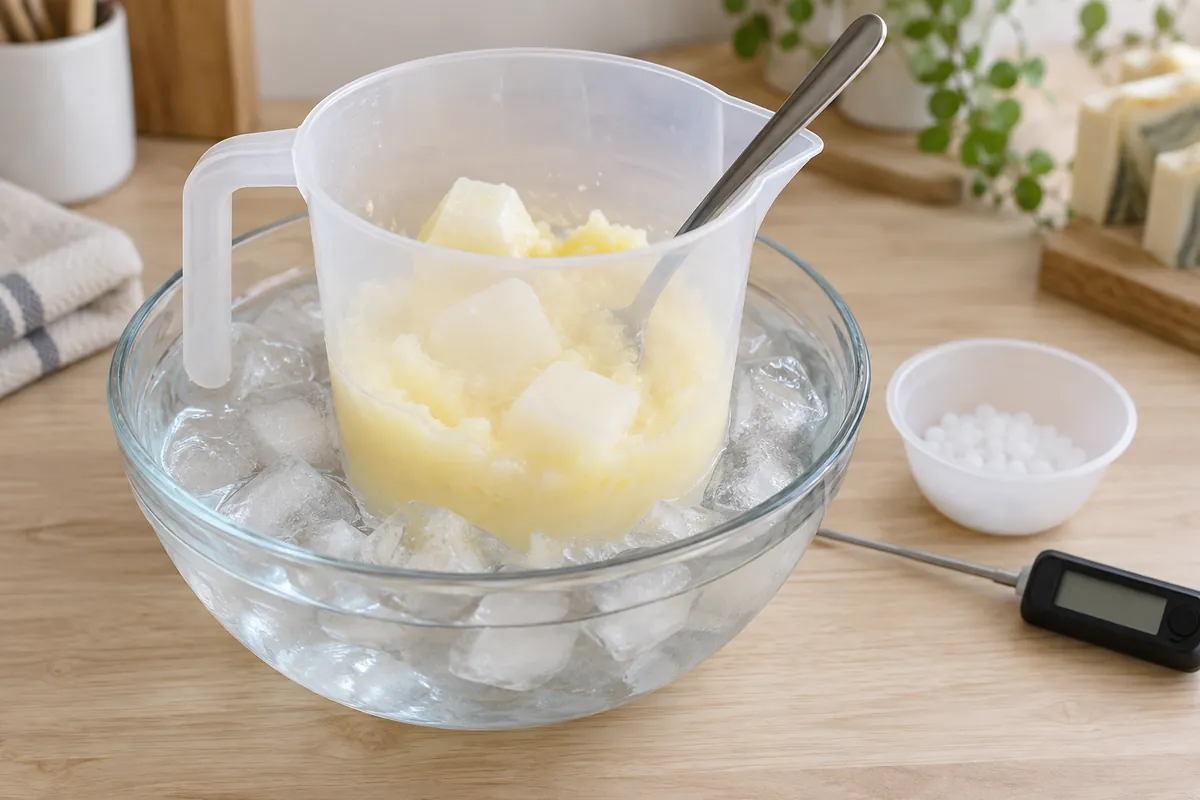 Part way through adding the lye: a pale yellow slush, the jug standing in iced water. Orange or brown means it has got too warm.
Lye in water, milk in the oils
Dissolve the lye in part of the water as usual, and blend the milk into the oils before the lye goes in (or stir it in at light trace). The milk never meets the hot solution, so it browns very little. The catch is that the lye now has less water to dissolve in, which makes the solution stronger and hotter. Sodium hydroxide dissolves at 108 g per 100 g of water at 20 °C, so every 100 g of lye needs at least 93 g of water to dissolve at all.
Worked through the recipe below, with the water raised to 38 % of the oils (380 g): dissolve the 139.6 g of lye in 210 g of plain water, a 39.9 % solution, and blend 195.3 g of goat milk, carrying the other 170 g of water, into the oils. Push more of the water into the milk and the calculator warns you. With 230 g of milk the lye is left 179.8 g of water, a 43.7 % solution that it flags as running hot and strong, and once less than 129.2 g of water is left for the lye, it tells you the lye cannot dissolve.
Split the liquid and let the calculator check it. 195.3 g of goat milk in the oils leaves 210 g of plain water for 139.6 g of lye, a 39.9 % solution.
Open it in the calculatorStirring the milk in at light trace works the same way and needs nothing frozen, which makes it the easiest start: our yogurt and lavender bar and buttermilk and honey bar are made like that. In hot process the milk can wait until the cook is over and the lye is spent, as in our goat milk and shea hot process bar.
Faiola’s milk soaps in Pure Soapmaking often use this split: the lye goes into half or a little more of the liquid as plain water, and the rest goes in at thin trace as milk, warmed to about 29–32 °C (85–90 °F) because cold milk chills the hard oils and speeds trace. Check the solution it leaves: in her buttermilk soap the lye dissolves at 45 %, past the point where the calculator warns. Cavitch’s 1995 goat milk soap took a gentler route. She let a lye solution made with most of the water cool to 27 °C (80 °F), warmed the rest of the liquid, a sixth of it, as goat milk to the same temperature, and drizzled the lye into the milk while stirring briskly so it would not curdle. The mix warmed only to about 29 °C.
Milk powder
Powder saves the freezing. Either stir it into the recipe’s water and freeze that like fresh milk, or make it into a paste with a little of the water or oil and stir it in at light trace. A usual rate is 2 tablespoons of powder per cup (237 ml) of water, which is about 15 g for the recipe below; our goat milk powder bar stirs 16 g in as a paste at trace. Makela told her readers to use whole milk, not skim or powdered, and too much powder softens the bar. It is still milk, sugar and all, so it browns in hot lye like the fresh kind. Faiola goes further in Pure Soapmaking: 28 g (1 oz) of goat milk powder whisked into a little warm water and added at trace for 714 g (25.2 oz) of oils, which lets more milk in than the lye could take without scorching. Her fresh-milk alternative is 235 g (8.3 oz) of frozen milk as all the liquid.
What the calculator does with milk
It does two things, and both change the numbers.
It counts the water the milk carries. You set the recipe’s water as usual, and a milk entered as an additive supplies some or all of it, at its own water content: 87.03 % for goat milk. So 297.9 g of goat milk stands in for 259.2 g of water and the plain water drops to nothing. Books that swap milk for water gram for gram put about 13 % less water into the batch than they think. That is harmless, but it is a slightly stronger solution than the one written down.
It adds the milk’s fat to the superfat. The lye is weighed for the oils alone, so the milk’s fat is fat the lye was never counted for. The calculator adds it and reports the effective superfat:
| Milk as all the liquid | Milk to weigh | Fat it brings | Effective superfat |
|---|---|---|---|
| Goat milk | 297.9 g | 12.3 g | 7.1 % |
| Whole cow’s milk | 294.1 g | 9.6 g | 6.9 % |
| Buttermilk, cultured, low-fat | 288.9 g | 3.1 g | 6.3 % |
| Oat milk, unsweetened | 286.3 g | 7.9 g | 6.7 % |
| Almond milk, unsweetened | 266.2 g | 3.3 g | 6.3 % |
| Coconut milk, canned | 355.7 g | 75.9 g | 12.6 % |
| Heavy cream, 36 % fat | 449.2 g | 162.1 g | 19.1 % |
The recipe below (1000 g of oils, 6 % superfat, a 35 % lye concentration) with each milk as all of the liquid, from our calculator. Buttermilk’s lactic acid also uses 0.6 g of lye, which the calculator adds back.
Coconut milk and cream carry so much fat that a recipe using them either lowers its own superfat or uses them for only part of the liquid. Our coconut milk bar takes all its liquid as coconut milk and sets the oils at a 4.5 % superfat; our cream and honey bar stirs cream in at trace as a deliberate extra superfat, as Makela did with cream in place of part of the milk. For plant milks, buy unsweetened and without thickeners: added sugar scorches and can puff the loaf up like a soufflé, and guar gum or carrageenan speeds trace (Faiola). Our almond milk and oat bar uses unsweetened almond milk as all of its liquid.
The recipe: goat milk soap
This is our milk soap base with frozen goat milk as all of its liquid, for 1000 g of oils. It makes 1437.4 g of fresh soap, enough for a 1.5 litre loaf mould: about 13 bars of 110 g (3.9 oz).
| Ingredient | Grams | Ounces |
|---|---|---|
| Olive oil | 400 | 14.11 |
| Coconut oil | 250 | 8.82 |
| Palm oil | 250 | 8.82 |
| Shea butter | 100 | 3.53 |
| Sodium hydroxide (100 %) | 139.6 | 4.92 |
| Goat milk, frozen | 297.9 | 10.51 |
6 % superfat, water at a 35 % lye concentration, all of it carried by the milk. Effective superfat with the milk’s fat: 7.1 %. Across the published saponification ranges of these oils the superfat could sit anywhere from 2.6 to 9.3 %, which is why a margin is kept. Hardness 44, cleansing 17, conditioning 53: the quality numbers are a craft convention, useful for comparing recipes, not a specification.
For a palm-free bar, use lard in place of the palm oil: the lye becomes 139.2 g and the milk 297.1 g. The palm-free guide covers the other swaps. Our goat milk, oat and honey bar is a palm-free milk soap written out in full, with its own method, and so is our lavender goat milk bar, built on lard and olive oil.
Open it with the milk already in. 297.9 g of goat milk carries all 259.2 g of the water, and the calculator shows the effective superfat at 7.1 %.
Open it in the calculator- Freeze the milk. The day before, weigh 297.9 g of goat milk into an ice-cube tray and freeze it solid. Cubes melt evenly; a solid block does not.
- Set up. Put on splash goggles, nitrile gloves and long sleeves. Weigh the oils and the lye, ready the mould, clear a shelf in the fridge or freezer, and make an ice bath: a bowl of ice and water that a heat-safe polypropylene jug can stand in.
- Melt the solid oils. Melt the coconut oil, palm oil and shea butter gently, stir in the olive oil, and let the oils cool to 25 to 30 °C (77 to 86 °F).
- Add the lye to the milk. Put the frozen cubes in the jug and stand it in the ice bath. Sprinkle in a spoonful of lye and stir until it has dissolved into the melting milk before adding the next. Take 10 to 15 minutes over it and keep the mix below 30 °C (86 °F). It should end up pale yellow, smelling faintly of ammonia. If it thickens like custard, it is too cold: let it warm a few degrees.
- Strain and blend. Pour the milk and lye through a stainless steel sieve into the oils, which catches any curds and shows you that no lye beads are left undissolved. Stick blend in short bursts, stirring between them, to light trace.
- Add scent or colour. Stir in any fragrance or colourant at light trace. Fragrances containing vanillin turn brown in any soap, and honey or sugar adds heat, so leave them out of a first milk batch.
- Pour and chill. Pour into the mould, tap it on the bench to release air, and put it uncovered into the fridge, or the freezer, for 24 hours.
- Unmould and cut. Let the loaf come back to room temperature before you unmould it, or moisture condenses on the cold soap. An ungelled loaf takes longer to firm up, so wait until it is firm, usually 24 to 48 hours after pouring, then unmould it with gloves on and cut.
- Cure. Stand the bars on a rack with air around them for four to six weeks, turning them now and then. The ammonia smell goes in the first week or two.
What colour to expect, and what went wrong
A milk soap kept cold is cream to pale yellow when it is cut and may drift a shade darker over the cure. A light tan all through means the milk warmed a little as the lye went in. A darker centre with a paler rim is partial gel: the middle of the loaf got hot enough to brown and the edges did not. It is cosmetic. Some makers try to soften the ring by warming the set soap in a low oven for an hour or so, but in a milk soap that browns the rest to match; chilling the next loaf sooner is the better fix. Orange or brown and a burnt smell mean the milk scorched. The soap is still safe to use once cured and the smell fades; it just is not the pale bar you wanted.
A loaf that is still soft after two days in a cool room usually needs a few more days in the mould, not a rescue. Check the recipe went through the calculator with the milk entered as a liquid, weigh a bar or two over the cure to watch the water leave, and cure it the full six weeks before judging the lather.
Everything else works as it does in any bar. The additives guide covers what else can go in, and liquids in soap applies the same rules to beer, coffee, tea and juice.
Recipes to try
All recipesSources
- Protein in Handcrafted Soap (lecture slides) . Kevin M. Dunn, Handcrafted Soap and Cosmetic Guild , 2014. Lactose browns in lye; casein curdles but does not hydrolyse; goat milk's saponification value and the 4 to 6 % of the lye it uses.
- Making Natural Milk Soap (excerpted from Milk-Based Soaps) . Casey Makela, Storey Publishing , 1999. Lye added slowly to cold milk in an ice bath; pasteurising raw milk; skim and powdered milk as poor choices.
- The Natural Soap Chef . Heidi Corley Barto, Ulysses Press , 2012. Frozen goat milk and an ice bath; the ammonia smell fading with the cure.
- Natural Soap Making . Elizabeth Letcavage and Melissa Harden, Stackpole Books , 2013.
- The Complete Photo Guide to Soap Making . David Fisher, Creative Publishing International , 2018. How hot a lye solution gets; the milk-in-oils method; milk powder.
- Soap Crafting . Anne-Marie Faiola, Storey Publishing , 2013. Sodium lactate at 1 teaspoon per pound of oils.
- Handcrafted Soap . Delores Boone, North Light Books , 2002. Goat milk powder at 2 tablespoons per 8 ounces (237 ml) of water.
- Pure Soapmaking . Anne-Marie Faiola, Storey Publishing , 2016. Half the liquid as milk at thin trace, warmed to 29–32 °C; goat milk powder concentrate at trace; milks without thickeners or added sugar.
- The Natural Soap Book . Susan Miller Cavitch, Storey Publishing , 1995. Goat Milk Soap: a cooled lye solution drizzled into a sixth of the liquid as goat milk, both at 27 °C.
- The Everything Soapmaking Book, 3rd edition . Alicia Grosso, Adams Media , 2013. Half-and-half soap covered lightly so that it gels without overheating.
- Natural Soapmaking . Marie Browning, Sterling Publishing , 1999. Powdered milk softens the soap slightly.
- FoodData Central: Milk, goat, fluid (FDC 171278) and Milk, whole, 3.25 % milkfat (FDC 171265) . U.S. Department of Agriculture, Agricultural Research Service .
- CAMEO Chemicals: Sodium hydroxide solution, reactivity profile . NOAA Office of Response and Restoration . Reducing sugars heated above 84 °C with alkali give off toxic levels of carbon monoxide.
- Analysis of Glutamine Deamidation: Products, Pathways, and Kinetics . Riggs D.L. et al., Analytical Chemistry 91 , 2019.
- Goat's milk allergy in a family following household sensitization to goat's milk soap . Anantharajah A. and Randall K.L., Asia Pacific Allergy 11(2) e13 , 2021.
- Goat milk skin products may cause the development of goat milk allergy . De Luca J.F. et al., Clinical & Experimental Allergy , 2022.
- How to add lye to milk for cold process soap . Soap Queen (Bramble Berry), supplier guide . Craft practice only: target temperatures for the milk and lye, and how long the ammonia smell lasts.