Seaweed and sea salt bar
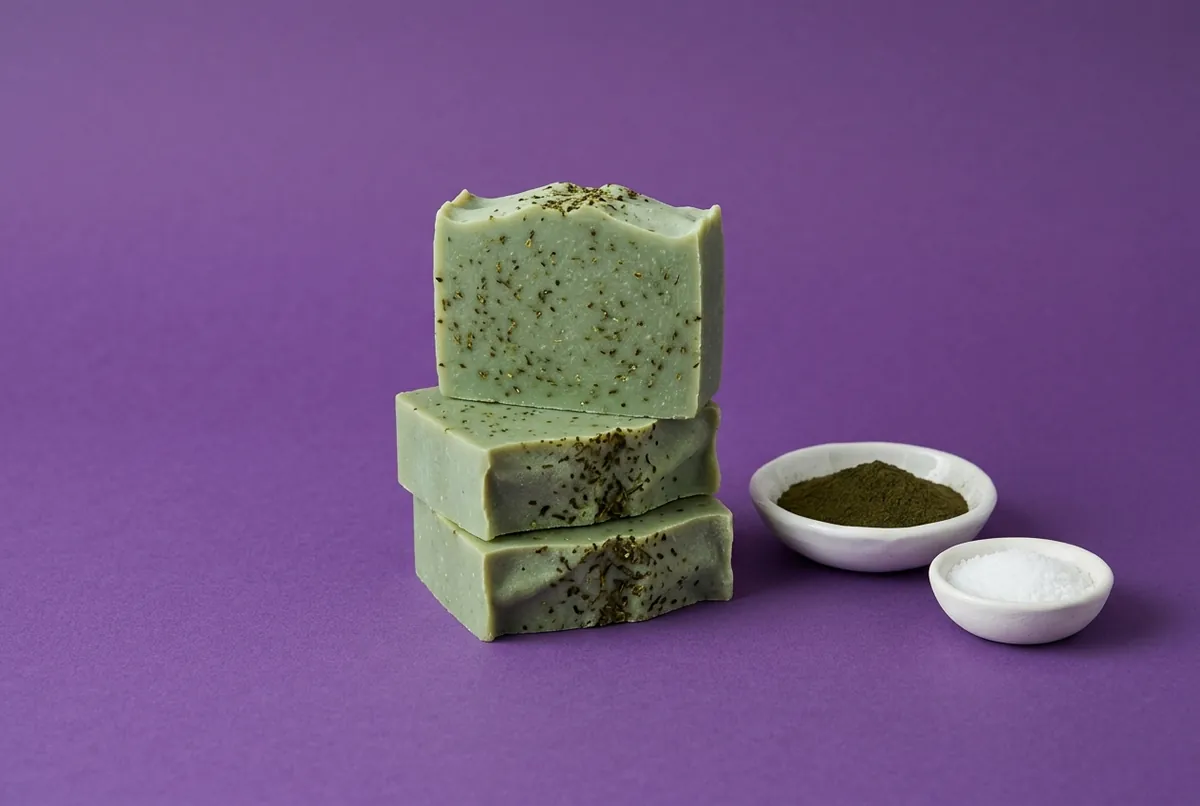
An everyday bar coloured a muted sea green with kelp and spirulina, with a little fine sea salt stirred in at trace for a firmer bar. Lavender, eucalyptus and cedarwood give it a fresh scent, and with only a little salt it lathers far more freely than a salt bar.
- Skill
- Beginner
- Method
- Cold process
- Batch
- 1000 g of oils about 1492 g of batter
- Hands-on
- 1 h 10 min
- Cure
- 4 weeks
- Gel phase
- No keep it cool
What you need
For 1000 g of oils, which fills a 1.5 litre loaf mould. Weigh everything, liquids included.
| Olive Oil · 40.0 % | 400 g | 14.11 oz |
| Coconut Oil · 30.0 % | 300 g | 10.58 oz |
| Shea Butter · 15.0 % | 150 g | 5.29 oz |
| Rice Bran Oil · 10.0 % | 100 g | 3.53 oz |
| Castor Oil · 5.0 % | 50 g | 1.76 oz |
| Sodium hydroxide (NaOH) · the lye, 100 % pure | 139.6 g | 4.92 oz |
| Distilled water · for a 33 % lye solution | 283.4 g | 10.00 oz |
| Kelp powder · about 1 tbsp, finely ground, stirred with the spirulina into 2 tbsp of the recipe's olive oil | 8 g | 0.28 oz |
| Spirulina powder · 2 tsp, stirred into the olive oil with the kelp | 4.7 g | 0.16 oz |
| Sea salt, fine · 2 tbsp, stirred into the batter at trace, not dissolved in the lye water | 32 g | 1.11 oz |
| Lavender essential oil · 1.5 % of the oils, at trace | 15 g | 0.53 oz |
| Eucalyptus radiata essential oil · 0.5 % of the oils, at trace | 5 g | 0.18 oz |
| Atlas cedarwood essential oil · 0.5 % of the oils, at trace | 5 g | 0.18 oz |
- Superfat
- 6 %
- Temperatures
- Oils and lye solution each at 35 to 40 °C (95 to 104 °F)
Method
-
Get ready
Open a window, put on splash goggles, nitrile gloves and long sleeves, and line or set out a 1.5 litre loaf mould. Wear a dust mask while you measure the kelp and spirulina powders. -
Weigh everything
Weigh 300 g coconut oil and 150 g shea butter into the pot, and 400 g olive oil, 100 g rice bran oil and 50 g castor oil into a jug. Weigh 31.6 g (2 tbsp) fine sea salt into a small bowl and 15 g lavender, 5 g eucalyptus and 5 g Atlas cedarwood essential oil into a small glass. -
Make the lye solution
Weigh 283.4 g distilled water into the lye jug and 139.6 g sodium hydroxide into a dry container. At an open window or under the extractor fan, pour the lye slowly into the water, never the reverse, stir until clear and leave it to cool, labelled and out of reach; the salt does not go in here. -
Disperse the seaweeds
Stir 8 g (about 1 tbsp) kelp powder and 2 tsp (4.7 g) spirulina into 2 tbsp (about 27 g) of the olive oil from the jug until no dry specks remain. -
Melt the fats
Melt the coconut oil and shea butter on the lowest heat, then pour in the rest of the olive oil and the rice bran and castor oils. Let the oils and the lye solution each come to 35 to 40 °C (95 to 104 °F). -
Blend to light trace
Pour the lye solution into the oils down the shaft of the stick blender, then pulse for a few seconds at a time, stirring between pulses. Stop at light trace, when the batter looks like thin custard and a drizzle leaves a faint line that sinks back within seconds. -
Add the colour and scent
Whisk in the seaweed oil, then the essential oils, and give a few short pulses until the batter is an even green with fine darker flecks. -
Stir in the salt
Stir in the 31.6 g of sea salt by hand with the spatula until it is evenly spread. The batter thickens slightly as it goes in. -
Pour and keep cool
Pour into the mould, tap it on the worktop and smooth the top. Lay a sheet of baking paper over it but no towel, and leave it in a cool room: heat dulls spirulina's green. -
Clean up
With your gloves still on, wipe the batter off the pot and tools with paper towels into the bin, then wash everything in hot soapy water. -
Unmould and cut
After 24 to 36 hours, when the loaf is firm, put your gloves back on, unmould it and cut it into bars about 2.5 cm (1 in) thick. The salt makes it set sooner and harden faster, so don't leave it for days before cutting. -
Cure
Stand the bars on edge on a rack with air around them, out of the sun, for four to six weeks, turning them every few days.
Tips
- The green starts bright and settles to a softer sea green within a week or two as the spirulina fades; kelp holds its browner olive. Cure and store the bars out of direct light.
- The salt goes in at trace, not into the lye water: a lye solution holds very little salt, and the rest would come back out as grit.
- Don't simply add more salt. Salt cuts lather, and an ordinary bar loses more of it the more you add; a salt bar needs mostly coconut oil and a high superfat, as in our pink salt spa bar.
- Buy finely ground, food-grade kelp powder; coarse flakes feel scratchy in the bar.
The oils
| Oil | Share |
|---|---|
| Olive Oil (virgin / refined / olive oil) | 40.0 % |
| Coconut Oil | 30.0 % |
| Shea Butter | 15.0 % |
| Rice Bran Oil | 10.0 % |
| Castor Oil | 5.0 % |
How it is made
| Process | Cold process |
| Alkali | NaOH |
| Superfat | 6 % |
| Water | lye water at 33 % |
| Iodine value | 59 |
| INS | 150 |
Why make it
An everyday bar with a seaside theme, cleansing 20 and conditioning 56 on our scale, with a little more coconut oil than usual so it still lathers freely around the salt. The salt, about 3 % of the oils, gives a firmer, longer-lasting bar while stopping far short of a salt bar, which trades lather for hardness. Seaweed bathing has a long history on Ireland's Atlantic coast, where hot seaweed baths were a Victorian craze and a few bathhouses still run (Tourism Ireland). In this bar, kelp and spirulina are colour and fine flecks; any benefit people hope for from seaweed rests on that tradition rather than on evidence about a rinse-off soap. The green softens to a muted sea green within weeks, and lavender, eucalyptus and cedarwood give it a fresh scent.
Sources
- Seaweed baths and County Sligo · Tourism Ireland
What tradition, makers' experience and research say about soaps like this, each labelled for what it is. It is not medical advice, and no soap treats a skin condition: if you have one, ask a doctor or pharmacist.
What the numbers say
- Lauric acid 14.8 %
- Myristic acid 5.7 %
- Palmitic acid 10.6 %
- Stearic acid 8.6 %
- Ricinoleic acid 4.4 %
- Oleic acid 41.5 %
- Linoleic acid 9.7 %
- Other 5.7 %
Saturated : unsaturated 44 : 56
Computed from the fatty acids of the fats above. The bands are what the craft has settled on, not chemistry — a bar outside one is not wrong.
From the guides
All guides
Natural colourants: what herbs, clays and spices really do in soap
Clays, charcoal and plant colours in cold-process soap: doses per 500 g of oils, infused oil, powder or lye, and the colour each one actually turns.
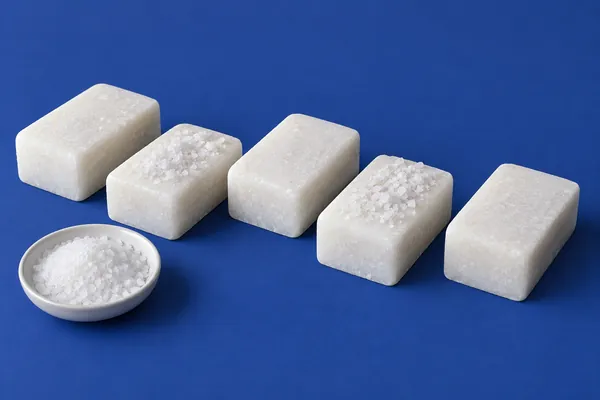
Salt bars: spa soap with sea salt
Why salt bars are mostly coconut oil at a 15 to 20 % superfat, how much salt to use and which to avoid, when to cut them, and how brine bars differ.

Soap additives: salt, sugar, sodium lactate, clays, oats, silk and more
What common soap additives do, how much to use and when they go in: sourced doses for sodium lactate, salt, sugar, honey, citric acid, clays, oats and silk.
Where these proportions come from
Our own formulation: olive oil with 30 % coconut oil, shea butter, rice bran oil and a little castor oil at a 6 % superfat. Coconut sits a little higher than in an everyday bar because salt cuts lather and coconut soap stands up to it best; at about 3 % of the oils, the salt firms the bar without turning it into a salt bar.