Shea and cocoa butter luxury bar
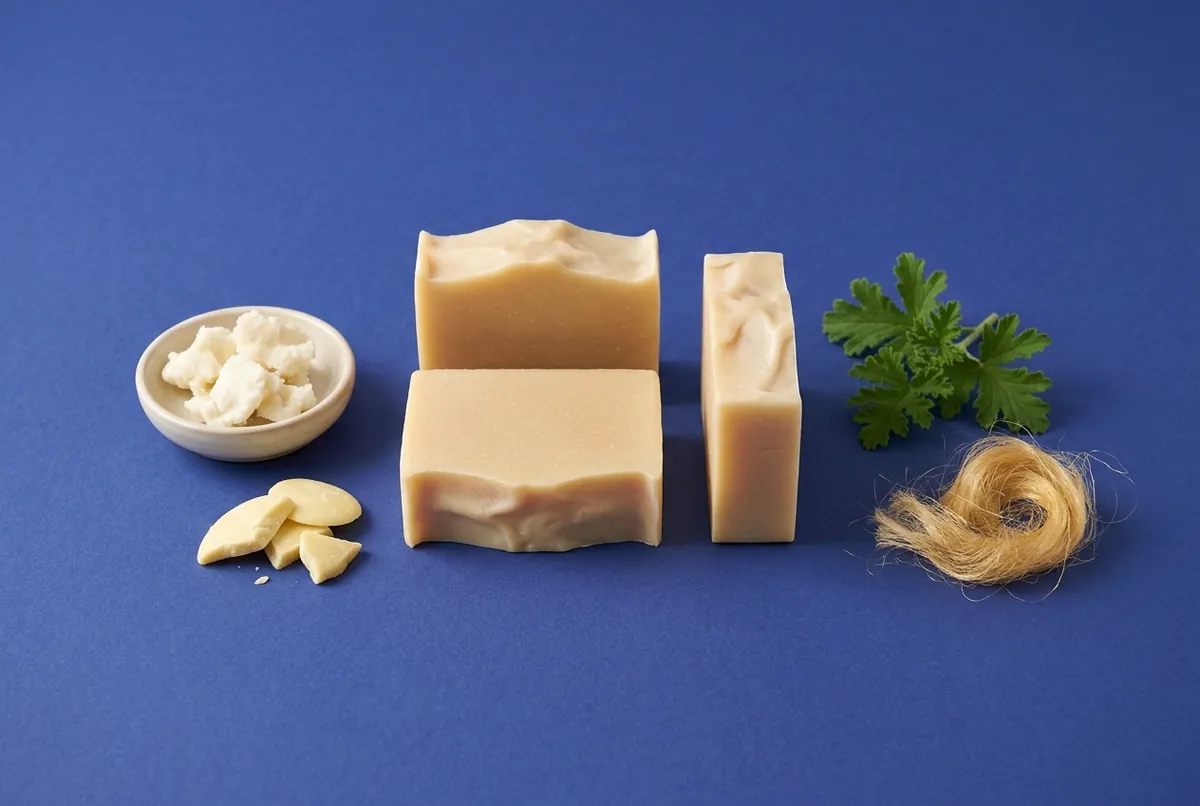
Forty per cent shea and cocoa butter make a dense, creamy bar with a rich lather, scented with rose geranium and, if you like, a pinch of tussah silk dissolved in the lye. Palm-free, with a 7 % superfat that leaves a little more oil in the bar.
- Skill
- Intermediate
- Method
- Cold process
- Batch
- 1000 g of oils about 1429 g of batter
- Hands-on
- 1 h 15 min
- Cure
- 6 weeks
- Gel phase
- Either way gel or not, both work
What you need
For 1000 g of oils, which fills a 1.5 litre loaf mould. Weigh everything, liquids included.
| Olive Oil · 35.0 % | 350 g | 12.35 oz |
| Shea Butter · 30.0 % | 300 g | 10.58 oz |
| Coconut Oil · 20.0 % | 200 g | 7.05 oz |
| Cocoa Butter · 10.0 % | 100 g | 3.53 oz |
| Castor Oil · 5.0 % | 50 g | 1.76 oz |
| Sodium hydroxide (NaOH) · the lye, 100 % pure | 133.2 g | 4.70 oz |
| Distilled water · for a 33 % lye solution | 270.5 g | 9.54 oz |
| Tussah silk (optional) · optional: two pea-sized pinches, dissolved in the hot lye solution | 0.1 g | 0.00 oz |
| Rose geranium essential oil · 2.5 % of the oils, at trace | 25 g | 0.88 oz |
- Superfat
- 7 %
- Temperatures
- Oils and lye solution each between 38 and 43 °C (100 and 110 °F)
Method
-
Get ready
Put on splash goggles, nitrile gloves and long sleeves, open a window or turn on the extractor fan, and keep children and pets out of the room. If you are adding silk, tease it into small, loose wisps now. -
Weigh the oils and the scent
Weigh 300 g shea butter, 100 g cocoa butter and 200 g coconut oil into the pot, 350 g olive oil and 50 g castor oil into a jug, and 25 g rose geranium essential oil into a small glass cup. -
Make the lye solution
Weigh 270.5 g distilled water into a heat-safe jug and 133.2 g sodium hydroxide into a dry container. In a well-ventilated spot, pour the lye slowly into the water, never the water onto the lye, and stir until clear. -
Dissolve the silk, then let it cool
If you are using silk, drop the wisps into the solution while it is still hot and stir gently with a stainless steel or polypropylene spoon, face turned away, for a few minutes until they disappear; a few fine strands left over are normal. With or without silk, leave the solution to cool, labelled and out of reach. -
Melt the butters
Melt the shea butter, cocoa butter and coconut oil together on the lowest heat until clear, then pour in the olive and castor oils. -
Check the temperatures
Carry on when both the oils and the lye solution are between 38 and 43 °C (100 and 110 °F). With this much butter, cooler oils start to set and thicken the batter before it has traced. -
Combine through a sieve
Pour the lye solution slowly into the oils through a small stainless steel sieve held low over the pot, to catch any silk strands. Tap the stick blender on the bottom of the pot to let trapped air out, and keep the blade under the surface while it runs. -
Blend to light trace
Pulse for a few seconds at a time, stirring between bursts. Butters bring trace on quickly, so check often and stop when a drizzle leaves a faint line on the surface. -
Stir in the rose geranium
Add the essential oil and stir it through by hand with the spatula. -
Pour and cover
Pour into the mould, tap it on the worktop to raise air bubbles, and smooth the top or texture it with the back of a spoon. Cover it with a lid or board, adding a towel only if the room is cool: a butter-rich loaf that gets too hot can crack on top. -
Unmould and cut
After 24 to 48 hours, when the loaf is firm, unmould it with gloves on and cut it into bars about 2.5 cm (1 in) thick. -
Cure
Stand the bars on edge in a dry, airy room for six weeks, turning them every few days.
Tips
- Unrefined cocoa butter smells of chocolate and tints the bar a warm cream; deodorised cocoa butter keeps it paler and lets the geranium come through.
- Geranium is a strong oil and 25 g is plenty. Lavender at 30 g is a softer, cheaper choice, or leave the bar unscented; the lye stays the same either way.
- The silk is optional and does not change the lye. Many makers find it gives the lather a smoother feel; leave it out for a vegan bar.
The oils
| Oil | Share |
|---|---|
| Olive Oil (virgin / refined / olive oil) | 35.0 % |
| Shea Butter | 30.0 % |
| Coconut Oil | 20.0 % |
| Cocoa Butter (Theobroma Oil) | 10.0 % |
| Castor Oil | 5.0 % |
How it is made
| Process | Cold process |
| Alkali | NaOH |
| Superfat | 7 % |
| Water | lye water at 33 % |
| Iodine value | 55 |
| INS | 146 |
Why make it
Forty per cent shea and cocoa butter make a dense bar with a creamy, lotion-like lather, creamy 32 and cleansing a gentle 14 on our scale, and a 7 % superfat leaves a little more oil in it: a bar for dry skin and for anyone who finds ordinary soap too stripping. Shea butter has been used on skin and hair across West Africa for generations, a tradition reviewed by Ugwu-Dike and Nambudiri (2022). In soap most of the butter becomes soap; what the bar keeps is its firmness, its creaminess and the small part of shea that lye cannot saponify. Many makers add silk for a silkier lather, a reputation that rests on experience rather than any study. Shea is a nut butter, so label it for allergies.
Sources
- A review of ethnomedicinal uses of shea butter for dermatoses in Sub-Saharan Africa · Dermatologic Therapy, 2022
What tradition, makers' experience and research say about soaps like this, each labelled for what it is. It is not medical advice, and no soap treats a skin condition: if you have one, ask a doctor or pharmacist.
What the numbers say
- Lauric acid 9.8 %
- Myristic acid 3.8 %
- Palmitic acid 10.4 %
- Stearic acid 17.6 %
- Ricinoleic acid 4.4 %
- Oleic acid 43.5 %
- Linoleic acid 7.0 %
- Other 4.2 %
Saturated : unsaturated 44 : 56
Computed from the fatty acids of the fats above. The bands are what the craft has settled on, not chemistry — a bar outside one is not wrong.
From the guides
All guides
Superfat and lye discount: why recipes leave some oil unsaponified
What superfat and lye discount mean, how the calculator applies them, where makers set them for each soap, and why oil added at trace isn't the oil left over.

Scenting soap: essential oils and fragrance oils
How much essential or fragrance oil to use in soap, what ounces per pound mean in percent, the IFRA limits for common essential oils, and EU allergen labelling.

Soap additives: salt, sugar, sodium lactate, clays, oats, silk and more
What common soap additives do, how much to use and when they go in: sourced doses for sodium lactate, salt, sugar, honey, citric acid, clays, oats and silk.
Guides with this recipe
Where these proportions come from
Adapted from the base bar in Heidi Corley Barto's The Natural Soap Chef (shea butter 30, palm 30, coconut 20, olive 20): the shea and coconut kept, the palm replaced by 10 % cocoa butter and more olive oil, 5 % castor oil added for lather, and the superfat set at 7 %.
Formulation adapted from The Natural Soap Chef by Heidi Corley Barto (Ulysses Press, 2012). The method and notes are ours.