Stearic acid shaving soap
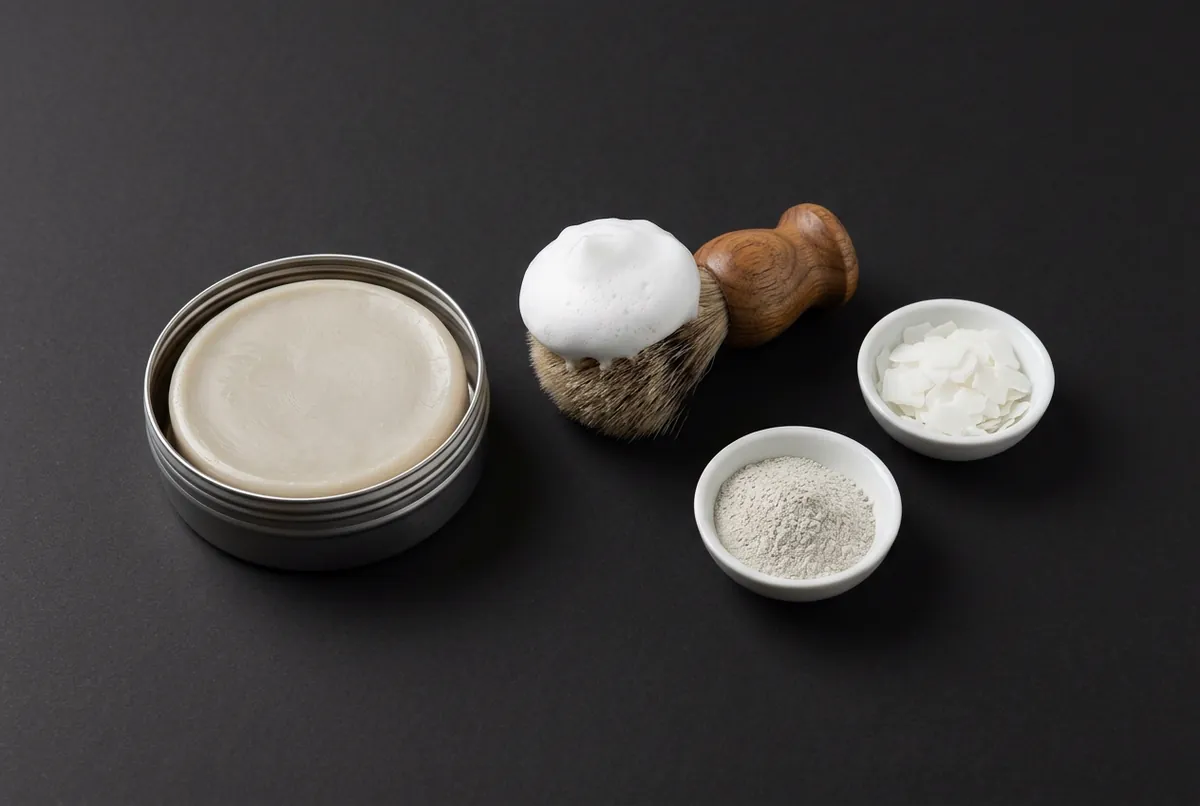
A firm shaving puck for tins, cooked in a slow cooker: 45 % stearic acid for a dense, cushioning lather, coconut oil to get it going, and almond oil and shea butter for feel, with glycerin and bentonite clay stirred in after the cook. Potassium hydroxide does half the saponification, so a damp brush loads quickly.
- Skill
- Advanced
- Method
- Hot process
- Batch
- 500 g of oils about 864 g of batter
- Hands-on
- 1 h 30 min
- Cure
- 6 weeks
- Gel phase
- In the pot it gels as it cooks
What you need
For 500 g of oils, which fills about eight 100 g shaving tins. Weigh everything, liquids included.
| Stearic Acid · 45.0 % | 225 g | 7.94 oz |
| Coconut Oil · 20.0 % | 100 g | 3.53 oz |
| Almond Oil · 15.0 % | 75 g | 2.65 oz |
| Castor Oil · 10.0 % | 50 g | 1.76 oz |
| Shea Butter · 10.0 % | 50 g | 1.76 oz |
| Sodium hydroxide (NaOH) · the lye, 100 % pure | 35.7 g | 1.26 oz |
| Potassium hydroxide (KOH) · the lye, 90 % pure; if your label says otherwise, weigh 58.9 g at 85 % or 52.7 g at 95 % | 55.6 g | 1.96 oz |
| Distilled water · for a 29 % lye solution | 225.0 g | 7.94 oz |
| Glycerin · after the cook, as a slurry with the clay | 25 g | 0.88 oz |
| Bentonite clay · 2 tsp, stirred smooth into the glycerin, then into the cooked soap | 7.8 g | 0.28 oz |
| Lavender essential oil · 2.0 % of the oils, after the cook | 10 g | 0.35 oz |
| Bergamot essential oil · 1.0 % of the oils, after the cook | 5 g | 0.18 oz |
- Superfat
- 5 %
- Temperatures
- Fats kept above 60 °C (140 °F) so the stearic acid stays melted, cooked on low, scent in below 82 °C (180 °F)
Method
-
Get ready
Put on splash goggles, gloves and long sleeves, and keep them on through the cook. Weigh 225 g stearic acid, 100 g coconut oil and 50 g shea butter into the slow cooker, 75 g almond oil and 50 g castor oil into a jug, 225 g distilled water into a heat-proof jug, and 35.7 g sodium hydroxide and 55.6 g potassium hydroxide flakes into dry containers. -
Make the lye solution
At an open window or under the extractor fan, stir both hydroxides into the water a little at a time, always lye into water, never the reverse, with your face turned away. It fizzes and gets very hot; leave it to cool, labelled and out of reach, while you melt the fats. -
Melt the fats hot
Melt the stearic acid, coconut oil and shea butter in the slow cooker on high, then stir in the almond and castor oils and turn the cooker to low. Keep the blend above 60 °C (140 °F), well clear of stearic acid's setting point of about 55 °C (131 °F), or it starts to set before the lye arrives. -
Add the lye and let it seize
Pour in the lye solution slowly, stirring with a sturdy spatula. The batter thickens to a paste almost at once: that is the stearic acid turning to soap, not a failure. Work it with the spatula and short bursts of the stick blender until no liquid lye is left in the pot. -
Cook it through
Cover and cook on low, folding the soap over every 15 to 20 minutes. It is done when the whole mass is translucent, like petroleum jelly, with no opaque patches, usually after about an hour. -
Make the clay slurry
While it cooks, stir the 2 tsp of bentonite clay into the 25 g of glycerin until it is smooth, with no lumps. -
Finish off the heat
Turn off the cooker and stir the clay slurry through the hot soap until the colour is even. -
Scent it below 82 °C
Let the soap cool to below about 82 °C (180 °F), then stir in the lavender and bergamot oils quickly, before it stiffens. -
Press into tins
Spoon the soap into tins, pressing each spoonful down firmly to push out air pockets and tapping the tin on the bench; smooth the tops. It fills about eight 100 g tins. -
Let the pucks dry
Leave the tins open somewhere airy for about six weeks before you put the lids on: the soap still has water to lose, and it firms up and shrinks a little as it goes. -
Load the brush
To use it, soak a brush in warm water, shake it out and swirl it over the puck until it carries a thick layer of soap, then build the lather in a bowl or on your face, adding water a little at a time.
Tips
- Half the saponification here is done by potassium hydroxide, so its purity matters. The recipe assumes 90 % flakes; with 95 % flakes the same weight takes the superfat from 5 % to about 2.4 %, so enter the figure on your label in the calculator before you weigh.
- Keep the superfat at 5 %. A shaving soap goes on skin that is about to be scraped, and the spread of published saponification values for these oils could eat two or three points of it in the worst case.
- For a harder, longer-lasting puck, lower the potassium hydroxide share in the calculator; for a softer soap that loads faster, raise it. Both lyes change when you do.
- Lanolin is a wax, not a fat. If you want it, stir it in after the cook and mark it as an after-the-cook oil in the calculator, which leaves it out of the lye and counts it as superfat.
The oils
| Oil | Share |
|---|---|
| Stearic Acid (triple-pressed, ~50:50 C16/C18) | 45.0 % |
| Coconut Oil | 20.0 % |
| Almond Oil (Sweet Almond Oil) | 15.0 % |
| Castor Oil | 10.0 % |
| Shea Butter | 10.0 % |
How it is made
| Process | Hot process |
| Alkali | NaOH + KOH |
| Superfat | 5 % |
| Water | 45 % of the oils |
| Iodine value | 30 |
| INS | 181 |
Why make it
A shaving soap for brush users: 45 % stearic acid gives the dense, cushioning lather shavers look for, creamy 62 on our scale, and with potassium hydroxide doing half the saponification a damp brush loads quickly. Glycerin adds slip, and clay gives the lather the glide makers value in shaving soap (Alicia Grosso). Brush and soap is the traditional way to prepare a beard, and there is a mechanical reason behind it: fully soaked beard hair is half as stiff as dry hair or less (Cowley and Vanoosthuyze 2012), and a brush works warm water and lather into the stubble. It suits anyone who shaves with a safety or straight razor, and it is not meant as a body soap. Let the pucks dry for their six weeks before you put the lids on.
Sources
- Alicia Grosso, The Everything Soapmaking Book, 3rd edition · Adams Media, 2013
- Insights into shaving and its impact on skin · British Journal of Dermatology, 2012
What tradition, makers' experience and research say about soaps like this, each labelled for what it is. It is not medical advice, and no soap treats a skin condition: if you have one, ask a doctor or pharmacist.
What the numbers say
- Lauric acid 9.8 %
- Myristic acid 4.7 %
- Palmitic acid 24.4 %
- Stearic acid 28.6 %
- Ricinoleic acid 8.9 %
- Oleic acid 17.2 %
- Linoleic acid 5.9 %
- Other 3.2 %
Saturated : unsaturated 69 : 31
Computed from the fatty acids of the fats above. The bands are what the craft has settled on, not chemistry — a bar outside one is not wrong.
From the guides
All guides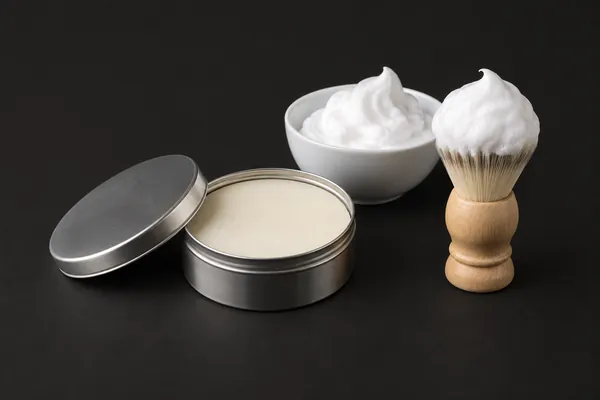
Shaving soap: stearic acid, dual lye and a dense lather
How shaving soap differs from a body bar: stearic acid for a dense, lasting lather, NaOH and KOH for a firm puck that loads fast, and hot process into tins.
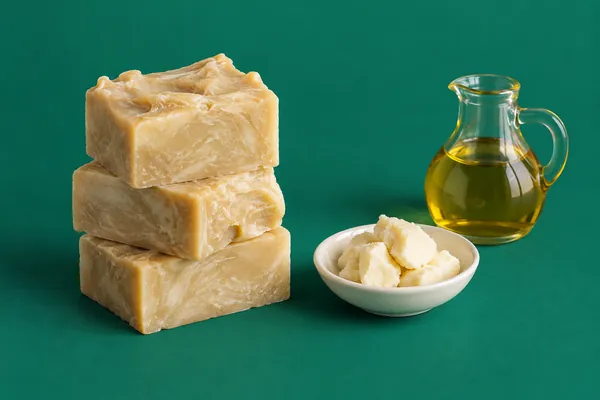
Hot process soap, step by step
Cook soap batter in a slow cooker until the lye is spent, then stir in the superfat oil, fragrance and colour. A full recipe with the calculator's numbers.
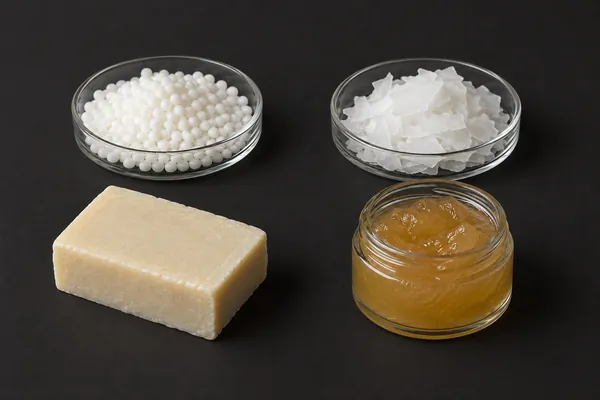
Sodium hydroxide, potassium hydroxide and dual lye explained
Why NaOH makes bars and KOH makes soft soap, converting between them, KOH purity, dual-lye recipes, and the calculator slip that turns a bar caustic.
Guides with this recipe
Where these proportions come from
Our own formulation in the shaving-soap convention: 45 % stearic acid, inside the usual 30 to 50 %, for a dense lather, a fifth coconut oil to start it, castor oil to steady it and almond oil and shea butter for feel, with half the saponification done by potassium hydroxide so the puck loads quickly and a 5 % superfat for margin. Glycerin goes back in after the cook because free stearic acid makes none, as in the cream soap of David Fisher's Complete Photo Guide to Soap Making, and the bentonite is close to the rate in Heidi Corley Barto's shaving soap.