White tea faux funnel pour bar
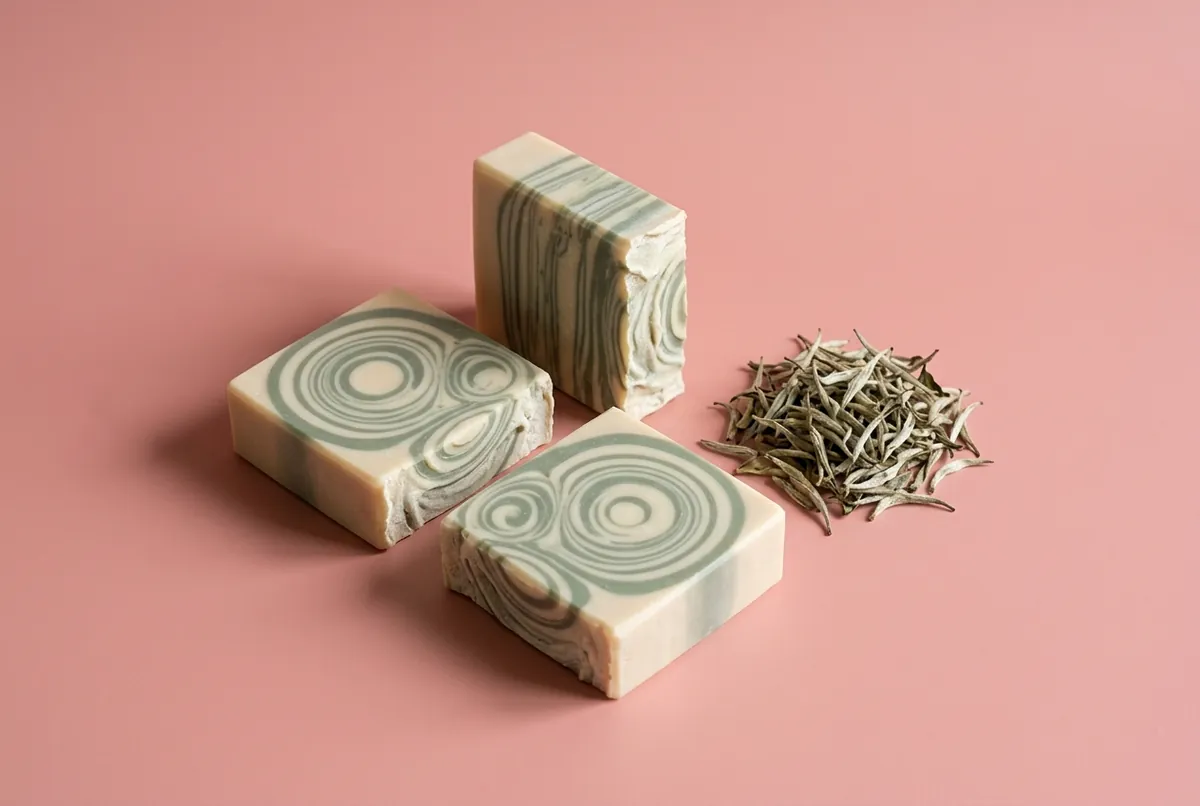
Cream and sage green batter squeezed in turn into random circles, so the top of every bar shows fine rings like a funnel pour, with no funnel and no dividers. Strong white tea, frozen, is all of its liquid, and eucalyptus its scent.
- Skill
- Intermediate
- Method
- Cold process
- Batch
- 900 g of oils about 1346 g of batter
- Hands-on
- 1 h 15 min
- Cure
- 6 weeks
- Gel phase
- No keep it cool
What you need
For 900 g of oils, which fills a 20 cm (8 in) square slab mould at least 4 cm deep. Weigh everything, liquids included.
| Olive Oil · 50.0 % | 450 g | 15.87 oz |
| Coconut Oil · 23.0 % | 207 g | 7.30 oz |
| Rapeseed Oil - Low Erucic Acid · 20.0 % | 180 g | 6.35 oz |
| Shea Butter · 7.0 % | 63 g | 2.22 oz |
| Sodium hydroxide (NaOH) · the lye, 100 % pure | 124.5 g | 4.39 oz |
| White tea, brewed strong and frozen in cubes · all of the liquid, brewed from 8 g of loose white tea or 5 tea bags in about 350 ml of distilled water; the lye goes onto it. The calculator lists it as brewed green tea, the same plant | 291 g | 10.26 oz |
| Titanium dioxide · 1 tsp, white half only, dispersed in 14 g of the recipe's canola oil | 4.7 g | 0.17 oz |
| Chromium oxide green · 0.75 tsp, green half only, dispersed in 14 g of the recipe's canola oil | 3.7 g | 0.13 oz |
| Rubbing alcohol (isopropyl, 91 % or stronger), in a fine spray bottle · misted lightly over the top against soda ash; it evaporates. Flammable: keep it away from flames | 1 tbsp | |
| Eucalyptus oil (globulus) · 2.5 % of the oils, at trace | 23 g | 0.79 oz |
- Superfat
- 5 %
- Temperatures
- Tea lye kept as cold as you can while the lye dissolves; oils cooled to 32 to 38 °C (90 to 100 °F)
Method
-
Brew and freeze the tea
The day before, steep 8 g of loose white tea, or 5 tea bags, in about 350 ml of distilled water just off the boil for 10 minutes. Strain it, let it cool, weigh 290.8 g into an ice-cube tray and freeze it solid. -
Get ready
Put on goggles, gloves and long sleeves and open a window. Line the slab mould and set it level where it can stay, with two squeeze bottles of about 500 ml, a funnel to fill them, two jugs and a bowl of iced water in reach. -
Disperse the colours
Weigh the canola oil and take 28 g of it. Stir the titanium dioxide into 14 g in one jug and the chromium green into the other 14 g in the second, until a smear on a white plate shows no grains. -
Add the lye to the frozen tea
Stand the container of frozen tea in the iced water and sprinkle the 124.5 g of sodium hydroxide onto it a tablespoon at a time, stirring until each dissolves before the next; never pour the tea onto the lye. Take 5 to 10 minutes and keep it as cold as you can, since the slower it warms, the paler the soap. It darkens and smells odd, which is normal. -
Melt and scent the oils
Melt the coconut oil and shea butter gently, add the olive oil and the rest of the canola oil, and let them cool to 32 to 38 °C (90 to 100 °F). Stir in the eucalyptus oil. -
Blend to very light trace
Pour the tea lye into the oils through a stainless steel sieve, tap out trapped air, and blend in short pulses only until the batter is smooth and barely thickened, thinner than custard. The fine rings need thin batter. -
Split and fill the bottles
Pour half the batter, about 655 g, into the green jug and whisk it evenly green; whisk the white into the half left in the pot. Fill one squeeze bottle from each, keeping the rest to top them up. -
Squeeze white circles
Squeeze white batter into the mould in about six places, scattered at random, counting to five for each so the circles come out much the same size. -
Squeeze green into each
Squeeze green firmly into the middle of each white circle, again for a count of five, so it pushes the white outwards into a ring. -
Keep alternating
Go on squeezing white, then green, into the middle of each circle, topping up the bottles as they empty, until all the batter is in. Tap the mould on the worktop every few rounds to settle it, and don't add dividers: they break the rings. -
Keep it cool
Mist the top lightly with rubbing alcohol, away from any flame, and leave the slab uncovered in a cool room so it does not gel. Kept cool, the tea stays pale and the white stays clear of glycerin rivers. -
Unmould and cut
Unmould with gloves on after 2 to 3 days, once firm, and cut the slab into 9 bars, three by three. -
Cure
Stand the bars on edge with air between them, out of direct sun, for 6 weeks, turning them every few days.
Tips
- Random centres are what make the fine lines: scattered circles run into each other as they spread, and the rings crowd together where they meet.
- Expect cream and a soft sage green, not white and emerald: lye turns tea tan, and chromium oxide is a muted green to begin with.
- If the bottles start to clog, the batter has thickened: pour the rest straight from the jugs, still alternating into the middle of each circle. The rings come out broader.
The oils
| Oil | Share |
|---|---|
| Olive Oil (virgin / refined / olive oil) | 50.0 % |
| Coconut Oil | 23.0 % |
| Rapeseed Oil - Low Erucic Acid (Canola Oil) | 20.0 % |
| Shea Butter | 7.0 % |
How it is made
| Process | Cold process |
| Alkali | NaOH |
| Superfat | 5 % |
| Water | lye water at 30 % |
| Iodine value | 71 |
| INS | 133 |
Why make it
A gentle, conditioning bar, conditioning 65 and cleansing 16 on our scale, with half olive oil and a little shea, so it suits dry skin and daily use. People make it for the pattern: fine concentric rings of cream and sage from two squeeze bottles, with no funnel and no dividers. Strong white tea replaces the water. Tea soap is a lovely idea, but lye turns tea tan and changes much of what it holds, so the tea's part is colour and story rather than any proven effect on the skin. Eucalyptus gives a clean, fresh scent. Keep it out of gel so the cream stays pale, and give it the full six weeks: olive-rich bars start soft and firm up as they cure.
What tradition, makers' experience and research say about soaps like this, each labelled for what it is. It is not medical advice, and no soap treats a skin condition: if you have one, ask a doctor or pharmacist.
What the numbers say
- Lauric acid 11.3 %
- Myristic acid 4.4 %
- Palmitic acid 10.1 %
- Stearic acid 5.4 %
- Oleic acid 51.6 %
- Linoleic acid 11.5 %
- α-Linolenic acid 2.2 %
- Other 5.6 %
Saturated : unsaturated 34 : 66
Computed from the fatty acids of the fats above. The bands are what the craft has settled on, not chemistry — a bar outside one is not wrong.
From the guides
All guides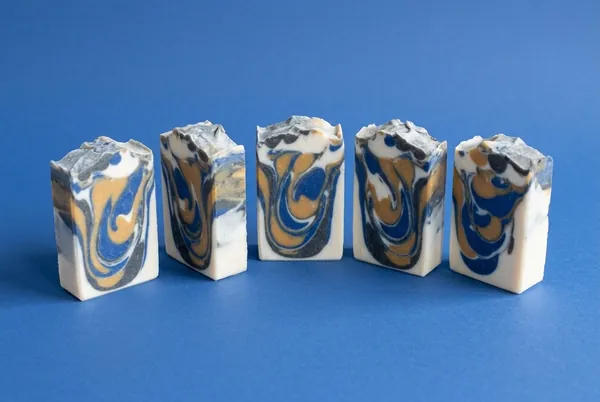
Swirl techniques: in the pot, drop, hanger, spoon and Taiwan
Seven cold-process swirls step by step, with the batter, recipe and temperatures that keep soap fluid, and why swirls turn muddy or lumpy.
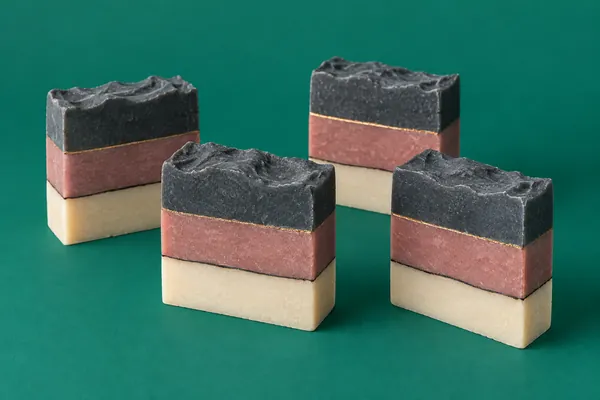
Layers, mica lines and pencil lines
Layered cold-process soap: batter thickness, pouring over a spatula, working out each layer from the mould, and pencil lines that don't split the bar.
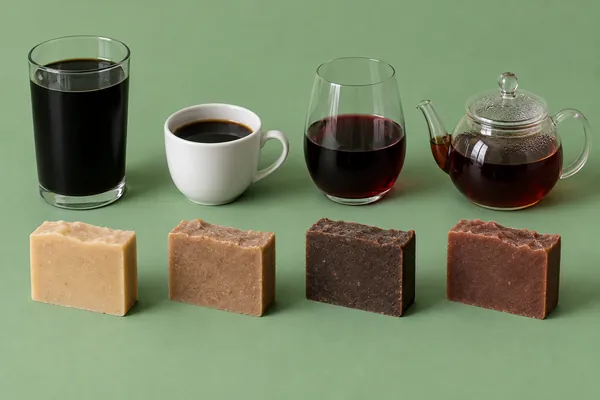
Beer, wine, coffee, tea and juice in soap
Using beer, wine, coffee, tea or juice in place of soap's water: how to prepare each one, add the lye safely, and what the calculator does with the liquid.
Where these proportions come from
Adapted from Anne-Marie Faiola's white tea faux funnel pour: her palm-free blend of half olive oil with coconut oil, canola and a little shea butter, frozen white tea as all of the liquid, and white and green batter squeezed in turn into random centres in a slab, with no dividers. We soap it at our 5 % superfat and a 30 % lye solution, keep it out of gel, and cut her eucalyptus from 4.5 % of the oils to 2.5 %.
Formulation adapted from Pure Soapmaking by Anne-Marie Faiola (Storey Publishing, 2016). The method and notes are ours.