In short
- Water as a percentage of oils, lye concentration and water-to-lye ratio are three ways of writing one quantity. Concentration is the one that means the same thing in every recipe.
- Less water traces faster, runs hotter, unmoulds firmer and reaches a given hardness weeks sooner. More water gives working time for swirls, but olive-rich batter can separate.
- The floor is set by solubility: sodium hydroxide saturates at about 52 % at 20 °C, and a 50 % solution starts to crystallise below about 12 °C (54 °F).
- A master batch is the same soap weighed differently. The calculator works out how much solution to weigh and how much plain water to add.
On this page
- One amount of water, three ways to write it
- Why concentration is the better control
- What more water and less water do
- Trace and separation
- Firmness, cure and shrinkage
- Ash, rivers and bars that won’t set
- How far can you discount the water?
- Master batching
- Liquids other than water
- Choosing a concentration
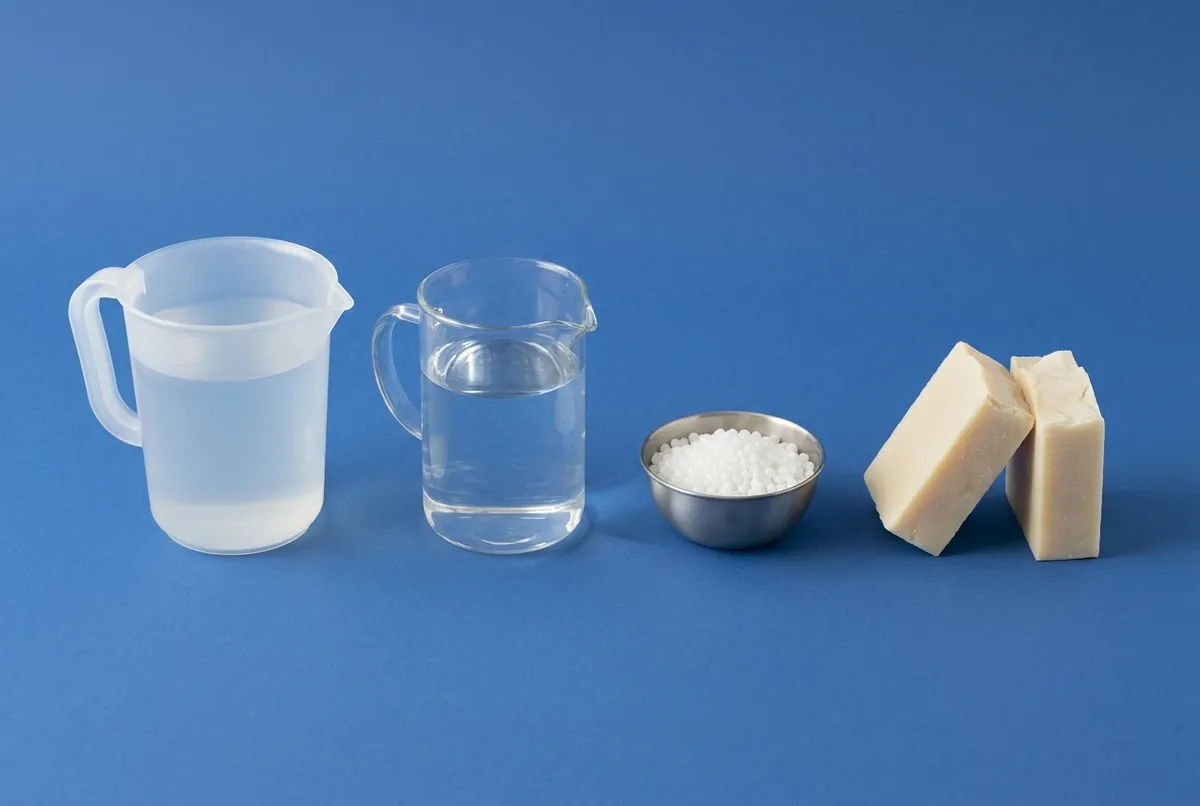
Water takes no part in saponification. It dissolves the lye so the lye can reach the oils, and most of it then leaves the bar during cure. Kevin Dunn made the point that this is why a “water discount” has nothing to discount from: lye has a chemically correct amount for a given set of oils, water does not. What water has instead is effects. It changes how fast the batter traces, how firm the loaf is the next day, how long the bars take to cure and how much they shrink. This guide covers those effects, the physical limit on how little water you can use, and master batching.
One amount of water, three ways to write it
Makers state water in three ways, and all three describe the same grams:
- Water as a percentage of oils: 1000 g of oils at 38 % means 380 g of water.
- Lye concentration: the lye as a share of the lye solution, lye ÷ (lye + water). A 33 % solution is 33 g of lye in every 100 g of solution.
- Water-to-lye ratio: 2 : 1 means twice the lye’s weight in water.
Concentration and ratio convert directly, because both are about the lye alone: a ratio of r to 1 is a concentration of 100 ÷ (1 + r) %. Percentage of oils needs the recipe, because it depends on how much lye the oils need. For 1000 g of 40 % olive, 30 % coconut and 30 % palm oil at a 5 % superfat, the calculator asks for 144.1 g of sodium hydroxide, and at a 33 % solution for 292.6 g of water, which is 29.3 % of the oils and a ratio of 2.03 : 1. The calculator shows all three side by side, whichever one you typed.
| Lye concentration | Water : lye | Water per 100 g of NaOH | Water as % of oils, 40/30/30 bar |
|---|---|---|---|
| 25 % | 3 : 1 | 300 g | 43.2 % |
| 27 % | 2.7 : 1 | 270 g | 39.0 % |
| 30 % | 2.33 : 1 | 233 g | 33.6 % |
| 33 % | 2.03 : 1 | 203 g | 29.3 % |
| 35 % | 1.86 : 1 | 186 g | 26.8 % |
| 40 % | 1.5 : 1 | 150 g | 21.6 % |
| 50 % | 1 : 1 | 100 g | 14.4 % |
The last column is 1000 g of 40 % olive, 30 % coconut and 30 % palm oil at a 5 % superfat (144.1 g of sodium hydroxide), from our calculator.
Why concentration is the better control
Water as a percentage of oils drifts with the recipe. The old default of 38 % of oils gives a 25.3 % lye solution for a pure olive oil soap, 27.5 % for the 40/30/30 bar and 31.4 % for a pure coconut soap, all at a 5 % superfat, because coconut oil needs about 35 % more lye than olive oil, dissolved in the same 380 g of water. Concentration describes what the lye actually dissolves in, so 33 % behaves much the same in any recipe.
The conventions have a history. Dunn surveyed four books: Ann Bramson’s recipes of 1972 work out at 25 to 27 %, Susan Cavitch’s of 1997 mostly at exactly 27 %, Robert McDaniel’s of 2000 at 33 to 38 %, and Anne Watson’s 2007 edition at 30 to 37 %, averaging 33 %. He suggests the early books’ 26 to 27 % is where calculators got the idea of a standard amount of water. Cavitch’s earlier Natural Soap Book (1995) fits the pattern: her bars take 3 lb of water to about 8 lb of oils, some 37.5 % of the oils, which for her base bar is about a 26 % solution. The “full water” default of 38 % of oils lands in the same place for a typical recipe, and it is a habit of the craft. Our calculator starts at 33 %.
A “water discount” usually means using some percentage less water than a calculator’s default, which makes it ambiguous: 10 % off 38 % of oils is 34.2 % of oils, which for the 40/30/30 bar is a 29.6 % solution, and something different for every other recipe. When you share a recipe, give the concentration.
What more water and less water do
The clearest evidence is Dunn’s 2008 study for the Handcrafted Soapmakers Guild. He made the same soaps three times, differing only in water, at 50 %, 33.3 % and 25 % lye concentration: palm, coconut and olive oil soaps and a four-oil blend. The batter was mixed by shaking it in a bottle, and every bar was held at 60 °C (140 °F) for four hours to finish saponifying. He then followed moisture, hardness and free alkali for 60 days.
Trace and separation
Less water traced faster, which matches what Watson and Faiola report from the craft: a water discount shortens your working time, so more water is the usual choice for intricate swirls and for fragrances known to speed trace. Batter that thickens in the first minute and then separates is something else: false trace. Watson puts it down to melted fat starting to set as the batter cools below its working range; the strength of the lye solution does not cause it.
More water has a limit that matters for safety. Dunn’s pure olive oil soaps at 33.3 % and 25 % would not trace in his setup, and when he moulded them anyway they separated: a chalky, lye-heavy layer settled to the bottom and unsaponified oil rose to the top. His four-oil blend, 39 % of it olive, showed noticeable separation at 25 % as well. A stick blender brings olive oil to trace faster than his shaken bottles did, but the lesson stands: slow, olive-rich recipes are the ones where a lot of water can leave you with bars that are part soap and part lye.
Firmness, cure and shrinkage
Low-water bars came out of the mould firmer and drier. At unmoulding the palm soaps held 111, 200 and 273 parts per thousand of water at 50, 33.3 and 25 %. The two wetter palm soaps took 14 and 31 days to dry to the moisture the low-water one started with, and the coconut soaps took 25 and 46 days. Dunn’s rule of thumb from palm oil was about two weeks of cure saved at each step down in water. The gap narrows with time. By 60 days all three palm soaps were very hard, though the wetter coconut soaps were still noticeably softer, and Dunn’s conclusion was that low-water and high-water bars head for the same hardness in the end: less water gets you there sooner.
Water that leaves is weight that leaves, which is the shrinkage and warping makers see on high-water bars. From Dunn’s moisture figures, the wettest palm soap lost about a fifth of its weight over the 60 days and the driest about 6 %.
A firmer bar at 24 hours helps with cavity moulds, as Dunn notes, and Faiola lists a 5 to 15 % water discount alongside sodium lactate and freezing as ways to get soap out of a stubborn silicone mould.
Ash, rivers and bars that won’t set
Soda ash forms where unreacted lye at the surface meets carbon dioxide in the air, and Faiola’s list of ways to reduce it includes using 5 to 10 % less water. Glycerin rivers, the translucent veins in coloured soap, come from the soap running hot and show most with titanium dioxide or oxides in it; Soap Queen adds that high water makes them likelier. Wet batches also stay soft longer: Dunn’s highest-water coconut soap took 52 days to reach the hardness his low-water one had at unmoulding. The soda ash, glycerin rivers and soft soap guides go into each, and the gel phase guide covers how water changes the way a loaf heats up and gels.
| More water (weaker solution) | Less water (stronger solution) | |
|---|---|---|
| Trace | Slower, more time for designs | Faster, less time |
| Separation | Olive-rich batter can separate | More resistant |
| At unmoulding | Softer | Firmer, easier from cavity moulds |
| Cure to a given hardness | Weeks longer | Weeks shorter |
| Weight lost in cure | More | Less |
| Soda ash and glycerin rivers | More likely | Less likely |
| Dissolving the lye | Easy | Slower and hotter, with more fumes |
| After a full cure | Much the same bar | Much the same bar |
Summarised from Dunn’s 2008 study, Watson, Faiola and Soap Queen. The last row is Dunn’s conclusion that the bars converge.
How far can you discount the water?
The floor is set by how much lye water can hold. Sodium hydroxide saturates at about 52 % by weight at 20 °C, which is 108 g of it in 100 g of water (the International Chemical Safety Card gives 109 g per 100 mL). Below that much water, some of the lye cannot dissolve, and solid lye stirred into batter leaves caustic grains in the bars. The calculator checks this whenever you weigh the lye dry: if the water going in with the lye is less than the lye’s weight divided by 1.08, it shows a danger warning. For the 40/30/30 bar’s 144.1 g of sodium hydroxide, that minimum is 133.4 g of water, a ratio of about 0.93 : 1.
In practice the floor is a 50 % solution, 1 : 1 by weight, and even that sits close to the edge: OxyChem’s handbook gives 12 °C (54 °F) as the temperature at which 50 % caustic soda begins to crystallise, and Dow’s gives about 15 °C (60 °F). A 50 % solution is fine in a warm room and not in a cold garage.
You may read that lye will not dissolve in less than 1.5 parts of water. It will: 1.5 : 1 is a 40 % solution, comfortably inside what water holds at room temperature. Letcavage and Buck, who base the recipes in their beginner’s book on 2.5 parts of water (a 28.6 % solution), put the floor at 2 parts, “or you may end up with undissolved pockets of lye in your soap”. Both floors are cautious: at 20 °C, water dissolves more than its own weight of lye. Dunn made sound soap at 50 % and found nothing dangerous about low-water soap, and suggests that makers can experiment down to that concentration with small batches. Trace comes very fast up there, though. The recipes in his survey all sit between 25 and 38 %, and our calculator marks solutions above 40 % as strong and below 25 % as dilute.
Stronger solutions are also hotter to make. Dissolving sodium hydroxide gives off heat, and with less water to absorb it the solution climbs higher. The heat guide puts numbers on the lye solution’s temperature; the practical rule is to add strong lye slowly, stirring, in a heat-safe container.
Master batching
A master batch is lye dissolved ahead of time at a known strength, usually 50 %: equal weights of sodium hydroxide and distilled water. It saves waiting for a fresh solution to cool, and the dry lye is opened far less often. Dunn made all the soaps in his water study from one 50 % stock.
The soap does not change. The calculator still works out the recipe’s lye and water, then splits them: the master batch to weigh is the lye ÷ (strength ÷ 100), and the extra water is the recipe’s plain water minus the water already in the solution. For the 40/30/30 bar at a 33 % solution, that is 288.2 g of 50 % master batch, holding 144.1 g of sodium hydroxide and 144.1 g of water, plus 148.5 g of extra water. In the Lye section, choose Master batch under Weigh the lye as and enter the strength; the recipe then lists the solution and the extra water. If your stock is weaker than the recipe’s own concentration it says so, because no amount of extra water can fix that. With dual lye the master batch holds the sodium hydroxide and the potassium hydroxide is weighed dry.
Weigh it from a master batch. The 40/30/30 bar at a 33 % solution becomes 288.2 g of 50 % master batch and 148.5 g of extra water.
Open it in the calculator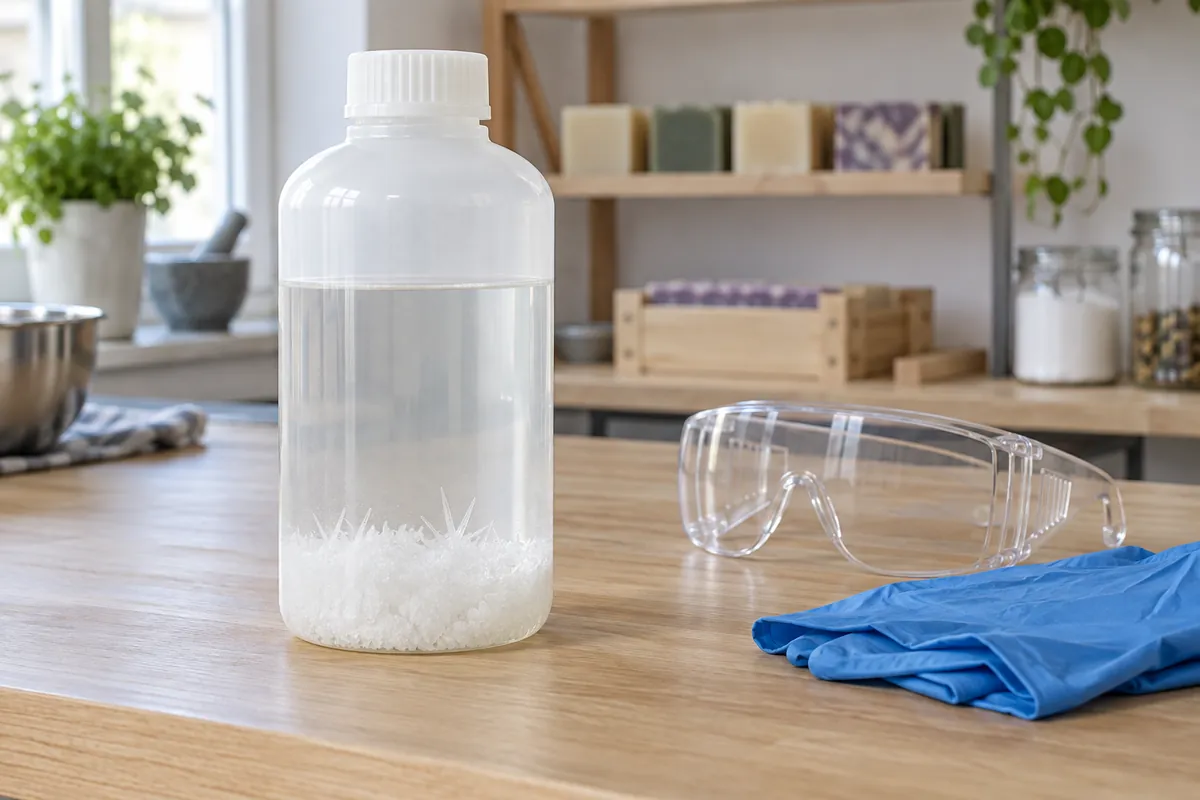 A 50 % master batch that has been kept too cold. The liquid above the crystals is no longer 50 %, so it cannot be weighed until it is warmed and fully dissolved again.
Liquids other than water
Milk, beer, coffee, tea and juices can replace some or all of the water. The calculator counts the water they carry, so whole milk, which is about 88 % water, supplies 88 g of the recipe’s water per 100 g, and it shows only the plain water still needed. Milk’s fat is counted too, as extra superfat. Replace all the water in the 40/30/30 bar with 332 g of whole milk dissolved with the lye, and the effective superfat rises from 5 % to about 6 %. Our goat milk, oat and honey bar works that way, with the milk frozen in cubes so the lye does not scorch it.
When the liquid goes in matters as much as how much. The lye dissolves only in the liquid that goes in with it, so a liquid held back until trace leaves the lye solution stronger than the recipe’s concentration. Replace half the water in the 40/30/30 bar with milk added at trace and the lye dissolves in 146.3 g of water, a 49.6 % solution; the calculator warns that it runs hot and strong. Hold all of the liquid back and it warns that the lye cannot dissolve at all. Our buttermilk and honey bar holds back about 40 % of its liquid as buttermilk on purpose, so its lye starts in a stronger solution than the 27 % the whole recipe works out at. Anne-Marie Faiola’s Pure Soapmaking does the same in several recipes: the total liquid stays near a third of the oils’ weight, and half of it goes in at thin trace as warm milk, brewed tea or purée. In her buttermilk soap that leaves the lye in about a 45 % solution. As she points out, this is not a water discount: the same water goes in by the end, so none of a discount’s benefits, a harder bar and a faster cure, follow.
See the lye solution as mixed. Half the water as milk at trace leaves the lye in a 49.6 % solution, and the calculator says so.
Open it in the calculatorHow each liquid behaves once lye meets it, from scorched milk to foaming beer, is in the liquids guide and the milk soap guide.
Choosing a concentration
Start at 33 %: it traces at a pace a beginner can manage and cures in a reasonable time. Move towards 28 to 30 % when a design needs time or a fragrance is known to accelerate, unless the recipe is mostly olive oil; our high-olive bastile bar goes the other way, to 35 %, to help a soft soap set. Move towards 35 to 40 % for firmer unmoulding from cavity moulds, less soda ash and a shorter cure, accepting faster trace. Whatever you choose, write it down as a concentration, and let the calculator turn it into grams.
Recipes to try
All recipesSources
- The "Water Discount" . Kevin M. Dunn, The Handcrafted SoapMaker (Handcrafted Soapmakers Guild), issue 2008-2 , 2008. Identical soaps at 50, 33.3 and 25 % lye concentration, followed for moisture, hardness and free alkali over 60 days; survey of lye concentrations in four books.
- OECD SIDS Initial Assessment Report: Sodium hydroxide (SIAM 14) . OECD / UNEP , 2002. Solidifies at 20 °C above 52 % by weight, the maximum solubility; dissolution strongly exothermic.
- International Chemical Safety Card 0360: Sodium hydroxide . ILO / WHO , 2010. Solubility 109 g per 100 mL of water at 20 °C.
- Caustic Soda Handbook . Occidental Chemical Corporation (OxyChem) . 50 % caustic soda begins to crystallise at 54 °F (12 °C).
- Caustic Soda Solution Handbook (Form No. 102-00011) . The Dow Chemical Company , 2004. 50 % solution begins to freeze at about 60 °F (15 °C); freezing changes the concentration of solid and liquid; always add caustic solution to water, never water to caustic.
- Enthalpy of Solution of Electrolytes . CRC Handbook of Chemistry and Physics (after Parker, NSRDS-NBS 2, 1965) . NaOH −44.51 kJ/mol and KOH −57.61 kJ/mol at infinite dilution, 25 °C.
- OECD SIDS Initial Assessment Report: Potassium hydroxide (SIAM 13) . OECD / UNEP , 2001. Water solubility 1120 g/L at 20 °C.
- Little White Lyes (Handcrafted Soap and Cosmetic Guild conference) . Kevin M. Dunn , 2015. Caustic soda absorbs water and carbon dioxide; sodium carbonate does not dissolve in 50 % lye.
- Smart Soapmaking . Anne L. Watson, Shepard Publications , 2013.
- Soap Crafting . Anne-Marie Faiola, Storey Publishing , 2013.
- Pure Soapmaking . Anne-Marie Faiola, Storey Publishing , 2016. Total liquid about a third of the oils, half of it added at thin trace as milk, tea or purée; the buttermilk soap's lye dissolved in an equal weight of water and a little more; water held back for a later addition brings none of a water discount's benefits.
- The Natural Soap Book . Susan Miller Cavitch, Storey Publishing , 1995. Bars made with 3 lb of water (or water and milk) to about 8 lb of oils.
- Basic Soap Making . Elizabeth Letcavage and Patsy Buck, Stackpole Books , 2009. Water at 2.5 times the lye as the book's rule, never below 2 times for fear of undissolved lye; two of its own recipes go below that floor.
- Explaining and Preventing Glycerin Rivers . Soap Queen (Bramble Berry) . Secondary source for craft practice: excess water and heat make glycerin rivers likelier.
- Milk, whole, 3.25 % milkfat (FDC 171265) . USDA FoodData Central .