Liquid castile soap
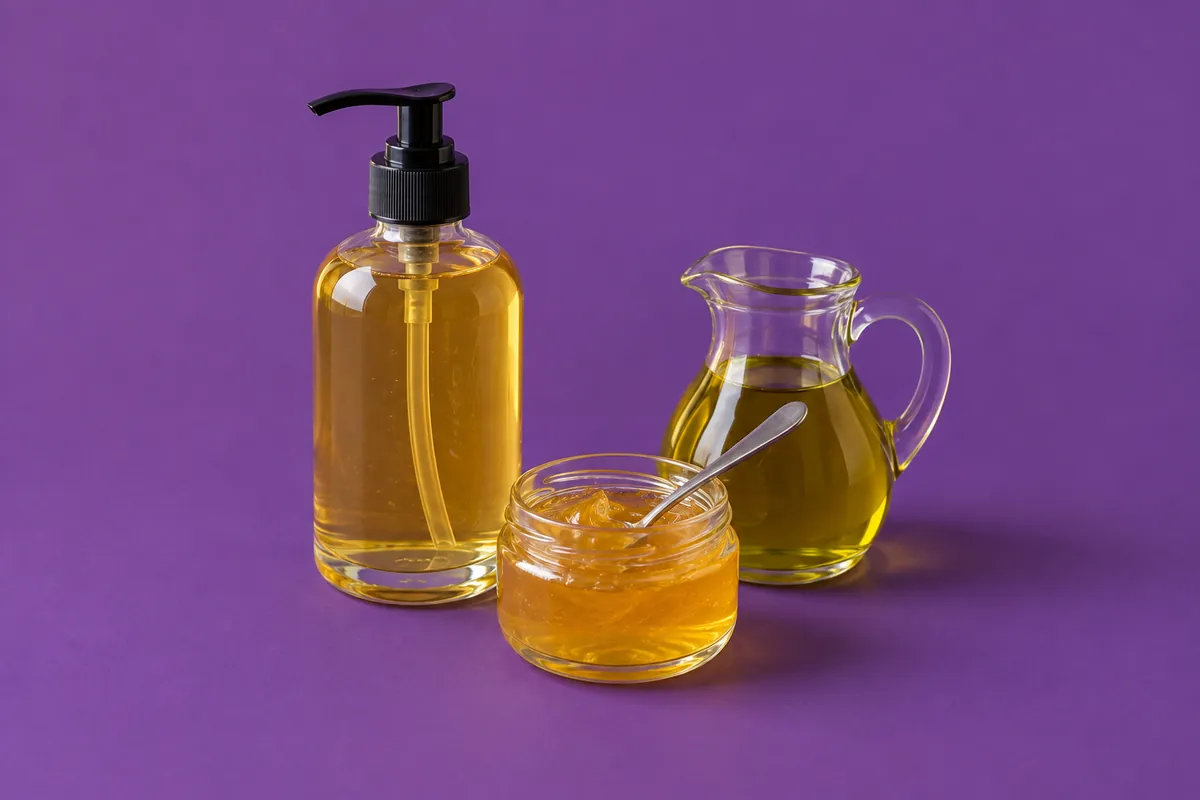
True liquid castile: olive oil and nothing else, cooked with potassium hydroxide into a golden paste and diluted to a mild, low-foaming soap that a little salt thickens. The paste keeps in a closed jar, so you dilute only what you will use.
- Skill
- Advanced
- Method
- Hot process
- Batch
- 500 g of oils about 907 g of batter
- Hands-on
- 1 h 30 min
- Cure
- 2 weeks
- Gel phase
- In the pot it gels as it cooks
What you need
For 500 g of oils, which fills three 1-litre pump bottles once diluted. Weigh everything, liquids included.
| Olive Oil · 100.0 % | 500 g | 17.64 oz |
| Potassium hydroxide (KOH) · the lye, 90 % pure; if your label says otherwise, weigh 107.9 g at 85 % or 96.5 g at 95 % | 101.9 g | 3.59 oz |
| Distilled water · for a 25 % lye solution | 305.6 g | 10.78 oz |
| Boiling distilled water for the clarity test · for each 28 g spoonful of paste you test | 59 ml | |
| Distilled water to dilute the paste · 2959 g less the weight of your cooked paste: at least this much, and more for every gram of steam the cook drove off; boiling hot | 2052 g | 72.38 oz |
| Table salt, to thicken (optional) · dissolved in the 80 g of hot distilled water below and added a gram of solution at a time | 20 g | 0.71 oz |
| Hot distilled water for the salt solution · only if you thicken with salt | 80 g | 2.82 oz |
- Superfat
- 3.5 %
- Temperatures
- Lye solution cooled below 82 °C (180 °F), oil at 65 to 71 °C (150 to 160 °F), cooked on low
Method
-
Get ready
Put on sealed goggles, nitrile gloves and long sleeves, and keep them on until the paste is cooked. Weigh 500 g of olive oil into a slow cooker of 3.5 litres or more, 305.6 g of distilled water into a heat-proof jug and 101.9 g of potassium hydroxide flakes into a dry container, then close the flake tub at once: it pulls water from the air. -
Make the lye solution
At an open window, add the flakes to the water a little at a time, stirring, never the water to the flakes. Potassium hydroxide fizzes loudly and gets hotter than sodium hydroxide as it dissolves; let the solution cool below 82 °C (180 °F), and keep it away from aluminium, tin and zinc, which it attacks, giving off hydrogen. -
Warm the oil
Heat the olive oil in the slow cooker on low to 65 to 71 °C (150 to 160 °F). -
Blend to a stiff paste
Pour the lye solution into the oil and stick blend in bursts of a minute or two, stirring between them. The batter thickens, separates and thins, then comes back like thick apple sauce, sometimes several times; keep going until it sets into a stiff, opaque paste that stretches like taffy and the blender can barely move, which with olive oil alone takes at least half an hour. -
Cover and cook
Put the lid on and leave the cooker on low. Check after 15 to 20 minutes and again 15 to 20 minutes later, stirring back any liquid that has separated, then stir every 30 to 45 minutes. -
Cook until translucent
Over 2 to 3 hours the paste turns golden and translucent from the edges inwards. It is ready to test when no opaque, creamy patches come up as you fold it over. -
Test a spoonful in boiling water
Stir 28 g (1 oz) of paste into 59 ml (2 fl oz) of boiling water until it dissolves, and let it cool. Clear or faintly hazy means the paste is done; milky, or with an oily film on top, means another hour of cooking and a second test. -
Weigh the paste
Turn off the cooker, let the paste cool and weigh all of it. It will weigh less than the 907.4 g that went in, because steam left the pot, and the dilution needs the real figure. -
Work out the water
The paste holds 591.7 g of soap: the 500 g of oil plus the 91.7 g of pure potassium hydroxide in 101.9 g of 90 % flakes. At 20 % soap that makes 2959 g of liquid soap however much steam the cook drove off, so the water to add is 2959 g minus your paste's weight, about 2.26 g for every gram of paste if it lost none; the liquid soap dilution calculator does the same sum. -
Dilute it overnight
Break the paste into a large pot or jar and pour on all but the last 200 g of that water, boiling hot. Stir gently without whipping up foam, cover it and leave it overnight; the next day, at room temperature, add the rest only if it is still thicker than you want. -
Thicken it with salt if you like
Olive oil soap thickens well with salt. Dissolve 20 g of table salt in 80 g of hot distilled water, stir 1 g of this into a 100 g sample and wait an hour, repeating until a dose stops helping; then give the batch the same amount per 100 g, since past its peak more salt thins it again. -
Settle and bottle
Leave the soap covered for a week or two so any haze sinks, then pour the clear soap off the sediment into washed and dried pump bottles. -
Keep it clean
Diluted, this is four-fifths water, and it can grow bacteria and mould once they get in: never top up a half-empty bottle, and keep the rest as paste in a closed jar, diluting a little at a time. To keep diluted soap for long, or to sell it, it needs a preservative that works at pH 9 to 10, and soap for sale needs a challenge test as well.
Tips
- The lye assumes potassium hydroxide flakes of 90 % purity, the usual label figure. If your label says otherwise, enter it in the calculator before you weigh: flakes purer than the figure you used make the paste lye-heavy.
- Leave out the borax and citric acid that older recipes stir in. With this superfat there is no spare lye for them to neutralise; borax is prohibited in cosmetics in the EU and UK, and citric acid turns soap back into fatty acid, which clouds it.
- To scent it, stir half a teaspoon of essential oil into 85 g of warm soap first and wait half an hour, because some oils thin or cloud liquid soap. If the sample stays clear, use 0.5 to 1 % of the diluted soap's weight.
- Use distilled water for the paste and the dilution. Minerals in tap water form insoluble soaps that show as haze and sediment.
The oils
| Oil | Share |
|---|---|
| Olive Oil (virgin / refined / olive oil) | 100.0 % |
How it is made
| Process | Hot process |
| Alkali | KOH |
| Superfat | 3.5 % |
| Water | lye water at 25 % |
| Iodine value | 85 |
| INS | 106 |
Why make it
Olive oil alone makes one of the gentlest soaps there is: cleansing 0 and conditioning 82 on our scale, with a low, creamy lather rather than big bubbles. Castile is the old name for hard olive oil soap from Spain and the Mediterranean, long valued by tradition as a mild soap; the liquid form, made with potassium hydroxide, is what many people now keep for hands, body and cleaning round the house. Like any true soap it is alkaline, most bar soaps testing at pH 9 to 10 (Tarun et al.), so some people with dry or sensitive skin still find it drying and prefer a syndet. The honest catches are practical. It takes an afternoon to cook and a week to settle, and once diluted it is four-fifths water: refilled soap dispensers have been shown to grow bacteria and pass them to hands (Zapka et al.), so dilute a little at a time.
Sources
- Soap · Encyclopaedia Britannica, 11th edition, via Wikisource, 1911
- Evaluation of pH of Bathing Soaps and Shampoos for Skin and Hair Care · Tarun J. et al., Indian Journal of Dermatology 59(5):442–444, 2014
- Bacterial hand contamination and transfer after use of contaminated bulk-soap-refillable dispensers · Zapka C. A. et al., Applied and Environmental Microbiology 77(9), 2011
What tradition, makers' experience and research say about soaps like this, each labelled for what it is. It is not medical advice, and no soap treats a skin condition: if you have one, ask a doctor or pharmacist.
What the numbers say
- Palmitic acid 13.8 %
- Stearic acid 2.8 %
- Oleic acid 69.0 %
- Linoleic acid 12.3 %
- Other 2.6 %
Saturated : unsaturated 17 : 83
Computed from the fatty acids of the fats above. The bands are what the craft has settled on, not chemistry — a bar outside one is not wrong.
From the guides
All guides
Liquid soap from potassium hydroxide paste
Real liquid soap from scratch: a potassium hydroxide paste cooked until it dissolves clear, diluted by weight, thickened with salt and kept free of microbes.
Castile soap: pure olive oil, and why it's worth the wait
What castile soap really is, why pure olive oil traces slowly and starts soft and slippery, how long to cure it, and a recipe with the calculator's numbers.
Sodium hydroxide, potassium hydroxide and dual lye explained
Why NaOH makes bars and KOH makes soft soap, converting between them, KOH purity, dual-lye recipes, and the calculator slip that turns a bar caustic.
Where these proportions come from
The castile tradition fixes the oil: olive oil and nothing else, here saponified with potassium hydroxide so it stays liquid. The superfat is 3.5 %, half a point above the usual 0 to 3 % for liquid soap, because olive oil's published saponification range is wide enough that at 3 % the worst case just tips into spare lye. The paste method, its 25 % lye solution, the boiling-water test and the dilution by weight follow the liquid soap chapter of David Fisher's Complete Photo Guide to Soap Making, as our liquid soap guide does.