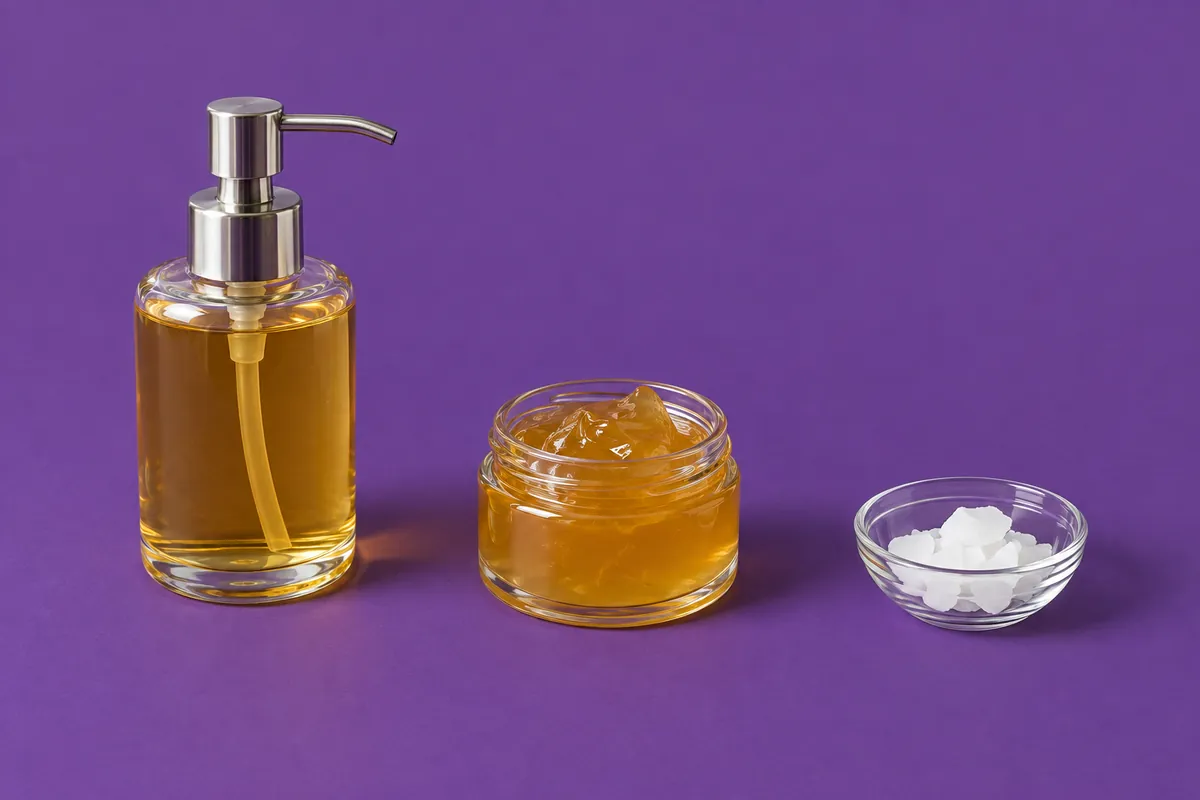
In short
- Liquid soap is a potassium soap. Potassium salts of fatty acids stay dissolved in water, where sodium ones set into bars or lumpy gels.
- Enter your potassium hydroxide's real purity, usually about 90 %, and keep the superfat low. Free oil does not dissolve in the finished soap; it clouds it.
- Cook the paste until a spoonful dissolves clear in boiling water, weigh it, then dilute by weight: 15 to 25 % soap suits a pump bottle.
- Borax and citric acid only neutralise lye that is really there. In a well-calculated paste, borax adds a salt that is banned in EU and UK cosmetics, and citric acid turns soap back into fatty acid.
- Diluted soap is mostly water. Use distilled water, clean bottles and small batches, and a preservative that works at pH 9 to 10 if you sell it.
On this page
- Why liquid soap needs potassium
- Two numbers that differ from a bar recipe
- Potassium hydroxide purity
- Superfat
- Making the paste
- Diluting: how much water
- Why it clouds, and how to clear it
- Neutralising: what borax and citric acid really do
- Soap cannot be made neutral
- Borax
- Citric acid
- When it is worth doing
- Thickening
- Keeping diluted soap clean
- Grating a bar into water is not the same thing
Liquid soap is true soap made with potassium hydroxide rather than sodium hydroxide, cooked into a stiff paste and then dissolved in water. It takes more patience than a bar and exact numbers twice over: once for the lye, and once for the dilution, because the finished soap is mostly water. This guide gives the method with a worked batch, explains what the dilution calculator does, and looks hard at the step most recipes add without saying why: neutralising.
Why liquid soap needs potassium
A soap molecule is the same fatty-acid chain whichever alkali made it; only the partner changes. Sodium soaps crystallise as they cool, which is how a bar sets. Potassium soaps are far more soluble, so a potassium soap dissolves into a clear liquid and stays that way at room temperature. Thomssen’s 1922 soap-making manual describes liquid soap as nothing more than a potash soap dissolved in water, and that is still the whole definition. The NaOH, KOH and dual lye guide sets the two alkalis side by side.
The oils behave much as they do in a bar, with one extra question: how thick the soap will be, and whether it can be made thicker.
- Coconut oil and the other lauric oils lather fast and dissolve very clear, but they give a thin soap that salt hardly thickens.
- Olive, high-oleic sunflower and other oleic-rich oils lather less and give a milder, thicker soap that thickens readily with salt.
- Castor oil makes a very clear soap that still thickens with salt.
- Palm, tallow, cocoa butter and other fats rich in palmitic and stearic acid make a hazy soap, because their potassium soaps crystallise as it cools. Thomssen ruled tallow out of clear liquid soap for that reason.
Fisher puts the choice as lather against body: mostly coconut oil for a foaming dispenser, mostly liquid oils for a soap that pours like the commercial kind. The three recipes below sit between the two. Two more are written out in full with a method: our coconut liquid hand soap, half coconut, and our liquid castile, all olive.
| Recipe | Oils, % of the fats | Oleic acid in the fats |
|---|---|---|
| Liquid hand soap | coconut 40, olive 40, castor 20 | 31 % |
| Liquid body wash | coconut 30, olive 45, castor 15, high-oleic sunflower 10 | 42 % |
| Liquid shampoo | coconut 30, olive 35, castor 20, avocado 10, jojoba 5 | 34 % |
Oleic acid from the calculator’s fatty-acid profile of each recipe. Classic Bells finds that salt thickens a liquid soap well only when roughly half its fatty acids are oleic, so of these the body wash is the likeliest to thicken with salt.
Two numbers that differ from a bar recipe
Potassium hydroxide purity
Sodium hydroxide is sold close to pure. Potassium hydroxide is not: the OECD’s assessment gives the industrial product as about 91 % KOH and 8 % water, and flakes are usually labelled 90 %. The calculator assumes 90 % unless you change it, and divides the pure requirement by 0.9 to give the weight of flakes. Leave the setting at 100 % with 90 % flakes and the paste is a tenth short of lye: greasy, cloudy and slow to trace. A recipe that does not state its purity is only half written. Grosso’s liquid soap in The Everything Soapmaking Book weighs 177 g (6.25 oz) of potassium hydroxide for 766 g (27 oz) of coconut, castor and jojoba oil: a 3.1 % superfat in our calculator if the flakes are pure, 12.8 % with ordinary 90 % flakes, far more free oil than a clear soap can carry. Enter the figure on your label, and keep the tub shut. Potassium hydroxide pulls water and carbon dioxide from the air, so a tub left open weighs heavier than the lye in it.
Superfat
A bar carries a few percent of unreacted oil as a cushion. In liquid soap that oil has nowhere to go: it does not dissolve in the soap solution, so it shows as haze or as a film on top. Liquid soap is therefore made at a superfat of 0 to 3 %. With potassium hydroxide, the calculator adds a note between 3 and 4 % and a warning above 4 %. The superfat guide covers where that convention comes from.
Why not always 0 %? Because the lye figure is only as good as the saponification values behind it, and real oils vary within their published ranges. Made at 0 %, our liquid body wash could be anywhere from 3.1 % lye-heavy to 2.9 % oil-rich, by the calculator’s range check. At 3 % the worst case is still a hair below zero, and the calculator flags it. At 3.5 %, half a point above the usual range, the worst case is 0.5 % and the best 6.3 %: the recipe can no longer come out lye-heavy, which is what makes neutralising unnecessary. That is why the body wash page, the worked batch and our two written-out liquid soaps all use 3.5 %, and the calculator’s note is the price of that margin.
Run the worked batch. 500 g of oils for the liquid body wash at a 3.5 % superfat take 111.6 g of 90 % potassium hydroxide in 334.7 g of water.
Open it in the calculatorThe water in that link is three times the weight of the potassium hydroxide, a 25 % solution, the same proportion as Fisher’s paste. The recipe pages in the table above give the paste more water, as much as the weight of the oils, which makes a softer paste that is slower to trace. Either works, because the dilution step accounts for whatever water the paste holds.
Making the paste
A potassium soap does not trace like a bar. The batter thickens, then thins and separates, then comes back looking like mashed potato or thick apple sauce, sometimes several times, before it finally sets into a stiff, opaque paste that stretches like pulled taffy and that the blender can barely move. That is liquid soap’s trace, and it is where the cooking starts. Grosso describes the batter as milky and opaque from the start yet thin, until it thickens all of a sudden, big bubbles rising as it firms, so watch the blender. Use a pot four to five times the volume of the batch: coconut-rich potash soap swells as it saponifies, and Thomssen sized his kettles that way for the same reason.
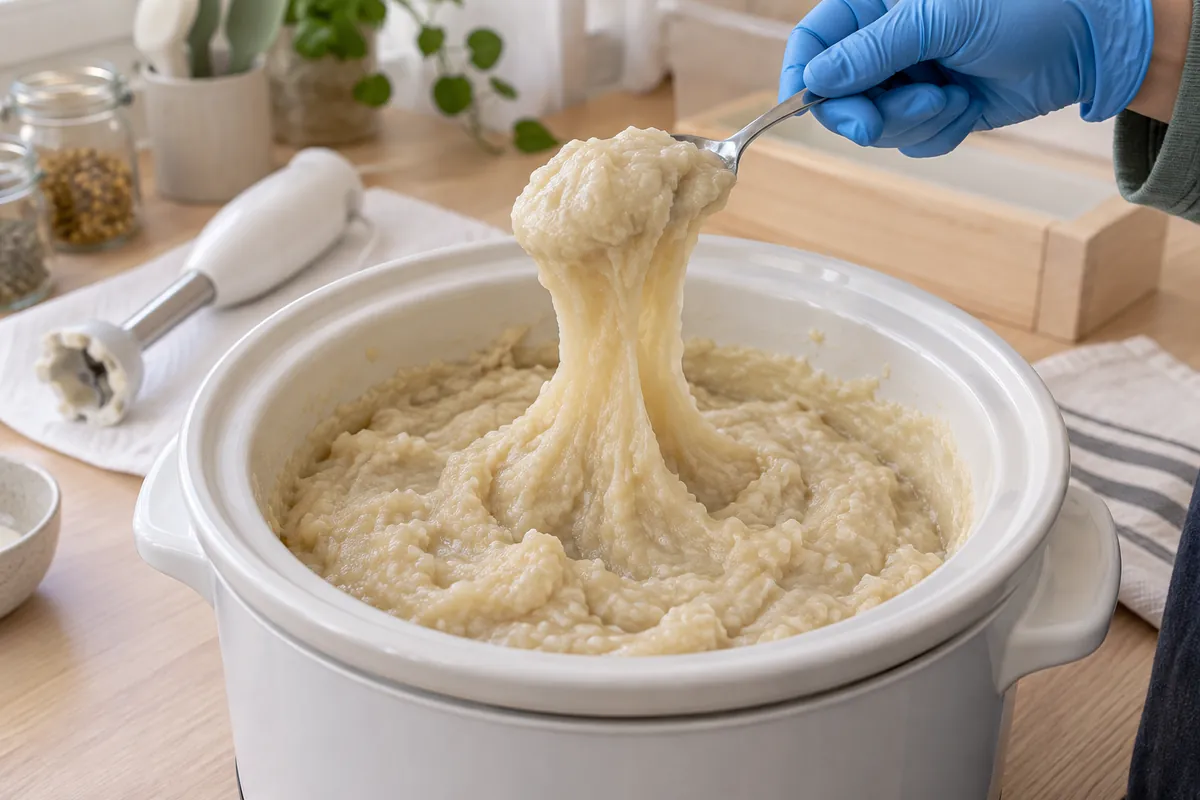 Liquid soap’s trace: a stiff, opaque paste that stretches like taffy. From here it is cooked until it turns translucent.
- Weigh everything. Run the recipe through the calculator with the purity on your potassium hydroxide’s label, then weigh the oils into the slow cooker, the potassium hydroxide into a dry container and the distilled water into a heat-proof jug. For the worked batch that is 150 g of coconut oil, 225 g of olive oil, 75 g of castor oil, 50 g of high-oleic sunflower oil, 111.6 g of potassium hydroxide and 334.7 g of water.
- Make the lye solution. In a ventilated spot, wearing goggles and gloves, add the potassium hydroxide to the water a little at a time and stir until it has dissolved. It gets very hot and sizzles as it goes in. Leave it to cool below 82 °C (180 °F).
- Heat the oils. Warm the oils to 65–71 °C (150–160 °F) in the slow cooker on low.
- Blend to trace. Pour the lye solution into the oils and stick-blend in bursts. Keep going through the false traces and separations until the batter sets into the stiff, opaque, taffy-like paste. Fisher’s paste, made entirely from liquid oils, took 30 to 40 minutes to get there.
- Cook until translucent. Cover the pot and leave it on low. Check it after 15 to 20 minutes and again 15 to 20 minutes later, stirring back any liquid that has separated, then stir every 30 to 45 minutes. The paste turns golden and translucent; Fisher’s took 2 to 3 hours to become translucent right through.
- Test it in boiling water. Stir 28 g (1 oz) of paste into 59 ml (2 fl oz) of boiling water and let it cool. Clear or faintly hazy means the paste is done. Milky, or with a film floating on top, means another hour of cooking and a second test. A paste that stays milky after that probably had more oil than its lye could take; it is still soap, but it will dilute cloudy.
- Weigh the paste. Turn off the heat, let the paste cool and weigh all of it. It will weigh less than the ingredients did, because some water left as steam, and the dilution needs the real figure.
- Dilute it by weight. Work out the water with the dilution calculator, as below. Add most of it hot to the paste, or to the part of the paste you want to use, and break up the lumps gently without whipping up foam. Cover it and leave it for several hours or overnight, and add the rest only if the soap is still too thick once it is back at room temperature.
- Settle, scent and bottle. Leave the diluted soap to stand for a week or two, then pour the clear soap off any sediment. Test a fragrance in a small sample before scenting the batch, and bottle the soap into clean containers.
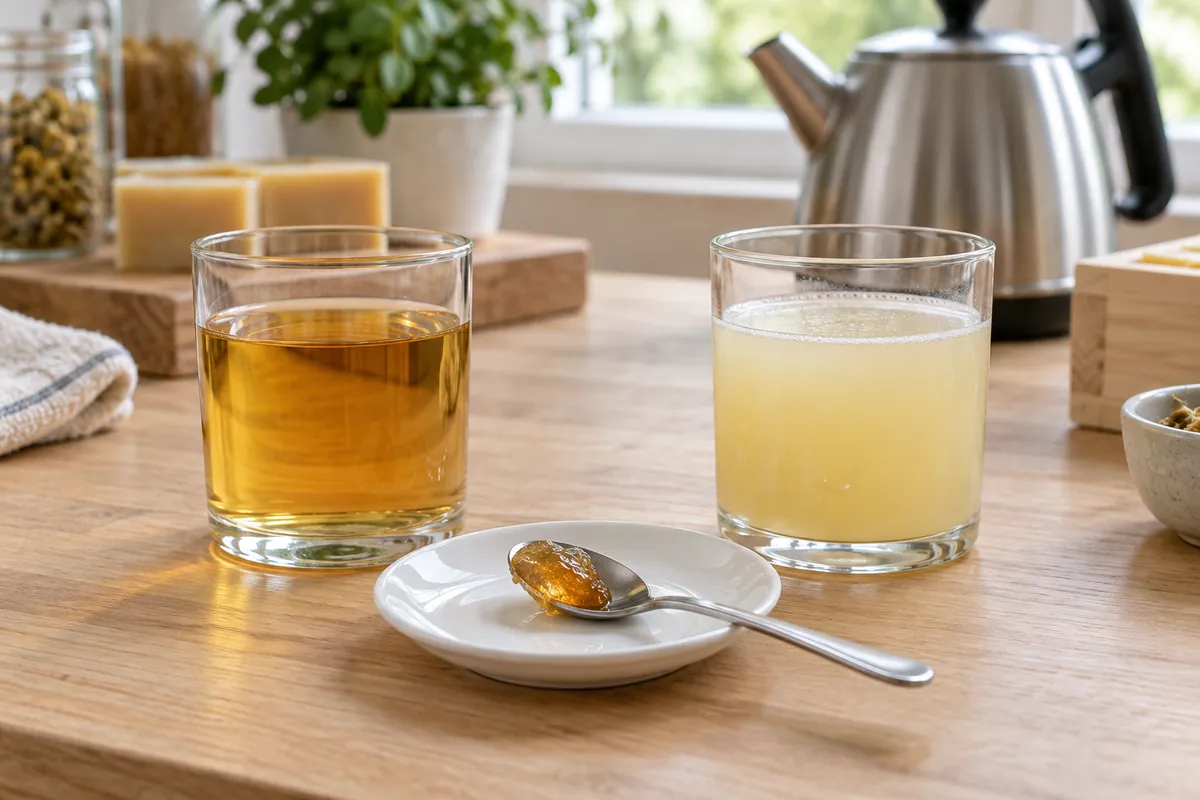 The doneness test. A finished paste dissolves clear or faintly hazy (left); an unfinished one stays milky and needs another hour.
Diluting: how much water
Dilution is where liquid soap recipes stop agreeing with each other, because “one part paste” means nothing until you know how much water the paste already holds. The liquid soap dilution calculator takes four numbers: the weight of your paste after the cook, the oils in the batch, the pure potassium hydroxide, which is the weighed flakes times their purity (111.6 g at 90 % is 100.4 g), and the strength you want. It counts the oils plus the pure potassium hydroxide as soap, because saponification conserves mass: the soap and glycerin weigh what the fat and the hydroxide weighed. Everything else in the paste it treats as water, and it gives you the water to add: the soap divided by the target strength, minus the paste. The liquid soap calculator does both halves in one place: the potassium hydroxide and the paste’s water from the oils, then the water to add once you have weighed the paste, with a check on whether your superfat could come out lye-heavy.
Say the worked batch weighs 920 g once cooked. Its 600.4 g of soap make it a 65 % paste. At 20 % it becomes 3002 g of liquid soap, so it needs 2082 g of water.
| Use | Soap in the finished liquid | Source |
|---|---|---|
| Foaming dispenser | about 10 % | Classic Bells |
| Pump or squeeze bottle | 15 to 25 % | our calculator; Thomssen’s liquid soaps held about 20 % fatty acids |
| Thickened by using less water | 30 to 40 % | Classic Bells, for soaps about half oleic |
Starting points only: the oils decide how thick a given strength turns out.
Add the water hot; boiling is fine. A paste dissolves over hours and looks stubbornly lumpy for most of them, so leave it overnight before deciding it needs more water. Hold back the last tenth, because a soap that ends up too thin cannot be taken back, while one that is a little thick takes a minute to fix. Judge it at room temperature, since liquid soap thickens, and can cloud, as it cools. Use distilled water for the dilution as well as the paste: Thomssen’s point that hard water forms insoluble soaps, which settle out as sediment, still stands. You need not dilute it all at once, either. Paste keeps in a closed jar (Fisher and Grosso refrigerate it), so dilute only what you will use soon.
Grosso dilutes with the paste’s own weight of water, brought to the boil and then simmered uncovered for 15 to 30 minutes, never left, because a covered pan boils over. For her recipe that makes a strong soap, about a third soap by the dilution calculator’s arithmetic, and she finds a foaming dispenser needs it thinner.
Why it clouds, and how to clear it
| What you see | Likely cause | What to do |
|---|---|---|
| Milky right through, and it failed the boiling-water test | An unfinished paste, or more oil than the lye could take: a high superfat, or 100 % purity entered for 90 % flakes | Cook it longer; if it stays milky, the lye was short, so check the purity setting and keep the superfat low next time |
| Clear when warm, hazy when cold, or a sediment in the bottle | Palmitic and stearic soaps crystallising | Let it settle and pour off the clear soap; use fewer hard fats next time |
| Haze or scum that appears with tap water | Calcium and magnesium soaps from hard water | Distilled water, and a chelator in the dilution water (see antioxidants and chelators) |
| Cloud, or sudden thinning, just after scenting | The fragrance | Test fragrances in a sample; use less, or another |
| A greasy layer on top after adding an acid | The acid turned soap back into fatty acid | Do not acidify it; see the next section |
Fisher, like many makers, lets diluted soap stand for one to two weeks so that the haze sinks, then pours the clear soap into another bottle. Liquid soap makers sometimes call this settling time sequestering, which confuses things, because to a chemist sequestering means binding the calcium and magnesium in hard water with a chelator such as sodium citrate. Both help: settling removes what has already formed, and a chelator keeps hard-water minerals from forming scum in the first place. Thomssen’s factories went further, chilling their liquid soap and filtering it cold so that anything inclined to crystallise did so before it was bottled. The hard water guide explains the scum.
Neutralising: what borax and citric acid really do
Many liquid soap recipes finish by “neutralising” the soap with borax or citric acid. Fisher stirs in two tablespoons of a solution of 28 g of borax in 113 g of hot water for every 454 g (1 lb) of paste, reasoning that liquid soap is made at 0 % superfat and any excess lye should be buffered. Some recipes, older ones especially, went further and were designed with a small excess of lye, which then had to be neutralised (Classic Bells). Whether any of this does something depends on one question: is there spare lye in the paste?
Soap cannot be made neutral
A solution of true soap is alkaline, about pH 9 to 10, because soap is the salt of a weak acid and a strong base: 53 of the 64 bathing soaps in one Indian survey measured between 9 and 10 (the soap pH guide explains why some soaps read higher). That alkalinity belongs to the soap itself, not to free lye. Fatty acids keep hold of their potassium only down to about pH 8 to 10. Kanicky and Shah measured their apparent pKa, the pH at which half is soap and half free acid, at 10.15 for stearic acid, 9.85 for oleic, 9.24 for linoleic and 8.28 for linolenic. Push a liquid soap’s pH down towards 7 and more and more of it turns back into free fatty acid, which does not dissolve, so the soap clouds and then separates. The only thing a neutraliser can usefully remove is hydroxide the oils never used.
Borax
Dissolved, borax becomes an equal mixture of boric acid and borate, which is why a borax solution is used to calibrate pH meters: NIST certifies a 0.01 mol/kg solution at pH 9.195 at 25 °C. The boric acid half can take up hydroxide, about 0.29 g of potassium hydroxide for each gram of borax (two hydroxides for every formula unit of the decahydrate, which weighs 381.37 g/mol). So borax will soak up a small excess of lye, and it cannot pull the soap much below pH 9, because it is itself a buffer at 9.2. Fisher’s dose, a few grams of borax per 454 g of paste, can absorb a couple of grams of potassium hydroxide: a sensible size for a small excess, and pointless without one. In a paste with no spare lye it has nothing useful to do. Its boric acid half takes a little potassium from the soap instead, and as a salt it thickens some soaps, coconut-rich ones in Fisher’s experience, and clouds or separates others (Classic Bells).
There is a legal reason to leave it out as well. Boric acid and the borates, borax included, are on the list of substances prohibited in cosmetic products in the EU, where Regulation (EU) 2019/1966 put them, and in Great Britain, which kept the same entries. Canada allows boric acid and its salts at up to 5 %, with warnings on the label. A liquid soap sold in the EU or Great Britain cannot contain borax at all.
Citric acid
Citric acid is a real acid: each gram of the anhydrous powder neutralises 0.88 g of potassium hydroxide, or 0.62 g of sodium hydroxide, which is the figure the calculator uses when citric acid goes into a bar. If a paste has spare lye, citric acid removes it, and the potassium citrate it forms even helps against hard water. Once the spare lye is gone, though, the acid starts taking potassium from the soap itself and leaves free fatty acid behind. That is superfat by another route, and it brings the haze and oily film that a low superfat was chosen to avoid. Classic Bells reports the same effect from baking soda, which behaves as a weak acid in soap.
When it is worth doing
Only when the paste really holds spare lye: a recipe calculated at 0 % or close to it, potassium hydroxide purer than the figure you entered, or a weighing slip. Start with the numbers. The calculator’s range check tells you whether the recipe could come out lye-heavy at all, and if you doubt your flakes, the NaOH and KOH guide shows how to measure their purity with citric acid. Testing the paste itself is harder. Phenolphthalein, the indicator that turns pink in alkali, colours a watery soap whether or not it holds free lye. Thomssen warned in 1922 that in a soap with much water in it, the soap’s own dissociation can turn it pink “in spite of the fact the mass is on the acid side”, and he dissolved his samples in alcohol, where the indicator answers to free alkali alone. The soap pH guide explains that method and its limits. If a paste does turn out lye-heavy, the cleanest fix is the soap boiler’s: cook in a little more oil, weighed with the calculator, so that the spare lye becomes more soap. Thomssen corrected over-alkaline soft soap exactly that way. Better still, calculate with a small superfat in the first place, as the worked batch does, and the step disappears.
Thickening
Diluted potassium soap is naturally thin, and how thick it can get depends mostly on the oils. Without a synthetic thickener, there are two ways to give it body: use less water, or add salt.
Salt works through the shape of the soap’s micelles, the clusters soap molecules form in water. With salt present, potassium oleate builds long, thread-like micelles that tangle into a network and make the liquid thick and springy; it is a system physical chemists study for exactly that behaviour (Molchanov and colleagues). That fits what soapmakers see: salt thickens oleic-rich soaps and does little for coconut-rich ones, and Fisher found that saltwater could take a liquid-oil soap almost to a gel.
Make a 20 % salt solution: Fisher dissolves 28 g of salt in 113 g of hot water. Try it on a 100 g sample of soap before you salt the batch. Add it to room-temperature soap in small steps, starting at about 0.2 % salt by weight of the soap (1 g of the solution per 100 g of soap), stir gently, and wait an hour before judging, because the thickening takes time to develop. Stop as soon as a dose makes no difference or the soap turns thinner: past its peak, more salt thins it again. Classic Bells puts the useful range between 0.2 and 2 % salt.
Table salt is what most makers use, Fisher and Classic Bells among them. It does swap some of the potassium in the soap for sodium, which is how old soap boilers turned soft potash soap into hard soda soap (Thomssen), and sodium soaps are the less soluble kind. If salt makes your soap cloudy, potassium chloride thickens without adding sodium.
Fragrance changes thickness too. Fisher tests each one by stirring half a teaspoon into 85 g (3 oz) of warm soap and waiting half an hour, because some fragrances thicken the soap, some thin it and some cloud it. The thinning has a likely cause: in the potassium oleate study, adding a hydrocarbon turned the thread-like micelles back into spheres and cut the viscosity by up to four to five orders of magnitude. Scent at 0.5 to 1 % of the finished soap to begin with (Classic Bells; Fisher goes up to 2 %), and see the scenting guide for limits.
Keeping diluted soap clean
The paste is about two-thirds soap and keeps well in a closed jar. Diluted soap is four-fifths water, and anything that is mostly water can grow bacteria and mould once they get in. Studies of liquid soap dispensers show how easily that happens. About one in four bulk-refill dispensers in public washrooms has been found contaminated, and in a primary school, washing with soap from such dispensers raised the Gram-negative bacteria on the hands of pupils and staff 26-fold (Zapka and colleagues). In German hotels, 70 % of refillable pump dispensers were contaminated against 11 % of non-refillable ones, and the way in turned out to be the pump’s pressure release (Lucassen and colleagues). Neither study was about handmade potash soap. True soap does some of the preserving itself, but less the more it is diluted (Classic Bells), and a high pH is not a preservative.
- Dilute with distilled water only. Honey, aloe, milk, beer and anything else carrying sugar, starch or protein feed microbes (Classic Bells).
- Wash and dry bottles and pumps before filling them. Never top up a half-empty bottle; empty it, wash it and refill it.
- Keep the paste, and dilute a little at a time.
- If you sell liquid soap, it needs a preservative that works at pH 9 to 10, and few do, so check the pH range your supplier states; a challenge test on the finished soap is how you show that it works. The safety assessment guide explains what that involves in the EU and UK.
Grating a bar into water is not the same thing
Many recipes sold as “natural liquid soap” grate a bought bar into hot water, or dilute a bought liquid soap. That dissolves someone else’s soap rather than making any, and sodium soap does not stay dissolved gracefully: Classic Bells tested such mixtures and found them usable for a few days to a week or two before the thickness drifted, and Grosso got a slimy, sticky mixture that separated almost at once and dried to a crust. A pourable soap that stays pourable has to be a potassium soap, and that means making the paste.
Potash soap that is diluted only partly, or not at all, is the family of soft soaps and cream soaps in the cream soap guide.
Recipes to try
All recipesSources
- The Complete Photo Guide to Soap Making . David Fisher, Creative Publishing International , 2018. Liquid soap chapter: choosing the oils, the KOH paste method and its temperatures and times, the boiling-water doneness test, dilution, borax neutralising, salt and borax thickening, fragrance testing and settling.
- The Everything Soapmaking Book, 3rd edition . Alicia Grosso, Adams Media , 2013. Liquid Soap in Slow Cooker: 6.25 oz of potassium hydroxide for 27 oz of oils with no purity stated; a thin, milky trace that sets suddenly; paste diluted 1:1, simmered uncovered; spare paste refrigerated; grated bar soap separating and crusting.
- Soap-Making Manual . E. G. Thomssen, D. Van Nostrand Company , 1922. Liquid soaps as potash soap solutions of about 20 % fatty acids; coconut potash soap swelling in the kettle; cold sediment and cold filtering; hard water; tallow unsuitable for clear soap; salt turning potash soap into soda soap; testing alkalinity in alcohol; correcting soft soap with oil.
- OECD SIDS Initial Assessment Report: Potassium hydroxide (SIAM 13) . OECD / UNEP , 2001. Industrial potassium hydroxide about 91 % pure, about 8 % water; a white, deliquescent solid.
- International Chemical Safety Card 0357: Potassium hydroxide . ILO / WHO , 2010. Corrodes aluminium, tin, lead and zinc, giving off hydrogen; rinse skin with plenty of water for at least 15 minutes.
- NIOSH Pocket Guide to Chemical Hazards: Potassium hydroxide . US National Institute for Occupational Safety and Health . Takes up water and carbon dioxide from the air, giving off heat.
- Scientific Soapmaking: The Chemistry of the Cold Process . Kevin M. Dunn, Clavicula Press , 2010. Lye purity arithmetic, as used in the calculator.
- Certificate of Analysis, Standard Reference Material 187f: Sodium Tetraborate Decahydrate (Borax), pH Standard . National Institute of Standards and Technology , 2025. A 0.01 mol/kg borax solution has a certified pH of 9.195 at 25 °C.
- Atomic weights of the elements 2013 . IUPAC, Pure and Applied Chemistry 88(3) , 2016. Molar masses behind the neutralising figures for borax and citric acid.
- Effect of degree, type, and position of unsaturation on the pKa of long-chain fatty acids . Kanicky J. R. and Shah D. O., Journal of Colloid and Interface Science 256(1) , 2002. Apparent pKa of stearic acid 10.15, oleic 9.85, linoleic 9.24, linolenic 8.28.
- Evaluation of pH of Bathing Soaps and Shampoos for Skin and Hair Care . Tarun J. et al., Indian Journal of Dermatology 59(5) , 2014. Most bathing soaps measured pH 9 to 10.
- Regulation (EC) No 1223/2009 on cosmetic products, Annex II, entries 1395 and 1396 . legislation.gov.uk, as substituted by Commission Regulation (EU) 2019/1966 . Boric acid, and borates and tetraborates including borax, are listed as substances prohibited in cosmetic products.
- Cosmetic Ingredient Hotlist: boric acid and its salts . Health Canada , 2025. Permitted up to 5 % with label warnings, or 0.1 % as a pH adjuster.
- Self-assembled networks highly responsive to hydrocarbons . Molchanov V. S. et al., Langmuir 23(1) , 2007. Potassium oleate with potassium chloride forms a network of entangled wormlike micelles; a little hydrocarbon turns them into spheres and cuts the viscosity by up to four to five orders of magnitude.
- Bacterial hand contamination and transfer after use of contaminated bulk-soap-refillable dispensers . Zapka C. A. et al., Applied and Environmental Microbiology 77(9) , 2011.
- A loophole in soap dispensers mediates contamination with Gram-negative bacteria . Lucassen R., van Leuven N. and Bockmühl D., MicrobiologyOpen 12(5) , 2023.
- Liquid soap: Tips for making . Classic Bells . Secondary source for craft practice: a 1 to 3 % superfat, why older recipes needed neutralising, and tests of bar soap dissolved in water.
- Liquid soap: Tips for diluting and thickening . Classic Bells . Secondary source for craft practice: dilution strengths, salt curves from 0.2 to 2 %, and the oleic content salt thickening needs.
- Should You Add Preservative to Liquid Soap? . Classic Bells . Secondary source: the more dilute the soap, the less it preserves itself; few preservatives work at the high pH of soap.