Savon noir, olive soft soap
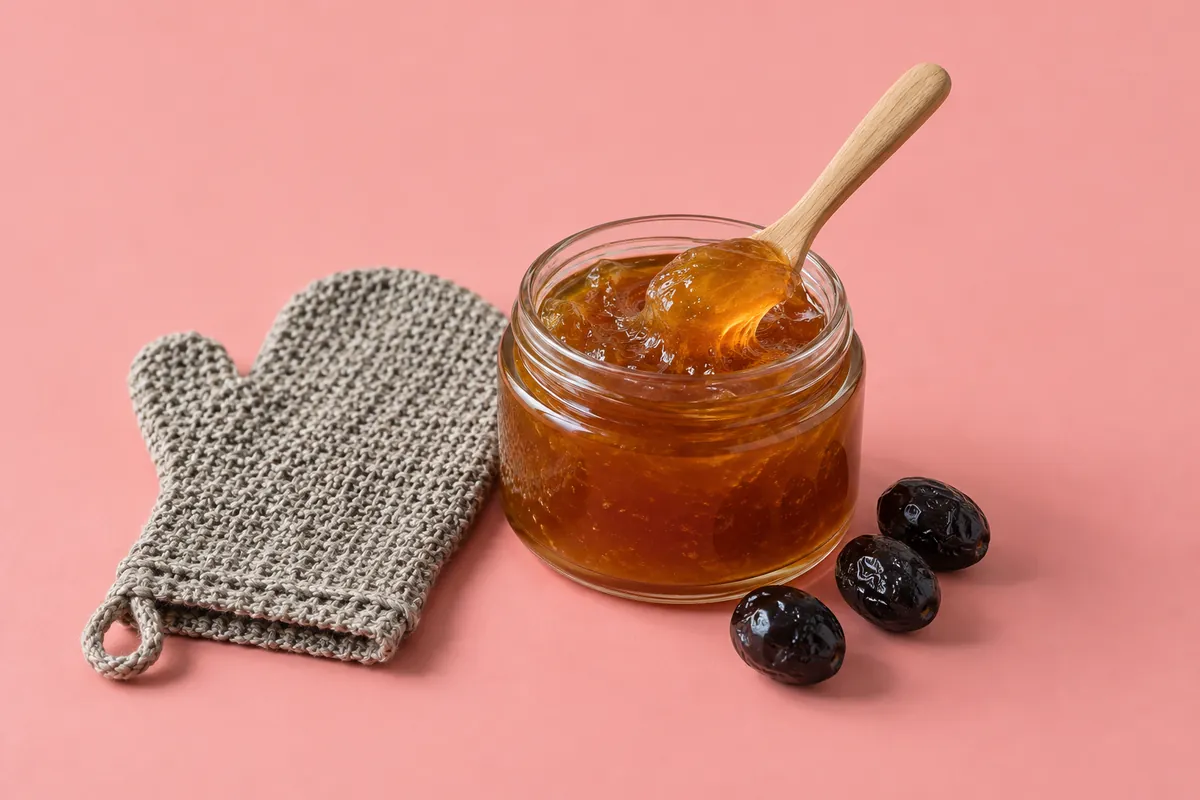
The soft olive soap of the Moroccan hammam: olive oil cooked with potassium hydroxide into a translucent paste you scoop from a jar. Spread it on damp skin and rinse it off, following it with a rough mitt if you like, or use it as an all-round soft soap. Lightly scented with eucalyptus.
- Skill
- Advanced
- Method
- Hot process
- Batch
- 500 g of oils about 1107 g of batter
- Hands-on
- 1 h 15 min
- Cure
- None ready once cool
- Gel phase
- In the pot it gels as it cooks
What you need
For 500 g of oils, which fills about 1.2 litres of lidded jars. Weigh everything, liquids included.
| Olive Oil · 100.0 % | 500 g | 17.64 oz |
| Potassium hydroxide (KOH) · the lye, 90 % pure; if your label says otherwise, weigh 107.9 g at 85 % or 96.5 g at 95 % | 101.9 g | 3.59 oz |
| Distilled water · for a 17 % lye solution | 500.0 g | 17.64 oz |
| Distilled water, just boiled, for the doneness test · a small glassful, with a heaped teaspoon of paste stirred in | 60 ml | |
| Distilled water, just boiled, to soften the paste · up to this much, stirred in 20 g at a time after the cook, only if the paste is stiffer than you want | 100 g | 3.53 oz |
| Eucalyptus essential oil (globulus) · 1.0 % of the oils, after the cook | 5 g | 0.18 oz |
- Superfat
- 3.5 %
- Temperatures
- Lye solution cooled below 82 °C (180 °F), oil at 65 to 71 °C (150 to 160 °F), cooked on low
Method
-
Get ready
Put on sealed goggles, nitrile gloves and long sleeves, and keep them on until the soap is cooked. Weigh 500 g olive oil into a slow cooker of 3.5 litres or more, 500 g distilled water into a heat-proof jug and 101.9 g potassium hydroxide flakes into a dry container, then close the flake tub at once: it pulls water from the air. -
Make the lye solution
At an open window, add the flakes to the water a little at a time, stirring, never the water to the flakes. Potassium hydroxide fizzes and gets hotter than sodium hydroxide as it dissolves; let the solution cool below 82 °C (180 °F), and keep it away from aluminium, tin and zinc, which it attacks, giving off hydrogen. -
Warm the oil
Heat the olive oil in the slow cooker on low to 65 to 71 °C (150 to 160 °F). -
Blend to a paste
Pour the lye solution into the oil and stick blend in bursts of a minute or two, stirring between them and resting the blender now and then so its motor does not overheat. With water equal to the oil the batter stays thin for a long time, then thickens, separates and comes back, sometimes more than once; keep going until it holds together as a thick, opaque paste, which with olive oil alone can take 30 to 45 minutes. -
Cover and cook
Put the lid on and leave the cooker on low. Stir back any liquid that has separated after 15 to 20 minutes and again 15 to 20 minutes later, then stir every 30 to 45 minutes. -
Cook until translucent
Over 2 to 3 hours the paste turns golden amber and translucent from the edges inwards. It is ready to test when no opaque, creamy patches come up as you fold it over. -
Test a spoonful in hot water
Stir a heaped teaspoon of paste into 60 ml of just-boiled distilled water until it dissolves, and let it cool. Clear or faintly hazy means the soap is done; milky, or with an oily film on top, means another hour of cooking and a second test. -
Cool it a little and scent it
Turn off the cooker and leave the soap with the lid on for about 30 minutes, until it is warm rather than hot. Stir in 5 g eucalyptus essential oil until it disappears, or leave it out for an unscented soap. -
Soften it if you like
Savon noir should be a soft jelly you can scoop with a spoon. If yours is stiffer, stir in just-boiled distilled water 20 g at a time, up to 100 g, letting each addition melt in before the next; water can go in later, but it never comes out. -
Pot it
Ladle the soap into clean jars while it is still warm and soft, and put the lids on once it has cooled. It sets to a soft, glossy, translucent amber jelly. -
Clean up with your gloves on
Scrape the pot and tools with paper towels into the bin, then wash them in hot water. Any uncooked paste on them is still caustic. -
Use it the hammam way
After a warm bath or shower, spread a teaspoon over damp skin, keeping it away from the face and eyes, and leave it for a few minutes. Rinse it off well, rubbing with a rough kessa mitt as you rinse if you like the scrub. -
Store it
Keep the jars closed, somewhere cool and out of the light, and take the soap out with a clean, dry spoon rather than wet fingers so no water gets in. Use it within a year.
Tips
- Ours comes out amber, not black: Moroccan black soap takes its dark colour from olive pomace oil or crushed black olives. For a darker paste, use olive pomace oil, which has its own entry in the calculator and takes a little less lye, so choose it there before you weigh.
- The lye assumes potassium hydroxide flakes of 90 % purity, the usual figure on the label. If yours says otherwise, enter it in the calculator before you weigh: flakes purer than the figure used leave the paste lye-heavy.
- In France the name also covers a household soft soap, often of linseed oil: see our linseed soft soap. For a pourable olive soap, see our liquid castile soap, the same oil and lye cooked with less water and diluted.
- The calculator scores it 0 for cleansing, because that figure counts only lauric and myristic acids. A potash soap of olive oil still washes well and dissolves readily, even in cool water.
The oils
| Oil | Share |
|---|---|
| Olive Oil (virgin / refined / olive oil) | 100.0 % |
How it is made
| Process | Hot process |
| Alkali | KOH |
| Superfat | 3.5 % |
| Water | 100 % of the oils |
| Iodine value | 85 |
| INS | 106 |
Why make it
Savon noir is a potash soap, so it stays a soft jelly instead of setting into a bar, and made of olive oil alone it scores 0 for cleansing and 82 for conditioning on our scale. In Morocco, tradition uses it in the hammam: spread on skin softened by steam, left for a few minutes, then rinsed and rubbed off with a rough kessa mitt, which does the scrubbing. In France the name covers a soft soap sold for the body and a runnier one for the house. Olive oil potash soap was also the textile trade's first choice for washing wool and silk, because it dissolves readily in cold water and rinses out easily. None of this rests on trials, only on long use. It is alkaline like any soap, so keep it out of the eyes and rinse it off well.
Sources
- The Handbook of Soap Manufacture · W. H. Simmons and H. A. Appleton, Scott, Greenwood & Son, 1908
- FAQ: savon de Marseille and savon noir · Marius Fabre (manufacturer)
What tradition, makers' experience and research say about soaps like this, each labelled for what it is. It is not medical advice, and no soap treats a skin condition: if you have one, ask a doctor or pharmacist.
What the numbers say
- Palmitic acid 13.8 %
- Stearic acid 2.8 %
- Oleic acid 69.0 %
- Linoleic acid 12.3 %
- Other 2.6 %
Saturated : unsaturated 17 : 83
Computed from the fatty acids of the fats above. The bands are what the craft has settled on, not chemistry — a bar outside one is not wrong.
Try it differently
1 variationsThe same soap with one thing moved. Each opens in the calculator ready to change again.
From the guides
All guides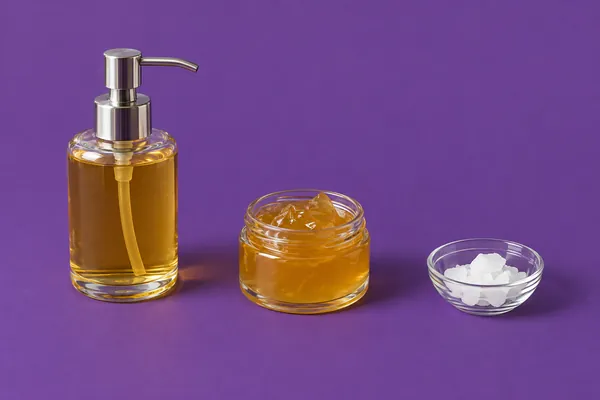
Liquid soap from potassium hydroxide paste
Real liquid soap from scratch: a potassium hydroxide paste cooked until it dissolves clear, diluted by weight, thickened with salt and kept free of microbes.
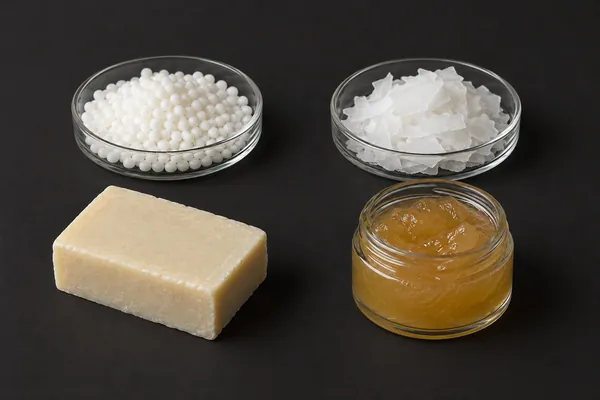
Sodium hydroxide, potassium hydroxide and dual lye explained
Why NaOH makes bars and KOH makes soft soap, converting between them, KOH purity, dual-lye recipes, and the calculator slip that turns a bar caustic.
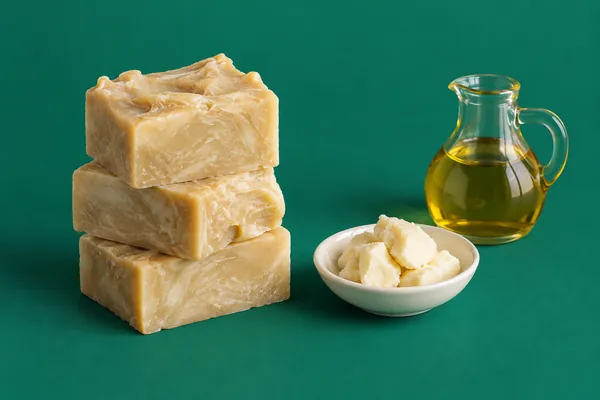
Hot process soap, step by step
Cook soap batter in a slow cooker until the lye is spent, then stir in the superfat oil, fragrance and colour. A full recipe with the calculator's numbers.
Guides with this recipe
Where these proportions come from
North African black soap is olive oil, often olive pomace oil or crushed whole olives, saponified with potash, giving a soft paste rather than a bar; in France the name also covers household soft soaps. Ours is olive oil alone, cooked to a paste in a slow cooker as our liquid castile is, with water equal to the oil. The superfat is 3.5 %, raised from 0 %: the lowest, in half-point steps, at which the published saponification ranges cannot leave the paste lye-heavy (at 0 % they could by 3.3 %). A paste soap wants the worst case at 0 % rather than 1 %, because more oil clouds it. The method is ours.