In short
- Rebatching remelts finished soap with 10 to 25 % of its weight in liquid: the fresher the soap, the less it needs.
- Use low, even heat: a slow cooker, a bowl over simmering water or a roasting bag in a pan of water. A microwave works for a small batch at reduced power, in short bursts; at full power it scorches the soap.
- Oil stirred in at the end stays oil, so it raises the superfat. The calculator tells you by how much.
- A lye-heavy batch can be saved when you know exactly how much lye went in: the lye calculator gives the oil to add. When you do not know, discard it.
- Rebatched bars are rustic, need a few days to firm up and a couple of weeks to dry.
On this page
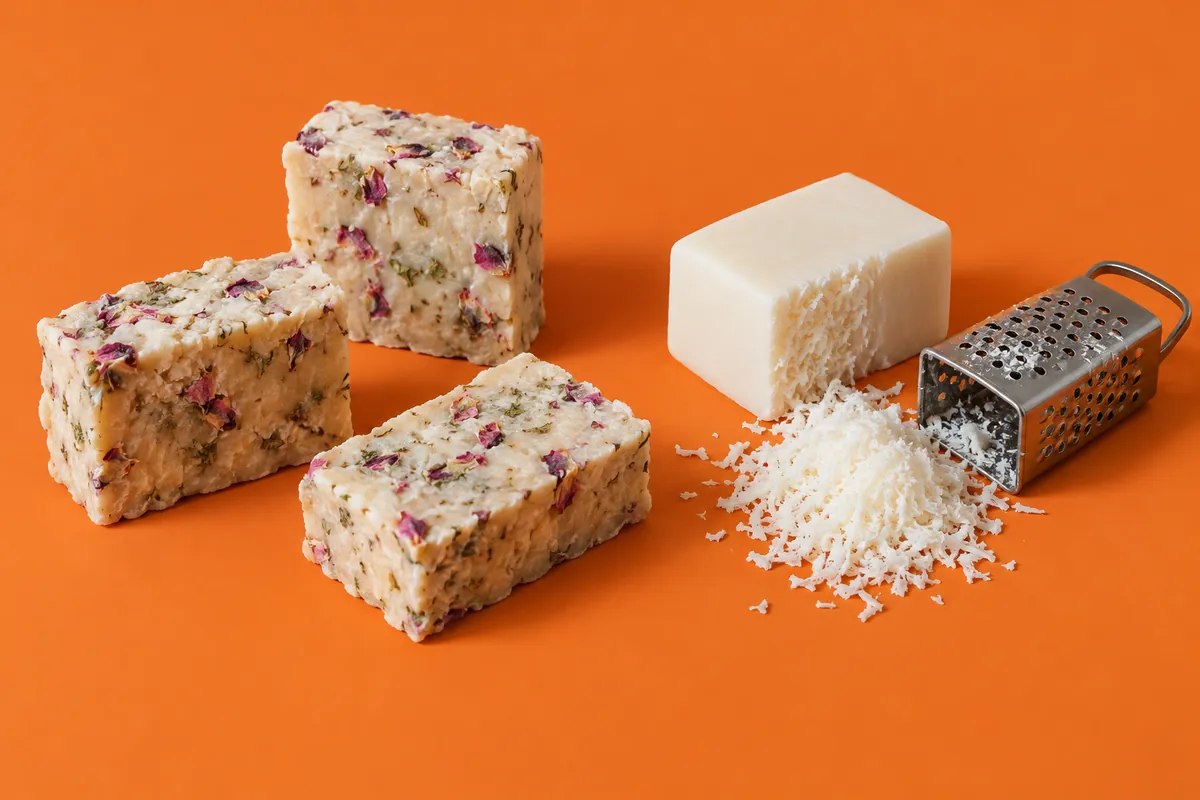
Rebatching takes cold or hot process soap that is already made, grates it, and heats it gently with a little liquid until it softens into a thick mash you can press into a mould. Nothing new is being made into soap; the soap is soap already. That is the whole point of it. Petals, greens and fragrances that fresh lye would spoil survive a rebatch, and a batch with a mistake in it gets a second chance. This guide gives the method and the numbers, then the rescue that needs the most care: a batch with too much lye in it.
What rebatching is, and what it is not
Makers use two names for the same technique. It is rebatching when it rescues a batch that went wrong, and hand-milling when it is done on purpose, to add something or to make a few bars from a larger plain batch.
It is not what soap companies mean by French milled or triple milled soap. That is an industrial process that grinds soap and passes it through rollers and presses several times, which gives a dense, smooth, even bar. In Simmons and Appleton’s 1908 description, chips of soap were dried from about 30 % water to 11–14 %, rolled three or four times between granite rollers with the colour and perfume, and forced through a warm nozzle into a solid bar; drier chips crumbled and cracked, wetter ones stuck and blistered. It cannot be copied in a kitchen, and hand-milled soap never looks like it.
Nor is it melt and pour. A melt-and-pour base is formulated with extra glycerin and solvents so that it melts to a pourable liquid. Ordinary soap has none of that: it softens into a paste but never turns runny.
When it is worth doing
To add what fresh lye would spoil. Rose petals turn black in fresh cold process batter; in a rebatch they keep their colour. So do greens such as spinach and kale, and citrus peel. A fragrance that seizes a fresh batch can go into a rebatch, where there is nothing left for it to speed up.
To test. Make one large batch plain, then rebatch it a few bars at a time to try scents, colours and additives before you commit a whole batch to one.
To fix a mistake you can measure. You left out an oil, the fragrance or the colour, and you know exactly what and how much. Grate the batch and add it back.
To rescue a batch that separated or would not trace, when you know the weights were right. Cooking it through often brings it together (see below).
It is not worth doing for a batch you cannot account for. If you weighed something wrongly and do not know by how much, a rebatch is a guess. That matters most with the lye.
How much liquid
Liquid is what turns the shreds back into a workable mass, and the right amount depends on how old the soap is. Fresh soap still holds most of its water; soap that has cured for weeks has lost much of it.
- Soap a day or two old needs hardly any.
- Soap about a week old: about 10 % of the soap’s weight.
- Soap cured for months: up to 25 %.
For fairly fresh soap, 57 to 85 g of liquid per 454 g (2 to 3 oz per pound) is a good start. Too little and the soap dries and scorches before it melts. Too much and it pours more easily, but the bars stay soft for weeks and shrink and warp as the water leaves.
Water works. Milk, fresh or reconstituted from powder, melts the soap more smoothly and makes it noticeably more fluid, at the cost of an ivory tint; tea, juice and plant milks work too. Older soap softens better if you stir in the liquid and leave the shreds to soak overnight before you heat them.
For soap less than about two weeks old, liquid sodium lactate makes a big difference: 14 to 28 g per 454 g of shreds (0.5 to 1 oz per pound), added with the liquid, makes the mash almost as pourable as fresh batter. The effect fades as the soap ages.
The recipe matters too. Soaps high in olive oil are the hardest to rebatch, and milk soaps are among the easiest.
The method
- Grate the soap. Use a box grater or a food processor kept for soap. Soap that is only a day or two old can still be caustic, so wear gloves, and goggles if it is a batch you suspect has too much lye.
- Mix in the liquid. Weigh it, pour it over the shreds and stir until they are evenly damp but not swimming. Leave older soap to soak overnight.
- Heat it low and covered. A slow cooker on low with the lid on is the easiest. A heatproof bowl over a pan of simmering water works, and so does a sealed roasting bag set in a pan of simmering water and squeezed to mix. Fisher finds the microwave scorches it; other makers use one at reduced power for a small batch, as below.
- Stir every 20 to 30 minutes. Scrape the sides down each time. The soap turns translucent at the edges first, then softens into a thick, glossy mash; with a slow cooker this usually takes an hour or so. If it starts to dry out, sprinkle on a spoonful of water. Do not let it boil, and do not leave it.
- Take it off the heat and stir in the extras. Oil, fragrance, colour and botanicals go in now. Mix clays and powdered colours with a little glycerin or liquid first, or they streak. Scent goes further than in fresh batter: Grosso uses a teaspoon per pound of soap, against a tablespoon per pound of oils in her cold process.
- Press it into the mould. Scoop it in, press it into the corners, and bang the mould on the worktop to knock out air pockets. From a roasting bag, cut off a corner and squeeze it out.
- Let it firm up. Leave it in the mould for two to four days, until it is hard enough to come out cleanly.
- Dry it. Set the bars on a rack and turn them every few days so they dry evenly. Give them at least two weeks for the added water to leave.
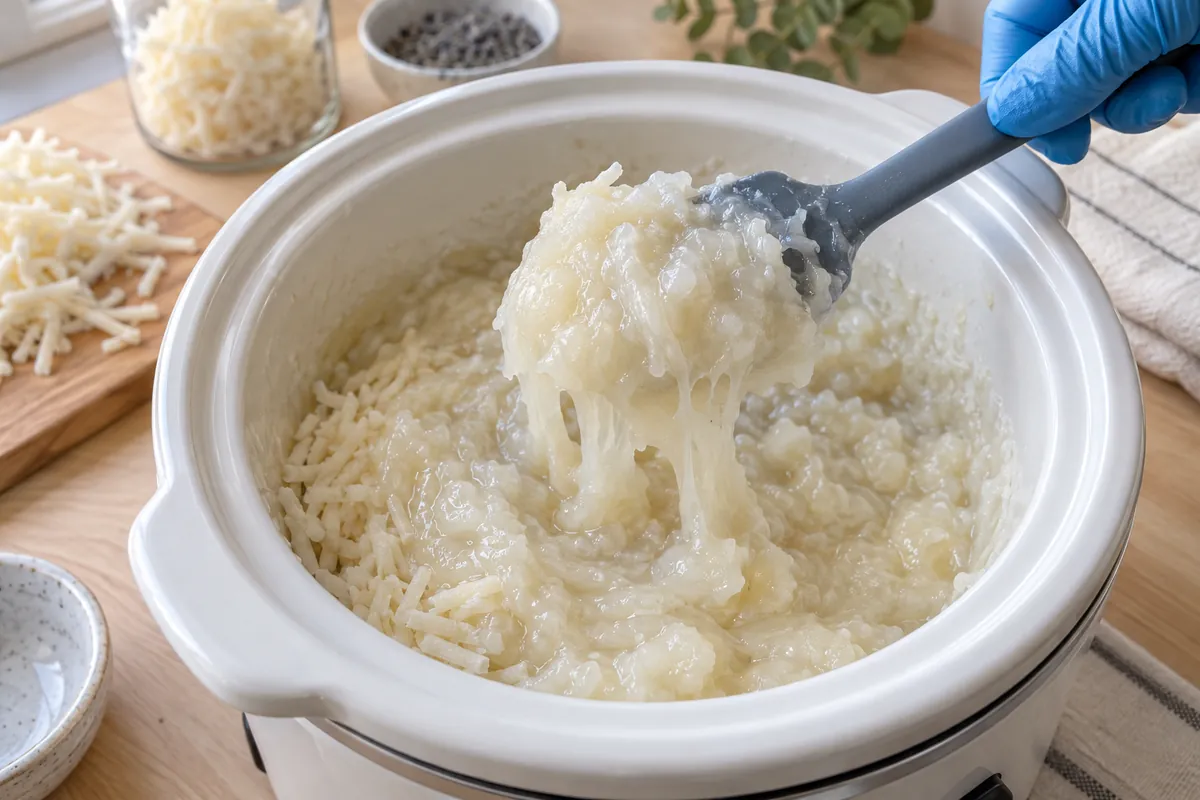 Ready to mould: translucent, thick and glossy, with a few shreds left at the edge that will melt as you stir in the extras.
In the microwave. Keep to about 450 g (1 lb) of shreds or less, and use low to medium power. Letcavage and Buck soften three small bars a few days to a week old, grated, with ¼ cup (59 ml) of water for 1 minute at 70 % power, stir in the colour, then give them 10 seconds at 50 %, when the soap foams up like cheesy mashed potatoes. Grosso heats 450 g of shreds with 115 g (4 oz) of water, covered, on medium in 3-minute bursts, which can take 15 to 30 minutes. Either way the mash gets very hot and steams, and on high it can scorch, foam out of the bowl or melt a plastic mould (Grosso).
Adding oil, and what it does to the superfat
Oil stirred into finished soap does not become soap. There is no free lye left in a cured bar to react with it, so every gram stays as oil and adds to the superfat the recipe already had.
The melt-and-pour calculator has a rebatch mode that works this out. It takes a typical bar to be about 70 % oils by weight and divides the oil you add by that: 20 g of oil in 1000 g of soap adds 2.9 percentage points of superfat on top of the original recipe’s. It warns above 5 points, where the bar gets soft and is more likely to go rancid.
Rebatch 1 kg of soap. With 15 % liquid, 2 % oil and 2 % fragrance, the calculator's rebatch mode gives 150 g of liquid, 20 g of oil and 20.8 g of fragrance, and 2.9 points of added superfat.
Open the calculatorChoose an oil that keeps. Oil that never meets lye stays as it went in only for a while, and saturated and monounsaturated oils (olive, high-oleic sunflower, shea, cocoa butter) last longest. Oils rich in linoleic and linolenic acid are the usual suspects when bars develop orange spots.
Fixing a batch with too much lye
This is the rescue people most want from a rebatch, and it works only when you know how much lye actually went in. The fix is to add enough oil to use up the extra lye, and the lye calculator tells you how much.
Say you made the everyday bar, 40 % olive, 30 % coconut and 30 % palm oil, with 1000 g of oils at a 5 % superfat, for which the calculator asks 144.1 g of sodium hydroxide, and you find afterwards that you weighed 154.1 g. Those 10 g turn a 5 % superfat into about −1.6 %: the soap is lye-heavy. To find the fix, enter the recipe’s oils in grams and add olive oil until the calculator, still at 5 %, asks for the lye you actually used. At 478 g of olive oil it asks 154.2 g. So 78 g of olive oil, cooked into the soap, brings the batch back to a 5 % superfat.
Check the rescue. 478 g of olive oil, 300 g of coconut oil and 300 g of palm oil at a 5 % superfat need 154.2 g of sodium hydroxide, within 0.1 g of what went into the pot.
Open it in the calculatorDo it as soon as you find the mistake, while the soap is fresh and remelts easily. Add the oil at the start, with the shreds and the liquid, not at the end: the extra lye has to react with it, which takes heat and time. And cook it as you would hot process soap, stirring, until the whole mass has turned translucent. Once the bars have set, test one as the soap pH guide describes: a drop of phenolphthalein on a fresh cut, or a pH strip pressed into a paste of the soap and a little distilled water. Ordinary soap reads about 9 to 10 and turns phenolphthalein faintly pink; an instant, vivid magenta or a strip reading above 12 means the soap is still lye-heavy and should not be used.
Separated batches
Sometimes a fresh batch separates in the mould, with oil pooling on top or pockets of liquid inside. What to do depends on why.
If the weights were right and the cause was mixing (not blended long enough, or soaped so cold that the hard oils set before they emulsified), cooking the whole batch through can bring it back. Scrape everything into a stainless steel pot no more than a third full, liquid included, and heat it on medium-low, stirring often, until it turns into a thick, gelatinous mass like mashed potato. That takes 15 to 60 minutes. Scoop it into moulds, leave it two to four days before unmoulding, and dry it for the usual weeks of cure.
If the cause was a weighing mistake you cannot measure, the wrong lye (potassium hydroxide instead of sodium hydroxide) or something you cannot name, cooking will not save it, even though Pure Soapmaking offers the same cook for a batch made with stale lye, potassium hydroxide or a measuring slip. Cooking finishes a reaction; it cannot change the proportions. Treat any liquid in it as lye, and discard it. The troubleshooting guide and soft soap guide help you tell which case you have.
What to expect
Rebatched soap is rustic. However carefully you do it, the texture is coarser than a fresh pour, and it has to be scooped and pressed rather than poured. Milk and sodium lactate make it smoother, but never as smooth as fresh batter. Simple swirls are possible with very fresh soap and sodium lactate; anything more intricate belongs in a fresh batch.
The bars shrink a little as the added water leaves, which is why turning them matters. If the soap was already cured when you grated it, the rebatched bars are ready once that water has gone, in two weeks or so. If it was fresh, they still need the rest of the original cure; count from the day you first made it.
Recipes to try
All recipesSources
- The Complete Photo Guide to Soap Making . David Fisher, Creative Publishing International , 2018. Hand-milling by slow cooker and by roasting bag; 57 to 85 g of liquid per 454 g of fairly fresh soap; milk for smoothness; 14 to 28 g of sodium lactate per 454 g of soap under two weeks old; the microwave scorches it; rebatch only a mistake you can measure; French milling is a separate, industrial process.
- Smart Soapmaking . Anne L. Watson, Shepard Publications , 2013. Rebatch to correct a mistake only when you know exactly what was wrong; hand-milling to add special ingredients; pH strip readings above 12 mean the soap should not be used.
- Natural Soap Making . Elizabeth Letcavage and Melissa Harden, Stackpole Books , 2013. Soaps heavy in olive oil are the hardest to rebatch and milk soaps the easiest; melt on low heat and never leave it unattended.
- Soap Crafting . Anne-Marie Faiola, Storey Publishing , 2013. Save Our Soap: cooking a separated batch in a pot no more than a third full, on medium-low heat, for 15 to 60 minutes; whether it can be saved depends on why it separated.
- Basic Soap Making . Elizabeth Letcavage and Patsy Buck, Stackpole Books , 2009. Microwave rebatching of young bars: ¼ cup of water for three bars, 1 minute at 70 % power, then 10 seconds at 50 % after the colour.
- The Everything Soapmaking Book, 3rd edition . Alicia Grosso, Adams Media , 2013. Hand milling: 4 oz of water per pound of shreds; the microwave on medium in 3-minute bursts for a pound or less, and what full power does; a teaspoon of scent per pound of soap.
- The Handbook of Soap Manufacture . W. H. Simmons and H. A. Appleton, Scott, Greenwood and Son , 1908. French milling: chips dried to 11–14 % water, milled three or four times and compressed through a warm nozzle.
- Pure Soapmaking . Anne-Marie Faiola, Storey Publishing , 2016. The 'hot-process hero' cook, offered even for batches with stale lye, potassium hydroxide or measuring mistakes.
- Superfat . Classic Bells, Soapy Stuff . Oil added to finished soap stays as oil for a while but not for ever; saturated and monounsaturated fats last longest.