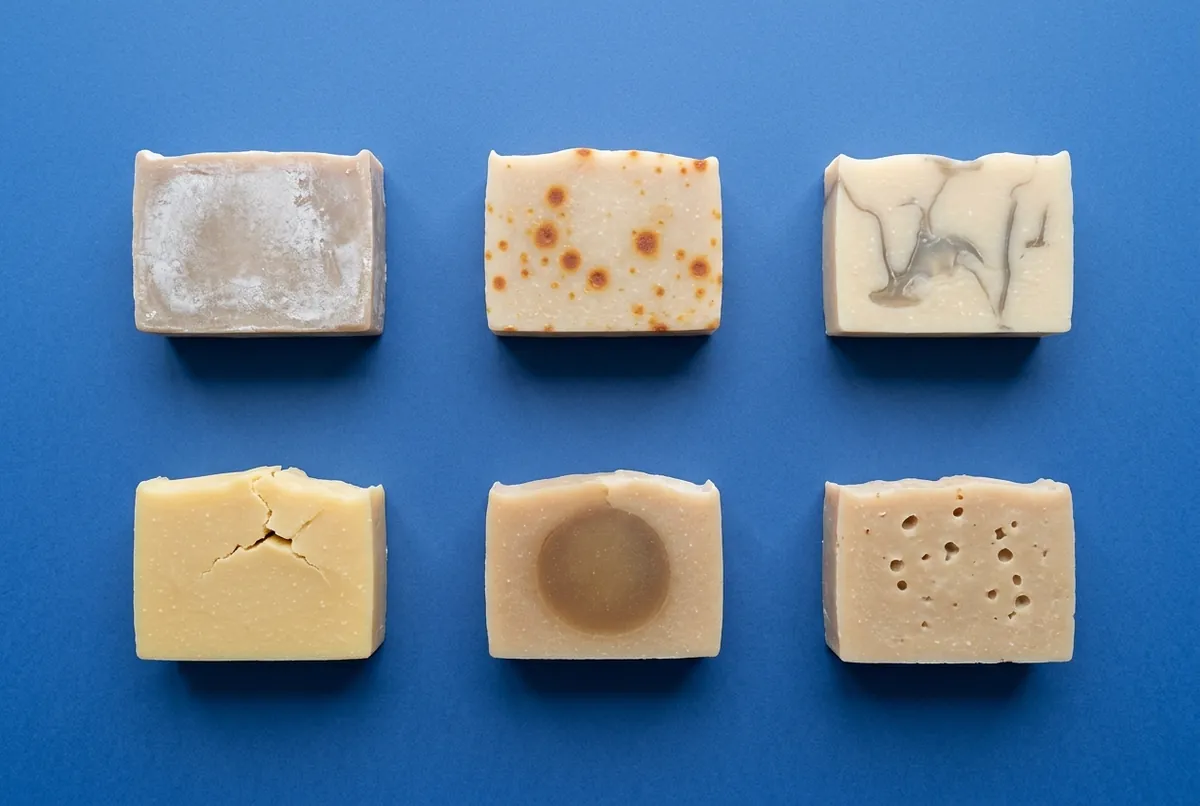
In short
- Most soap faults are cosmetic. The ones that matter for safety are lye pockets, separation and soap that is lye-heavy all through.
- Wait two or three days before judging a batch, then look for wet pockets, gritty crystals, weeping liquid or an oily layer, and test anything suspect.
- In the pot, trouble mostly comes from fragrance, heat and water; in the mould, from heat and air; during the cure, from oxygen, damp and light.
- A separated batch can often be rescued by cooking it within a day. One that has set with lye pockets should be binned.
On this page
This page covers the problems makers meet most often in cold process soap, grouped by when you notice them. Each row says what the fault looks like, what usually causes it, what to do with the batch in front of you, what to change next time, and whether the soap is safe to use. The sections after the tables deal with the judgement calls, and five guides go deeper into the commonest problems.
Is it unsafe, or only ugly?
Soap is unsafe when it carries free lye, and that happens in two ways. Either the batch had more lye than its oils could use, from a weighing slip, a forgotten oil or a recipe nobody ran through a calculator, or the lye never mixed evenly into the oils because the batter was poured at false trace, separated in the mould or held undissolved lye. Nearly everything else on this page is about looks, feel or shelf life.
The signs of free lye are:
- pockets of clear liquid in the cut bars, or liquid weeping from fresh soap;
- hard, gritty or glassy white crystals inside the bar;
- an oily layer over a hard, chalky one;
- a bar that is harsh and crumbly all through, or that stings.
To check a suspect batch:
- Wait. DeeAnna Rouse of Classic Bells waits two to three days before testing, to let saponification finish.
- Cut it and look, with gloves on. Pockets, crystals and layers show on a cut face, and they are the plainest evidence there is.
- Try a drop of phenolphthalein on a fresh cut. It turns pink from about pH 8.2, so a faint pink that creeps in slowly shows on well-made soap too; an instant, vivid magenta, above all in spots or streaks, is the look of free lye.
- Measure pH properly, or not at all. On a calibrated meter, a 1 % solution of well-made soap reads about 9 to 10, a little higher if it is mostly olive oil, and no pure soap in Kevin Dunn’s figures reaches 12, so 12 or more means free alkali. Rouse finds cheap strips read 2 to 3 units low, and 1 part per thousand of excess lye raises the pH by only about 0.3, so a strip can flag a grossly lye-heavy bar but cannot clear a doubtful one.
The definitive check is a titration of the free alkali; Dunn treats less than 1 part per thousand of free sodium hydroxide as safe. A small excess fades as the soap cures: in one of Dunn’s bars, the free alkali at the bottom fell from 4.9 to 0.9 parts per thousand over 60 days. Pockets of lye don’t fade. The traditional zap test, a fingertip touched to the tongue, puts soap in your mouth at the moment it is most likely to be caustic, and our pH guide explains why we don’t recommend it.
The soap pH and testing guide goes through each test in detail.
The problems at a glance
In the pot
| Problem | What you see | Usual causes | Fix now | Next time | Safe to use? |
|---|---|---|---|---|---|
| Acceleration | Batter thickens far faster than planned, but still pours | Fragrance, hot batter, little water, hard fats, long stick blending | Stop blending, stir by hand, pour a simple design at once | Soap cooler with full water; stir the fragrance in by hand, last | Yes |
| Seizing | Batter sets into a stiff lump, often seconds after the fragrance goes in | A fragrance not proven in cold process: clove and other eugenol-rich oils, many florals and spices | Press it into the mould fast, or cook it as hot process | Test new fragrances in a 500 g batch | Test first |
| Ricing | Hard lumps like grains of rice in batter that is still fluid | A fragrance reacting with the hard fats | Stick blend the lumps smooth, then pour | Test fragrances, soap cooler, use more soft oils | Test first |
| False trace | Grainy thickening within a minute or two of adding the lye, before any fragrance | Hard fats setting in batter that is too cool | Keep blending until smooth | Melt the fats fully; keep butter-rich batter warm enough | Test first, if it was poured |
| Won’t trace | Batter still thin and streaky after several minutes of blending | A weak blender or cool, olive-rich batter; or too much oil or water, too little lye, or potassium hydroxide in place of sodium | Blend on, up to five minutes, and recheck every weight | Weigh everything; fresh sodium hydroxide; a stronger blender | Test first |
| Separation | Oil pooling on the batter or the poured loaf | No true emulsion; too much water in a slow recipe; a fragrance that won’t mix; weak or wrong lye | In the pot, blend again; in the mould, cook it within a day | Blend to a real emulsion; less water for olive-rich soap; fresh lye | No |
“Test first” means handle with gloves and check for free lye, as above, before anyone uses the soap.
In the mould
| Problem | What you see | Usual causes | Fix now | Next time | Safe to use? |
|---|---|---|---|---|---|
| Cracks and alien brain | A split along the top, or a wrinkled, glossy, fully gelled top | Too much heat: hot soaping, heavy insulation, sugars and milk, a lot of butter, a heating fragrance | Uncover, lift the mould, add a fan; trim the top later | Soap cooler, insulate less, chill sugary batches | Yes, unless it separated or the bars feel harsh |
| Volcano | Soap swells up through a crack and spills over the mould | Severe overheating, usually from sugars or alcohol | Gloves and goggles on; scoop the overflow into a spare mould; cool the loaf | As for cracks | Test first |
| Soda ash | A dull white, powdery film on the top and exposed sides | Lye still at the surface meeting carbon dioxide in the air | Steam, rinse or plane it off | Cover the mould; soap warmer; use a little less water | Yes |
| Won’t set | Still soft or sticky after two or three days | Too much water, mostly soft oils, or too little working lye; a loaf kept cold can need an extra day | Wait; check the numbers and the lye | Less water, more hard fats, fresh lye, sodium lactate | Yes, unless it is greasy or weeps |
| Stuck in the mould | Soap clings or tears when you try to unmould it | Still too soft; small cavities that never warmed up | Wait a few days, or freeze it and push it out | Less water, sodium lactate, or let the soap gel | Yes |
Most of the heat problems in this table are cosmetic; the overheating guide explains when they are not.
When you cut
| Problem | What you see | Usual causes | Fix now | Next time | Safe to use? |
|---|---|---|---|---|---|
| Partial gel | A darker, translucent centre with a paler rim | The edges cooled before gel reached them | Leave it, or try warming the soap in a low oven | Insulate the whole mould, or chill it fully | Yes |
| Glycerin rivers | Translucent veins or crackle through opaque soap, worst with titanium dioxide | Slow cooling after gel, a lot of water, titanium dioxide | Nothing; they are cosmetic | A lye solution of 33 % or stronger; cool fast after gel; disperse titanium dioxide in oil | Yes |
| Holes | Small round holes scattered through the bar, or a smooth tunnel down the middle | Round holes: trapped air. Tunnels: overheating | Nothing; plane or rebatch for looks | Burp the stick blender and tap the mould; soap cooler for tunnels | Yes, unless a hole holds liquid |
| White spots | Soft, waxy white flecks inside the bar that don’t sting | Stearic- and palmitic-rich fat that set in cool batter, or palm oil not fully melted and stirred | Nothing, once lye is ruled out | Melt and stir the whole tub of palm or butter; soap warmer | Test first |
| Lye pockets | Pockets of clear liquid, or hard, gritty white crystals, in the bar | Separation, pouring at false trace, lye not fully dissolved, the watery last of the pot poured in unmixed | Gloves on; don’t use it; bin it | Dissolve the lye completely; blend to a real emulsion; leave streaky dregs in the pot | No |
| Oily patches | Oil pockets, oil weeping out, or a greasy layer on top | A fragrance that didn’t mix in, separation, a very high superfat | A thin film may soak back in over a few days; test | Test fragrances; blend all the oils before the lye goes in | Test first |
| Crumbly or brittle | Bars crumble, chip or shatter as you cut | Too much lye, deep soda ash, cutting too late, too much honey or sodium lactate | Test for lye first; if it passes, use it | Weigh carefully; cut when the soap feels like cold cheddar | Test first |
A cut face with a smooth knife tells air marks from true white spots; see below.
During cure and storage
| Problem | What you see | Usual causes | Fix now | Next time | Safe to use? |
|---|---|---|---|---|---|
| Sweating | Beads of liquid or a tacky film on cured bars in damp weather | Glycerin, salt or honey drawing water from humid air | Pat dry, put in a drier room with a fan, then wrap | Cure with airflow, dehumidify, wrap once cured | Yes |
| Orange spots (DOS) | Orange spots or blotches weeks or months later, with a stale smell | Unsaturated oils oxidising, helped by old oils, trace metals, heat and light | Cut the spots out for your own use; it can’t be reversed | Fresh oils, fewer polyunsaturated oils, distilled water, EDTA and rosemary extract, no metal racks | Own use only |
| Colour change | Colour shifts in the pot or over the cure, fades in light, or turns tan to brown | Colourants that react with alkali (some micas and dyes, alkanet, madder, turmeric); vanilla in the fragrance; sunlight | Nothing; the soap is fine | Oxides, ultramarines and micas tested in cold process; check fragrances for vanillin; store out of light | Yes |
| Fragrance fading | Scent weak after the cure, or gone within months | Light top notes and citrus evaporating; the alkali breaking some scents down; too little fragrance | Nothing for these bars; rebatch to add scent | Dose within the supplier’s limit; add base notes; store wrapped, cool and dark | Yes |
“Own use only”: rancid soap is not known to harm skin, but it smells, and it should not be sold or given away.
In the pot
How fast batter moves is decided by the fragrance, the heat, the water and the fats. Eugenol, the main aroma chemical in clove and cinnamon leaf oils, is the best-measured accelerator: in Dunn’s measurements, batter thickened faster with more of it, as it did with more heat and less water. The seizing guide covers what to do mid-batch and how to test a fragrance before trusting it with a full loaf. False trace, which is cool fat setting rather than soap forming, is covered in the trace guide. Separation is the one pot problem that becomes a safety problem, and the soft soap guide covers it in full.
In the mould
A loaf heats itself. Too much heat cracks it or pushes it out of the mould, heat that reaches the middle but not the edges leaves a partial gel, and a cool loaf with its top open to the air grows soda ash. The overheating guide and the soda ash guide cover these, and the gel phase guide explains how to steer a loaf one way or the other.
Partial gel is cosmetic, and there may be no undoing it: Kelly Cable finds nothing changes the look once the soap has set. Rouse does try, warming the soap, cut or uncut, at the oven’s lowest setting, usually 63 to 77 °C (145 to 170 °F), for about an hour and letting it cool slowly; it may help soften the ring, and she can’t promise it will go, though some makers who have tried it say it becomes less obvious. Cable prevents it by putting the fresh loaf in a 77 °C (170 °F) oven until it has gelled evenly. Next time, either insulate the whole mould or chill it: the halfway house is what causes the ring.
Soap stuck in a mould is still too soft, and small silicone cavities, which lose their heat and rarely gel, are the usual culprits. Soap Queen freezes a stubborn mould for 24 hours and Anne-Marie Faiola freezes soap solid if it tears; frozen soap no longer flexes, so it pops out. Sodium lactate helps too: Corbion, which makes it, sells it for bar soap to harden bars and help them release from moulds. The unmoulding guide and the moulds guide cover the rest.
When you cut
Holes. Round holes are air: whipped in by a stick blender switched on before it was tipped to let its trapped air out, splashed in with the lye, or caught when thick batter was poured. Soap Queen burps the blender, pours the lye down its shaft and taps the mould firmly once it is filled. A long, smooth tunnel down the middle of a loaf is a heat tunnel, left by overheating.
White spots. Most white flecks inside a bar are high-melting fat that set before it could mix in. Amanda Aaron of Lovin Soap got them with her lye at 16 °C (60 °F) and oils at 27 °C (80 °F), and soaps butter-rich recipes at 38 to 49 °C (100 to 120 °F) to avoid them; palm oil scooped from a part-melted tub leaves its stearin in clumps the same way, so melt and stir the whole container before weighing. She also shows that a wire cutter can drag tiny air bubbles into round marks that look like spots: cut a slice with a smooth knife, and if the marks vanish, they were air. Hard, glassy or damp crystals are a different matter; treat them as lye until tested. White streaks can go either way. Alicia Grosso finds that streaks which neither leak nor sparkle usually mean fragrance or colour not fully stirred in, a matter of looks, while sparkly, crusty white means too much lye; Susan Miller Cavitch’s rule is to make sure white swirls are not shiny chunks of lye before shrugging them off.
Lye pockets. Cavitch warns that watery or oily puddles in the pot “signal a poorly mixed solution that will result in pockets of solid lye in the final bars”. If the last of the batter at the bottom of the pot is watery and uneven, the mixing wasn’t finished, and she leaves it out of the mould.
Crumbly or brittle bars. Test first, because one cause is too much lye. If the soap passes, the usual cause is timing. Rouse cuts when a loaf feels like fridge-cold cheddar; if it has gone too hard, she warms it on the oven’s lowest setting, checking every 10 to 15 minutes, and cuts it with a flat blade or a wire, because a wedge-shaped knife splits firm soap. Salt bars go hard fast and need cutting within hours.
Oily patches. A thin film of oil on top of a new loaf, less than about 3 mm (1/8 in), can soak back in over one to three days, Faiola finds. If it doesn’t, or the oil sits in pockets, treat the batch as separated. Oil weeping from cured bars is often fragrance that never mixed in: wipe it off, and next time use less of that fragrance and stir it in more thoroughly. Grosso draws the line between the two kinds of leak: oil seeping from cut bars is usually too much essential oil and seldom serious, while a watery leak from the block is caustic lye solution from a weighing mistake, and the batch goes in the bin.
During the cure
Two of the problems that appear after cutting come from the air. Sweating is glycerin pulling water from humid air and does no harm; orange spots are oxygen turning the fats rancid, and are permanent.
Colour. Fresh soap is strongly alkaline, and many colourants change in alkali. Oxides and ultramarines hold their colour. Faiola finds some micas shift, blues towards purple and greens towards coral, while others fade entirely, and many food dyes fade to nothing in fresh cold process soap. Natural colours move most: alkannin, the pigment in alkanet root, goes from red through purple to blue as the pH rises, and curcumin, in turmeric, turns red in strong alkali. Many natural colours also fade in light. Vanilla-type fragrances turn soap tan to brown over days or weeks, starting at the surface; that is the vanillin, not a fault in the soap. The colouring guide and the natural colourants guide go further.
Fragrance. Light top notes, citrus above all, fade first, and soap’s alkali breaks some aroma chemicals down. Faiola finds ordinary orange oil vanishes from cold process soap, while five-fold or ten-fold orange lasts better. The dose matters too, within the supplier’s safe limit, and so does storage: cured soap keeps its scent longer wrapped, cool and dark. The scenting guide covers doses and limits.
Rescue, rebatch or bin
| Situation | What to do |
|---|---|
| A cosmetic fault only: ash, cracks, rivers, partial gel, holes, colour | Use it. Steam, plane or trim for looks |
| Seized, riced or separated, still soft, within about a day | Cook it as hot process until it is even, then test it |
| Evenly and mildly lye-heavy, and you know why, such as an oil left out at a known weight | Rebatch it with the missing oil, calculated, or grate it for laundry, with gloves on |
| Lye-heavy, and you don’t know why | Bin it |
| Set hard with lye pockets, or an oily layer over a chalky one that stings | Bin it |
| Orange spots | Cut them out for your own use; rebatching won’t help |
| Too little or too much fragrance | Rebatch with more fragrance, or with unscented soap to dilute it |
The rescue cook is ordinary hot process on a failed batch; the hot process guide covers the method and the rebatching guide how to add a missing oil by the numbers.
To bin a batch safely, let it harden, then wrap it in two or three bags, wearing gloves and goggles, and put it out with the household rubbish. Never pour soap batter or lye down a drain.
Sources
- The 'Water Discount' . Kevin M. Dunn, The Handcrafted Soapmaker 2008-2 , 2008. Free alkali below 1 part per thousand treated as safe; high-water olive soaps separated into chalky, lye-heavy soap under a layer of oil.
- Little White Lyes . Kevin M. Dunn, lecture to the Handcrafted Soap and Cosmetic Guild , 2015. pH of 1 % solutions of pure soaps, after Kanicky et al.; caustic soda purity.
- Trace Analysis . Kevin M. Dunn, lecture to the Handcrafted Soapmakers Guild , 2010.
- Caustic Soda Handbook . Occidental Chemical Corporation (OxyChem) , 2026. First aid: flush skin and eyes with water.
- Zap test . DeeAnna Rouse, Classic Bells .
- Soap pH . DeeAnna Rouse, Classic Bells .
- Rescue oven processing . DeeAnna Rouse, Classic Bells .
- Tips for cutting a loaf of soap into bars . DeeAnna Rouse, Classic Bells .
- Soapy Mess-Up Quick Guide . Soap Queen (Bramble Berry) , 2015.
- What Are The White Spots In My Soap? . Amanda Aaron, Lovin Soap , 2017.
- Natural plant-derived compounds in food and cosmetics: a paradigm of shikonin and its derivatives . S. Malik, P. Brudzyńska and M. R. Khan, Materials 16(12):4377 , 2023.
- The chemistry of curcumin: from extraction to therapeutic agent . K. I. Priyadarsini, Molecules 19(12):20091-20112 , 2014.
- PURASAL S/HQ 60 sodium lactate for bar soap . Corbion .
- Soap Crafting . Anne-Marie Faiola, Storey Publishing , 2013.
- The Complete Photo Guide to Soap Making . David Fisher, Creative Publishing International , 2018.
- The Natural Soap Making Book for Beginners . Kelly Cable, Althea Press , 2017.
- Pure Soapmaking . Anne-Marie Faiola, Storey Publishing , 2016. Why soap won't trace: a weak blender, too much oil or water, not enough lye; blending up to five minutes.
- The Everything Soapmaking Book, 3rd edition . Alicia Grosso, Adams Media , 2013. Leaking essential oil against leaking lye solution; sparkly, crusty soap as lye-heavy; white streaks from fragrance or colour not stirred in.
- The Natural Soap Book . Susan Miller Cavitch, Storey Publishing , 1995. Troubleshooting table: white swirls checked for chunks of lye, harsh cracked bars; watery puddles in the pot leading to lye pockets; the unmixed last of the pot left out; a year lost to adulterated olive oil.
- The Handbook of Soap Manufacture . W. H. Simmons and H. A. Appleton, Scott, Greenwood & Son (Project Gutenberg edition) , 1908. A tallow found to hold 40 % unsaponifiable wax; raw materials analysed before use.