In short
- Saponification gives off heat. How hot a loaf gets depends on the mould, the starting temperature, the water, the oils and what has been added.
- Glycerin rivers are misnamed. Slow cooling after gel lets the soap sort itself into opaque and translucent patches, and pigment, above all titanium dioxide, makes them show.
- Cracks, alien-brain tops and volcanoes are overheating. Sugars, milk, alcohol, heating fragrances and heavy insulation are the usual causes.
- Heat tunnels are smooth holes left in an overheated core.
- For fewer rivers, use less water and cool the loaf quickly after gel. For less heat, soap cooler and insulate less.
On this page
Cold process soap makes its own heat, and a loaf in a wrapped mould can hold a surprising amount of it. Most of the faults in this guide come from that heat, either going too high or fading away too slowly. They are cosmetic as long as the batch has not separated, and they are easier to prevent once you know what sets the temperature of a loaf.
Where the heat comes from
Two steps give off heat. Dissolving sodium hydroxide in water heats the solution quickly, and saponification itself is exothermic, so a loaf keeps warming for hours after it is poured. In a big, wrapped mould the heat builds faster than it escapes and the soap goes into gel: it turns darker and translucent, from the middle outwards. Soap Queen puts a gelling loaf at up to about 82 °C (180 °F), and Anne-Marie Faiola at 22 to 33 °C (40 to 60 °F) above the pouring temperature.
Gel is not melting. Kevin Dunn identifies it as neat soap, a liquid-crystal phase of soap and water in which the soap molecules lie in ordered sheets but can still slide past each other. It does the finished soap no harm: in his tests gelled and ungelled bars matched in hardness and alkalinity, though they took up water differently when soaked.
Dunn’s measurements show what decides how hot a loaf gets:
- The mould. A big block holds its heat; individual cavity moulds lose it.
- The starting temperature. Warmer oils and lye give a higher peak.
- The water. High-water soap gels at moderate temperatures; low-water soap gels only when it gets hot.
- The oils. Saturated fats saponify faster and can raise the peak.
- Fragrances and additives. Some speed the reaction and raise the peak. Sugars are the classic case: milk, honey, fruit purées, juices, beer and wine all make a batch run hotter.
Water cuts both ways, which is why advice about it can sound contradictory. More water makes a loaf gel at a lower temperature, and so encourages rivers and some cracking; less water speeds saponification, and DeeAnna Rouse of Classic Bells notes that soaps rich in coconut, palm kernel or babassu oil are notorious for overheating, cracking and even overflowing when made with too little. Read the water together with the oils and the soaping temperature.
Glycerin rivers
Glycerin rivers are translucent, watery-looking veins, clouds or a crackle pattern running through otherwise opaque soap. They are easiest to see in soap whitened with titanium dioxide.
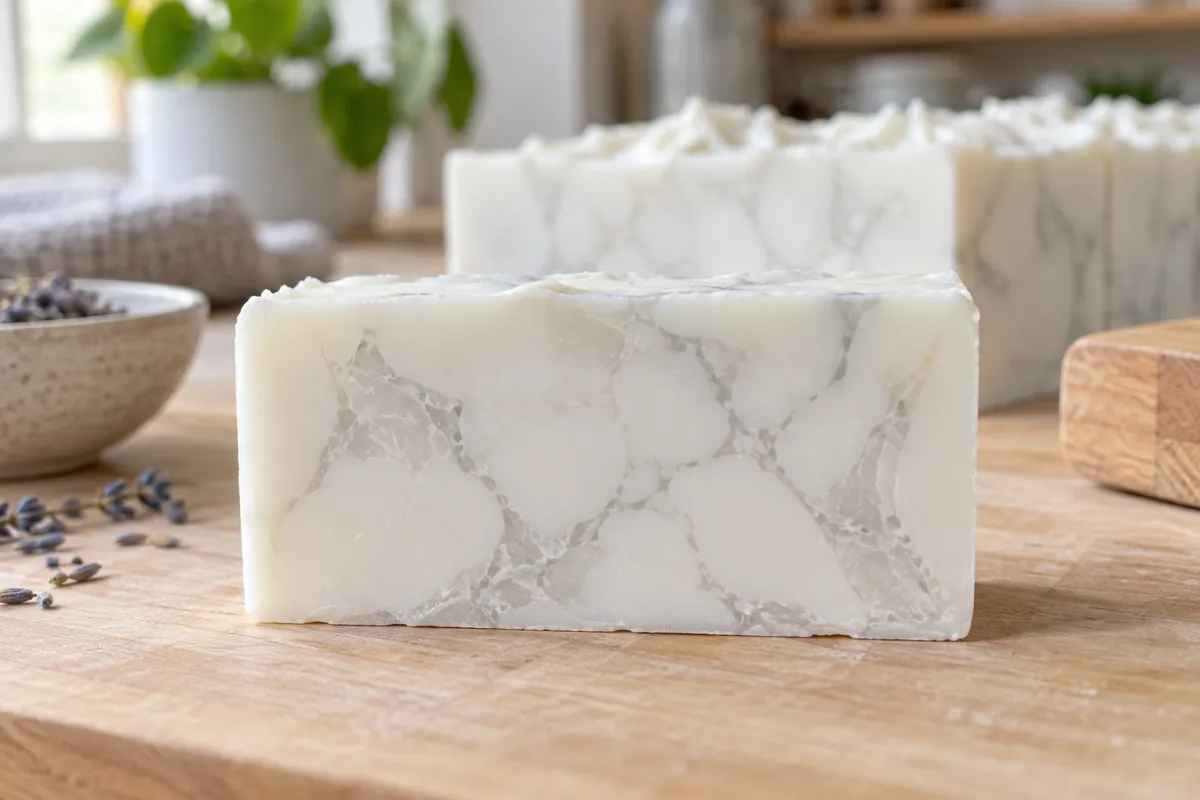 Glycerin rivers in a bar whitened with titanium dioxide.
The name is misleading, and Classic Bells explains why: the glycerin is not separating out. Soap is a mixture of different soaps. Sodium stearate and palmitate, from the saturated fats, set first as a loaf cools down from gel, and they are opaque when solid; sodium oleate stays liquid longer and sets translucent. If the loaf cools slowly, the two have time to gather into patches big enough to see. The 1911 Encyclopaedia Britannica describes the same thing in factory “mottled soap”, which soapmakers made on purpose by colouring hot soap and letting it cool slowly in its frames: the stearate and palmitate “form a semi-crystalline solid, while the oleate, solidifying more slowly, comes by itself into translucent veins”. Pigment makes the pattern show because it does not spread evenly between the two. Simmons and Appleton’s 1908 handbook gives the factory rule that follows: cooled slowly, mottled soap grew large crystals and “a distinct bold mottle”; cooled too fast, it gave “a small mottle, or no mottle at all”. So mottled soap went into wooden frames, covered to cool gradually, while other soaps went into iron frames, and transparent soap was poured into narrow frames to cool fast.
Soap Queen explains rivers as glycerin congealing when the soap gets too hot. The causes and cures she gives are the same, so for making soap it matters little which account is right.
What makes rivers more likely:
- A gel followed by slow cooling. Warm soaping, heavy insulation, a heating pad or an oven. Rouse calls cold process oven processing with a weak lye solution “a good way to grow a nice crop of crackles and rivers”.
- More water. Rouse finds gel fairly unlikely at a lye concentration of 33 % or more, and much more likely at 31 % or less, because high-water soap gels at a lower temperature.
- Water that isn’t even. Batter not scraped and mixed before pouring, or a colourant dispersed in water and added to only part of the batter.
- Titanium dioxide. The pigment that shows rivers most, and the more so when it is dispersed in water.
- Heating fragrances. Soap Queen advises checking the supplier’s notes.
Rivers do not change how the soap works; Rouse says they have essentially no effect on performance. Soap Queen adds that where they are thick or bunched in one part of a bar, that part can be softer than the rest.
To prevent them:
- Use less water. A lye concentration of 33 % or stronger, counting every source of water: EDTA or citrate solutions, water-dispersed colours, purées. Soap Queen suggests a water discount of 10 % or more.
- Mix the batter evenly. Scrape the sides of the pot and stir well before pouring.
- Disperse titanium dioxide in oil, not water or glycerin. Soap Queen mixes 1 teaspoon of pigment into 1 tablespoon of a light oil. Rouse’s own photographs show mottling right through the part of a bar she whitened with titanium dioxide mixed in glycerin.
- Choose gel or no gel, and see it through. To prevent gel, soap about 5 °C (10 °F) cooler, or at room temperature, and put the mould in the freezer for 24 hours. To gel, let the loaf reach full gel, then cool it quickly: a fan, with the mould on a rack so air can get underneath, does it without a fridge.
The colouring guide covers titanium dioxide and other pigments in more detail.
Small amounts of water matter. The usual three oils at a 33 % lye solution take 292.6 g of water for 1000 g of oils. At 31 %, where gel and rivers become much more likely, they take 320.8 g: only about two tablespoons more.
Open it in the calculatorCracks and alien brain
A crack along the top of a loaf, or a wrinkled, ridged surface like a brain, means the soap got too hot. Modern Soapmaking explains the crack: the top sets while the inside is still heating, heat and expanding soap are trapped underneath, and the top splits to let them out. Alien brain is the same heat in a loaf that has gelled right through, with the surface buckling as it swells.
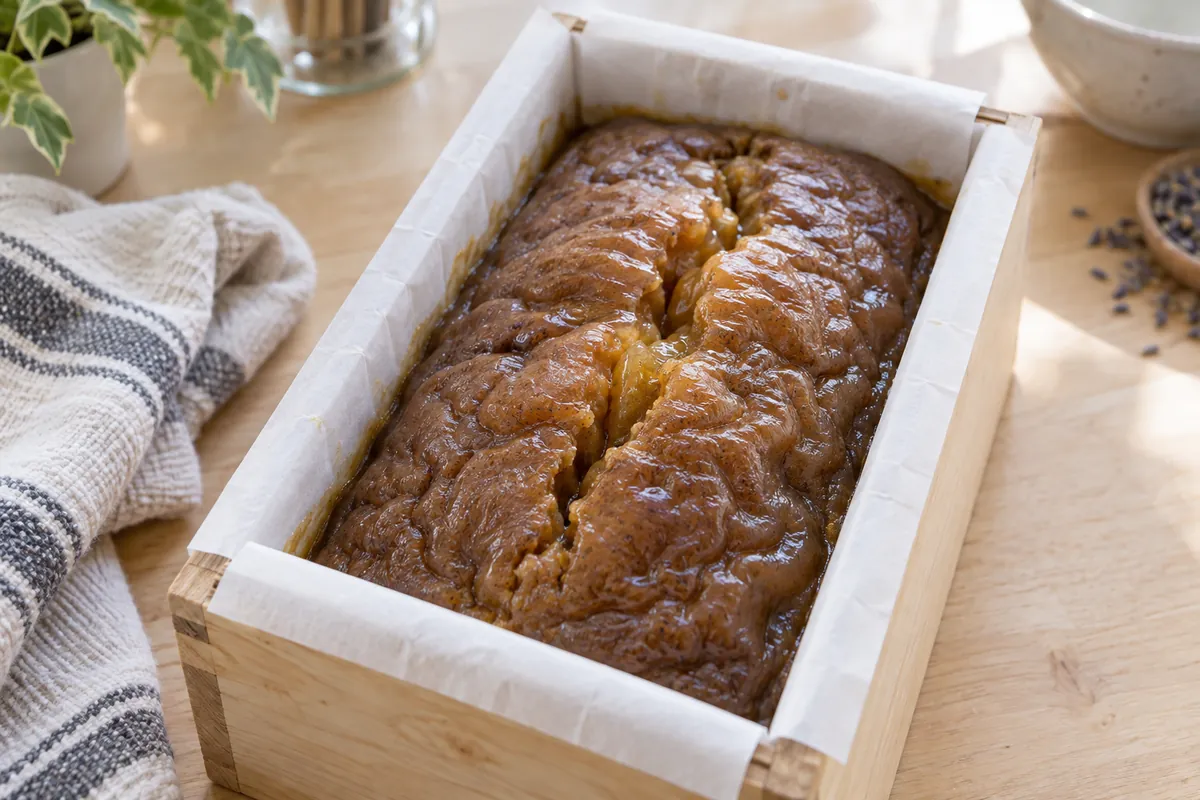 Alien brain: a fully gelled, overheated loaf with a buckled top and a crack where the soap has pushed up.
The usual causes:
- Hot soaping. Soap Queen finds tops crack when lye and oils go in at 60 °C (140 °F) or more.
- Too much insulation. Several blankets, a heating pad left on, a warm room.
- Sugars. Milk, honey, fruit purée, juice, beer and wine. Read the milk carton too: Anne-Marie Faiola warns that sugar added to shop milk can puff the soap out of the mould “like a soufflé”.
- A lot of hard oils and butters. Soap Queen names cocoa, shea and mango butters; Faiola finds cocoa butter above 15 % of the oils can contribute to cracking.
- Too much alcohol spray. A drenched top dries out and hardens over soap that is still heating, as Modern Soapmaking warns.
- A big batch in one mould. Anne Watson notes that a large batch poured into one mould can overheat, because a stick blender leaves more heat in the batter than hand stirring did.
When it happens: take off the insulation, lift the mould so air can get underneath, and put a fan on it. A crack often settles back; while the soap is still soft you can press it together with a spatula, gloved, because the soap is hot and caustic. Soap Queen closes a crack in soap that has just cooled by spraying it with alcohol, covering it with plastic wrap and rubbing it gently. Otherwise trim or plane the top once the soap is firm. One check before you do: Susan Miller Cavitch lists too much lye among the causes of cracks, so if the bars feel harsh, test them before blaming the heat.
Next time: soap cooler, insulate less, and keep sugary batches cold (see the table below). Modern Soapmaking lays plastic wrap on the surface after pouring and takes it off once the soap starts to gel, so the top stays soft; skip that with anything that runs hot.
Volcanoes
If the heat keeps building after the top cracks, the swelling soap pushes up through the crack and can pour over the side of the mould. Sugars are the usual cause: Soap Queen’s examples are a coconut milk soap and a pumpkin purée soap. Our coconut milk bar and goat milk, oat and honey bar stay out of trouble by freezing the milk, soaping at about 30 °C and keeping the mould cold.
Put on gloves and goggles, then scoop the overflow into a spare mould with a spatula, and move the loaf somewhere cool. Once a volcano has started, the looks are usually lost, and the aim is usable soap and a small mess. Most volcano soap is still sound once it sets. If the loaf separated, with an oily layer over a hard, chalky one, treat it as lye-heavy: see separation.
Heat tunnels
Heat tunnels are smooth-walled holes or channels in the middle of a loaf, where the core got hottest. Soap Queen lists the usual contributors as some fragrances and essential oils, beeswax, honey, cocoa butter and milk, and the cure as lye and oils about 8 °C (15 °F) cooler and no more insulation than a towel. The soap is fine to use.
Tunnels are long, smooth-sided and central, usually in a loaf with other signs of heat. Small round holes scattered through the bars are air bubbles, and a cavity that holds liquid or crystals is something else again: treat it as a possible lye pocket, as the troubleshooting guide describes.
Keeping a batch in control
| The batch | What to do |
|---|---|
| Milk, honey, sugar, fruit, beer or wine | Chill or freeze the liquid, soap at 32–38 °C (90–100 °F) or cooler, skip the insulation, and put the mould in the fridge or freezer for 24 hours |
| A fragrance that heats | Soap cooler and insulate less; read the supplier’s notes first |
| A lot of hard oils and butters | Soap cooler, with lighter insulation |
| A lot of coconut, palm kernel or babassu | Don’t cut the water too far |
| You want full gel without cracks | Moderate temperatures and a towel. If you use a heating pad, Soap Queen checks it after 30 minutes and switches it off if the soap is getting too hot; Faiola watches for cracking, bubbling or the soap rising |
| A silicone mould | Soap below 49 °C (120 °F), as Faiola does: overheated soap in silicone can come out pock-marked |
| A salt bar | No insulation: Alicia Grosso finds salt soap makes plenty of heat on its own |
| You want no rivers | A lye solution of 33 % or stronger, then either no gel or a quick cool after it |
| A big batch | Split it between moulds |
The gel phase guide explains when to encourage gel and when to stop it, the heat guide puts numbers on where the heat comes from, and the milk soap guide covers the coldest method of all, for batches whose sugars scorch at the first sign of heat.
Recipes to try
All recipesSources
- Time and Temperature in Soapmaking . Kevin M. Dunn, lecture to the Handcrafted Soapmakers Guild , 2009. Gel is neat soap, a liquid-crystal phase; the peak temperature depends on the mould, starting temperature, water, oils and additives.
- Soap (the section on mottled soap) . Encyclopaedia Britannica, 11th edition , 1911.
- Crackling, streaking, and mottling (aka glycerin rivers) . DeeAnna Rouse, Classic Bells .
- Full water and other drippy myths . DeeAnna Rouse, Classic Bells .
- Explaining and Preventing Glycerin Rivers . Soap Queen (Bramble Berry) , 2019.
- All About Gel Phase . Soap Queen (Bramble Berry) , 2019.
- Heat Tunnels and the Solution . Soap Queen (Bramble Berry) , 2011.
- Troubleshooting: Volcano Soap and Soap Cracked on Top . Kenna Cote, Modern Soapmaking .
- Sodium hydroxide solution: reactivity profile . NOAA CAMEO Chemicals (citing Bretherick's Handbook of Reactive Chemical Hazards, 1995) .
- Soap Crafting . Anne-Marie Faiola, Storey Publishing , 2013.
- Smart Soapmaking . Anne L. Watson, Shepard Publications , 2013.
- The Handbook of Soap Manufacture . W. H. Simmons and H. A. Appleton, Scott, Greenwood & Son (Project Gutenberg edition) , 1908. Mottled soap cooled slowly in wooden frames for a bold mottle, too fast giving little or none; iron frames for other soaps; transparent soap cooled fast in narrow frames.
- Pure Soapmaking . Anne-Marie Faiola, Storey Publishing , 2016. Added sugar in milk puffing soap out of the mould; signs of overheating on a heating pad; silicone kept below 120 °F against pock marks.
- The Natural Soap Book . Susan Miller Cavitch, Storey Publishing , 1995. Troubleshooting table: cracks from too much lye, beating the batter or a fast set; harsh bars unusable.
- The Everything Soapmaking Book, 3rd edition . Alicia Grosso, Adams Media , 2013. Salt soap left uninsulated because it makes its own heat.