Buttermilk and honey bar
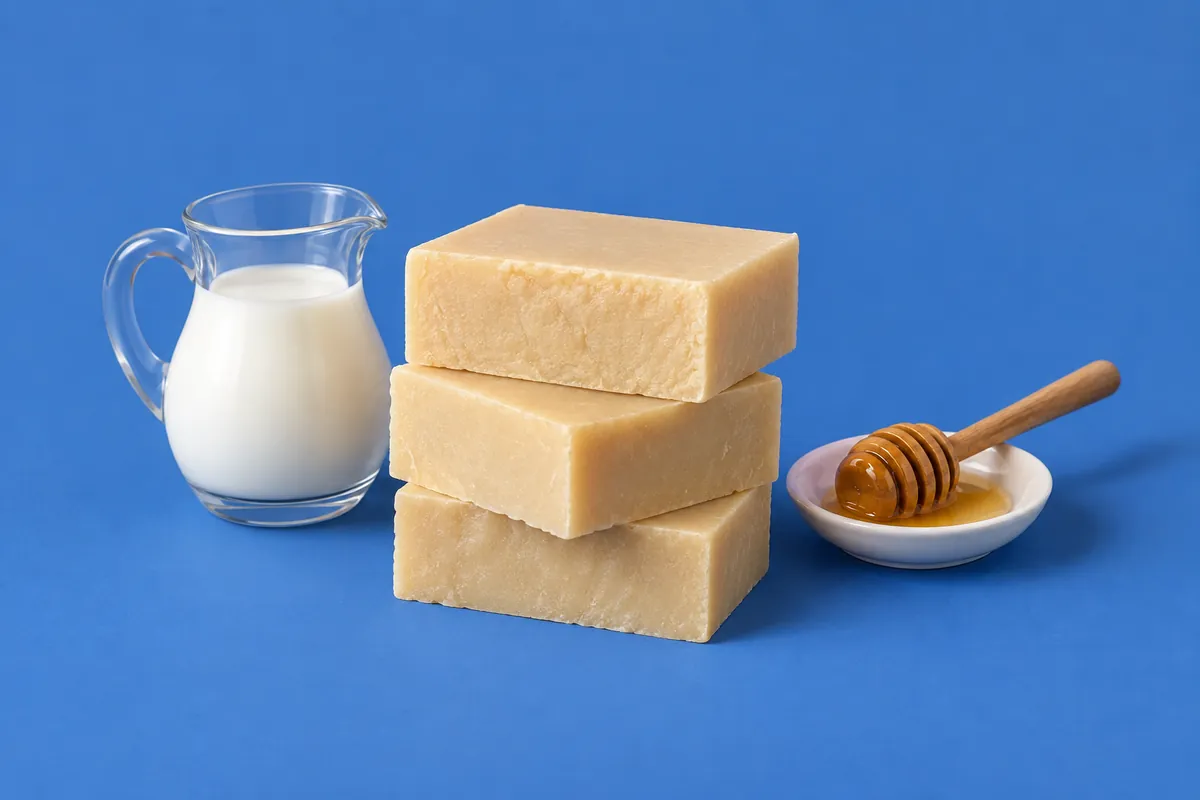
A farmhouse bar of lard, olive and coconut oil with cultured buttermilk and honey stirred in at trace. The lye goes into plain water, so the buttermilk never meets the hot solution and there is nothing to freeze.
- Skill
- Intermediate
- Method
- Cold process
- Batch
- 1000 g of oils about 1573 g of batter
- Hands-on
- 50 min
- Cure
- 6 weeks
- Gel phase
- No keep it cool
What you need
For 1000 g of oils, which fills a 1.6 litre loaf mould. Weigh everything, liquids included.
| Olive Oil · 40.0 % | 400 g | 14.11 oz |
| Lard · 30.0 % | 300 g | 10.58 oz |
| Coconut Oil · 25.0 % | 250 g | 8.82 oz |
| Castor Oil · 5.0 % | 50 g | 1.76 oz |
| Sodium hydroxide (NaOH) · the lye, 100 % pure | 141.5 g | 4.99 oz |
| Distilled water · for a 39 % lye solution | 219.6 g | 7.75 oz |
| Buttermilk, cultured · chilled; about 40 % of the water, stirred in at light trace | 170 g | 6.00 oz |
| Honey · 2 tbsp, warmed and whisked into the buttermilk | 42 g | 1.48 oz |
- Superfat
- 5 %
- Temperatures
- Lye solution and oils at 30 to 35 °C (86 to 95 °F), the buttermilk cold from the fridge
Method
-
Make the lye solution first
Put on goggles, gloves and long sleeves and work where the air moves. Sprinkle 141.5 g of sodium hydroxide into 219.6 g of cold distilled water, never the water onto the lye, stir until it clears, and leave it to cool to 30 to 35 °C (86 to 95 °F), which takes an hour or more. -
Ready the buttermilk and honey
Shake the carton, weigh 170 g of buttermilk into a jug and keep it in the fridge. Stand the honey jar in hot water until it runs, then whisk the 2 tablespoons of honey into the cold buttermilk until no streaks remain. -
Melt the oils
Melt the lard and coconut oil gently, stir in the olive and castor oils, and let them cool to 30 to 35 °C (86 to 95 °F). Line the mould and clear a shelf in the fridge. -
Blend to light trace
Pour the lye solution into the oils through a sieve and stick blend in short bursts, stirring between them, until the batter looks like thin custard and a drizzle leaves a faint trail on the surface. -
Add the buttermilk and honey
Pour in the buttermilk and honey and stick blend for 10 to 15 seconds. The batter can look curdled for a moment as the buttermilk meets the lye; a few more seconds of blending makes it smooth again. -
Pour
Honey thickens the batter quickly, so pour as soon as it is smooth, tap the mould on the bench to bring up any air, and smooth the top with a spatula. -
Chill for a day
Put the mould uncovered in the fridge for 24 hours. Buttermilk and honey both carry sugar, and kept cold the loaf stays pale instead of heating into gel and turning tan. -
Unmould and cut
Let the loaf come back to room temperature before you unmould it, or moisture beads on the cold soap. It carries more water than most bars, so wait until it is firm, usually two to three days after pouring, then cut it into bars with gloves on. -
Cure
Stand the bars on a rack with air around them for six weeks, turning them now and then. Any faint ammonia smell from the milk proteins goes in the first week or two.
Tips
- The lye solution here is about 39 %, stronger than usual, because 160 g of the recipe's water arrives later, in the buttermilk and honey. It runs hotter as it dissolves, so make it first and give it time to cool.
- Buttermilk's lactic acid uses a little of the lye, under half a gram in this batch, and the calculator adds it back. Don't discount the lye any further.
- Expect a pale caramel cream that deepens a shade over the cure, since honey darkens soap. Orange or brown patches mean the loaf got warm.
The oils
| Oil | Share |
|---|---|
| Olive Oil (virgin / refined / olive oil) | 40.0 % |
| Lard (pure rendered pork fat) | 30.0 % |
| Coconut Oil | 25.0 % |
| Castor Oil | 5.0 % |
How it is made
| Process | Cold process |
| Alkali | NaOH |
| Superfat | 5 % |
| Water | 38 % of the oils |
| Iodine value | 58 |
| INS | 150 |
Why make it
A farmhouse bar: lard for hardness and a creamy lather, olive oil for mildness and a quarter coconut for bubbles, balanced at cleansing 18 and conditioning 56 on our scale. Makers choose milk soaps for dry skin because the lather feels richer; Casey Makela, whose book on milk soaps is a standard, describes milk as making soap creamier and less drying. That is craft experience rather than tested fact. Buttermilk's lactic acid is neutralised by the lye, so the bar is no acid peel, and the sugars in the buttermilk and honey mainly lift the lather. It is unscented, a sensible choice for skin that reacts to fragrance. The caveats: lard makes it unsuitable for vegans, and a milk and honey bar needs cool handling to stay pale.
Sources
- Making Natural Milk Soap (excerpted from Milk-Based Soaps) · Storey Publishing, 1999
- The Complete Photo Guide to Soap Making · Creative Publishing International, 2018
What tradition, makers' experience and research say about soaps like this, each labelled for what it is. It is not medical advice, and no soap treats a skin condition: if you have one, ask a doctor or pharmacist.
What the numbers say
- Lauric acid 12.3 %
- Myristic acid 5.3 %
- Palmitic acid 15.3 %
- Stearic acid 6.5 %
- Ricinoleic acid 4.4 %
- Oleic acid 43.2 %
- Linoleic acid 8.0 %
- Other 6.5 %
Saturated : unsaturated 42 : 58
Computed from the fatty acids of the fats above. The bands are what the craft has settled on, not chemistry — a bar outside one is not wrong.
From the guides
All guides
Milk soap: goat milk, freezing and keeping it pale
How to make goat milk soap without scorching it: frozen milk, lye added a spoonful at a time, a cool mould, and a full recipe worked through the calculator.
Water in soap: lye concentration, water discounting and master batches
Water as % of oils, lye concentration and water:lye ratio are one number. What more or less water does to trace and cure, how low to go, and master batching.

Soap additives: salt, sugar, sodium lactate, clays, oats, silk and more
What common soap additives do, how much to use and when they go in: sourced doses for sodium lactate, salt, sugar, honey, citric acid, clays, oats and silk.
Guides with this recipe
Where these proportions come from
Our own farmhouse blend of lard, olive and coconut oil. The liquid is split the way Fisher splits it for buttermilk: the lye dissolves in plain water, and the buttermilk goes into the batter separately instead of into the hot solution. He blends it into the oils beside a one-to-one lye solution; we leave more water with the lye and add the buttermilk at light trace.
Formulation adapted from The Complete Photo Guide to Soap Making by David Fisher (Creative Publishing International, 2018). The method and notes are ours.