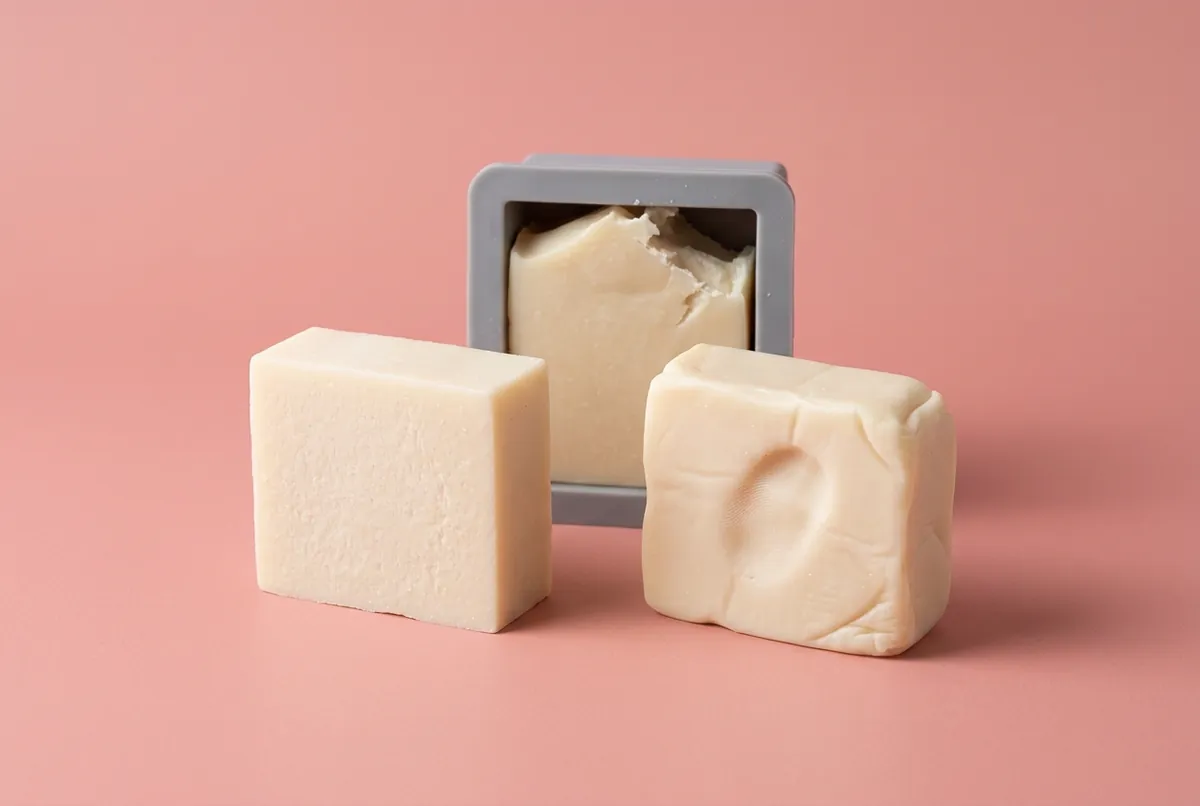
In short
- Most soft soap is wet or made of soft oils. Give it time, and next time use less water or more hard fats.
- Soft, greasy soap points to too little working lye: a weighing slip, lye that has absorbed water, or potassium hydroxide used by mistake.
- Oil pooling on the loaf, or liquid in the cut bars, is separation, and the lower layer can be caustic. Handle it with gloves, then cook it or bin it.
- Beads of liquid on cured bars in damp weather are glycerin pulling water from the air, and harmless. Weeping on fresh soap may not be.
- Rebatch only when you know what went wrong. Never add lye or oil on a guess.
On this page
A loaf that should be ready to cut is still soft after two or three days. Or it is soft and greasy, or there is oil lying on top of it, or a rack of cured bars is wet on a humid morning. These can look alike, but most are harmless and one is not. This guide sorts them out and says what to do with each.
First, what kind of soft?
| What you see | Most likely | Safe to use? |
|---|---|---|
| Soft but dry to the touch, the same all the way through | Too much water or mostly soft oils; a loaf kept cold can also need an extra day | Yes; give it time |
| Soft and greasy all through | Too little working lye, or a very high superfat | Test first |
| The batter never traced and stayed soupy | Lye missing, weak or the wrong kind | Test first |
| Oil pooling on top of the loaf, or wet pockets in the cut bars | Separation | No: gloves on |
| Clear beads on fresh soap in its first days | Possibly lye weeping from a batch that separated or was mismeasured | Test the liquid first |
| Beads or a tacky film on cured bars in damp weather | Glycerin dew | Yes |
Soft is also a matter of time. Soap Queen expects most soap to leave the mould in two or three days, and David Fisher cuts at 24 to 48 hours. Anne-Marie Faiola notes that recipes heavy in liquid oils, and soap in silicone cavity moulds, can take up to a week. Castile, made only of olive oil, stays soft for weeks and hardens over months; the high-olive bastile bar uses a 35 % lye solution for that reason and still wants eight weeks. Soap Queen’s rule of thumb is that soap still very soft after one to two weeks is unlikely to firm up much more. Skipping gel is not a cause: Dunn made one recipe gelled and ungelled and found the cured bars equally hard (see gel phase).
Too much water
Water is the commonest cause, and the easiest to fix next time. Kevin Dunn made identical soaps at three strengths of lye solution, 50, 33 and 25 %, and followed them for two months. The low-water bars were harder from the day they were unmoulded; the others caught up only slowly. In coconut oil soap, the 33 % and 25 % bars took 19 and 52 days to reach the hardness the 50 % bar had on its first day, and in his four-oil blend, 12 and 36 days. He found no danger in the low-water soaps, up to and including a 50 % solution.
The old habit of setting water as a percentage of the oils makes this worse for exactly the soaps that suffer most. DeeAnna Rouse of Classic Bells points out that water at 38 % of the oils gives a 25 % lye solution for pure olive oil soap but a 31 % solution for coconut soap: the most water goes to the slow, soft recipe that needs it least.
Liquids added later count as water too. Letcavage and Buck take the weight of any milk or herbal infusion out of the lye water; “otherwise, your soap will have too much water and will require a very long drying time”. The calculator does this for you when the liquid is entered as an additive.
Castile with less water. Pure olive oil soap with water at 38 % of the oils is a 25.3 % lye solution: 380 g of water for 1000 g of oils. At a 33 % solution it takes 261.2 g, and at 38 % only 209.9 g.
Open it in the calculatorOur castile recipe is written at a 33 % solution for that reason. At the traditional 38 % of the oils it still works, but expect a long wait before it will unmould.
For the soap in the mould now: give it time. If it is stuck in a silicone mould, freeze it: Soap Queen freezes the mould for 24 hours, Faiola freezes soap solid if it tears, and frozen soap releases because it no longer flexes. Soap Queen also suggests rebatching very wet soap to drive off some of the water. The unmoulding guide covers the rest.
Soft oils
Hardness comes mostly from the saturated fats: coconut, palm kernel, palm, lard, tallow, the butters. A recipe that is mostly olive, canola, sunflower or other liquid oils starts soft and hardens slowly. The calculator’s hardness figure shows it: our everyday bar of olive, coconut and palm oils scores 45, pure olive oil soap 17. Those quality numbers are a craft convention, not a measurement, but they track this well. A lot of castor oil makes a bar tacky rather than hard; our shampoo bar recipes warn that past about 20 % a bar stays tacky however long it cures.
Next time, move some of the liquid oil to a hard fat, or add sodium lactate. Its maker, Corbion, sells it for bar soap to increase hardness and help release from moulds. Classic Bells uses 1 to 3 % of the fat weight of the 60 % solution, and Faiola adds 1 teaspoon per pound of oils to the lye water, which in Pure Soapmaking she finds “cuts unmolding time roughly in half”. More is not better: above about 3 % Classic Bells finds bars get softer and rubbery.
Not enough working lye
Soap that is soft and greasy, rather than just soft, usually got less lye than its oils needed. There are four ways that happens.
A weighing slip. Check the scale against something of known weight, and go back over what went in. A forgotten oil does the opposite: it leaves too much lye, and the soap is harsh and crumbly, not soft.
Lye that has gone off. Sodium hydroxide takes up water and carbon dioxide from the air; its manufacturer’s handbook tells analysts to handle samples quickly for that reason. The water is dead weight, and the carbon dioxide turns part of it into sodium carbonate, which does not make soap from fat. Dunn simulated caustic soda at 95 down to 80 % purity and got softer soap. Signs to look for are beads that are clumped, damp or stuck together. A lye solution left open weakens the same way, which is why Susan Miller Cavitch covers hers as soon as it has cooled. Two checks: a fresh 50 % solution of good sodium hydroxide should heat itself to at least 82 °C (180 °F), Classic Bells finds, and Dunn notes that sodium carbonate does not dissolve in 50 % lye but floats on it. If you know the purity, divide the weight of lye by it; the calculator has a purity setting that does this. Store lye sealed and dry.
The wrong alkali. Potassium hydroxide makes soft soap, and it is also heavier for the same work. For our everyday bar, 1000 g of oils need 144.1 g of sodium hydroxide, or 224.6 g of potassium hydroxide at the usual 90 % purity. Weigh out 144.1 g of potassium hydroxide by mistake and the batch gets only 64 % of the alkali it needs. It makes a soft, greasy paste that never hardens, full of unsaponified oil, though it is not caustic. Washing soda, which is sodium carbonate, used by mistake gives batter that never traces at all. The reverse mistake is dangerous: sodium hydroxide weighed out at the potassium hydroxide figure, 224.6 g where 144.1 g is right, is 56 % more alkali than the oils can use. That batch is badly lye-heavy and should be binned. The NaOH and KOH guide explains the conversion.
Something that ate the lye. Acids use up lye: every 10 g of citric acid neutralises 6.25 g of sodium hydroxide, and vinegar and lemon juice do the same. Dunn measured that goat milk used in place of water takes 4 to 6 % of the lye in a typical soap. Enter acids in the calculator as additives and it adds the lye they need; left out of the recipe, they add to the superfat and soften the bar. Milk is different: the lye it uses already acts as a small extra discount, so Dunn advises against cutting the lye any further for it.
Poor mixing and false trace
A batch poured before the oils and lye were truly emulsified can set soft and uneven, with greasy patches or pockets. Anne Watson points out that a stick blender mixes fat and lye down to a microscopic level, so the batter does not need to reach thick trace, only a real emulsion. The trap is false trace: hard fats setting in batter that is too cool, which looks like trace but isn’t. Cocoa butter melts at 31 to 35 °C and shea butter at 33 to 40.5 °C, by the figures on our oil pages, so room-temperature lye poured into oils only just above those temperatures can chill them solid. Modern Soapmaking places false trace below about 29 °C (85 °F) and warns that pouring it leads to lye pockets. Keep blending until the batter is smooth; the trace guide shows the difference.
Separation in the mould
Separation is the one soft-soap problem that is a safety problem. Oil pools on the batter or on the poured loaf, sometimes over a pale, grainy base like porridge with melted butter on it; later the cut bars can have wet pockets, an oily top and a hard, chalky bottom.
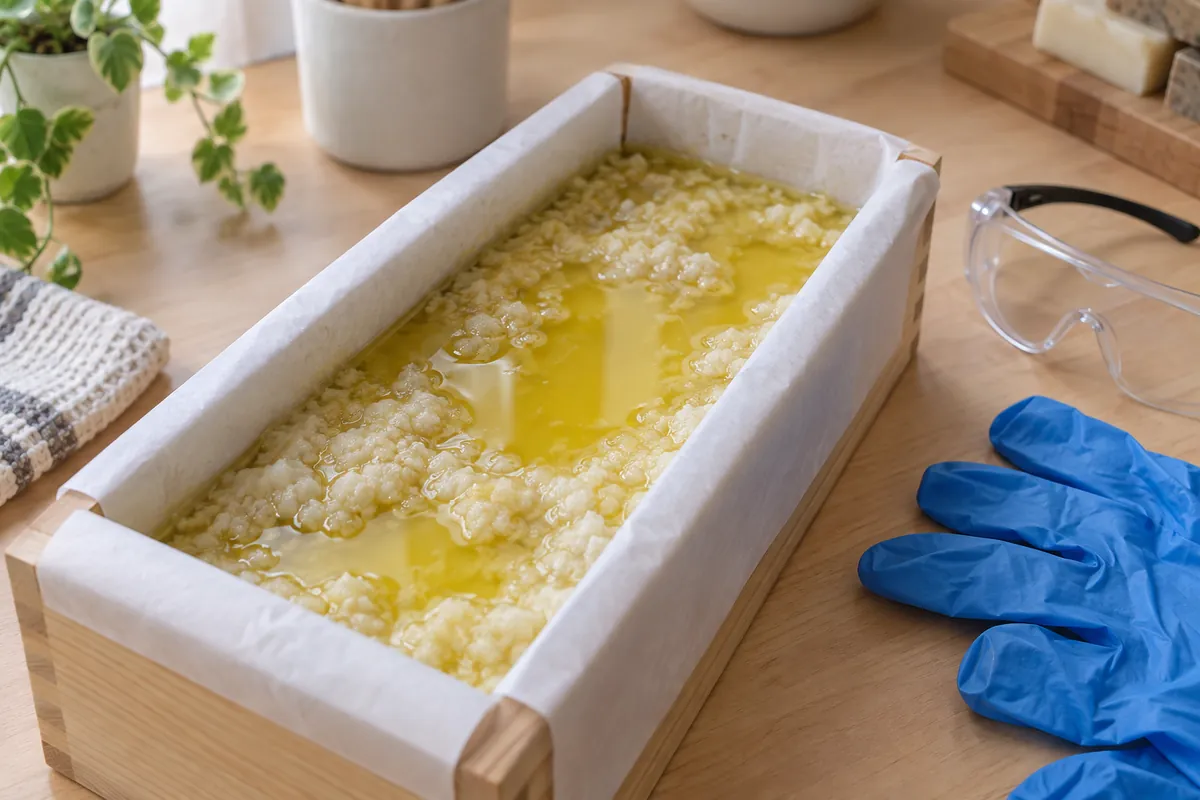 A separated loaf: oil has floated to the top, and the soap underneath may be carrying the lye the oil never met.
Dunn saw why it matters. His pure olive oil soaps at 33 % and 25 % lye solutions never traced and separated in the mould: “a chalky, lye-heavy soap settled to the bottom of each mold and unsaponified oil rose to the top.” His four-oil blend at 25 % separated partly, acidic on the oily top and alkaline at the bottom. He mixed each soap by shaking it for 15 seconds on a paint shaker and swirling it, not with a stick blender, so a stick-blended batch is less likely to separate; but the direction holds. Slow, oleic-rich recipes with a lot of water separate most easily, and less water helps.
The other usual causes are batter poured before it emulsified or at false trace, a fragrance that will not mix in (see seizing and ricing), weak lye, potassium hydroxide used by mistake, and, rarely, severe overheating. Too much essential oil can look like it: Cavitch found the excess lying in small puddles on a slick, hard block, and bars that may stay somewhat greasy and never harden properly.
The soap boilers’ rule explains why a rescue cook can mend a separated batch but not a wrong recipe. Soap that is greasy and caustic at once, Simmons and Appleton wrote in 1908, shows “incomplete saponification”, which “can only be remedied by further heating” and mixing: the lye and the oil are both there and have not finished meeting. Soap that is greasy because it was short of lye has nothing left to react with.
What to do:
- Still in the pot: keep stick blending to bring it back together. It may thicken fast when it does.
- In the mould, still soft, within about a day: cook it. Scrape it into a stainless steel pot or a slow cooker, heat it gently and stir until it is one even, gelatinous mass, then press it into moulds. Soap Queen finds this rescue works up to about 24 hours after the batch went wrong; Faiola notes it does not always work. Test the bars once they have set.
- Set hard, with liquid pockets or a caustic layer: bin it.
Sweating and glycerin dew
Beads of liquid or a tacky film on cured bars, usually in humid weather or after bars come out of the fridge, are glycerin dew. Every batch of cold process soap keeps the glycerin that saponification releases, about 0.77 g for every gram of sodium hydroxide, or some 110 g for every 1000 g of oils in our everyday bar. Glycerin is a humectant. It takes up or gives off water until it matches the air around it, and the damper the air, the more it holds: the Glycerine Producers’ Association’s tables show glycerin in balance with air at 50 % relative humidity is 79 % glycerin, and at 80 % only about half. Bramble Berry sees cold process soap start to sweat when the humidity climbs above roughly 70 to 80 %.
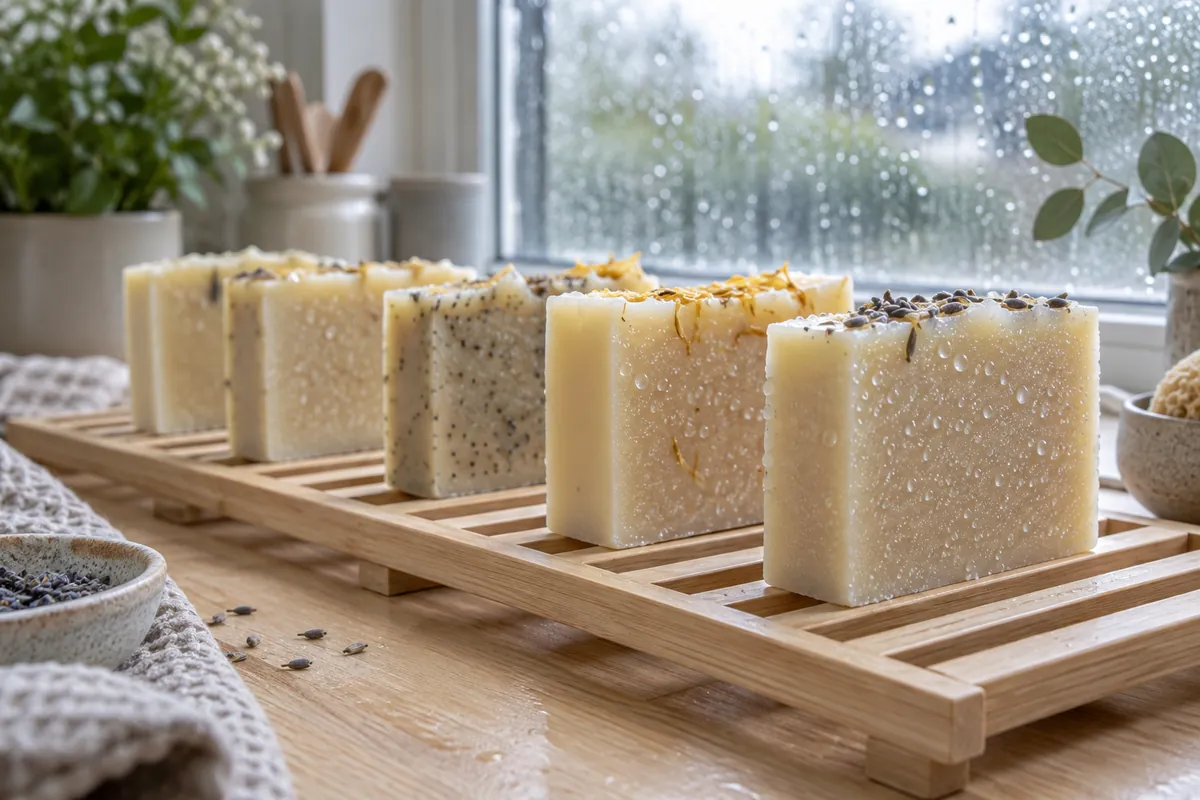 Glycerin dew on cured bars on a damp day. It dries off when the air does.
Some ingredients add to it:
- Salt. Sodium chloride takes water from air above about 75 % relative humidity, so salt bars can sweat in damp weather for months. Dead Sea salt contains magnesium chloride, which does so from about 33 %, air drier than most homes. Fisher warns that Dead Sea and Epsom salts, with their magnesium, turn a salt bar mushy.
- Honey, and castor oil above about 10 %, both named by Bramble Berry.
- Extra glycerin. Melt and pour bases carry much more of it, which is why they sweat most. Dunn found his high-glycerin transparent soaps sweated in humid air, and more with more glycerin.
- A cold bar in a warm room. Soap out of the fridge or freezer collects condensation.
What to do: pat the bars dry, move them to a drier room with a fan for a day or two, then wrap them. Bramble Berry advises keeping the curing room below about 50 to 60 % relative humidity, and wrapping bars once they have cured. The soap is fine.
One caution: beads on fresh cold process soap in its first days are not always dew. Liquid weeping from a batch that separated can be lye solution. If fresh soap weeps, handle it with gloves and test the liquid before deciding it is harmless.
Wait, rebatch or bin
| Situation | What to do |
|---|---|
| Soft but dry and even, and the numbers check out | Wait. Freeze to release it from the mould, then give it a longer cure |
| Soft because of too much water | Wait, or rebatch it to drive some water off |
| Greasy from a high superfat or an uncounted acid, but not caustic | Use it, but store it cool and use it first: extra free oil goes rancid sooner |
| Potassium hydroxide used by mistake | Bin it, or cook in the calculated sodium hydroxide if you know exactly what went in |
| Separated, still soft, within about a day | Cook it, then test |
| Set with liquid pockets, or a chalky layer that stings | Bin it, with gloves on |
| Sweating | Dry it and wrap it; nothing is wrong with the soap |
Rebatching is only a fix when you know what went wrong and by how much; the rebatching guide explains how to do it with the numbers. Adding lye or oil on a guess turns one problem into two.
Recipes to try
All recipesSources
- The 'Water Discount' . Kevin M. Dunn, The Handcrafted Soapmaker 2008-2 , 2008. Soaps at 50, 33.3 and 25 % lye concentration: hardness and moisture over 60 days; high-water olive soaps separated into chalky, lye-heavy soap under a layer of oil.
- Little White Lyes . Kevin M. Dunn, lecture to the Handcrafted Soap and Cosmetic Guild , 2015. Caustic soda picks up water and carbon dioxide; soap made with simulated 95 to 80 % pure caustic soda was softer; correct by dividing by the purity.
- Caustic Soda Handbook . Occidental Chemical Corporation (OxyChem) , 2026.
- Humidity fixed points of binary saturated aqueous solutions . L. Greenspan, Journal of Research of the National Bureau of Standards 81A(1):89-96 , 1977. Sodium chloride 75.3 % and magnesium chloride 32.8 % relative humidity at 25 °C.
- Physical Properties of Glycerine and its Solutions . Glycerine Producers' Association , 1963. Table 15: glycerol solutions in equilibrium with air at 25 °C.
- Transparency and Meltability in Hot-Process Soap . Kevin M. Dunn, lecture to the Handcrafted Soapmakers Guild , 2012.
- PURASAL S/HQ 60 sodium lactate for bar soap . Corbion .
- NaOH or KOH purity check . DeeAnna Rouse, Classic Bells .
- Full water and other drippy myths . DeeAnna Rouse, Classic Bells .
- Soapy Mess-Up Quick Guide . Soap Queen (Bramble Berry) , 2015.
- Why Is My Cold Process Soap Sweating? . Bramble Berry , 2026.
- Time and Temperature in Soapmaking . Kevin M. Dunn, lecture to the Handcrafted Soapmakers Guild , 2009. Gelled and ungelled soaps from one recipe had the same consistency, alkalinity and hardness.
- Protein in Handcrafted Soap . Kevin M. Dunn, Handcrafted Soap and Cosmetic Guild , 2014. Milk consumes 4 to 6 % of the lye in a typical soap.
- Controlling trace in cold process soapmaking . Modern Soapmaking . False trace below about 85 °F (29 °C), and lye pockets if it is poured.
- Soap Crafting . Anne-Marie Faiola, Storey Publishing , 2013.
- The Complete Photo Guide to Soap Making . David Fisher, Creative Publishing International , 2018.
- Smart Soapmaking . Anne L. Watson, Shepard Publications , 2013.
- Making Natural Milk Soap (excerpted from Milk-Based Soaps) . Casey Makela, Storey Publishing , 1999. Read in the 1999 excerpt, Making Natural Milk Soap.
- Pure Soapmaking . Anne-Marie Faiola, Storey Publishing , 2016. Sodium lactate at 1 teaspoon per pound of oils in the lye water, cutting unmoulding time roughly in half.
- Basic Soap Making . Elizabeth Letcavage and Patsy Buck, Stackpole Books , 2009. Water in the lye solution reduced by the weight of any milk or infusion added, or the soap takes a very long time to dry.
- The Natural Soap Book . Susan Miller Cavitch, Storey Publishing , 1995. Excess essential oil pooling on a slick, hard block and leaving bars greasy; lye solution covered once cool, since air weakens it.
- The Handbook of Soap Manufacture . W. H. Simmons and H. A. Appleton, Scott, Greenwood & Son (Project Gutenberg edition) , 1908. A greasy, soft feel together with free caustic as the sign of incomplete saponification, remedied by further heating and mixing.
- The Everything Soapmaking Book, 3rd edition . Alicia Grosso, Adams Media , 2013. A block leaking caustic lye solution as the sign of a mismeasured batch.