Egg yolk feather swirl bar
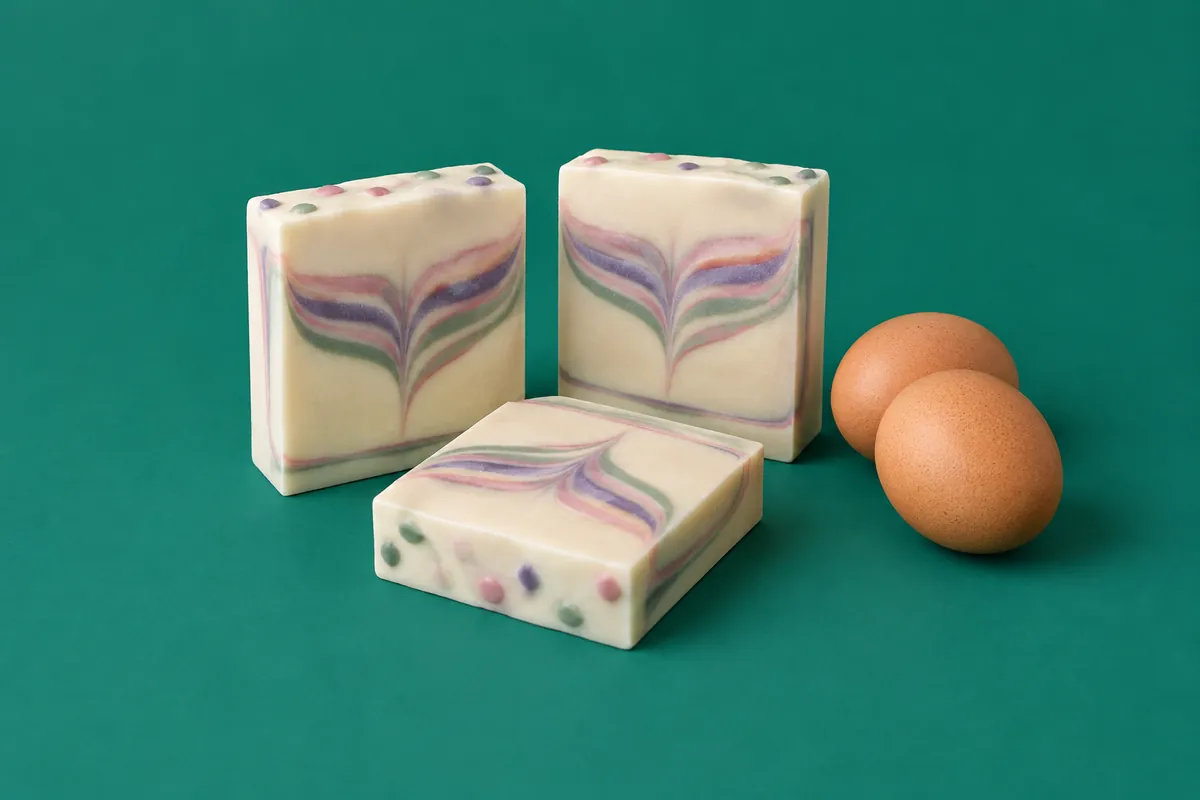
Two egg yolks stirred in at very thin trace, kept cool so they never cook, and a hidden feather of pink, violet and green layers dragged down through the middle of every bar. Palm-free, with a white top dotted in the same colours and a lavender and litsea scent.
- Skill
- Advanced
- Method
- Cold process
- Batch
- 900 g of oils about 1369 g of batter
- Hands-on
- 1 h 40 min
- Cure
- 6 weeks
- Gel phase
- No keep it cool
What you need
For 900 g of oils, which fills a 25 × 9 cm loaf mould filled 6 cm deep (about 1.4 litres), with two card dividers and a wire hanger tool. Weigh everything, liquids included.
| Coconut Oil · 26.0 % | 234 g | 8.25 oz |
| Olive Oil · 22.0 % | 198 g | 6.98 oz |
| Rapeseed Oil - Low Erucic Acid · 17.0 % | 153 g | 5.40 oz |
| Shea Butter · 14.0 % | 126 g | 4.44 oz |
| Cocoa Butter · 10.0 % | 90 g | 3.17 oz |
| Almond Oil · 5.0 % | 45 g | 1.59 oz |
| Avocado Oil · 3.0 % | 27 g | 0.95 oz |
| Castor Oil · 3.0 % | 27 g | 0.95 oz |
| Sodium hydroxide (NaOH) · the lye, 100 % pure | 125.6 g | 4.43 oz |
| Distilled water · for a 31 % lye solution | 274.1 g | 9.67 oz |
| Egg yolks, at room temperature · 2 large yolks, whisked into 60 g of the recipe's olive oil and poured in through a sieve at very thin trace | 36 g | 1.27 oz |
| Titanium dioxide · 2 tsp, the white batter, dispersed in 36 g of the recipe's sweet almond oil | 9.4 g | 0.33 oz |
| Ultramarine pink · 0.13 tsp, pink jug only, dispersed in ½ tsp (2 g) of the recipe's sweet almond oil | 0.5 g | 0.02 oz |
| Ultramarine violet · 0.13 tsp, violet jug only, dispersed in ½ tsp (2 g) of the recipe's sweet almond oil | 0.5 g | 0.02 oz |
| Chromium oxide green · 0.13 tsp, green jug only, dispersed in ½ tsp (2 g) of the recipe's sweet almond oil | 0.6 g | 0.02 oz |
| Isopropyl (rubbing) alcohol, 91 to 99 %, in a spray bottle · misted over the finished top to keep soda ash off; it evaporates and is not part of the soap | 30 ml | |
| Lavender oil · 2.0 % of the oils, at trace | 18 g | 0.63 oz |
| Litsea oil (May Chang) · 0.5 % of the oils, at trace | 4.5 g | 0.16 oz |
- Superfat
- 5 %
- Temperatures
- Oils and lye solution at 32 to 35 °C (90 to 95 °F), the eggs at room temperature
Method
-
Make the tools
Straighten a wire coat hanger, bend one end up as a handle, and thread drinking straws onto the wire to cover a straight run as long as the inside of the mould less 1 cm; then bend the other end up as a second handle. The straws thicken the wire for a bolder feather. Cut two strips of stiff card as long as the mould and 2 cm taller, and wrap them in packing tape. -
Get ready
Put on goggles, gloves and long sleeves and open a window. Line the mould and set it level where it can stay, with the dividers, the hanger, three small jugs and four squeeze bottles in reach. -
Separate the yolks
Let 2 large eggs come to room temperature, separate them and keep the whites for the kitchen. Weigh 60 g of the recipe's olive oil into a cup and whisk the yolks, about 36 g, into it. Wash your hands and the bowl. -
Disperse the colours
Weigh the sweet almond oil and take 42 g of it. Stir the titanium dioxide into 36 g in a jug, and the ultramarine pink, the ultramarine violet and the chromium green each into ½ teaspoon (2 g) in its own small jug, until smooth. -
Make the lye solution
Where the air moves, pour the 125.6 g of sodium hydroxide slowly into the 274.1 g of water, never the reverse (the yolks bring about 19 g more), and stir until clear. Leave it labelled and out of reach to cool to 32 to 35 °C (90 to 95 °F). -
Melt and scent the oils
Melt the coconut oil, cocoa butter and shea butter, stir in the canola, avocado and castor oils and the rest of the olive and almond oils, and let them cool to 32 to 35 °C (90 to 95 °F); much cooler, and the butters start to thicken the batter. Stir in the lavender and litsea oils. -
Blend to very thin trace
Pour the lye solution in down the blender shaft, tap out trapped air, and blend in short pulses only until the batter is smooth and opaque, thin as single cream. -
Add the yolks
Pour the yolk and oil through a sieve into the batter and whisk them in by hand. Keep the batter thin from here on: the layers need time. -
Colour the portions
Pour about 55 g of batter into each small jug and whisk them pink, violet and green. Whisk the white into the batter left in the pot and set about 300 g of it aside in a jug for the top. -
Pour the base and set the dividers
Pour white into the mould about 1.2 cm deep, some 270 g, then push the two dividers into it lengthwise, 3 cm apart down the middle, and tape a tab from each end to the rim. -
Stack the middle
Fill the squeeze bottles, one with each colour and one with white from the pot. Squeeze a thin layer of green into the centre channel, then white, pink, white, violet and white, and go round again until the centre is about 3.5 cm deep, keeping a tablespoon of each colour back. Gaps in a layer are fine. -
Fill the sides
Pour white into the two outer channels, a little on each side in turn so the dividers stay upright, until they reach the depth of the centre. -
Lift the dividers
Untape the tabs and pull the dividers straight up, slowly, one at a time. -
Draw the feather
Push the hanger straight down through the middle of the coloured layers until the straws lie on the bottom along the whole length. Slide it across the bottom to one side, draw it up that wall and lift it out. -
Top it
Whisk the reserved white and pour it gently over the top in a back-and-forth pattern. Squeeze a green squiggle down the length, a pink dot in each curve, and a smaller violet dot on each pink one. -
Leave it uncovered
Mist the top with alcohol, away from any flame, and leave the mould uncovered in a cool room for 24 to 48 hours, with no towel, so the loaf stays cool and does not gel. -
Unmould and cut
Unmould with gloves on once firm, usually after 2 days, and cut bars about 2.5 cm (1 in) thick: each shows the coloured layers pulled down into a feather through its middle. -
Cure
Stand the bars on edge with air between them, out of direct sun, for 6 weeks, turning them every few days.
Tips
- Faiola keeps the oils and lye at 29 to 35 °C (85 to 95 °F) so the yolk cannot cook, and leaves the loaf uncovered for the same reason. We work at the top of her window because this blend's butters thicken cool batter, and the feather needs it thin; room-temperature eggs keep the yolk from chilling it.
- Egg yolk tints the batter, so the white here comes out a warm ivory rather than bright white.
- Practise the hanger's path in the empty mould first: straight down, across the floor, up one side. The straws must clear both end walls.
- Name the egg on the label if you sell or give the soap away: people with an egg allergy will want to know.
The oils
| Oil | Share |
|---|---|
| Coconut Oil | 26.0 % |
| Olive Oil (virgin / refined / olive oil) | 22.0 % |
| Rapeseed Oil - Low Erucic Acid (Canola Oil) | 17.0 % |
| Shea Butter | 14.0 % |
| Cocoa Butter (Theobroma Oil) | 10.0 % |
| Almond Oil (Sweet Almond Oil) | 5.0 % |
| Avocado Oil | 3.0 % |
| Castor Oil | 3.0 % |
How it is made
| Process | Cold process |
| Alkali | NaOH |
| Superfat | 5 % |
| Water | lye water at 30 % |
| Iodine value | 61 |
| INS | 144 |
Why make it
A showpiece for a maker with a few loaves behind them: the hidden feather takes dividers, squeeze bottles and a steady hand, and people turn the finished bar over to look at it. The base is balanced, cleansing 18 and conditioning 58 on our scale, palm-free and lightly scented with lavender and litsea. Egg yolk is a kitchen-cupboard addition makers value for a dense, creamy lather and a warm ivory colour, and Anne-Marie Faiola adds it for the vitamins in the yolk. In soap most of the yolk's fat simply becomes more soap, and we know of no testing of egg in a rinse-off bar, so its reputation rests on makers' experience. Anyone with an egg allergy should pass this one by, and the label should say egg.
Sources
- Pure Soapmaking · Storey Publishing, 2016
What tradition, makers' experience and research say about soaps like this, each labelled for what it is. It is not medical advice, and no soap treats a skin condition: if you have one, ask a doctor or pharmacist.
What the numbers say
- Lauric acid 12.8 %
- Myristic acid 4.9 %
- Palmitic acid 10.1 %
- Stearic acid 11.2 %
- Ricinoleic acid 2.7 %
- Oleic acid 42.9 %
- Linoleic acid 9.9 %
- α-Linolenic acid 2.0 %
- Other 5.6 %
Saturated : unsaturated 42 : 58
Computed from the fatty acids of the fats above. The bands are what the craft has settled on, not chemistry — a bar outside one is not wrong.
From the guides
All guides
Soap additives: salt, sugar, sodium lactate, clays, oats, silk and more
What common soap additives do, how much to use and when they go in: sourced doses for sodium lactate, salt, sugar, honey, citric acid, clays, oats and silk.
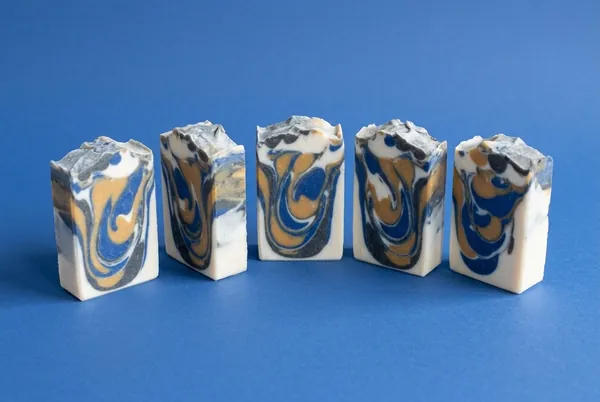
Swirl techniques: in the pot, drop, hanger, spoon and Taiwan
Seven cold-process swirls step by step, with the batter, recipe and temperatures that keep soap fluid, and why swirls turn muddy or lumpy.
Where these proportions come from
Adapted from Anne-Marie Faiola's egg yolk secret-feather swirl: her canola, olive, sweet almond, castor and coconut oils with the palm and palm kernel replaced by cocoa butter, shea butter and a little more coconut oil, avocado oil for her avocado butter, and the yolks whisked into part of the olive oil and added at very thin trace inside her cool temperature window. We use ultramarine violet for her mixed purple and cut her scent from 4.2 % of the oils to 2.5 %.
Formulation adapted from Pure Soapmaking by Anne-Marie Faiola (Storey Publishing, 2016). The method and notes are ours.