Fast-curing bar
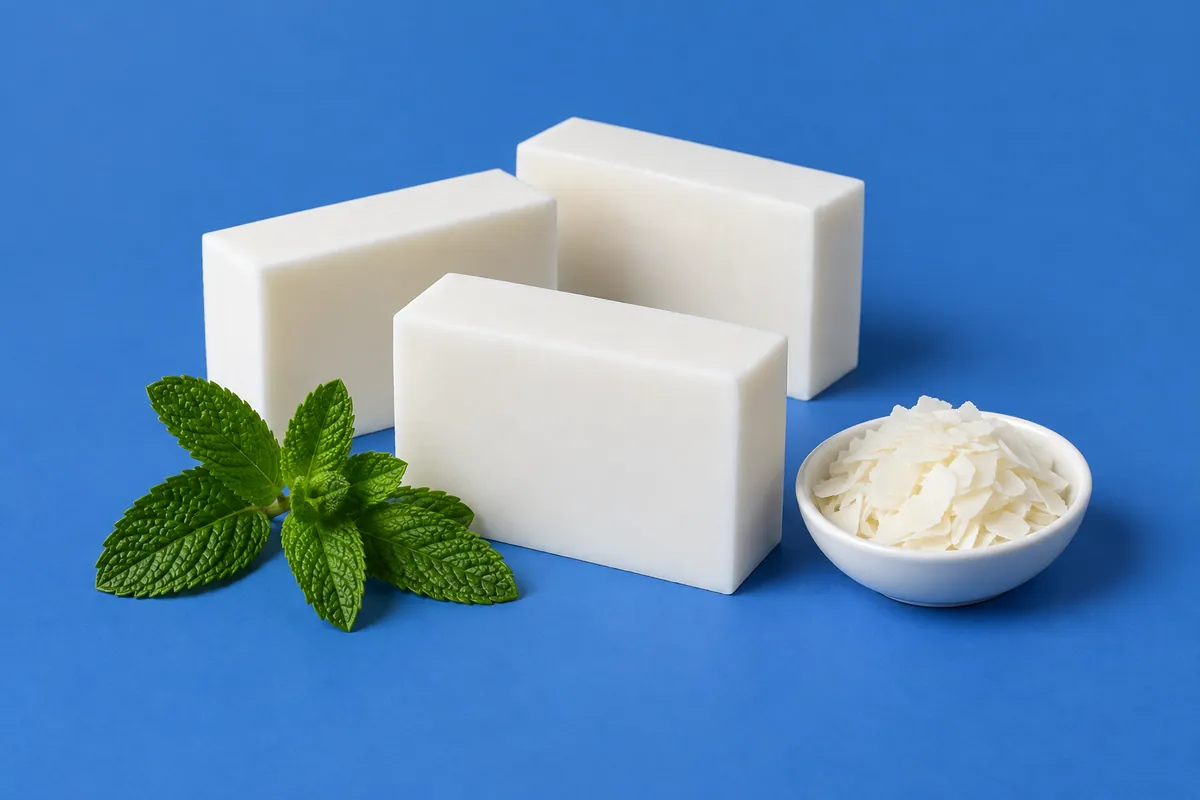
A hard, bubbly peppermint bar made with less water and plenty of hard fat, so it can be used after about three weeks. Palm stearin and a strong lye solution make it trace fast: have everything ready, and keep this one for your second batch or later.
- Skill
- Intermediate
- Method
- Cold process
- Batch
- 1000 g of oils about 1378 g of batter
- Hands-on
- 50 min
- Cure
- 3 weeks
- Gel phase
- Either way gel or not, both work
What you need
For 1000 g of oils, which fills a 1.5 litre loaf mould. Weigh everything, liquids included.
| Coconut Oil · 30.0 % | 300 g | 10.58 oz |
| Palm Stearin · 30.0 % | 300 g | 10.58 oz |
| Olive Oil · 30.0 % | 300 g | 10.58 oz |
| Castor Oil · 10.0 % | 100 g | 3.53 oz |
| Sodium hydroxide (NaOH) · the lye, 100 % pure | 143.3 g | 5.05 oz |
| Distilled water · for a 40 % lye solution | 214.9 g | 7.58 oz |
| Peppermint essential oil · 2.0 % of the oils, at trace | 20 g | 0.71 oz |
- Superfat
- 5 %
- Temperatures
- Oils at 45 to 50 °C (113 to 122 °F), lye solution at 40 to 45 °C (104 to 113 °F)
Method
-
Get everything ready first
Put on splash goggles, nitrile gloves and long sleeves, open a window or turn on the extractor fan, and keep children and pets out of the room. Line the mould and put it right beside the pot: this batter can go from thin to thick within a couple of minutes. -
Weigh the oils and the peppermint
Weigh 300 g palm stearin and 300 g coconut oil into the pot, and 300 g olive oil and 100 g castor oil into a jug. Weigh 20 g peppermint essential oil into a small glass cup. -
Make the strong lye solution
Weigh 214.9 g distilled water into a heat-safe jug and 143.3 g sodium hydroxide into a small dry container. In a well-ventilated spot, pour the lye slowly into the water, never the water onto the lye, and stir until completely clear with no grains left on the bottom. A solution this strong gets hotter and takes longer to dissolve than usual; leave it to cool to 40 to 45 °C (104 to 113 °F), labelled and out of reach. -
Melt the palm stearin and coconut oil
Melt them together on low heat until completely clear with no flakes left; palm stearin needs more heat than most fats, often 55 to 60 °C (131 to 140 °F). Then pour in the olive and castor oils. -
Check the temperatures
Carry on when the oils are between 45 and 50 °C (113 and 122 °F) and the lye solution between 40 and 45 °C (104 and 113 °F). Palm stearin starts to set below about 44 °C (111 °F), and cool oils give a false trace that looks thick but has not emulsified. -
Add the peppermint to the oils
Stir the peppermint oil into the warm oils now, so there is nothing left to add once the batter starts to thicken. -
Combine
Pour the lye solution into the oils over the spatula and stir by hand for 30 seconds with the stick blender switched off. -
Blend only briefly
Give two or three pulses of a few seconds each, then stir by hand. Stop at the first light trace, usually within a minute or two; the batter keeps thickening in the mould, so do not chase a thick trace in the pot. -
Pour at once
Pour into the mould straight away, tap it on the worktop, smooth the top and cover it with a lid or board. It needs no towel: it heats and gels on its own. If the top starts to crack, take the lid off and move the mould somewhere cooler. -
Clean up with your gloves on
Wipe the raw batter off the pot and tools with paper towels into the bin, then wash everything in hot soapy water. -
Unmould and cut early
After 12 to 24 hours, when the loaf has cooled and feels firm, unmould it with gloves on and cut it into bars about 2.5 cm (1 in) thick. Cut it that day: hard stearin soap turns brittle within a few days and can crumble under the knife. -
Cure
Stand the bars on edge in a dry, airy room for three weeks, turning them every few days. They are ready to use then, and a fourth week makes them a little milder still.
Tips
- Palm stearin is the high-melting part of palm oil, usually sold as flakes, and not the same as palm oil: the two take different amounts of lye. Buy it certified by the Roundtable on Sustainable Palm Oil (RSPO).
- If the batter turns thick and grainy the moment the lye goes in, it is probably false trace from the stearin setting. Pulse a few seconds more: false trace thins again as the batter warms, where true trace keeps thickening.
- Weigh one bar every few days while it cures. When it stops getting lighter it has finished drying, which is the surest sign it is ready.
- Keep swirls and layers for slower recipes; this one gives you no time. For a relaxed first batch, make Everyday bar, the usual three.
The oils
| Oil | Share |
|---|---|
| Coconut Oil | 30.0 % |
| Palm Stearin | 30.0 % |
| Olive Oil (virgin / refined / olive oil) | 30.0 % |
| Castor Oil | 10.0 % |
How it is made
| Process | Cold process |
| Alkali | NaOH |
| Superfat | 5 % |
| Water | lye water at 40 % |
| Iodine value | 51 |
| INS | 161 |
Why make it
Much of a cure is simply drying, and as Anne L. Watson writes, drying time depends on how much water the soap was made with. This bar starts with about a quarter less water than a standard recipe and 60 % hard fats, so it is firm enough to use after about three weeks rather than four to six. On our scale it reads hardness 50 and cleansing 21, with a big, bubbly lather helped by 10 % castor oil. Makers reach for a recipe like this before a market or when presents are due soon. The catch is at the pot rather than in the bathroom: a strong lye solution and palm stearin trace fast, so it is not a first batch. The bars still grow a little milder with a fourth week.
Sources
- Smart Soapmaking, by Anne L. Watson · Shepard Publications, 2013
What tradition, makers' experience and research say about soaps like this, each labelled for what it is. It is not medical advice, and no soap treats a skin condition: if you have one, ask a doctor or pharmacist.
What the numbers say
- Lauric acid 14.8 %
- Myristic acid 6.1 %
- Palmitic acid 25.3 %
- Stearic acid 3.5 %
- Ricinoleic acid 8.9 %
- Oleic acid 31.1 %
- Linoleic acid 6.6 %
- Other 5.5 %
Saturated : unsaturated 53 : 47
Computed from the fatty acids of the fats above. The bands are what the craft has settled on, not chemistry — a bar outside one is not wrong.
Try it differently
2 variationsThe same soap with one thing moved. Each opens in the calculator ready to change again.
From the guides
All guides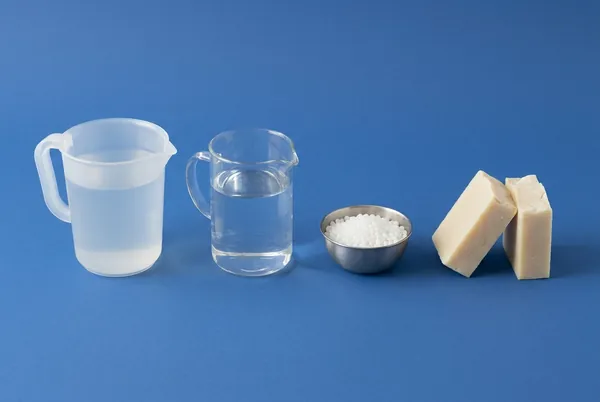
Water in soap: lye concentration, water discounting and master batches
Water as % of oils, lye concentration and water:lye ratio are one number. What more or less water does to trace and cure, how low to go, and master batching.
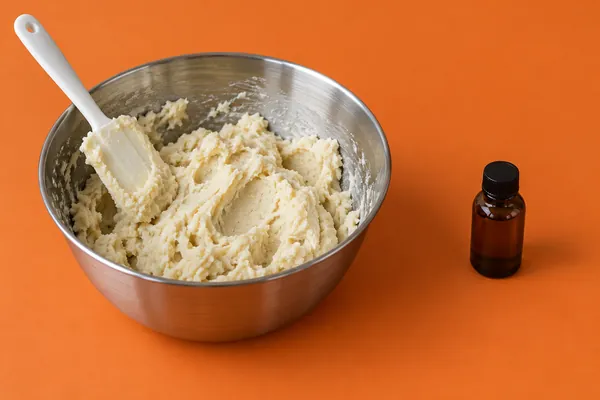
Seizing, ricing and acceleration
Why soap batter suddenly thickens, sets solid or turns lumpy, which fragrances and conditions cause it, what to do mid-batch, and how to test a new scent small.
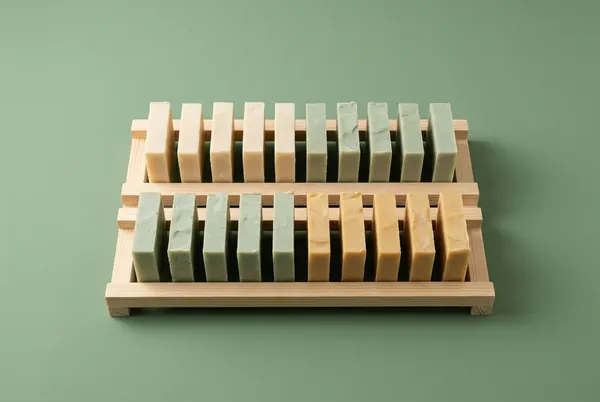
Curing and storing handmade soap
What curing does to cold process soap and what it doesn't, how long it takes, how to set bars up to cure, how to tell when they're done, and how to store them.
Where these proportions come from
Our own construction: high saturated fat and a steep water discount, the two levers that shorten a cure. Coconut oil and palm stearin make up 60 % of the oils for a bar that is hard from the start, and the lye is dissolved as a 40 % solution, so there is less water to dry out.