Hot-process clay swirl bar
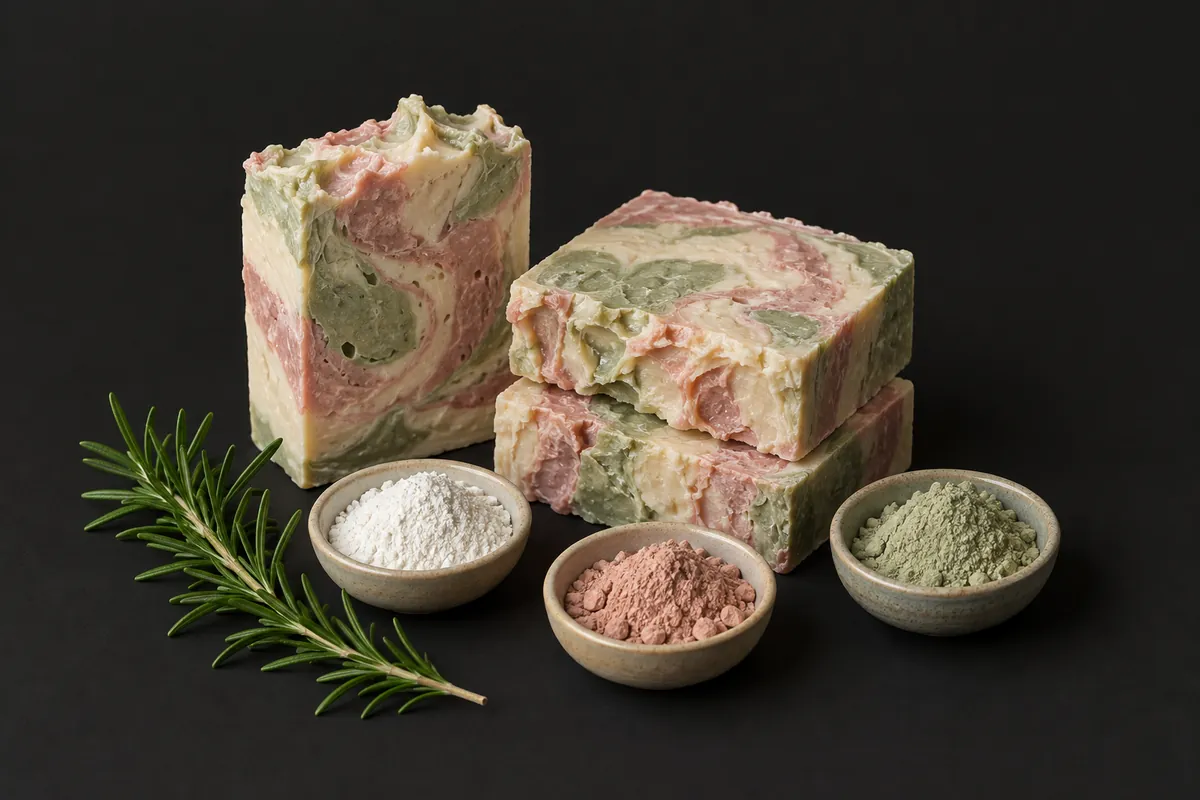
A hot process bar coloured after the cook with three clays, kaolin cream, rose pink and French green, spooned into the mould in blobs and swirled once with a chopstick. The cook uses up the lye first, so the clays and the lavender, rosemary and clary sage scent go into finished soap. Palm-free.
- Skill
- Advanced
- Method
- Hot process
- Batch
- 1000 g of oils about 1552 g of batter
- Hands-on
- 2 hours
- Cure
- 4 weeks
- Gel phase
- In the pot it gels as it cooks
What you need
For 1000 g of oils, which fills a 1.8 litre loaf mould. Weigh everything, liquids included.
| Olive Oil · 55.0 % | 550 g | 19.40 oz |
| Coconut Oil · 30.0 % | 300 g | 10.58 oz |
| Shea Butter · 10.0 % | 100 g | 3.53 oz |
| Castor Oil · 5.0 % | 50 g | 1.76 oz |
| Sodium hydroxide (NaOH) · the lye, 100 % pure | 139.9 g | 4.93 oz |
| Distilled water · 272 g for a 34 % lye solution, 72 g set aside | 344.4 g | 12.15 oz |
| Sodium lactate (60 % solution) · 2 tsp, warmed, stirred in after the cook to loosen the soap | 13.1 g | 0.46 oz |
| Kaolin clay · 2 tsp, after the cook, in one third, mixed with 16 g of the held-back water | 5.5 g | 0.19 oz |
| Rose clay · 2 tsp, after the cook, in one third, mixed with 19 g of the held-back water | 6.3 g | 0.22 oz |
| French green clay · 1 tbsp, after the cook, in one third, mixed with 37 g of the held-back water | 12.5 g | 0.44 oz |
| Lavender essential oil · 1.5 % of the oils, after the cook | 15 g | 0.53 oz |
| Rosemary essential oil · 1.0 % of the oils, after the cook | 10 g | 0.35 oz |
| Clary sage essential oil · 0.5 % of the oils, after the cook | 5 g | 0.18 oz |
- Superfat
- 6 %
- Temperatures
- Oils and lye solution below 77 °C (170 °F) when they meet, cooked on the slow cooker's low setting, scent and colour in below 82 °C (180 °F)
Method
-
Get ready
Put on splash goggles, gloves and long sleeves and keep them on until the soap is in the mould: hot, uncooked batter is caustic and sticks to skin. Set a slow cooker of at least 3.5 litres to low, line the mould, and warm three heatproof bowls and three spoons with hot water. -
Weigh everything
Weigh 550 g olive oil, 300 g coconut oil, 100 g shea butter and 50 g castor oil into the slow cooker. Weigh 344.4 g distilled water into the lye jug, pour 72 g of it back out into three cups, 16 g, 19 g and 37 g, and weigh 139.9 g sodium hydroxide into a dry container. -
Mix the clays
Stir 2 tsp (5.5 g) kaolin into the 16 g cup, 2 tsp (6.3 g) rose clay into the 19 g cup and 1 tbsp (12.5 g) French green clay into the 37 g cup, each until smooth. Set them by the cooker with 2 tsp (13.1 g) sodium lactate and 15 g lavender, 10 g rosemary and 5 g clary sage essential oil. -
Make the lye solution
Where the air moves, pour the sodium hydroxide slowly into the rest of the water, never the reverse, and stir until clear. With a fifth of the water set aside it gets hotter than usual, so stir gently with your face well back, and let it cool to below 77 °C (170 °F). -
Blend to trace
Melt the oils in the slow cooker. With the oils and the lye solution both below 77 °C (170 °F), pour in the lye solution and stick blend to a thick trace, like pudding, so the batter does not separate as it heats. -
Cook, folding in the edges
Lay cling film over the pot, put the lid on and cook on low. Every 15 to 20 minutes, fold the glossy edges into the centre and stir down any foam; never leave it, because hot batter can climb out of the pot. -
Cook until translucent
Keep going until the whole batch looks like petroleum jelly, glossy and a little stretchy, with no opaque streaks when you fold it over. That usually takes about an hour; Grosso allows up to three. Judge it by eye, never with your tongue. -
Loosen and scent it
Turn off the heat and stir in the warmed sodium lactate. When the soap has cooled to below about 82 °C (180 °F), stir in the essential oils quickly and thoroughly. -
Split into thirds
Working fast, spoon the soap into the three warm bowls, about 475 g in each. -
Colour each third
Stir a spoonful of soap from each bowl into its clay until smooth, then work it back through the rest of the bowl until the colour is even: kaolin for cream, rose clay for dusty pink, French green for sage. -
Glop it in
Spoon the three colours into the mould in alternating blobs, a spoonful at a time, building two or three uneven layers and pressing each spoonful down lightly so no gaps are left between them. -
Swirl once
Push a chopstick to the bottom of the mould at one end and draw it through to the other end in a single zigzag, keeping the tip on the bottom all the way. -
Settle the soap
Bang the mould firmly on the worktop several times to knock out air pockets, then rough up the top with the back of a spoon. -
Unmould and cut
When the loaf has cooled and firmed, often within a few hours and certainly by the next day, unmould it and cut it into bars so that each shows all three colours. -
Cure
The bars are safe to use once set, but stand them on a rack with air around them for four to six weeks, turning them now and then, while the extra water dries out and they harden.
Tips
- Hot process soap stiffens fast as it cools, so set out the bowls, clays and spoons during the cook and move quickly once it is done. If a bowl goes stiff before it reaches the mould, stand it in the switched-off slow cooker for a few minutes to soften.
- A glopped swirl gives chunky marbling, not the fine lines of a cold process swirl: the thick soap stays where you put it. One pass of the chopstick is enough, and every extra pass mixes the pink and green towards a muddy grey.
- Grosso checks a finished cook with phenolphthalein. Expect a faint pink even when it is done, since ordinary soap is about pH 9 to 10; a vivid magenta means it needs more cooking.
- Warm the sodium lactate and the clay cups in a bowl of hot water before they go in. Cold additions make hot soap seize up around them.
The oils
| Oil | Share |
|---|---|
| Olive Oil (virgin / refined / olive oil) | 55.0 % |
| Coconut Oil | 30.0 % |
| Shea Butter | 10.0 % |
| Castor Oil | 5.0 % |
How it is made
| Process | Hot process |
| Alkali | NaOH |
| Superfat | 6 % |
| Water | 2.5:1 water to lye |
| Iodine value | 59 |
| INS | 150 |
Why make it
Make this to learn colour work in hot process, or for a rustic bar you can use within days. Cooking the soap first uses up the lye, so the clays and the lavender, rosemary and clary sage go into finished soap, and the bars can be used as soon as they have set, though a cure makes them harder and longer-lasting (Fisher). The base is a palm-free everyday bar, cleansing 20 and conditioning 58 on our scale, with a good lather from the coconut. Kaolin, rose clay and French green clay give soft, natural colours and a little slip; cosmetic safety reviewers class clays as absorbents and bulking agents, and there is no good evidence for the idea that clay in a soap purifies skin. Expect chunky marbling rather than fine lines.
Sources
- The Complete Photo Guide to Soap Making · Creative Publishing International, 2018
- Amended safety assessment of naturally-sourced clays as used in cosmetics · Cosmetic Ingredient Review, 2023
What tradition, makers' experience and research say about soaps like this, each labelled for what it is. It is not medical advice, and no soap treats a skin condition: if you have one, ask a doctor or pharmacist.
What the numbers say
- Lauric acid 14.7 %
- Myristic acid 5.7 %
- Palmitic acid 10.7 %
- Stearic acid 6.7 %
- Ricinoleic acid 4.4 %
- Oleic acid 45.1 %
- Linoleic acid 8.1 %
- Other 5.9 %
Saturated : unsaturated 42 : 58
Computed from the fatty acids of the fats above. The bands are what the craft has settled on, not chemistry — a bar outside one is not wrong.
From the guides
All guides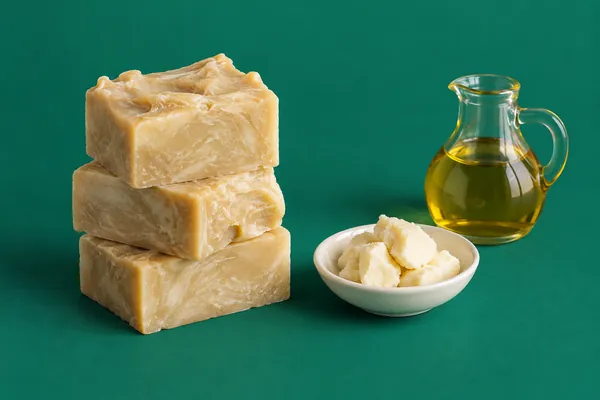
Hot process soap, step by step
Cook soap batter in a slow cooker until the lye is spent, then stir in the superfat oil, fragrance and colour. A full recipe with the calculator's numbers.
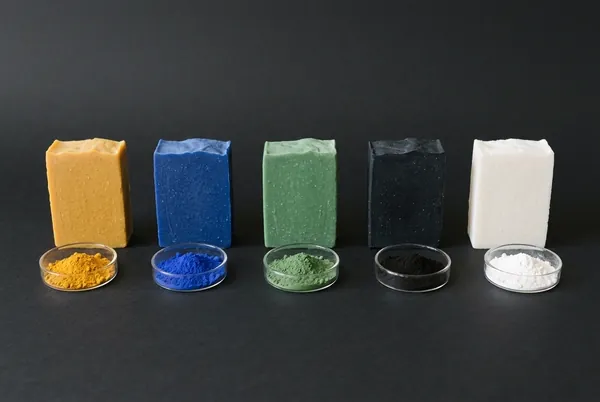
Colouring soap: micas, oxides, ultramarines and pigments
Which colourants survive cold-process soap, how much to use per 500 g of oils, how to disperse and split colour, and what the EU, UK and US rules ask.
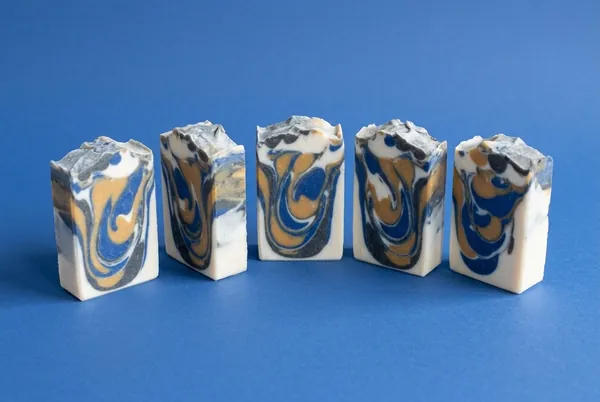
Swirl techniques: in the pot, drop, hanger, spoon and Taiwan
Seven cold-process swirls step by step, with the batter, recipe and temperatures that keep soap fluid, and why swirls turn muddy or lumpy.
Where these proportions come from
Adapted from Alicia Grosso's basic hot-process soap, about 57 % olive oil, 30 % coconut oil and 9 % palm kernel oil with a little castor: her palm kernel oil replaced by shea butter, and every oil cooked at a 6 % superfat, where her lye works out at about a 12 % superfat by our figures. The colour follows her method for hot process, each colour its own small batch, glopped into the mould and swirled with a chopstick. The water is 2.5 times the lye, as in our hot process guide, with a fifth of it held back to carry the clays.
Formulation adapted from The Everything Soapmaking Book, 3rd edition by Alicia Grosso (Adams Media, 2013). The method and notes are ours.