Kukui and nut oil bar
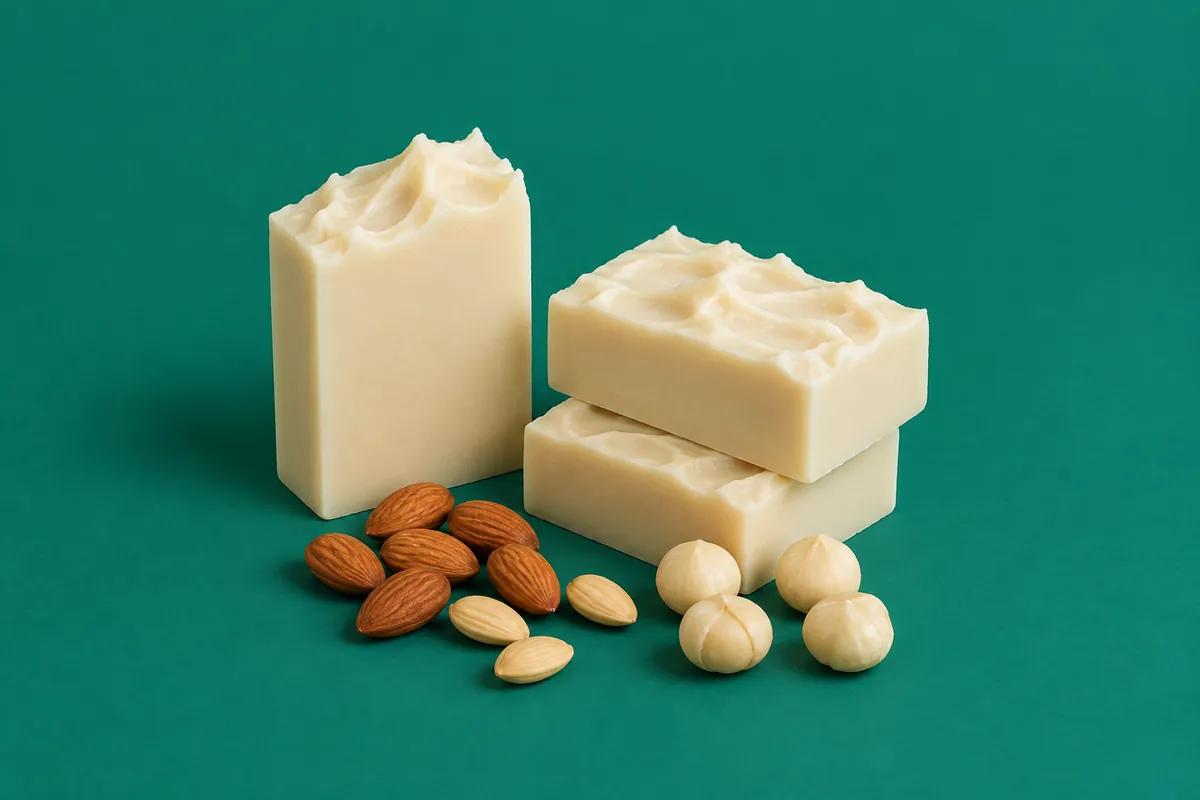
A rich, dense bar built around three nut oils, sweet almond, apricot kernel and kukui, with cocoa butter and shea butter on an olive and coconut base, scented with bergamot and a little ylang-ylang. A gift bar at a modern 6 % superfat, and not one for anyone with a nut allergy.
- Skill
- Intermediate
- Method
- Cold process
- Batch
- 1000 g of oils about 1444 g of batter
- Hands-on
- 1 h 15 min
- Cure
- 6 weeks
- Gel phase
- Either way gel or not, both work
What you need
For 1000 g of oils, which fills a 1.5 litre loaf mould. Weigh everything, liquids included.
| Coconut Oil · 28.0 % | 280 g | 9.88 oz |
| Olive Oil · 27.0 % | 270 g | 9.52 oz |
| Cocoa Butter · 12.0 % | 120 g | 4.23 oz |
| Shea Butter · 12.0 % | 120 g | 4.23 oz |
| Almond Oil · 6.0 % | 60 g | 2.12 oz |
| Apricot Kernel Oil · 6.0 % | 60 g | 2.12 oz |
| Kukui Nut Oil · 6.0 % | 60 g | 2.12 oz |
| Jojoba Oil · 3.0 % | 30 g | 1.06 oz |
| Sodium hydroxide (NaOH) · the lye, 100 % pure | 137.8 g | 4.86 oz |
| Distilled water · for a 33 % lye solution | 279.7 g | 9.87 oz |
| Rosemary extract (ROE) · stirred into the liquid oils, to help the nut oils keep | 1 g | 0.04 oz |
| Bergamot essential oil · 2.0 % of the oils, at trace | 20 g | 0.71 oz |
| Ylang-ylang essential oil · 0.5 % of the oils, at trace | 5 g | 0.18 oz |
- Superfat
- 6 %
- Temperatures
- Oils and lye solution each at 38 to 43 °C (100 to 110 °F), so the butters stay melted
Method
-
Get ready
Put on splash goggles, nitrile gloves and long sleeves, open a window or turn on the extractor fan, and keep children and pets out of the room. Line a 1.5 litre loaf mould. -
Weigh the oils
Weigh 280 g coconut oil, 120 g cocoa butter and 120 g shea butter into the pot. Into a jug, weigh 270 g olive oil, 60 g each of sweet almond, apricot kernel and kukui nut oil, 30 g jojoba oil and 1 g rosemary extract, and stir. -
Make the lye solution
Weigh 279.7 g distilled water into a heat-safe jug and 137.8 g sodium hydroxide into a dry container. With the window open, pour the lye slowly into the water, never the water onto the lye, and stir until clear with your face turned away. Leave it to cool, labelled and out of reach. -
Melt the butters
Melt the coconut oil, cocoa butter and shea butter on the lowest heat until clear, then take the pot off the heat and stir in the jug of liquid oils. -
Mix the essential oils
Weigh 20 g bergamot and 5 g ylang-ylang essential oil into a small glass and stir them together. -
Check the temperatures
Carry on when the oils and the lye solution are both between 38 and 43 °C (100 and 110 °F). Any cooler and a blend that is nearly a quarter butter starts to set, thickening into a false trace before the lye has taken hold. -
Blend to light trace
Pour the lye solution into the oils down the shaft of the stick blender, then blend in short bursts, stirring between them, until a drizzle leaves a faint line on the surface. Butters bring trace on fast, so check often. -
Scent it
Stir in the bergamot and ylang-ylang by hand with the spatula until no streaks of oil remain. -
Pour and texture the top
Pour into the mould, tap it on the worktop to raise air bubbles and rough up the top into soft peaks with the back of a spoon. -
Cover lightly
Lay a board or lid over the mould, adding a towel only if the room is cold. A butter-rich loaf that overheats can crack on top; one that gels a little is fine. -
Unmould and cut
After 24 to 48 hours, when the loaf is firm, unmould it with gloves on and cut bars about 2.5 cm (1 in) thick. -
Cure for six weeks
Stand the bars on edge in a dry, airy room, out of the sun, for six weeks, turning them every few days.
Tips
- Sweet almond and kukui nut oils are tree-nut oils, apricot kernel oil comes from a close relative of the almond, and shea butter is pressed from a nut: name them all on the label and keep this bar from anyone with a nut allergy.
- Cavitch made this bar with her usual lye discount of about 15 %, which leaves that much of the oil unsaponified. We use 6 %: a bigger superfat gives a softer bar that turns rancid sooner, and with three nut oils richer in linoleic acid than olive oil, that matters here.
- Buy the nut oils in small bottles, keep them cool and dark, and smell each one before you weigh it. An oil that smells stale, like old crayons or paint, will spot the soap orange however good the rest of the recipe is.
- Bergamot's bright note softens over the cure while the ylang-ylang holds on. For an unscented bar, leave both out; nothing else changes.
The oils
| Oil | Share |
|---|---|
| Coconut Oil | 28.0 % |
| Olive Oil (virgin / refined / olive oil) | 27.0 % |
| Cocoa Butter (Theobroma Oil) | 12.0 % |
| Shea Butter | 12.0 % |
| Almond Oil (Sweet Almond Oil) | 6.0 % |
| Apricot Kernel Oil | 6.0 % |
| Kukui Nut Oil | 6.0 % |
| Jojoba Oil | 3.0 % |
How it is made
| Process | Cold process |
| Alkali | NaOH |
| Superfat | 6 % |
| Water | lye water at 33 % |
| Iodine value | 60 |
| INS | 145 |
Why make it
A gift bar, built on the oils people associate with luxury soap: sweet almond, apricot kernel and kukui, with cocoa butter and shea on an olive and coconut base. It is firm and balanced, cleansing 19 and conditioning 52 on our scale, with a smooth lather, and bergamot with a little ylang-ylang gives it a bright, floral scent. Kukui is the candlenut of Hawaii, where its oil was once burned for light (Maui Nui Botanical Gardens); makers today value it for a light, silky feel, a reputation that rests on experience rather than testing. The nut oils are rich in linoleic acid and turn rancid sooner than olive, which is why they stop at 18 % of the oils. It is not a bar for anyone with a nut allergy.
Sources
- Kukui (Aleurites moluccana) · Maui Nui Botanical Gardens
What tradition, makers' experience and research say about soaps like this, each labelled for what it is. It is not medical advice, and no soap treats a skin condition: if you have one, ask a doctor or pharmacist.
What the numbers say
- Lauric acid 13.8 %
- Myristic acid 5.4 %
- Palmitic acid 10.7 %
- Stearic acid 11.2 %
- Oleic acid 39.7 %
- Linoleic acid 11.8 %
- Other 7.7 %
Saturated : unsaturated 45 : 55
Computed from the fatty acids of the fats above. The bands are what the craft has settled on, not chemistry — a bar outside one is not wrong.
From the guides
All guides
The soaping oils: what each one brings to a bar
Twenty-five soaping oils, butters and waxes: what each does in a bar and why, the share makers give it, and what to watch for, with figures from our records.
Superfat and lye discount: why recipes leave some oil unsaponified
What superfat and lye discount mean, how the calculator applies them, where makers set them for each soap, and why oil added at trace isn't the oil left over.
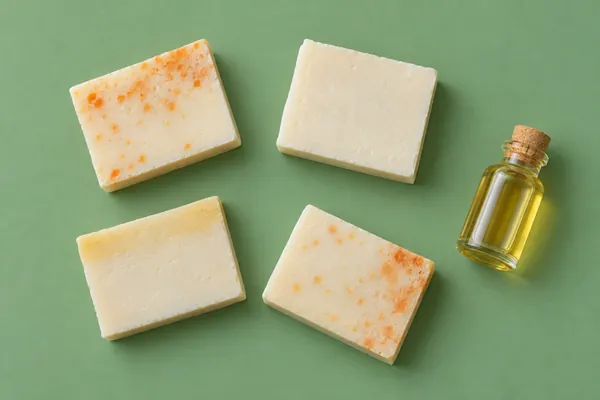
Dreaded orange spots (DOS) and rancid soap
What the orange spots on handmade soap are, why polyunsaturated oils, old fats and trace metals cause them, and which additives the tests show actually help.
Where these proportions come from
Adapted from the Gourmet Bar in Susan Miller Cavitch's The Natural Soap Book, the most extravagant of her bars: her olive and coconut base with sweet almond, apricot kernel and kukui nut oils at 6 % each, the palm oil replaced by cocoa butter and more shea butter, her jojoba halved to 3 %, rosemary extract in place of her grapefruit seed extract, and a 6 % superfat in place of her usual 15.5 % lye discount, which is high by today's practice.
Formulation adapted from The Natural Soap Book by Susan Miller Cavitch (Storey Publishing, 1995). The method and notes are ours.