Lavender goat milk bar
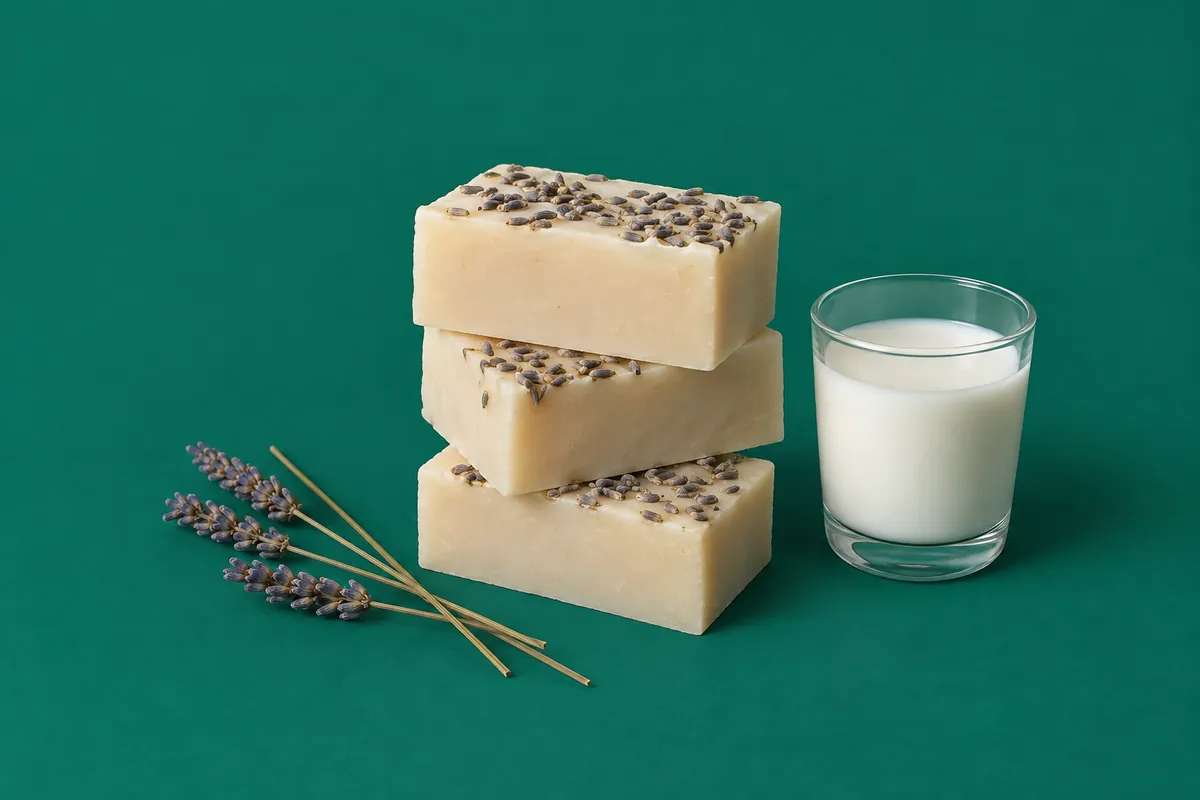
Frozen goat milk as all of the liquid, lavender essential oil and a scatter of dried lavender buds on top. The oils keep Makela's gentle idea, with less coconut than most bars, reworked around lard and olive oil at a safe 5 % superfat.
- Skill
- Intermediate
- Method
- Cold process
- Batch
- 1000 g of oils about 1497 g of batter
- Hands-on
- 1 hour
- Cure
- 6 weeks
- Gel phase
- No keep it cool
What you need
For 1000 g of oils, which fills a 1.5 litre loaf mould. Weigh everything, liquids included.
| Lard · 35.0 % | 350 g | 12.35 oz |
| Olive Oil · 30.0 % | 300 g | 10.58 oz |
| Coconut Oil · 20.0 % | 200 g | 7.05 oz |
| Almond Oil · 10.0 % | 100 g | 3.53 oz |
| Castor Oil · 5.0 % | 50 g | 1.76 oz |
| Sodium hydroxide (NaOH) · the lye, 100 % pure | 139.4 g | 4.92 oz |
| Goat milk, frozen in cubes · all of the liquid; the lye goes onto it | 325 g | 11.46 oz |
| Dried lavender buds · about a tablespoon, sprinkled over the poured soap | 2 g | 0.07 oz |
| Lavender essential oil · 3.0 % of the oils, at trace | 30 g | 1.06 oz |
- Superfat
- 5 %
- Temperatures
- Keep the milk and lye below 30 °C (86 °F) and soap at 27 to 30 °C (81 to 86 °F)
Method
-
Freeze the milk
The day before, weigh the goat milk into an ice-cube tray and freeze it solid; cubes melt more evenly than one block. -
Get ready
Put on goggles, gloves and long sleeves, work where the air moves, weigh the oils, lye and lavender oil, line the mould, clear a shelf in the fridge, and make an ice bath: a bowl of ice and water for the lye jug to stand in. -
Melt the oils
Melt the lard and coconut oil gently, stir in the olive, sweet almond and castor oils, and let them cool to 27 to 30 °C (81 to 86 °F). -
Add the lye to the milk
With the jug of frozen milk standing in the ice bath, sprinkle the lye onto the milk a spoonful at a time, never the milk onto the lye, and stir each one in before adding the next. Take 10 to 15 minutes and keep it below 30 °C (86 °F); it should end up pale yellow, smelling faintly of ammonia. -
Strain and blend
Pour the milk and lye through a stainless steel sieve into the oils and stick blend in short bursts, stirring between them, to light trace. -
Add the lavender oil
Blend in the lavender essential oil and keep going until the batter is like thick custard, firm enough to hold the buds on its surface. -
Pour
Pour into the mould, tap it on the bench to release air and smooth the top. -
Top with lavender buds
Sprinkle the dried lavender buds over the surface and press them in lightly with the back of a spoon, so they stay put when the soap sets. -
Chill
Put the mould uncovered in the fridge for 24 hours, so the milk sugar never heats up enough to brown. -
Unmould and cut
Let the loaf come back to room temperature, then unmould it once firm, 24 to 48 hours after pouring. Lay it on its side to cut, so the knife does not drag buds down across the bars. -
Cure
Stand the bars on a rack with air around them for six weeks, turning them now and then. The ammonia smell goes in the first week or two.
Tips
- Lavender buds turn brown where they touch the soap, usually within a week, and nothing stops it. On the top it looks deliberate; stirred through the batter they look like specks of dirt, so keep them up there.
- If the milk and lye thicken like custard, it is too cold: lift the jug out of the ice bath for a minute and stir, and it loosens as it warms a few degrees.
- For a bar without lard, use shea butter in its place and run the recipe through the calculator again, since the lye and the milk both change.
The oils
| Oil | Share |
|---|---|
| Lard (pure rendered pork fat) | 35.0 % |
| Olive Oil (virgin / refined / olive oil) | 30.0 % |
| Coconut Oil | 20.0 % |
| Almond Oil (Sweet Almond Oil) | 10.0 % |
| Castor Oil | 5.0 % |
How it is made
| Process | Cold process |
| Alkali | NaOH |
| Superfat | 5 % |
| Water | lye water at 33 % |
| Iodine value | 62 |
| INS | 144 |
Why make it
A traditional milk soap in the style Casey Makela made popular: frozen goat milk as all the liquid, lavender to scent it and a scatter of buds on top. Lard makes a hard, mild bar with a creamy lather, and with coconut kept to a fifth it cleanses at 14 on our scale. Makers have long chosen goat milk soap for dry or delicate skin, and Makela writes that milk makes soap creamier and less drying; that reputation rests on experience, since there are no good trials of milk soap on skin, and the lye turns the milk's fat into soap. The lavender is there because people love the smell. For fragrance-sensitive skin, leave the essential oil out; the bar is just as good without it.
Sources
- Making Natural Milk Soap (excerpted from Milk-Based Soaps) · Storey Publishing, 1999
What tradition, makers' experience and research say about soaps like this, each labelled for what it is. It is not medical advice, and no soap treats a skin condition: if you have one, ask a doctor or pharmacist.
What the numbers say
- Lauric acid 9.8 %
- Myristic acid 4.4 %
- Palmitic acid 15.4 %
- Stearic acid 7.0 %
- Ricinoleic acid 4.4 %
- Oleic acid 45.1 %
- Linoleic acid 9.6 %
- Other 6.0 %
Saturated : unsaturated 39 : 61
Computed from the fatty acids of the fats above. The bands are what the craft has settled on, not chemistry — a bar outside one is not wrong.
From the guides
All guides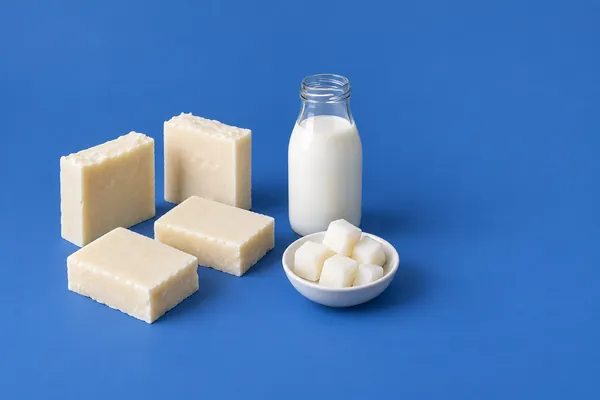
Milk soap: goat milk, freezing and keeping it pale
How to make goat milk soap without scorching it: frozen milk, lye added a spoonful at a time, a cool mould, and a full recipe worked through the calculator.
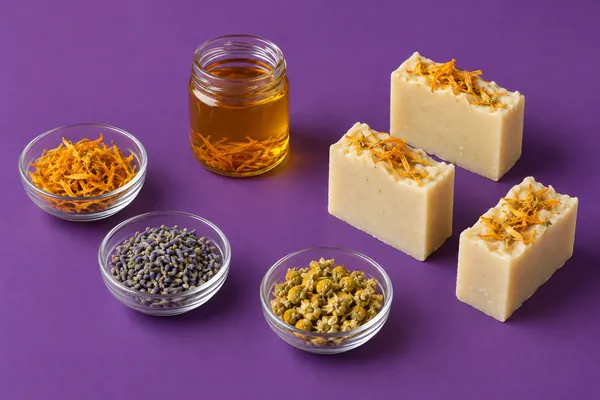
Herbs, flowers and infusions in soap
What dried herbs, petals, infused oils and herbal teas really do in soap: which survive lye, how to infuse an oil, and which claims a herbal soap can make.
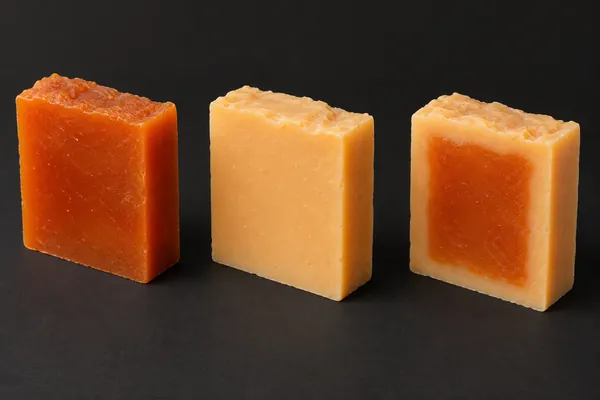
Gel phase: to insulate or keep it cool
What gel phase is, why a loaf turns dark and translucent, how gelled and ungelled bars differ, why partial gel is cosmetic, and how to cause or prevent it.
Where these proportions come from
After Makela's lavender milk soap: milk as all of the liquid, lavender essential oil and lavender flowers. Her printed recipe, vegetable shortening with liquid oils, comes out lye-heavy by our numbers, so the oils and lye here are ours: lard in the place shortening was invented to fill, with olive, sweet almond and a modest share of coconut, at 5 % superfat.
Formulation adapted from Making Natural Milk Soap (excerpted from Milk-Based Soaps) by Casey Makela (Storey Publishing, 1999). The method and notes are ours.