Nettle and yarrow split bar
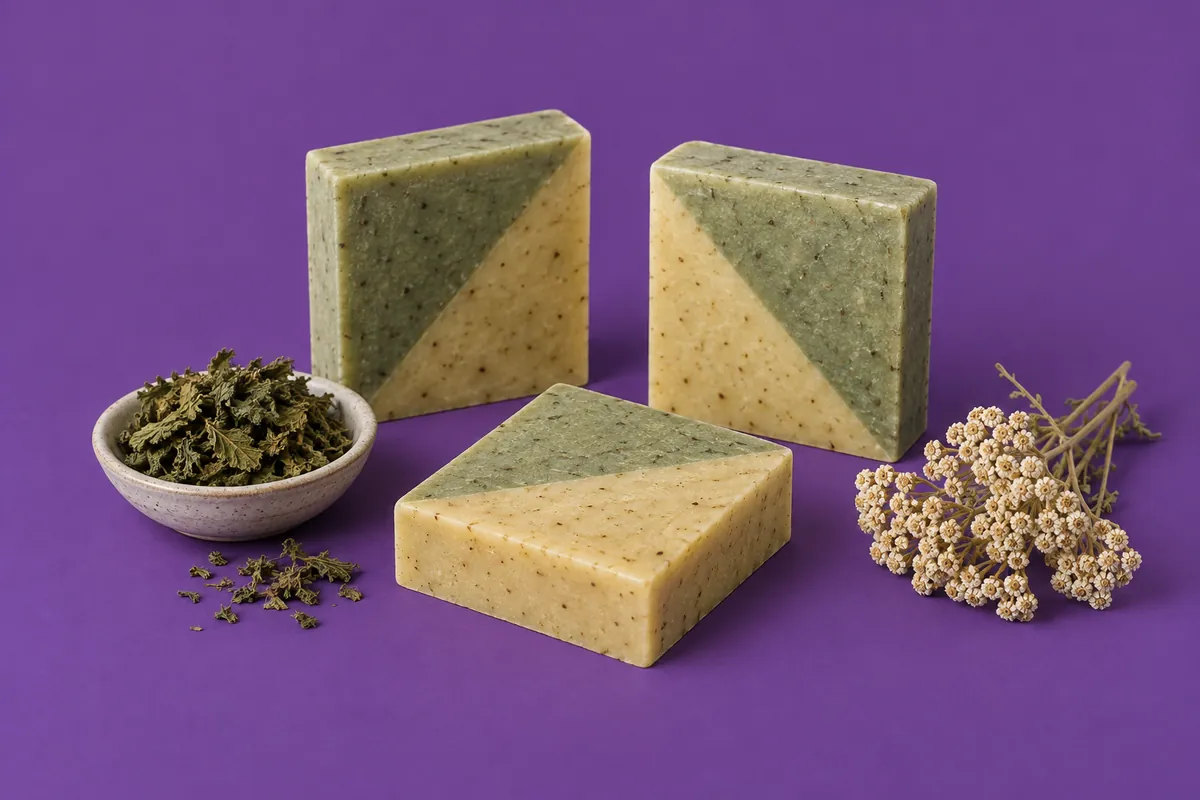
A square bar split corner to corner, soft green nettle on one side and pale yellow yarrow on the other, poured into a milk carton with a card divider. The beeswax recipe is soaped hot, then frozen so it stays out of gel.
- Skill
- Intermediate
- Method
- Cold process
- Batch
- 600 g of oils about 869 g of batter
- Hands-on
- 1 h 15 min
- Cure
- 6 weeks
- Gel phase
- No keep it cool
What you need
For 600 g of oils, which fills a 1 litre gable-top milk carton with its top cut off, and a card divider. Weigh everything, liquids included.
| Olive-Pomace Oil · 39.0 % | 234 g | 8.25 oz |
| Rice Bran Oil · 25.0 % | 150 g | 5.29 oz |
| Coconut Oil · 24.0 % | 144 g | 5.08 oz |
| Apricot Kernel Oil · 5.0 % | 30 g | 1.06 oz |
| Castor Oil · 3.0 % | 18 g | 0.63 oz |
| Shea Olein · 2.0 % | 12 g | 0.42 oz |
| Beeswax · 2.0 % | 12 g | 0.42 oz |
| Sodium hydroxide (NaOH) · the lye, 100 % pure | 82.3 g | 2.90 oz |
| Distilled water · for a 33 % lye solution | 167.0 g | 5.89 oz |
| Nettle leaf powder · green half only, about 1½ tsp dispersed in 10 g of the recipe's apricot kernel oil | 2.5 g | 0.09 oz |
| Yarrow powder · yellow half only, about 1½ tsp dispersed in 10 g of the recipe's apricot kernel oil | 2.5 g | 0.09 oz |
| Litsea oil · 1.5 % of the oils, at trace | 9 g | 0.32 oz |
| Clary sage oil · 0.5 % of the oils, at trace | 3 g | 0.11 oz |
| Roman chamomile oil · 0.5 % of the oils, at trace | 3 g | 0.11 oz |
- Superfat
- 5 %
- Temperatures
- Beeswax melted with the coconut oil at about 65 °C (149 °F); oils and lye solution at 52 to 60 °C (125 to 140 °F) when they meet
Method
-
Prepare the carton
Rinse and dry a 1 litre gable-top carton from fresh milk or juice, waxed or plastic-coated inside, never a long-life carton lined with foil, and cut the top off where the gable starts. Cut a strip of stiff card to fit corner to corner inside it, about 10 cm across a 7 cm carton and as tall as the carton, and wrap it in packing tape so it can't soak up water. -
Get ready
Put on goggles, gloves and long sleeves, open a window, and clear an upright space in the freezer. Stand the carton in a small box or between two heavy tins so it can't tip, with two spouted jugs beside it. -
Disperse the colours
Weigh the 30 g of apricot kernel oil and put 10 g in each jug. Stir the nettle powder into one and the yarrow powder into the other until smooth. -
Make the lye solution
About half an hour before you soap, pour the 82.3 g of sodium hydroxide slowly into the 167.0 g of water where the air moves, never the reverse, and stir until clear. This batch is soaped hot, so the solution only needs to cool to 52 to 60 °C (125 to 140 °F). -
Melt the wax into the oils
Melt the beeswax and coconut oil together on low heat until the wax has fully melted, at about 65 °C (149 °F). Warm the olive pomace, rice bran, castor and shea oils with the last 10 g of apricot kernel oil to about 55 °C (131 °F) and pour the wax mixture in slowly, stirring; if it clouds, warm it gently until clear. -
Blend briefly
When the oils and the lye solution are both at 52 to 60 °C (125 to 140 °F), pour the lye in down the blender shaft and blend in short pulses for about 10 seconds, just to very light trace: heat and wax make this batter move fast. Stir in the essential oils by hand. -
Colour the halves
Pour 422 g of batter into each jug, the second taking what is left, and whisk until each colour is even. -
Pour both sides
Stand the divider in the carton from corner to corner. Pour the green into one side and the yellow into the other at the same time, or a little of each in turn, keeping the two levels within about 1 cm of each other so the divider doesn't lean. -
Lift the divider
Pull the divider straight up and out in one slow movement, then tap the carton gently on the worktop to bring up air. -
Freeze it
Stand the carton upright in the freezer for 4 to 6 hours. In a tall, narrow mould only the middle would gel, leaving a darker core in every bar, and the freezer keeps it all out of gel. -
Let it set
Take the carton out and leave it at room temperature for 2 to 3 days, until the soap is firm. -
Peel the carton
Snip the top edge and tear the carton away in a spiral, with gloves on. If it clings, freeze it for 2 hours and try again. -
Cut
Cut the column into slices about 2.5 cm (1 in) thick: about seven square bars, each split corner to corner into green and yellow. -
Cure in the dark
Stand the bars on edge with air between them for 6 weeks, turning them every few days, somewhere dark.
Tips
- Expect soft colours that keep moving. Nettle starts a gentle green and drifts towards khaki over the weeks, faster in light, though Faiola finds it steadier than most natural greens; yarrow gives a pale yellow-tan. Faiola gets a yellower yarrow by stirring it into the hot lye solution, but here that would tint the green side too.
- The calculator charges beeswax lye for its whole saponification value, about half an ordinary oil's, though most of the wax passes into the bar unchanged, so the true superfat sits a little above 5 %. At 2 % of the oils that is harmless. To soap cooler, replace the beeswax with more olive pomace oil and run the recipe through the calculator again.
- Olive pomace oil brings on trace sooner than extra virgin olive oil, which suits a quick pour like this one. With extra virgin, expect to blend a little longer.
The oils
| Oil | Share |
|---|---|
| Olive-Pomace Oil (refined / blended) | 39.0 % |
| Rice Bran Oil | 25.0 % |
| Coconut Oil | 24.0 % |
| Apricot Kernel Oil | 5.0 % |
| Castor Oil | 3.0 % |
| Shea Olein | 2.0 % |
| Beeswax (yellow / white) | 2.0 % |
How it is made
| Process | Cold process |
| Alkali | NaOH |
| Superfat | 5 % |
| Water | lye water at 33 % |
| Iodine value | 71 |
| INS | 134 |
Why make it
A small, pretty batch: nettle green and yarrow yellow meeting corner to corner in every bar, poured in a milk carton so it needs no special mould. Both plants belong to European country tradition, and yarrow's botanical name, Achillea, comes from the legend of Achilles; in this soap they are colourants only, a couple of grams each, and do nothing more for skin. The formula is gentle, cleansing 17 and conditioning 62 on our scale, with rice bran oil and a little beeswax, so it suits everyday washing. One caveat matters. Yarrow and chamomile both belong to the daisy family, and DermNet advises people with a daisy-family (Compositae) allergy not to use cosmetics made with these plants. If that is you, skip this bar, or make it without the yarrow and the Roman chamomile oil.
Sources
- Compositae allergy · DermNet, 2009
What tradition, makers' experience and research say about soaps like this, each labelled for what it is. It is not medical advice, and no soap treats a skin condition: if you have one, ask a doctor or pharmacist.
What the numbers say
- Lauric acid 11.8 %
- Myristic acid 4.7 %
- Palmitic acid 12.6 %
- Stearic acid 3.2 %
- Ricinoleic acid 2.7 %
- Oleic acid 43.8 %
- Linoleic acid 14.8 %
- Other 5.2 %
Saturated : unsaturated 37 : 63
Computed from the fatty acids of the fats above. The bands are what the craft has settled on, not chemistry — a bar outside one is not wrong.
From the guides
All guides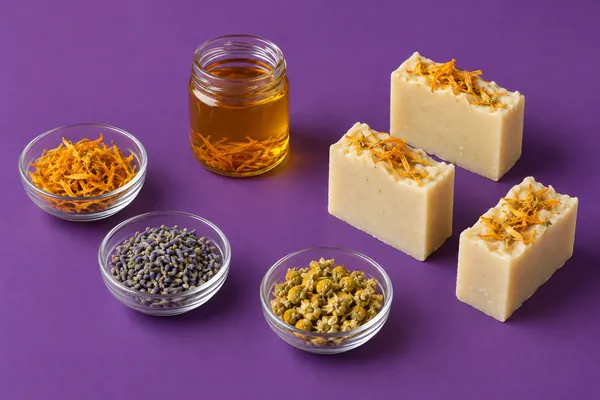
Herbs, flowers and infusions in soap
What dried herbs, petals, infused oils and herbal teas really do in soap: which survive lye, how to infuse an oil, and which claims a herbal soap can make.

Natural colourants: what herbs, clays and spices really do in soap
Clays, charcoal and plant colours in cold-process soap: doses per 500 g of oils, infused oil, powder or lye, and the colour each one actually turns.
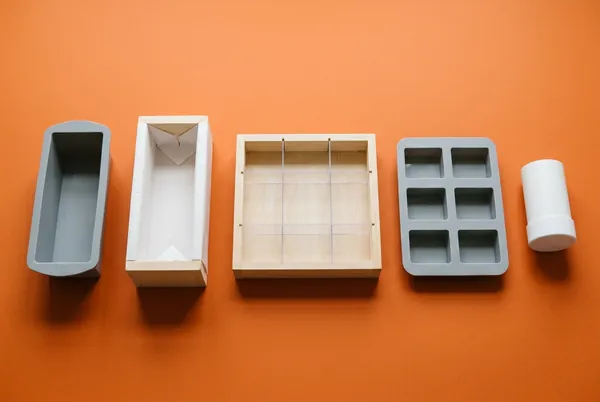
Soap moulds: choosing one and sizing a recipe to fit
Silicone, wood, slab, cavity, tube and improvised soap moulds; lining with freezer paper; and how to size a recipe to a mould, with a worked example.
Where these proportions come from
Adapted from Anne-Marie Faiola's nettle and yarrow bar: her palm-free oils with 2 % beeswax, soaped hot and then frozen, her milk-carton mould and diagonal divider, and her nettle and yarrow dispersed in apricot kernel oil. We use a 33 % lye solution in place of her 29 %, leave out her titanium dioxide, and cut her clary sage, chamomile and litsea from 4.1 % of the oils to 2.5 %.
Formulation adapted from Pure Soapmaking by Anne-Marie Faiola (Storey Publishing, 2016). The method and notes are ours.