Patchouli and orange swirl bar
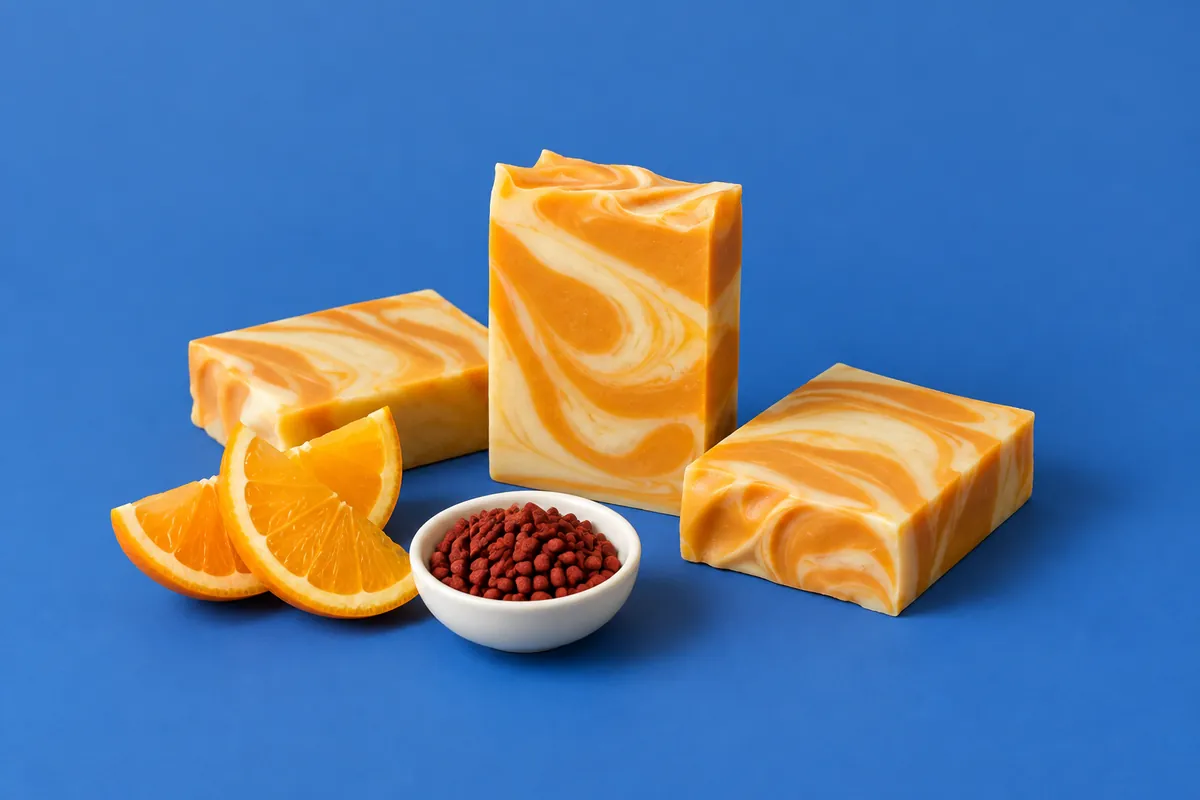
An earthy everyday bar scented with patchouli and sweet orange, with a warm orange swirl through a cream base. The orange comes from annatto seed infused in oil, which gives a smooth colour with no specks.
- Skill
- Intermediate
- Method
- Cold process
- Batch
- 1000 g of oils about 1493 g of batter
- Hands-on
- 1 h 20 min
- Cure
- 6 weeks
- Gel phase
- Yes insulate the mould
What you need
For 1000 g of oils, which fills a 1.5 litre loaf mould. Weigh everything, liquids included.
| Olive Oil · 45.0 % | 450 g | 15.87 oz |
| Coconut Oil · 25.0 % | 250 g | 8.82 oz |
| Avocado Oil · 10.0 % | 100 g | 3.53 oz |
| Shea Butter · 10.0 % | 100 g | 3.53 oz |
| Cocoa Butter · 5.0 % | 50 g | 1.76 oz |
| Castor Oil · 5.0 % | 50 g | 1.76 oz |
| Sodium hydroxide (NaOH) · the lye, 100 % pure | 138.9 g | 4.90 oz |
| Distilled water · for a 30 % lye solution | 324.1 g | 11.43 oz |
| Annatto seed · 1 tbsp, infused in 30 g of olive oil and strained; 25 g of the oil colours half the batter | 6.3 g | 0.22 oz |
| Olive oil for the annatto infusion · 25 g of the strained oil goes back in as part of the recipe's olive oil; the rest stays with the seeds | 30 g | 1.06 oz |
| Sweet orange essential oil · 2.0 % of the oils, at trace | 20 g | 0.71 oz |
| Patchouli essential oil · 1.0 % of the oils, at trace | 10 g | 0.35 oz |
- Superfat
- 5 %
- Temperatures
- Oils and lye solution each at 32 to 38 °C (90 to 100 °F)
Method
-
Make the annatto oil
In a small microwave-safe cup, warm 30 g of olive oil with 1 tablespoon of annatto seeds for 20 seconds, let it stand a minute, and warm it for 20 seconds more. Leave it to steep for 20 minutes, strain out the seeds, and weigh out 25 g of the deep orange oil. -
Get ready
Open a window or turn on the extractor fan, send children and pets out, and put on splash goggles, nitrile gloves and long sleeves. Set a 1.5 litre loaf mould on a level surface and have a second jug, a whisk and a spatula ready. -
Weigh everything
Weigh 250 g coconut oil, 100 g shea butter and 50 g cocoa butter into the pot, and 400 g olive oil, 100 g avocado oil and 50 g castor oil into a jug; set 25 g of plain olive oil aside in a cup beside the annatto oil. Weigh 324.1 g of distilled water into the lye jug, 20 g of sweet orange and 10 g of patchouli essential oil into a small cup, and the 138.9 g of sodium hydroxide last, into a dry container. -
Make the lye solution
Where air moves, pour the sodium hydroxide slowly into the water, never the water onto the lye, and stir until it turns clear. Keep your face away from the vapour and leave it to cool, labelled and out of reach. -
Melt the fats
Melt the coconut oil, shea butter and cocoa butter on the lowest heat until just clear, then pour in the olive, avocado and castor oils from the jug, leaving the two small cups aside. -
Blend to light trace
When the oils and the lye solution are each at 32 to 38 °C (90 to 100 °F), pour the lye solution into the oils and pulse and stir to light trace, like thin custard. Stir in the essential oils by hand. -
Split and colour
Pour half the batter, about 720 g, into the second jug and whisk in the annatto oil until it is an even orange. Stir the cup of plain olive oil into the half left in the pot, so both halves carry the same share of oil. -
Swirl in the pot
Pour the orange batter back into the pot in three or four places, some from high up so it plunges to the bottom and some from low down so it stays near the top. Draw a spatula once round the pot, and no more. -
Pour
Pour into the mould, moving slowly from one end to the other, then draw a chopstick through the top centimetre in loops if you like and tap the mould gently. -
Insulate
Cover the mould with its lid or a board, wrap it in a towel and leave it for a day. A full gel makes the orange brighter. -
Unmould and cut
The extra water makes this loaf slow to firm, so give it two days, then unmould it with gloves on and cut it into bars. -
Cure
Stand the bars on edge in a dry, airy place for six weeks, turning them every few days.
Tips
- Don't skip the plain olive oil in the cream half. Added to one half alone, the annatto oil would leave that half rich in oil and the other half short of it.
- Sweet orange fades as the soap cures and patchouli anchors it. Five-fold orange oil lasts longer if you can get it; use the same weight.
- At this strength annatto tints the lather faintly. For a softer orange, use 2 teaspoons of seed in the same 30 g of oil.
- Our IFRA data give no figure for patchouli oil, so ask your supplier for the certificate for your lot.
The oils
| Oil | Share |
|---|---|
| Olive Oil (virgin / refined / olive oil) | 45.0 % |
| Coconut Oil | 25.0 % |
| Avocado Oil | 10.0 % |
| Shea Butter | 10.0 % |
| Cocoa Butter (Theobroma Oil) | 5.0 % |
| Castor Oil | 5.0 % |
How it is made
| Process | Cold process |
| Alkali | NaOH |
| Superfat | 5 % |
| Water | lye water at 30 % |
| Iodine value | 60 |
| INS | 145 |
Why make it
An earthy, warm-smelling everyday bar for people who love patchouli, a scent with a devoted following since the 1960s. Sweet orange brightens it, and patchouli, a heavy base note that lingers, holds the blend together as the orange fades. The formula is mild and palm-free, cleansing 17 and conditioning 59 on our scale, with avocado oil, shea and cocoa butter, so it suits daily washing. Annatto seed, the colour in Red Leicester cheese, gives the swirl its orange without specks when it is infused in oil. The appeal is scent and colour; in a rinse-off bar neither patchouli nor annatto does anything for skin that the soap itself does not. Smell the patchouli before you commit a whole loaf to it: people rarely feel neutral about it.
What tradition, makers' experience and research say about soaps like this, each labelled for what it is. It is not medical advice, and no soap treats a skin condition: if you have one, ask a doctor or pharmacist.
What the numbers say
- Lauric acid 12.3 %
- Myristic acid 4.7 %
- Palmitic acid 11.7 %
- Stearic acid 8.3 %
- Ricinoleic acid 4.4 %
- Oleic acid 45.8 %
- Linoleic acid 8.3 %
- Other 5.6 %
Saturated : unsaturated 40 : 60
Computed from the fatty acids of the fats above. The bands are what the craft has settled on, not chemistry — a bar outside one is not wrong.
From the guides
All guides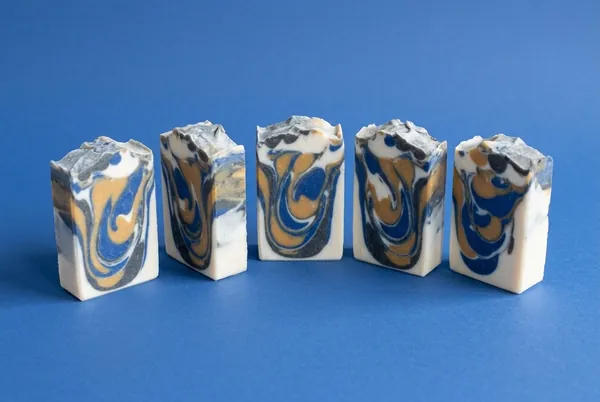
Swirl techniques: in the pot, drop, hanger, spoon and Taiwan
Seven cold-process swirls step by step, with the batter, recipe and temperatures that keep soap fluid, and why swirls turn muddy or lumpy.

Natural colourants: what herbs, clays and spices really do in soap
Clays, charcoal and plant colours in cold-process soap: doses per 500 g of oils, infused oil, powder or lye, and the colour each one actually turns.

Scenting soap: essential oils and fragrance oils
How much essential or fragrance oil to use in soap, what ounces per pound mean in percent, the IFRA limits for common essential oils, and EU allergen labelling.
Where these proportions come from
Our own palm-free formulation at a 5 % superfat and a 30 % lye solution, slow enough to swirl. The idea follows Kelly Cable's patchouli swirl soap, with an orange swirl coloured by annatto-infused oil in place of her spirulina and charcoal.
Formulation adapted from The Natural Soap Making Book for Beginners by Kelly Cable (Althea Press, 2017). The method and notes are ours.