Transparent glycerin bar
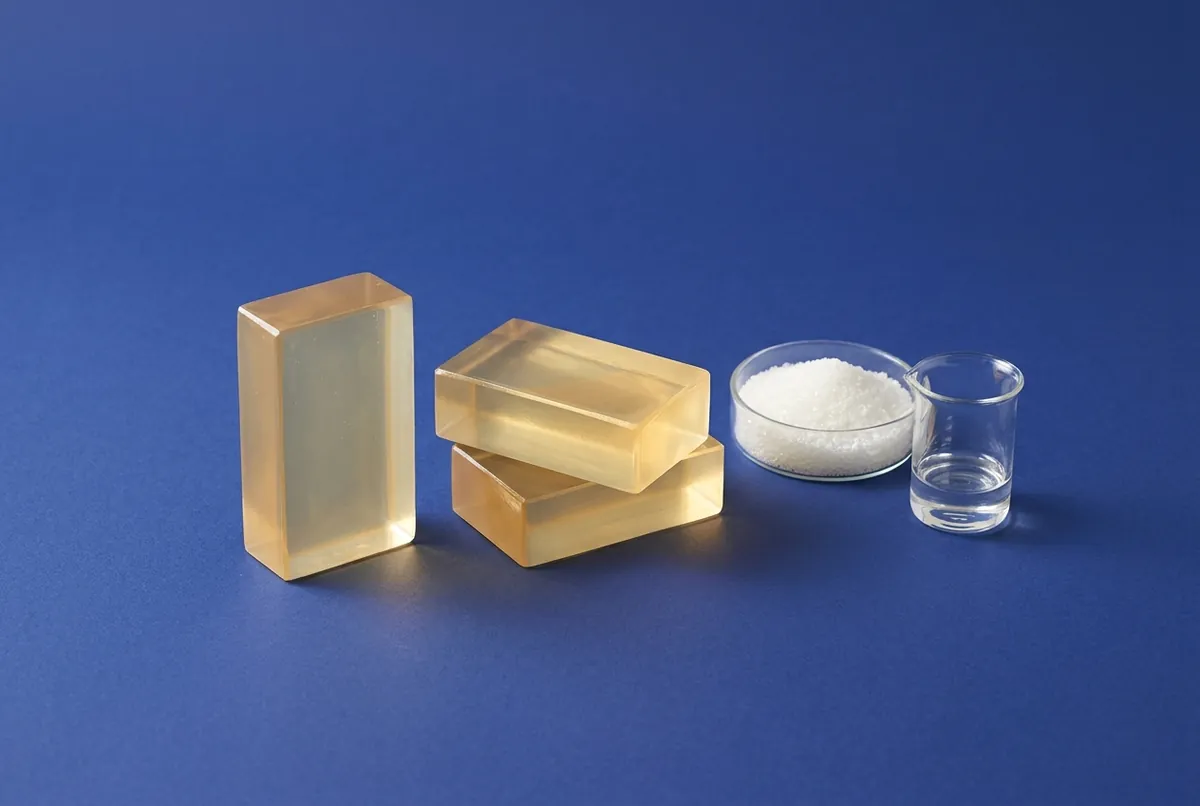
Clear soap made from scratch by Catherine Failor's solvent method: a tallow, coconut and castor oil soap gelled in a water bath, then dissolved in alcohol, glycerin and sugar syrup so it sets glass-clear. It is slow, exact work over hot alcohol, and fire safety matters as much as lye safety.
- Skill
- Advanced
- Method
- Hot process
- Batch
- 1000 g of oils about 2147 g of batter
- Hands-on
- 3 hours
- Cure
- 2 weeks
- Gel phase
- In the pot it gels as it cooks
What you need
For 1000 g of oils, which fills silicone moulds holding about 2.3 litres in all. Weigh everything, liquids included.
| Edible Tallow · 50.0 % | 500 g | 17.64 oz |
| Coconut Oil · 20.0 % | 200 g | 7.05 oz |
| Castor Oil · 30.0 % | 300 g | 10.58 oz |
| Sodium hydroxide (NaOH) · the lye, 100 % pure | 140.4 g | 4.95 oz |
| Distilled water · for a 33 % lye solution | 291.5 g | 10.28 oz |
| Ethanol, 95 % (190 proof) · after the gel, with the glycerin, weighed into a lidded jug | 346 g | 12.20 oz |
| Glycerin · after the gel, with the alcohol | 99 g | 3.49 oz |
| Granulated sugar · boiled into a syrup with 185 g of distilled water; never icing sugar, which can contain starch | 247 g | 8.71 oz |
| Distilled water, for the sugar syrup · boiled with the sugar; distilled, because minerals in tap water cloud the bar | 185 g | 6.53 oz |
| Sodium hydroxide, for the finishing solution · kept ready in a small labelled jar in case the phenolphthalein test calls for it, and added only if the test shows no pink; pour away what you don't use | 4.3 g | 0.15 oz |
| Distilled water, for the finishing solution · the finishing sodium hydroxide dissolves in this | 9 ml | |
| Phenolphthalein indicator solution · a drop on each sample to test for unsaponified fat and spare lye | 5 ml | |
| Stearic acid, only if the test stays deep pink · melted and stirred into the alcohol broth 12 to 25 g at a time, as the tips describe | 25 g | 0.88 oz |
| Lavender essential oil · 1.3 % of the oils, after the cook | 13 g | 0.46 oz |
| Geranium essential oil · 1.0 % of the oils, after the cook | 10 g | 0.35 oz |
- Superfat
- 3 %
- Temperatures
- Lye solution and oils at 57 to 63 °C (135 to 145 °F), gelled at 77 to 82 °C (170 to 180 °F), scented at 60 °C (140 °F)
Method
-
Set up for alcohol
Work on electric heat only, with no gas, pilot lights, candles or smoking in the room, and a window open. Put a dry-powder or carbon dioxide extinguisher and a spare lid within reach, and set a large pot holding 7 to 10 cm (3 to 4 in) of water on an electric hotplate as a water bath, with a couple of spoons on its base so the soap pot never sits on the hot bottom. -
Weigh everything
Put on goggles, gloves and long sleeves. Weigh 500 g tallow, 200 g coconut oil and 300 g castor oil into a stainless steel soap pot of about 5 litres, 291.5 g of distilled water into a heat-proof jug and 140.4 g of sodium hydroxide into a dry container; weigh the ethanol, glycerin, sugar and syrup water into separate covered containers, then take the alcohol bottle out of the room. -
Make the lye solutions
Add the sodium hydroxide to the water, never the reverse, stirring with your face turned away: it heats to about 93 °C (200 °F) and its steam carries lye. Dissolve the 4.3 g for the finishing solution in 9 ml of distilled water in a small lidded, labelled jar the same way, and let the main solution cool to 57 to 63 °C (135 to 145 °F). -
Melt the fats
Melt the tallow and coconut oil in the soap pot, add the castor oil and bring them to the same 57 to 63 °C (135 to 145 °F), warmer than for cold process, which speeds the reaction. -
Bring it to trace
Pour the main lye solution into the oils and stick blend to a light trace, which takes a few minutes. If the batter cools much below 57 °C (135 °F) first, warm it gently in the water bath. -
Gel it in the water bath
Cover the pot and stand it in the water bath at a gentle boil. When a ring of translucent soap shows at the edge, after 10 to 15 minutes, stir for a minute, scraping the bottom, then stir briefly two or three times more as trapped air makes it billow. Keep it covered and hot until it is translucent right through at 77 to 82 °C (170 to 180 °F), then hold it there about an hour more, stirring now and then. -
Test it and finish the lye
Take a small sample out of the pot and add a drop of phenolphthalein. The faintest pink means it is ready; no colour means some fat is still unsaponified, so stir in a quarter of the finishing solution, keep the pot hot for 15 minutes and test again, stopping at the first faint pink. Deep pink means spare lye: give it another half hour, and if it stays deep pink, correct it once the alcohol is in. -
Dissolve it in alcohol and glycerin
Turn off the heat. Standing back, pour in the ethanol and glycerin slowly, scrape every scrap of soap off the bottom and sides and break up the lumps with a whisk. Seal the pot with its lid or two layers of heavy plastic tied tight, return it to the water bath and simmer it gently for about 30 minutes, until a spoonful held to the light in a clear jar shows no specks. -
Add the sugar syrup
Bring the 185 g of syrup water to the boil, stir in the sugar until it dissolves, then cover it and simmer it for 2 to 3 minutes so the steam washes stray crystals off the sides. Unseal the soap pot and stir the syrup in. -
Test on cold glass
Drip a spoonful onto the base of an upturned glass chilled in the freezer and let it set. If it sets clear, carry on; if it is milky, rinse the skin off under hot water, and if it is still milky underneath, stir in more sugar syrup, about 35 g at a time and twice at most, then a little alcohol, testing after each. -
Settle and scent
Cover the pot and let the soap settle for about 20 minutes, until it cools to 60 °C (140 °F), so bubbles rise and specks sink. Skim off the foam, stir any skin back in, and stir in the lavender and geranium oils. -
Pour
Pour into moulds standing on a level surface. The soap sets in 1 to 6 hours, depending on the size of the mould. Pour any finishing solution you did not use down the sink with plenty of running water. -
Unmould, cut and cure
Unmould once it is firm right through, cut it into bars and cure them for at least two weeks somewhere warm and dry with air around each one; they clear further as the last of the alcohol and water leave. Give any bar that still feels soft another week.
Tips
- Ethanol gives off enough vapour to ignite at room temperature, the vapour creeps along the worktop because it is heavier than air, and its flame can be invisible. Never leave the pot. If it catches fire, don't move it or throw water on it: turn off the heat if you safely can, leave the room, shut the door and call the fire service.
- Use 95 % ethanol (190 proof), sold as grain alcohol or rectified spirit. Isopropyl alcohol is no safer, dissolves soap less well and leaves the bar less clear; Failor uses it for a third of the alcohol at most, and only at 99 %.
- If the phenolphthalein stays deep pink, stir melted stearic acid into the alcohol broth 12 to 25 g at a time, hold it at 71 °C (160 °F) for 15 to 20 minutes and test again until the pink fades. Each gram of stearic acid neutralises about 0.15 g of the free alkali.
- Lard or palm oil can replace the tallow, as Failor allows, but each takes its own lye, so run the swap through the calculator. Lard makes a slightly softer bar, and palm oil's wider published saponification range needs a 4 % superfat to keep the same margin.
The oils
| Oil | Share |
|---|---|
| Edible Tallow (beef/mutton dripping) | 50.0 % |
| Coconut Oil | 20.0 % |
| Castor Oil | 30.0 % |
How it is made
| Process | Hot process |
| Alkali | NaOH |
| Superfat | 3 % |
| Water | lye water at 32.5 % |
| Iodine value | 51 |
| INS | 152 |
Why make it
Clear soap is a craft piece. Fresh soap dissolved in alcohol, glycerin and sugar syrup sets like glass and shows off colour and embeds as nothing else can, and it has a long history: Andrew Pears settled on the world's first transparent soap in London in 1807 (Science Museum Group). The finished bar holds far more glycerin than an ordinary one, the glycerin added on top of the soap's own, and glycerin has been used in skin preparations for many years for the water it holds (Fluhr, Darlenski and Surber 2008). In a rinse-off bar much of it washes away, but many people find clear soap less drying. The caveats are real: hot alcohol is a fire risk, the work is slow and exact, and glycerin-rich bars sweat and soften in a humid bathroom.
Sources
- A and F Pears Limited · Science Museum Group Collection
- Glycerol and the skin: holistic approach to its origin and functions · British Journal of Dermatology, 2008
What tradition, makers' experience and research say about soaps like this, each labelled for what it is. It is not medical advice, and no soap treats a skin condition: if you have one, ask a doctor or pharmacist.
What the numbers say
- Lauric acid 9.8 %
- Myristic acid 5.8 %
- Palmitic acid 14.9 %
- Stearic acid 12.6 %
- Ricinoleic acid 26.6 %
- Oleic acid 21.5 %
- Linoleic acid 3.5 %
- α-Linolenic acid 1.1 %
- Other 5.2 %
Saturated : unsaturated 46 : 54
Computed from the fatty acids of the fats above. The bands are what the craft has settled on, not chemistry — a bar outside one is not wrong.
From the guides
All guides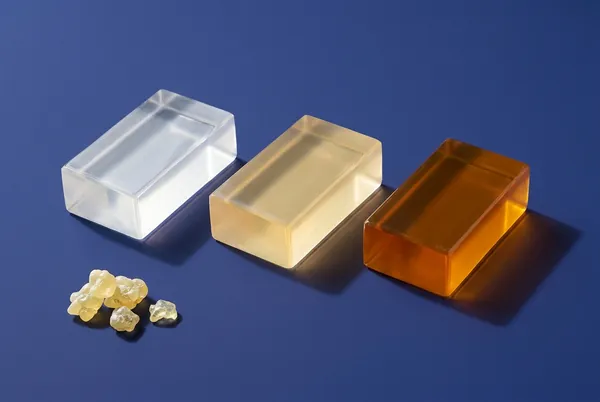
Transparent soap by the solvent method
Make true transparent soap from scratch: soap dissolved in alcohol, glycerin and sugar, with Failor's temperatures, clarity tests, fixes and fire safety.
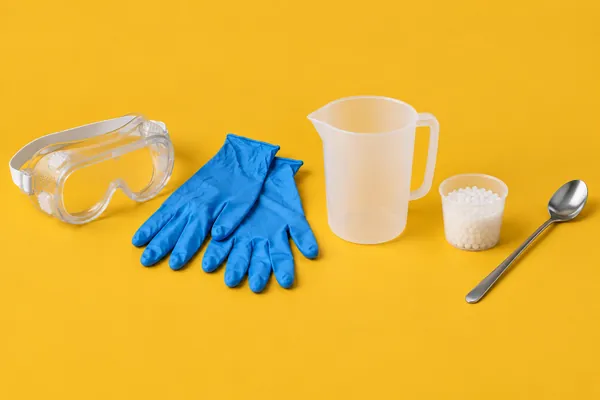
Handling lye safely
How to handle sodium hydroxide at home: splash goggles and gloves, lye into water, safe containers and storage, and first aid that works (water, not vinegar).
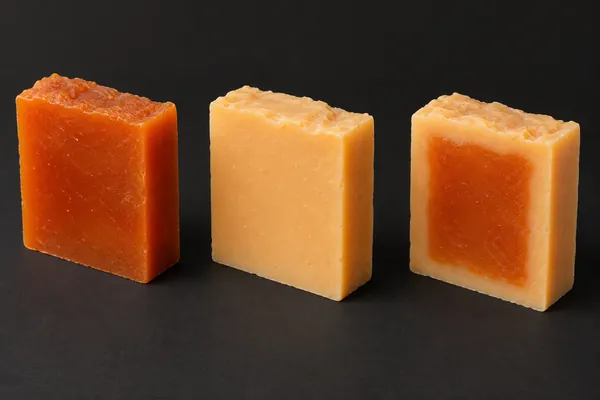
Gel phase: to insulate or keep it cool
What gel phase is, why a loaf turns dark and translucent, how gelled and ungelled bars differ, why partial gel is cosmetic, and how to cause or prevent it.
Where these proportions come from
Catherine Failor's Basic Recipe 1 scaled to 1000 g of oils, made with tallow, which she allows in place of palm oil: tallow 50 %, coconut 20 % and castor 30 %, with her proportions of alcohol, glycerin, sugar and syrup water and her 32.5 % lye solution. Failor calculates at 0 % superfat and corrects in the pot. This recipe weighs its lye at 3 %, the least that keeps the pot free of spare lye across the published saponification ranges of these fats, and lets her phenolphthalein test decide how much of a small finishing solution to add, which can take it no further than her 0 %.
Formulation adapted from Making Transparent Soap: The Art of Crafting, Molding, Scenting & Coloring by Catherine Failor (Storey Publishing, 2000). The method and notes are ours.