In short
- Bar soap is opaque because it grows fibrous crystals as it cools. Alcohol, glycerin and sugar keep the crystals too small to scatter light.
- The base soap is calculated at 0 % superfat, taken through gel in a water bath and tested for spare lye before the alcohol goes in.
- Ethanol vapour can ignite at room temperature and its flame can be invisible: electric heat only, a sealed pot, the bottle out of the room, and never leave it.
- Add solvent a little at a time and test each addition on cold glass. Too little leaves the bar cloudy; too much leaves it soft and sticky.
- A transparent bar is only 50 to 60 % soap, so it wears faster than an opaque one. Clear melt-and-pour base is the ready-made route.
On this page
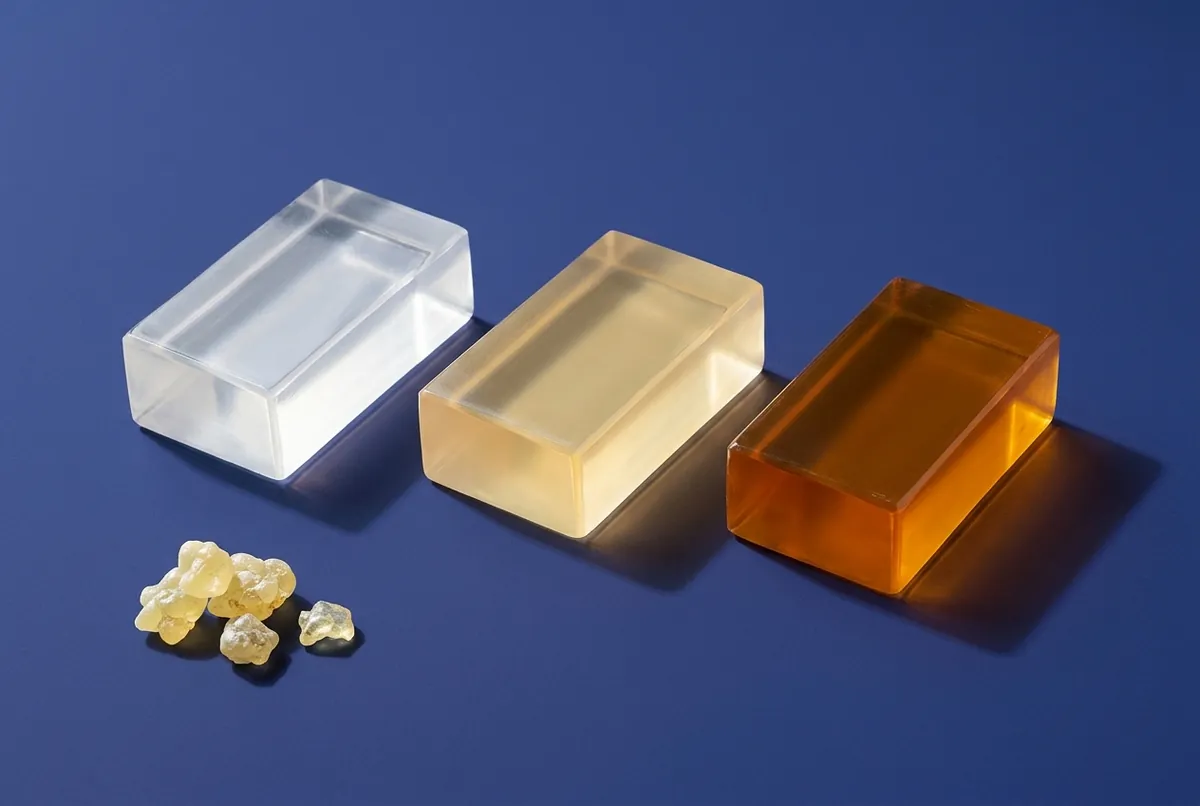
Transparent soap is ordinary soap that has been kept from crystallising. Made from scratch, it is a hot process soap dissolved in alcohol, glycerin and sugar syrup and poured while it is still clear. Catherine Failor’s Making Transparent Soap (Storey, 2000) remains the standard guide to making it at home, and this guide follows her process and her troubleshooting, with our calculator’s lye and the fire hazards set out in full.
What makes soap clear
Soap that gets hot enough passes through a clear stage. It turns glossy and translucent, the stage the gel phase guide describes, and as it cools it grows long, fibrous crystals that mesh together and scatter light. That felt of crystals is why a bar is opaque; the chemistry guide explains the liquid crystal underneath. Transparent soap is the same soap with solvents added while it is still clear. Ethanol, glycerin and sugar hold it in that state and keep its crystals so small that light passes through. Failor’s definition of transparent is a practical one: you should be able to read 14-point type through a slice 6 mm (¼ in) thick.
Two ingredients among the fats help as well. Castor oil, mostly ricinoleic acid, acts partly as a solvent while it makes soap, so the more castor oil a recipe has, the less alcohol it needs. Rosin does the same more strongly. Glycerin, despite the name “glycerin soap”, is useful rather than essential: Failor gives a transparent recipe with none at all, leaving the work to alcohol and sugar.
The idea is old. Failor traces the best-known transparent soap, Pears, to a London barber, Andrew Pears, who found that ordinary soap dissolved in alcohol set clear and mild. Thomssen’s 1922 manual names the same three agents, alcohol, sugar and glycerine, and allows castor oil up to a third of the fats. Simmons and Appleton’s 1908 handbook describes the older factory method, dried soap dissolved in alcohol, the alcohol distilled off again and the cloudy blocks kept for months at 35 °C (95 °F) until they cleared, and notes that sugar with castor oil had by then largely replaced the dearer alcohol and glycerine. It also quotes Richardson’s study of the same year: the agents work by forming a jelly and holding back crystallisation.
Clarity has a price. With all those solvents, a transparent bar is only about 50 to 60 % soap, against roughly 85 % for an opaque one, so it softens and wears away faster in use, although its pH is much the same (Failor).
Fire first
Failor’s precautions and the safety agencies’ advice point the same way, and none of it is optional.
- Electric heat only. Use an electric hob, or a hotplate plugged straight into the wall rather than into an extension lead. No gas, no pilot lights, no candles and no smoking in the room. Failor’s one fire in three years came from soap left heating on a gas range: it boiled over and the spill caught light.
- A water bath and a sealed pot. Heat the soap pot inside a larger pot of water, never directly, and keep it covered with a tight lid or, as Failor does, two layers of heavy plastic sheet stretched over the rim and tied tight. Leave at least 5 cm (2 in) of headroom once the alcohol is in.
- Only the alcohol you need in the room. Weigh it into a lidded jug before you start and put the bottle somewhere else. Fire that reaches a bulk container can flash back into it, as a series of educational demonstrations investigated by the US Chemical Safety Board showed.
- Air and attention. Ventilate the room so vapour cannot build up, and never leave the pot.
- A plan if it burns. Keep an extinguisher within reach: Failor recommends an all-purpose 2A-10B:C unit, and the responders’ Emergency Response Guidebook lists dry chemical or carbon dioxide for small alcohol fires. If the pot itself catches fire, do what London Fire Brigade advises for any pan fire: do not move it and do not throw water on it, turn off the heat if you can do so safely, then leave the room, close the door and call the fire service.
Isopropyl alcohol is no safer, with a flash point of 12 °C (53 °F). Failor uses it for only a quarter to a third of the ethanol, and only at 99 %, because it dissolves soap less well, leaves the bar less clear and smells.
The lye is the usual hazard too. Failor’s solution is 32.5 % sodium hydroxide, which heats to about 93 °C (200 °F) as it dissolves, and its steam carries lye, so keep your face away from it. Work in stainless steel or enamel, never aluminium, which caustic soda corrodes, giving off hydrogen. Wear goggles, gloves and long sleeves from start to finish; the lye safety guide covers first aid.
The recipe
Failor’s recipes make 11 to 12 lb (about 5 kg) of soap. Her Basic Recipe 1, scaled to 1000 g of oils and given our calculator’s lye, makes about 2.3 kg, some twenty 115 g (4 oz) bars. She treats palm oil, tallow and lard as interchangeable, although lard gives a slightly softer bar, but each needs its own amount of lye.
| Ingredient | Weight | Notes |
|---|---|---|
| Palm oil, tallow or lard | 500 g | 50 % of the oils |
| Coconut oil | 200 g | 20 % |
| Castor oil | 300 g | 30 % |
| Sodium hydroxide | 146.0 g with palm, 144.7 g with tallow, 145.2 g with lard | 0 % superfat |
| Distilled water, for the lye | 303.2 g, 300.6 g or 301.7 g | a 32.5 % solution, Failor’s standard strength |
| Ethanol, 95 % | 346 g | about 30 % of the oils plus the lye |
| Glycerin | 99 g | |
| Granulated sugar | 247 g | never powdered sugar, which usually contains starch |
| Distilled water, for the sugar | 185 g | minerals in tap water cloud the bar |
The oils and solvents are Failor’s Basic Recipe 1 scaled to 1000 g of oils. The lye and its water come from our calculator.
Failor makes transparent soap with no superfat. Free oil has nowhere to hide in a clear bar; it shows as a sticky, cloudy layer. The margin that a superfat gives a bar is replaced here by testing in the pot and correcting, and the method needs those tests: across the published saponification ranges of these oils, the calculator’s range check puts the palm version anywhere from 3.7 % lye-heavy to 3.5 % oil-rich, and the tallow version from 2.8 % to 2.7 %. Failor’s own recipe prints 12 oz (340 g) of caustic soda for her 81 oz (2296 g) of oils, about 1.7 % more than our calculator’s figure for complete saponification. That sits comfortably inside the spread, and it is exactly the kind of small excess her stearic-acid correction exists for. Grosso’s transparent soap in The Everything Soapmaking Book lands in the same place: 85 g (3 oz) of lye for 553 g (19.5 oz) of coconut, palm and castor oil, about 2 % more than our calculator’s figure for complete saponification. Factory practice once went further: Thomssen’s transparent soaps of 1922 were deliberately left with an excess of alkali, and he did not rate them as toilet soap. His manual has several such formulas; one of them is on our recipe pages as cold-made transparent soap I.
Our transparent glycerin bar reaches Failor’s end point from the safe side. Made with tallow, it weighs its lye at a 3 % superfat, 140.4 g, the least that keeps the pot free of spare lye across those ranges, and holds the other 4.3 g back as a small finishing solution. After the gel, the phenolphthalein test decides how much of it goes in, a quarter at a time, and all of it together only brings the soap to Failor’s 0 %.
Check the lye for your fat. With palm oil, 1000 g of oils at 0 % superfat take 146.0 g of sodium hydroxide in 303.2 g of water.
Open it in the calculatorDesigning your own
Failor gives ranges rather than rules, and says that straying a few points either way will not ruin a batch.
| Ingredient | Failor’s range |
|---|---|
| Palm oil or tallow | 30 to 75 % of the oils; she keeps to 50 to 60 % |
| Coconut or palm kernel oil | 10 to 35 %; more clouds the soap |
| Castor oil | 15 to 35 %; more gives a soft bar with poor lather |
| Rosin | 5 to 20 % |
| Alcohol | 30 to 35 % of the weight of oils plus dry lye |
| Glycerin | 8 to 12 % of the whole batch |
| Sugar, dry | 6 to 9 % of the batch; up to 13 to 14 % with no glycerin, 3 to 4 % with rosin |
| Water, lye and sugar water together | 12 to 20 % of the batch |
From Failor’s chapter on formulating. Basic Recipe 1 trades glycerin for sugar and sits just outside some of these.
Her method for a new recipe is to start at the lean end of the solvents and add more a little at a time, testing on glass after each addition, and to stop the moment the sample sets clear. More solvent only makes a softer bar. She works each new recipe out twice for this: at what she calls 60/40, with the solvents weighing 0.8 times the oils and dry lye together, and at 50/50, with the solvents weighing as much as them. She makes it with the first and adds from the difference only if a sample sets cloudy. The transparent soap calculator works out both for your blend. If you scale a recipe down, use the water bath throughout, as the method below does: a small batch makes too little heat of its own to gel and neutralise properly.
The method
The steps follow Failor’s paste method with the gel done in a water bath, which she recommends for smaller batches. The water bath is simply a larger pot with a few centimetres of gently boiling water and a couple of spoons on the bottom, so that the soap pot never sits on the hot base.
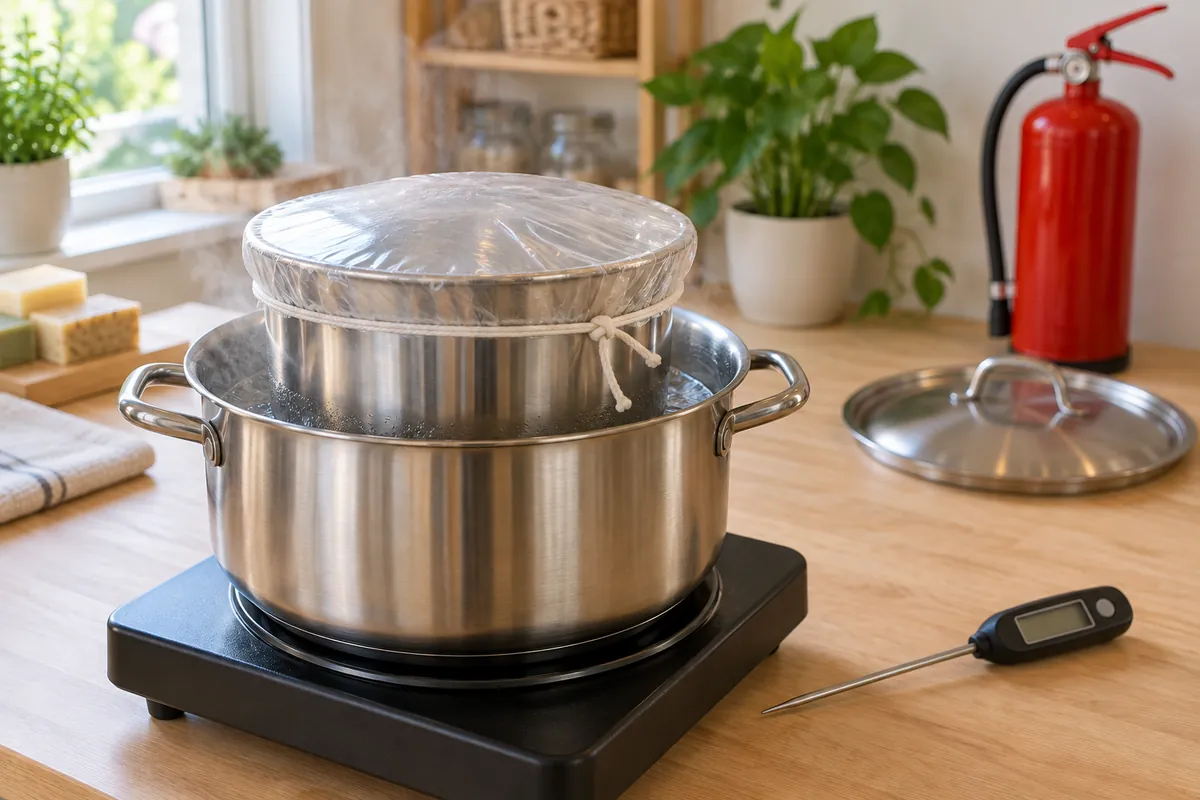 The set-up: a water bath on electric heat and a pot sealed tight, which keeps the alcohol in the soap and its vapour out of the room.
- Set up for alcohol. Clear the room of flames and pilot lights, open a window, and put the extinguisher and a spare lid within reach. Set the water bath on an electric hotplate, with 7 to 10 cm (3 to 4 in) of water in it. Weigh the alcohol, glycerin and sugar into separate covered containers, and take the alcohol bottle out of the room.
- Make the lye solution. Add the sodium hydroxide to the distilled water, stirring, with your face turned away from the steam. It heats to about 93 °C (200 °F); let it cool to 57–63 °C (135–145 °F).
- Melt the oils. Heat the oils in the soap pot to the same 57–63 °C (135–145 °F). That is hotter than cold process soap is made, and it speeds the reaction.
- Bring it to trace. Pour the lye solution into the oils and stick-blend to a light trace, which takes a few minutes; by hand it can take an hour. If the batter cools much below 57 °C (135 °F) before it traces, warm it gently.
- Gel it in the water bath. Cover the soap pot and set it in the water bath at a gentle boil. Within 10 to 15 minutes a ring of translucent soap appears at the edge: stir for a minute, scraping the bottom, then stir briefly two or three times over the next 10 minutes as trapped air makes it billow. Keep it covered and hot until it is translucent right through, at 77–82 °C (170–180 °F), and hold it there, stirring now and then, for about an hour.
- Test for spare lye. Put a drop of phenolphthalein, an indicator that turns pink in alkali, on a small sample taken out of the pot. The paste still holds its water, and in water the indicator turns faintly pink on any soap, so it is the depth of colour that counts. Failor looks for the faintest pink. A deep pink means spare lye: give it another half hour, and if it is still deep pink, go on to the next step and correct it once the alcohol is in, where the indicator answers to free alkali alone. No colour at all means the soap is short of lye: add a little lye solution, 12 to 25 g at a time for this batch, and cook for 20 minutes before each new test.
- Dissolve it in alcohol and glycerin. Turn off the heat. Standing back, pour in the alcohol and glycerin slowly; the hot soap throws off alcohol vapour. Scrape every scrap of soap off the bottom and sides, break up the lumps with a whisk, seal the pot and return it to the water bath. Bring it to a gentle simmer, expecting a plastic cover to balloon, and keep it there for about 30 minutes, until a spoonful held up to the light in a clear jar shows no specks of undissolved soap. If step 6 was deep pink, stir in melted stearic acid now, about 12 to 25 g at a time for this batch, hold it at 71 °C (160 °F) for 15 to 20 minutes and test again, until the pink fades.
- Add the sugar syrup. Bring the sugar water to the boil, stir in the sugar until it dissolves, then cover it and let it simmer for 2 to 3 minutes so the steam washes stray crystals off the sides. Unseal the soap pot and stir the syrup in.
- Test on cold glass. Drip a spoonful onto the base of an upturned glass that has been chilled in the freezer, and let it set. If it is clear, carry on. If it is milky, rinse the surface skin off under hot water; if it is still milky underneath, go to the table below before you pour. Grosso’s version of the test is a puddle on a clear plastic lid, ten minutes in the freezer; if it comes out cloudy she adds alcohol, 14 g (0.5 oz) at a time for her 553 g batch of oils, and tests again.
- Settle, colour and scent. Cover the pot and let the soap settle for about 20 minutes, or until it has cooled to 60 °C (140 °F), so that bubbles rise and specks sink. Skim off any foam, stir any skin back in, and add colour and fragrance.
- Pour, unmould and cure. Pour into moulds on a level surface. The soap sets in 1 to 6 hours, depending on the size of the mould. Quick cooling helps the clarity: Simmons and Appleton filled narrow frames so the soap cooled fast, and Grosso puts her moulds straight into the freezer until the soap is firm. Unmould it once it is firm right through, cut it, and cure the bars for at least two weeks somewhere warm and dry with air around each one. Freshly cut faces can look hazy; they clear further as the last of the alcohol and water leave.
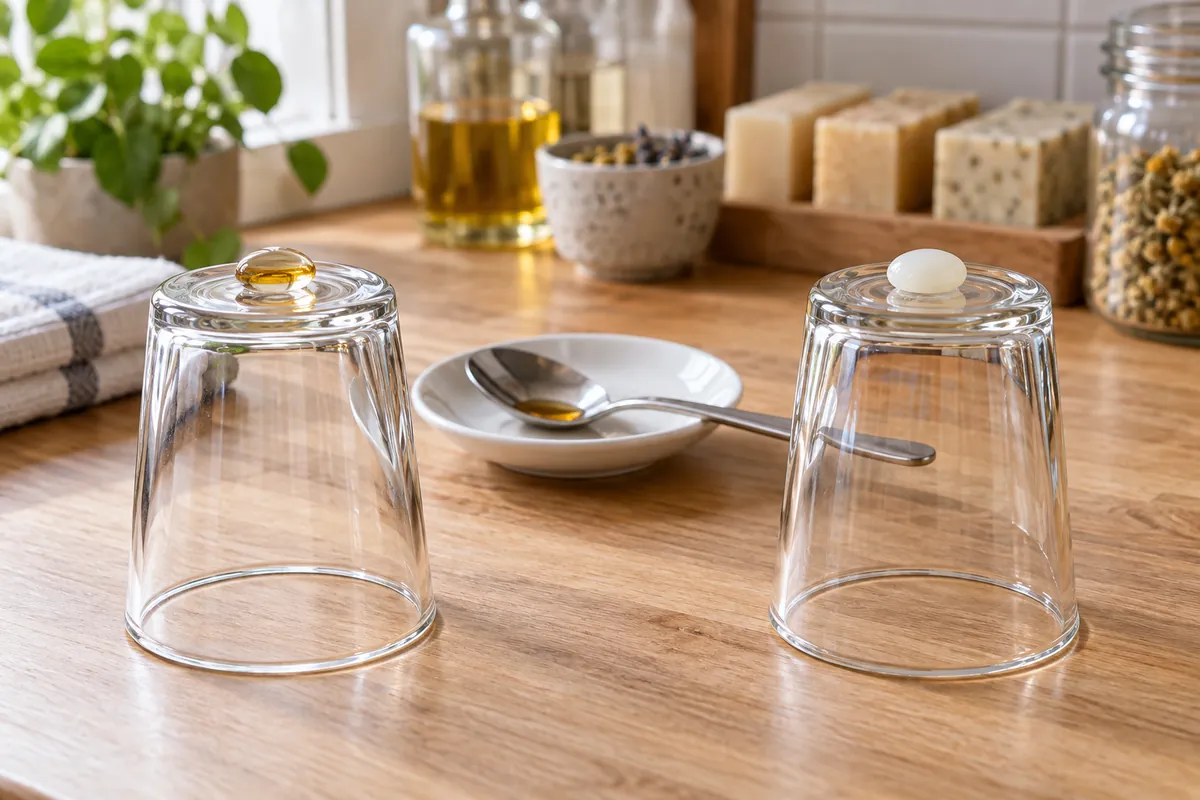 The glass test. A drop sets fast on a chilled glass, and the batch will be as clear as the drop, apart from the soft blotches of too much solvent, which only a full pour shows.
When the glass test says no
| Problem | Likely cause | Failor’s fix |
|---|---|---|
| No trace after an hour | Most often too little lye; also too much water, too cool, or slow stirring | Check the weights, add lye solution a little at a time, switch to a stick blender. If nothing works, pour it into a lined mould: it may still set as opaque soap |
| Curdles and separates | Mismeasured ingredients, a wide temperature gap, or excess lye; with rosin or stearic acid it is normal | Blend hard; if it stays curdled, suspect excess lye |
| Stays pasty and will not gel | Too much or too little lye, too much water, or too cool | Heat it in the water bath. If it stays pasty and a cooled sample splinters under a fingertip, it is lye-heavy: correct it with stearic acid |
| Will not dissolve in the alcohol | Below 65 °C (150 °F), or too little alcohol | Heat to 65–71 °C (150–160 °F) and add alcohol a little at a time until the broth is as thin as water |
| Milky sample on the glass | Usually too little solvent; also a lye error, too short a gel, alcohol lost to evaporation, or specks of undissolved soap | Add sugar syrup, about 35 g at a time for this batch and twice at most, then a little alcohol. Still milky after about 100 g of extra solvent means another cause |
| Soft, sticky or milky blotches once poured | Too much solvent, usually glycerin or sugar; the glass test cannot show this one | Remelt, stir in melted stearic acid with half its weight of lye solution, hold 10 to 15 minutes at 71 °C (160 °F), and pour again |
| White spots that spread after unmoulding | Stearate and palmitate soaps that the alcohol never fully dissolved | Remelt with a little more alcohol and cook it covered for 20 to 30 minutes |
| Still soft after a day | Too much solvent, often from correcting cloudiness | As for soft blotches |
| A sticky, cloudy layer on a clear slab | Too much oil, or too little lye | Remelt with a little lye solution; if the layer is thick, skim it off |
From Failor’s troubleshooting chapter, with her quantities scaled from her 11 to 12 lb batch to the recipe above.
Simmons and Appleton’s 1908 factory grid reads the same way. A sample that set firm but opaque wanted more sugar solution. One that was soft but clear, and not too alkaline, held too much water, which they corrected with a little soda ash; too much of it leaves a white bloom. A greasy, soft feel with free caustic meant the saponification was not finished, and hard water in the sugar solution left opaque streaks of lime soap.
Two of her checks need no chemicals. Pressed with a finger, a cooled sample that splinters into sharp pieces has too much lye, and one that feels soft and greasy and flattens has too little. And if the batch seems to have lost alcohol, weigh the pot’s contents against the total of the recipe; if they are well short, add alcohol a little at a time, testing on glass after each addition, rather than making up the whole difference at once. If you are unhappy with a batch, remelt it within a few days: the longer it stands, the more alcohol it loses.
Rosin and stearic acid
Rosin is not a fat. It is mostly resin acids such as abietic acid, which are free acids that the lye neutralises directly, so rosin soap is true soap (the chemistry guide has the detail). In transparent soap it adds more clarity than castor oil, acts as a preservative, and colours the bar from gold to deep amber; Failor notes that Pears was tinted with it. It also softens the bar, so she keeps it to 5 to 20 % of the oils, melts it together with stearic acid to firm the soap, and cuts the sugar to 3 to 4 % of the batch, because rosin soap turns cloudy with even a small excess of sugar. Expect the batter to thicken and curdle the moment the lye goes in: with rosin that is normal, and the soap gels quickly. Our calculator uses the minimum saponification value in India’s rosin standard, 160 mg KOH/g, where pure abietic acid would be 185.5, so a rosin batch errs towards unsaponified rosin rather than free lye. For more than a few percent, ask your supplier for the acid number.
Stearic acid is a free fatty acid too, and it reacts with lye almost instantly. Failor uses it to firm transparent soap and to correct it, but never lets it sit in the oils when the lye goes in, or the batch can thicken past stirring or curdle for good. She brings the other oils to trace first, then stirs in the melted stearic acid by hand. The same speed makes it the fix for spare lye: each gram neutralises about 0.15 g of sodium hydroxide, going by its saponification value of 206 to 212 mg KOH/g.
Colour and scent
Colour and scent go in last, at about 60 °C (140 °F), and transparent soap is kind to both. A fragrance cannot make it seize, because the soap finished reacting long before the scent goes in, and Failor finds that scents stay truer in transparent soap than in cold process soap, which she puts down to the alcohol lifting them as it does in a perfume. She scents at about 1 % of the batch, the rate of most commercial soap. She colours a few drops at a time and checks the shade in a jar filled 2.5 cm (1 in) deep, because a colour that looks pale in a spoon can make a bar dark and murky. Soap dyes give the widest range. Food colourings work for light shades, but in her experience blue fades within a month or two. Avoid fabric dyes, which carry salt, and salt clouds the soap. The scenting guide covers safe limits for essential oils.
Melt and pour: the ready-made route
If the alcohol puts you off, clear melt-and-pour base gives you transparent soap with neither lye nor hot alcohol in the kitchen. Commercial clear bases are soap kept transparent with glycerin and sorbitol, with propylene glycol to help them melt and often a synthetic detergent such as sodium laureth sulfate for lather (Fisher lists the usual ingredients). You melt the base, colour and scent it, and pour it, and it needs no cure. Failor’s one caution is heat: overheated base turns brittle or smells unpleasant. The melt-and-pour guide covers working with it, and the melt-and-pour calculator works out how much base a mould takes once the fragrance has its share.
Recipes to try
All recipesSources
- Making Transparent Soap: The Art of Crafting, Molding, Scenting & Coloring . Catherine Failor, Storey Publishing , 2000. The paste method and its temperatures and times, alcohol safety, Basic Recipe 1, the formulating ranges, the glass test, phenolphthalein, troubleshooting and her melt-and-mould alternative.
- Soap-Making Manual . E. G. Thomssen, D. Van Nostrand Company , 1922. Transparency from alcohol, sugar or glycerine; castor oil up to a third of the charge; factory transparent soaps left with excess alkali.
- The Handbook of Soap Manufacture . W. H. Simmons and H. A. Appleton, Scott, Greenwood and Son , 1908. Transparent soaps: the old alcohol method, sugar and castor oil replacing alcohol and glycerine, Richardson's jelly explanation, the sample tests and their fixes, soft water for the sugar solution, narrow frames and fast cooling.
- The Everything Soapmaking Book, 3rd edition . Alicia Grosso, Adams Media , 2013. Transparent Soap: 3 oz of lye for 19.5 oz of coconut, palm and castor oil; the frozen-lid clarity test and half-ounce alcohol additions; moulds straight into the freezer.
- NIOSH Pocket Guide to Chemical Hazards: Ethyl alcohol . US National Institute for Occupational Safety and Health . Flash point 55 °F, boiling point 173 °F, lower explosive limit 3.3 %.
- NIOSH Pocket Guide to Chemical Hazards: Isopropyl alcohol . US National Institute for Occupational Safety and Health . Flash point 53 °F, boiling point 181 °F.
- International Chemical Safety Card 0044: Ethanol (anhydrous) . ILO / WHO (IPCS) . Relative vapour density 1.6 (air = 1); the vapour mixes well with air and explosive mixtures form easily; no open flames or sparks.
- Emergency Response Guidebook 2024, Guide 127: Flammable liquids (water-miscible) . US Department of Transportation, Transport Canada and SCT Mexico , 2024. Ethanol can burn with an invisible flame; vapours are heavier than air, travel to ignition sources and flash back; dry chemical or CO2 for small fires.
- Key Lessons for Preventing Incidents from Flammable Chemicals in Educational Demonstrations . US Chemical Safety and Hazard Investigation Board , 2014. Flash fires in which flame travelled back into bulk containers of alcohol; keep bulk containers away from the work.
- What to do if a pan catches fire . London Fire Brigade .
- International Chemical Safety Card 0360: Sodium hydroxide . ILO / WHO , 2010. Corrodes aluminium, tin, lead and zinc, giving off hydrogen.
- Standard for Named Vegetable Oils (CXS 210-1999) and Standard for Named Animal Fats (CXS 211-1999) . Codex Alimentarius Commission (FAO/WHO) . Saponification value ranges behind the calculator's range check for palm, coconut, tallow and lard.
- IS 553:1984 Specification for gum rosin . Bureau of Indian Standards , 1984. Minimum saponification number 160 for the pale grades.
- The Complete Photo Guide to Soap Making . David Fisher, Creative Publishing International , 2018. What goes into clear melt-and-pour base.