Unna-style superfatted tallow bar
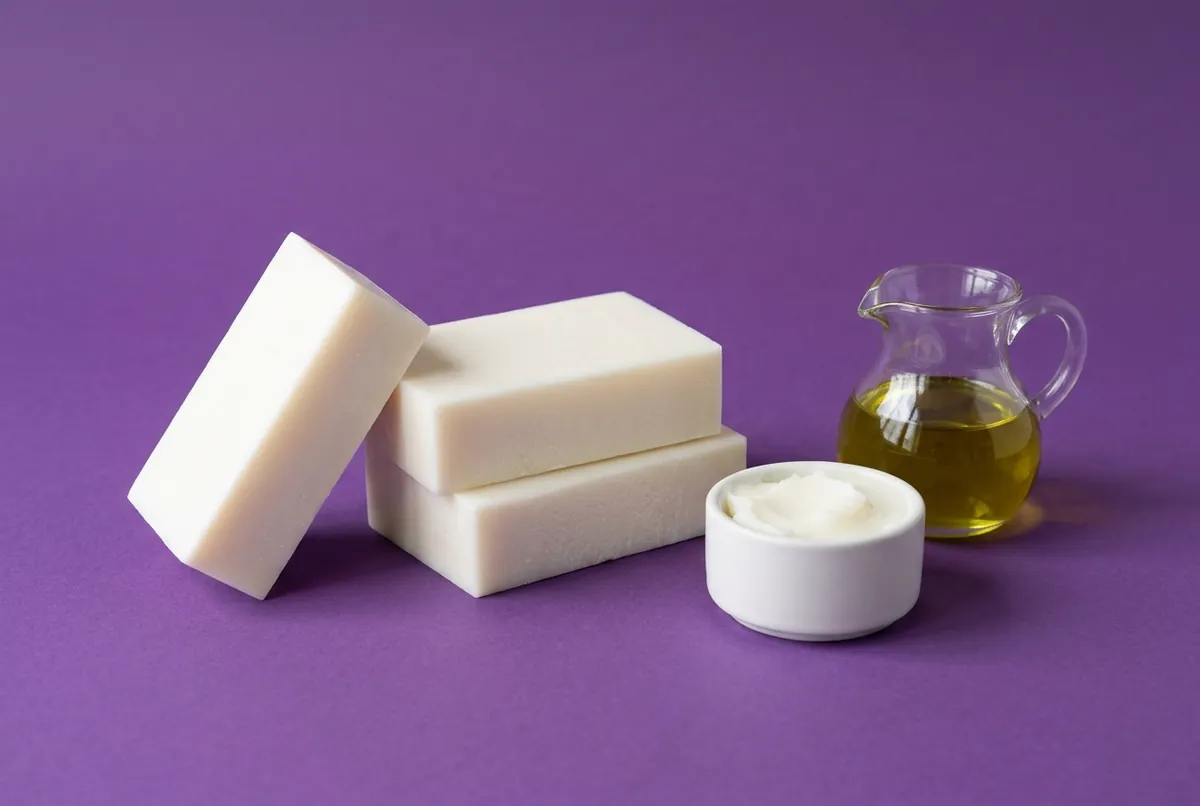
Eight parts beef tallow to one of olive oil, saponified with soda and potash two to one and a little fat left over: the base Unna of Hamburg came to prefer after taking up medicated soap in 1886. Ours carries no remedies; it makes a hard, white bar with a low, creamy lather.
- Skill
- Intermediate
- Method
- Cold process
- Batch
- 1000 g of oils about 1457 g of batter
- Hands-on
- 1 hour
- Cure
- 6 weeks
- Gel phase
- Either way gel or not, both work
What you need
For 1000 g of oils, which fills a 1.5 litre loaf mould. Weigh everything, liquids included.
| Edible Tallow · 89.0 % | 890 g | 31.39 oz |
| Olive Oil · 11.0 % | 110 g | 3.88 oz |
| Sodium hydroxide (NaOH) · the lye, 100 % pure | 99.2 g | 3.50 oz |
| Potassium hydroxide (KOH) · the lye, 90 % pure; if your label says otherwise, weigh 54.6 g at 85 % or 48.8 g at 95 % | 51.5 g | 1.82 oz |
| Distilled water · for a 33 % lye solution | 306.1 g | 10.80 oz |
- Superfat
- 5 %
- Temperatures
- Fats and lye solution each at 38 to 43 °C (100 to 110 °F)
Method
-
Get ready
Put on splash goggles, nitrile gloves and long sleeves, open a window or turn on the extractor fan, and keep children and pets out of the room. Line a 1.5 litre loaf mould and set it where it can stay for two days. -
Weigh the fats
Weigh 890 g beef tallow into the pot and 110 g olive oil into a jug: eight parts tallow to one of olive oil. -
Make the lye solution
Weigh 306.1 g distilled water into a heat-safe jug, and 99.2 g sodium hydroxide and 51.5 g potassium hydroxide flakes into two dry containers. By the open window, stir the sodium hydroxide into the water, then the potassium hydroxide, a little at a time and never the water onto the lye; it runs hotter than a sodium hydroxide solution alone. Leave it to cool, labelled and out of reach. -
Melt the tallow
Melt the tallow on low heat until it is completely clear, since tallow needs more warmth than most fats, then pour in the olive oil. -
Check the temperatures
Carry on when the fats and the lye solution are both between 38 and 43 °C (100 and 110 °F). Tallow starts to set as it cools, and a batter that is too cool thickens before it has really traced. -
Blend to light trace
Pour the lye solution into the fats down the shaft of the stick blender and pulse for a few seconds at a time, stirring between bursts. Stop when the batter is opaque and a drizzle leaves a faint line on the surface. -
Pour and cover
Pour into the mould, tap it on the worktop to raise air bubbles, and cover it with a board and a folded towel for a day. It may gel into a darker, glossy centre, which is fine either way. -
Unmould and cut
The potash keeps the young loaf softer than an all-soda tallow bar. After about 48 hours, when it no longer dents under a gloved finger, unmould it and cut it into bars about 2.5 cm (1 in) thick; give it another day if it is still soft. -
Clean up
With your gloves still on, wipe the batter off the pot and tools with paper towels into the bin, then wash them in hot soapy water. -
Cure
Stand the bars on edge in a dry, airy room for six weeks, turning them now and then. Tallow soap keeps hardening for weeks, and a well-cured bar lasts a long time in use.
Tips
- Simmons and Appleton were not sold on the base they recorded: beyond doubting that it helped a toilet soap, they said a superfatted base had no place at all in germicidal soaps, because free fat blunts them. Today a superfat is chiefly a safety margin, since saponification values are ranges, as our superfat guide explains.
- Two parts soda to one of potash puts 24 to 26 % of the saponification on the potassium, however the parts are read, so the calculator's 25 % KOH share is Unna's balance: 99.2 g of sodium hydroxide to 51.5 g of 90 % flakes, almost exactly two to one by weight. With 95 % flakes the same weight takes the superfat from 5 % to about 3.7 %, so enter the figure on your label before you weigh.
- This is plain tallow soap with no coconut oil, so the lather is low, dense and creamy rather than bubbly. For more bubbles, swap some of the tallow for coconut oil and let the calculator work out both lyes again, though it will no longer be Unna's base.
- Unna's base was made to carry remedies, and the medicated soaps in the same 1908 book held mercury salts, coal tar and phenol. None of that belongs in soap: this bar carries nothing but soap and its spare fat.
The oils
| Oil | Share |
|---|---|
| Edible Tallow (beef/mutton dripping) | 89.0 % |
| Olive Oil (virgin / refined / olive oil) | 11.0 % |
How it is made
| Process | Cold process |
| Alkali | NaOH + KOH |
| Superfat | 5 % |
| Water | lye water at 33 % |
| Iodine value | 51 |
| INS | 145 |
Why make it
This is a piece of dermatological history. Paul Gerson Unna, the Hamburg dermatologist who opened his skin clinic in 1881 (Beiersdorf), took up medicated soaps in 1886 and got his best results with this superfatted base of tallow and olive oil (Simmons and Appleton 1908). Made without his remedies it is a very mild bar, cleansing 4 on our scale, hard and slow to wear, with a low, dense lather rather than bubbles. That suits dry skin and anyone who dislikes a stripping wash, and with nothing added for scent it fits the advice dermatologists give for dry, sensitive skin: a gentle, fragrance-free cleanser (American Academy of Dermatology). The trade-offs are a modest lather and the tallow, which makes it unsuitable for vegans.
Sources
- W. H. Simmons and H. A. Appleton, The Handbook of Soap Manufacture · Scott, Greenwood & Son, 1908
- Prof. Dr. Paul Gerson Unna · Beiersdorf
- Dermatologists' top tips for relieving dry skin · American Academy of Dermatology
What tradition, makers' experience and research say about soaps like this, each labelled for what it is. It is not medical advice, and no soap treats a skin condition: if you have one, ask a doctor or pharmacist.
What the numbers say
- Myristic acid 3.6 %
- Palmitic acid 23.8 %
- Stearic acid 20.3 %
- Oleic acid 41.0 %
- Linoleic acid 4.5 %
- α-Linolenic acid 1.4 %
- Other 3.9 %
Saturated : unsaturated 49 : 51
Computed from the fatty acids of the fats above. The bands are what the craft has settled on, not chemistry — a bar outside one is not wrong.
From the guides
All guides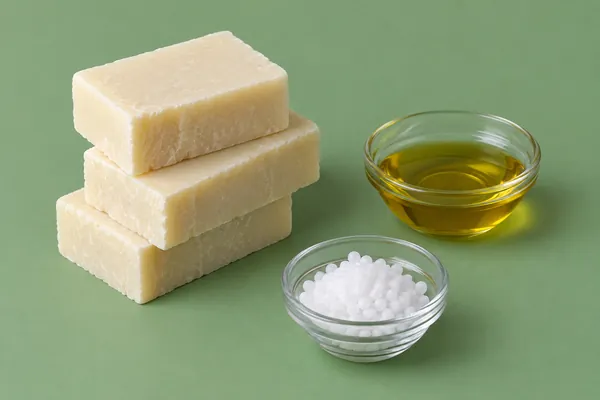
Superfat and lye discount: why recipes leave some oil unsaponified
What superfat and lye discount mean, how the calculator applies them, where makers set them for each soap, and why oil added at trace isn't the oil left over.
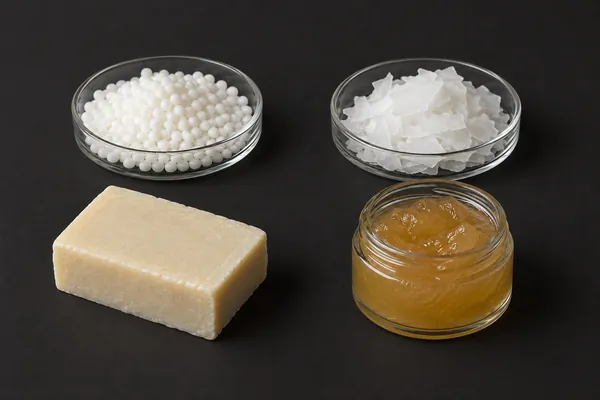
Sodium hydroxide, potassium hydroxide and dual lye explained
Why NaOH makes bars and KOH makes soft soap, converting between them, KOH purity, dual-lye recipes, and the calculator slip that turns a bar caustic.
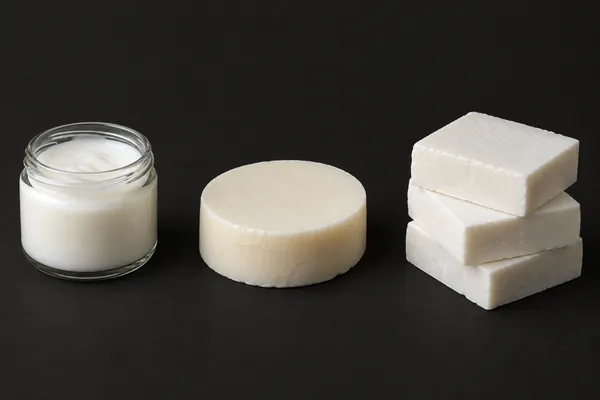
Lard and tallow: soaping with animal fats
Why lard and tallow make hard, mild, creamy soap, how to render and store them at home, how beef, mutton and pork fat differ, and classic recipes.
Where these proportions come from
Unna's superfatted soap base as Simmons and Appleton recorded it in 1908: one part olive oil to eight of beef tallow, saponified with two parts soda to one of potash, with fat enough to leave 3 or 4 % unsaponified. Unna of Hamburg came to it after taking up medicated soap in 1886, as a better way than plasters to carry remedies to the skin; in theory he favoured tallow alone, but this blend gave him his best results. The authors themselves doubted that a superfatted base did toilet soap any good. Here it is tallow 89 % and olive oil 11 %, with potassium hydroxide doing 25 % of the saponification and a 5 % superfat in place of his 3 to 4 %, so that tallow's published saponification range cannot take the bar below 2 %. The remedies are left out.
Formulation adapted from The Handbook of Soap Manufacture by W. H. Simmons and H. A. Appleton (Scott, Greenwood & Son, 1908). The method and notes are ours.